Loading page…
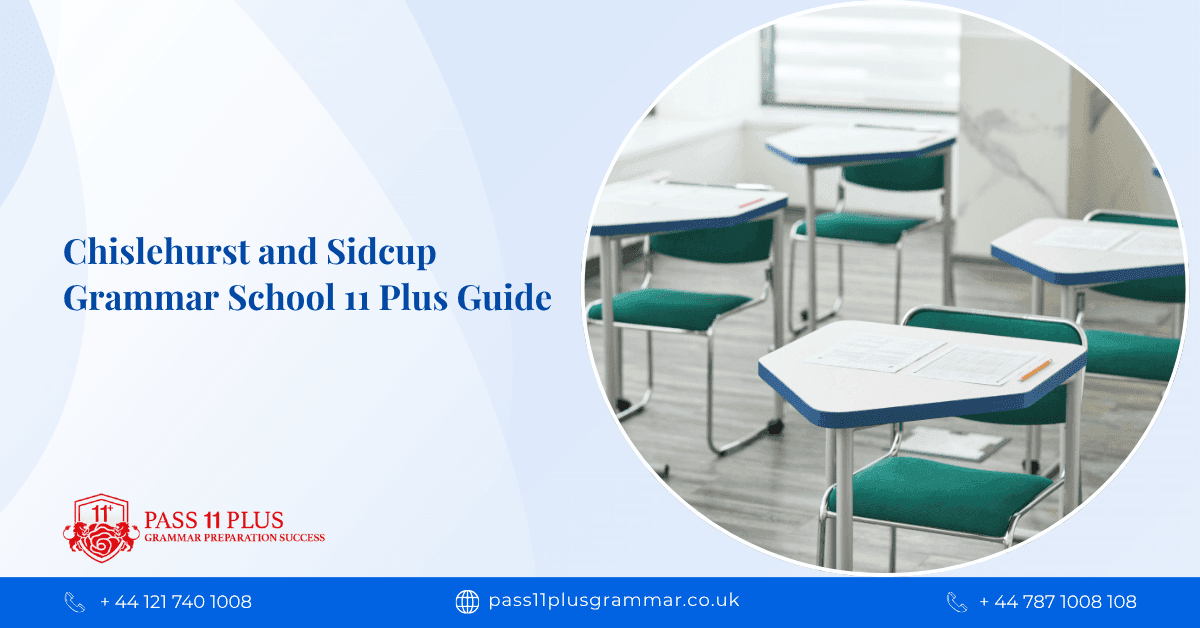
Chislehurst and Sidcup Grammar School 11 Plus Guide
Published on
Are you planning to apply to Chislehurst and Sidcup Grammar School? This guide contains everything you need to know about the Chislehurst and Sidcup Grammar School, what the school is like, how the Bexley Selection Test works, entry requirements, key dates, catchment area, and exactly how to prepare your child to give them the best possible chance.
About Chislehurst and Sidcup Grammar School
If you are looking at grammar schools in South East London, Chislehurst and Sidcup Grammar School, often called "Chis and Sid" by students and parents, is probably already on your list.
Founded in 1931, this co-educational grammar school sits in Sidcup, within the London Borough of Bexley. It has built a strong reputation over nearly a century for academic results, a broad curriculum, and a school culture where students are expected to work hard and think independently.
What makes it stand out? It offers a wide range of subjects, strong sixth form results, and an environment where behaviour is described by Ofsted as "exemplary." Students enjoy school, feel safe, and arrive eager to learn, which makes a big difference to results.
It is also one of only four grammar schools in Bexley, which means it is consistently oversubscribed. Getting in requires real preparation, not just ability.
Key Facts at a Glance
School type: Co-educational grammar school
Location: Hurst Road, Sidcup, Bexley
Local Authority: London Borough of Bexley
Year 7 places: 192
11+ exam used: Bexley Selection Test (administered by Quest Assessments)
Catchment area: No formal catchment, open to all who qualify
Competition level: Very high, only 31-35% of children who sit the Bexley test are deemed selective.
Chislehurst and Sidcup Grammar School Entry Requirements
To get a place at Chislehurst and Sidcup Grammar School, your child needs to do two things:
Pass the Bexley Selection Test and be "deemed selective", meaning they reach the qualifying standard set by Bexley Council.
Be offered a place based on the school's oversubscription criteria, because simply passing the test is not always enough.
This is a really important point that many parents miss. Passing the test gets your child into the pool of eligible candidates, but the school still uses its own criteria to decide who actually receives an offer.
There is no specific published pass score. Whether your child is deemed selective depends on the overall performance of all children who sat the test that year, it is a relative standard, not a fixed one. This is exactly why thorough, structured preparation is so important. You are not just preparing your child to pass, you are preparing them to score as highly as possible.
If you want expert guidance on grammar school admissions and how the whole process works, read our grammar school admissions guide, where we break everything down step by step.
What is the Bexley Selection Test?
The Bexley Selection Test is the 11+ entrance exam used by all four grammar schools in Bexley, including Chislehurst and Sidcup Grammar School. Your child only needs to sit it once, even if they are applying to more than one Bexley grammar school.
The test is administered by Quest Assessments and consists of two timed, multiple-choice papers, both taken on the same day in a single session. Each paper lasts around 50 minutes, with additional time given for instructions and practice questions at the start.
The full test session, including the break between papers, typically lasts between two and a half and three hours.
One practical note: your child must do all their working in the test booklet itself. No separate rough paper is provided. Practising this beforehand is important so it does not catch them off-guard on the day.
What Subjects Are Tested?
The two papers between them cover three main areas:
1. Verbal Ability & English Comprehension
Vocabulary, understanding written texts, and verbal reasoning. Your child needs to read carefully, understand tone and meaning, and think about words precisely.
2. Numerical Reasoning
Mathematical problem-solving. The content is based on what children are expected to know by the end of Year 5, but the questions require sharp reasoning, not just recall.
3. Non-Verbal Reasoning
Pattern recognition, shape relationships, and logical thinking. This tests how your child thinks rather than what they know — but it can absolutely be practised and improved.
The good news is that none of these areas is fixed ability. Every single one can be improved with the right preparation. Our 11 plus tuition covers all three tested areas, Verbal Reasoning, Numerical Reasoning, and Non-Verbal Reasoning, alongside English comprehension and exam technique, from Year 3 right through to exam day.
Key Dates for 2027 Entry
If your child is currently in Year 5 and you are planning for September 2027 entry, here are the key dates to put in your diary right now:
1st March 2026: Test registration opens
31st March 2026: Test registration closes. Do not miss this deadline
7th–10th September 2026: Bexley Selection Test dates (Year 6)
Early October 2026: Test results sent to parents
31st October 2026: Deadline to submit the Common Application Form (CAF) to your local authority
1st March 2027: National secondary school offers day
How to Apply to Chislehurst and Sidcup Grammar School
The application process has two separate parts, and it is easy to mix them up. Here is exactly what you need to do:
Step 1 - Register for the Bexley Selection Test (March)
Between 1st March and 31st March, register your child for the test using the link on the participating schools' websites or via Bexley Council's website. This step is separate from the school application itself.
Step 2 - Your Child Sits the Test (September)
The test takes place in the first or second week of September when your child is in Year 6. You will receive details by email about the exact location, time, and what your child needs to bring.
Step 3 - Receive Results (Early October)
Results are sent to parents by email in early October. These will confirm whether your child has been "deemed selective", meaning they have met the qualifying standard.
Step 4 - Submit the Common Application Form (by 31st October)
If your child meets the qualifying standard, name Chislehurst and Sidcup Grammar School on your Common Application Form (CAF) and submit it to your home local authority by the 31st October deadline. This is how your child is actually considered for a place.
Step 5 - Find Out If Your Child Has a Place (1st March)
Offers are made on National Secondary School Offers Day, 1st March of the year your child would start Year 7.
Chislehurst and Sidcup Grammar School Catchment Area
Chislehurst and Sidcup Grammar School does not have a formal catchment area. If your child sits the Bexley Selection Test and is deemed selective, they are eligible to apply for a place regardless of where you live. You do not have to live in Sidcup, Bexley, or even in London.
However, if there are more selective children than places available (which happens every year), the school uses its oversubscription criteria to decide who gets offered a place. Distance from the school is one of those criteria. In a tie-break situation, the child living closest to the school is prioritised.
So while there is no official catchment area, living closer to the school does give your child a practical advantage if places are tight. In recent years, successful applicants have typically lived within a few miles of the school.
How to Prepare Your Child for the Chislehurst and Sidcup Grammar School
The Bexley Selection Test is a competitive exam. With nearly 6,000 children sitting in each year and only around one in three being deemed selective, preparation is not optional; it is essential. Here is how to approach it sensibly.
1. Start Early - Year 3 or 4 if Possible
The children who tend to do best are those who have built their skills gradually over time, not those who crammed in the final few months. Starting in Year 3 or Year 4 means your child has time to develop a genuine understanding rather than surface-level familiarity with question types.
At Pass 11 Plus Grammar, our 11 plus tuition programme begins from Year 3 and follows a structured path all the way through to the exam. Each stage builds on the last, so nothing is rushed, and nothing is left to chance.
2. Cover All Three Areas of the Test
Many children are naturally stronger in one area than another. Some find numerical reasoning easy but struggle with non-verbal patterns. Others are good readers but need to build speed under timed conditions. A good preparation programme identifies these gaps and fills them, rather than just practising what your child is already good at.
Our expert 11 plus tutors cover Verbal Reasoning, Numerical Reasoning, Non-Verbal Reasoning, and English comprehension in every programme, with regular assessments to track where your child is and what needs more work.
3. Build Exam Technique Early
The Bexley Selection Test is multiple choice and timed. Many children who know the material still lose marks because they run out of time, second-guess themselves, or do not know how to handle a question they are stuck on. Exam technique is a skill, and it is learnable.
Practising under timed conditions, learning when to move on, and getting comfortable with the multiple-choice format all make a real difference on the day.
4. Use Mock Exams to Build Confidence
One of the biggest challenges on test day is not the questions; it is the pressure of a formal exam environment. Children who have practised in exam-like conditions beforehand are far less likely to freeze or panic.
Our 11 plus mock exams replicate real exam conditions - timed, formal, with detailed feedback afterwards. They show your child exactly where they are, what they need to improve, and what to expect on the real day. Many parents tell us that mock exams were the single most valuable part of their child's preparation.
5. Consider an Intensive Course in the Final Stretch
In the months before the September exam, an intensive burst of focused preparation can make a significant difference - especially for children who started later or who have specific gaps to close. Our 11 plus intensive courses are designed exactly for this: concentrated, exam-focused preparation that covers the highest-value topics efficiently and builds confidence quickly.
⚠ Limited Spaces Available
Want Your Child to Revise Smarter This Holiday?
Our intensive courses in Birmingham are designed to make the most of every school holiday. Expert tutors, small groups and a structured approach that builds real confidence fast.
Final Thoughts
The Chislehurst and Sidcup Grammar School is one of the most competitive grammar school entry processes in South East London. The families who succeed are almost always the ones who prepared early, prepared thoroughly, and prepared smartly.
That means covering all three areas of the Bexley Selection Test, building genuine exam technique, and using mock exams to develop real confidence before the day itself.
At Pass 11 Plus Grammar, we have spent over 30 years helping children do exactly that. Whether your child is just starting out in Year 3 or is in Year 5 and needs to accelerate, we have a programme built for where they are right now.
Frequently Asked Questions
Does Chislehurst and Sidcup Grammar School have a catchment area?
No. There is no formal catchment area for Chislehurst and Sidcup Grammar School. Any child who is deemed selective in the Bexley Selection Test is eligible to apply, regardless of where they live. However, when places are oversubscribed, distance from the school is used as a tiebreaker, so children living closer are prioritised.
When should my child start preparing for the Chislehurst and Sidcup 11 plus?
Ideally in Year 3 or Year 4. Starting early allows your child to build skills gradually, which leads to stronger, more confident performance than last-minute cramming.
Is Chis and Sid a good school?
Yes. Chis and Sid Grammar School is considered a good school, known for strong academic results, a wide curriculum, and positive student development.

Mr Singh
Founder, Pass My GCSE
Mr Singh is the founder of Pass My GCSE, with over 30 years of teaching experience. Having overcome academic setbacks himself, he is passionate about ensuring no child struggles alone. His approach focuses on personalised support, strong foundations, and building confidence. He has helped students achieve outstanding results in 11+ and GCSE examinations
Loading related posts…