Loading page…
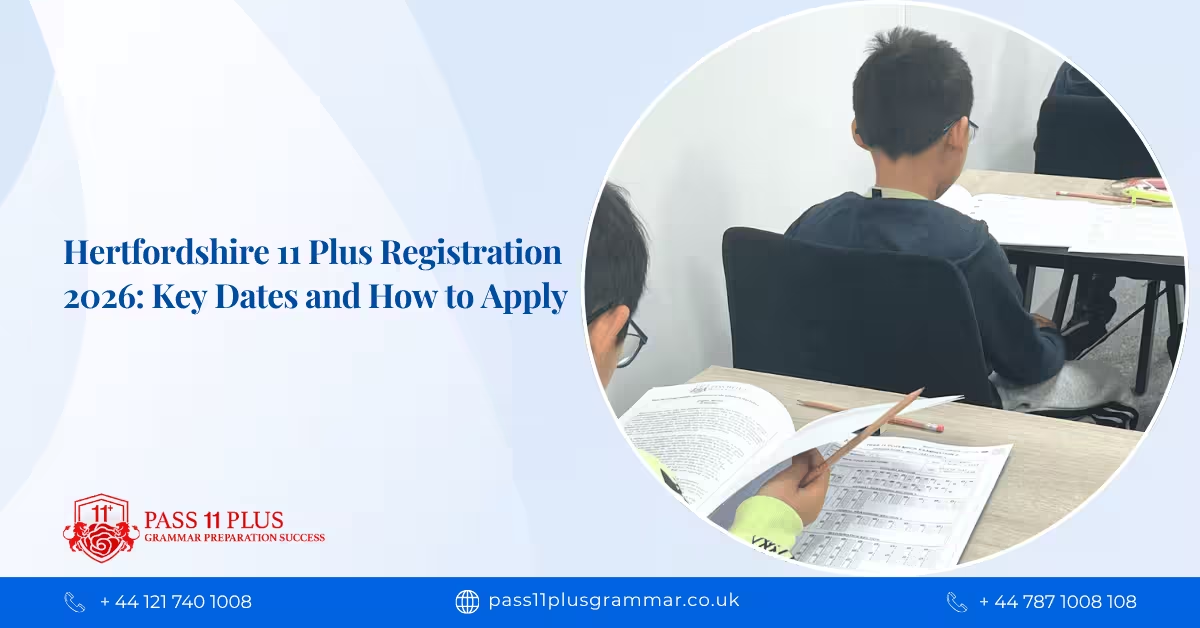
Hertfordshire 11 Plus Registration 2026: Key Dates and How to Apply
Published on
The Hertfordshire 11 plus in South West Hertfordshire is run by the South West Herts Schools Consortium. Registration for the 2026 academic test opened on 1st April 2026 and closes on 5th June 2026. The exam takes place on 5th September 2026. Results are sent to parents around 15th October 2026. Your child only needs to sit the test once to be considered for any of the six academic schools in the consortium. The test is produced by GL Assessment and covers maths and verbal reasoning.
If you are thinking about a grammar school place in Hertfordshire, this guide covers everything you need to know about the Hertfordshire 11 plus - when to register, which schools are involved, what the exam includes, how it is scored, what the pass mark is and how to prepare your child for September 2026.
Key facts
Consortium name: South West Herts Schools Consortium
Area covered: South West Hertfordshire
Test provider: GL Assessment
Papers: Two multiple-choice papers (maths and verbal reasoning)
Scoring: Age-standardised scores
Pass mark: No fixed mark - set annually by each school
Hertfordshire 11 plus 2026 dates
1st April 2026: South West Herts Secondary Transfer Test registration opens
29th April 2026: Dame Alice Owen's School test registration opens (separate process)
5th June 2026: South West Herts Secondary Transfer Test registration closes
10th June 2026: Dame Alice Owen's School test registration closes
26th June 2026: Parents notified of where their child will sit the test
5th September 2026: South West Herts academic ability test
7th September 2026: South West Herts first round music aptitude test
9th September 2026: Sports aptitude test (Queens' School only)
17th September 2026: First round music scores sent to parents
21st to 25th Sept 2026: South West Herts second round music test
15th October 2026: South West Herts academic test results day
31st October 2026: Secondary school Common Application Form deadline
1st March 2027: National secondary school offers day
The South West Hertfordshire consortium schools
The South West Herts Schools Consortium is a group of seven partially selective schools in South West Hertfordshire. Six of them use the academic ability test. One (Croxley Danes) uses the music aptitude test only. If your child is applying to more than one of these schools under the same criterion, they only need to sit that test once.
Parmiter's School
Queens' School
Rickmansworth School
St Clement Danes School
Watford Grammar School for Boys
Watford Grammar School for Girls
Croxley Danes School
There are also six other partially selective schools in Hertfordshire that are not part of the South West Herts consortium, including Bishop's Stortford High School, Chancellor's School, Dame Alice Owen's School, Goffs Academy, Hertfordshire and Essex High School and Hockerill Anglo-European College. These schools have their own separate registration and assessment processes.
How to register for the Hertfordshire 11 plus
Registration for the South West Herts Secondary Transfer Test is done online through the South West Herts Schools Consortium website. It is completely free. Here is what you need to do.
1. Check the registration window
Registration is open from 1st April 2026 to 5th June 2026. This is the only window to register your child for the September 2026 exam. There is no late registration option, so do not leave it too close to the deadline.
2. Register online
Go to the South West Herts Schools Consortium website and complete the online registration form. You will need your child's full name, date of birth, home address, current school name and a contact email address.
3. Choose which tests you want your child to sit
Select whether you are registering for the academic ability test, the music aptitude test, or both. If you are applying to Queens' School via the sports route, you will need to register for the sports aptitude test separately.
4. Look out for test centre details
By 26th June 2026, you will receive details about where your child will sit the test. The academic ability test takes place on 5th September 2026.
5. Arrange access arrangements if needed
If your child has special educational needs that might affect how they sit the exam, contact the schools or the consortium before the registration deadline to discuss access arrangements. Do not leave this until after registration closes.
What does the Hertfordshire 11 plus exam include?
The South West Hertfordshire Secondary Transfer Test includes three separate assessments. Not all schools use all three. Here is what each one involves.
Academic Ability Test
Two multiple-choice papers
Paper 1: Maths (Key Stage 2 curriculum)
Paper 2: Verbal reasoning
Produced by GL Assessment
Answer sheets marked by OMR (optical mark recognition)
Both papers sat on 5th September 2026
Music Aptitude Test
Two stages
Stage 1: 60 written questions over 45 minutes
Tests pitch, melody, texture and rhythm
Questions played from a CD
Stage 2: Live performance (up to 3 minutes) - by invitation only
First stage: 7th September 2026
Sports Aptitude Test
Based on the Eurofit (Council of European Physical Fitness) framework
Covers core movement skills
Only for children with exceptional sporting ability
Must also be within Queens' School's catchment area
Test date: 9th September 2026
What topics does the maths paper cover?
The maths paper is based on the Key Stage 2 national curriculum. This means it covers everything your child will have studied in primary school up to Year 6. Common topics include number and place value, fractions and decimals, multiplication and division, ratio and proportion, geometry and measurement, and data handling. There are no tricks or unusual formats. It is the same maths your child already learns at school, tested under timed conditions.
What does the verbal reasoning paper test?
Verbal reasoning tests your child's ability to work with words, letters and logic. Questions might ask your child to find words that do not belong in a group, work out a code using letters, complete a sentence using the right word, or spot patterns in sequences of letters and numbers. Most children find verbal reasoning less familiar than maths at first, which is why practising it early with our free 11 plus practice papers makes such a big difference.
How is the Hertfordshire 11 plus test scored?
After the exam, answer sheets are marked using Optical Mark Recognition (OMR) technology, a scanning system that reads the marks your child has made on their answer sheet. Once the raw scores are calculated, they go through a process called age standardisation.
What is age standardisation?
Age standardisation is a way of making the scoring fair for all children. Because children in Year 6 can have birthdays up to 12 months apart, the older children in the year group have simply had more time to learn. Age standardisation adjusts each child's raw score based on how many completed months old they were on the day of the test. This means a younger child and an older child are compared fairly, the score reflects ability, not just age.
Once you receive your child's standardised score in mid-October, you can use it to decide which schools to list on your common application form. At that point our 11 plus tutors are happy to help you think through your choices based on your child's result and your preferences.
What is the Hertfordshire 11 plus pass mark?
There is no single fixed pass mark for the Hertfordshire 11 plus. Each school in the consortium sets its own qualifying standard each year, based on the number of selective places available and the range of scores achieved by all children who sat the test that year.
This means the qualifying score can move slightly from year to year depending on how competitive the cohort is. A score that earned a place one year may not be enough the following year if more high-scoring children apply to the same school.
After results day on 15th October 2026, you will receive your child's standardised score. At that point you decide which schools to list on your secondary school Common Application Form, due by 31st October 2026. Schools that are oversubscribed then apply their own admissions criteria to decide which children get places.
How to apply to Hertfordshire grammar schools after results day
Getting through the 11 plus test is just the first step. Once results are released, you need to apply for your preferred schools through the secondary school admissions process. Here is how it works.
1. Receive your child's result (15th October 2026)
You will be told your child's standardised score and whether they have met the qualifying standard for each school you are interested in.
2. Complete your Common Application Form (CAF)
List up to six schools in preference order on your common application form through your home local authority - not through the consortium website. The deadline is 31st October 2026. Missing this deadline could affect your child's chances of a place.
3. Check each school's oversubscription criteria
If a school gets more applications than it has selective places, it uses its own criteria to rank applicants. These criteria differ between schools and typically include factors such as looked-after children, siblings, distance from the school or whether the child is in the school's catchment area. Check each school's website before finalising your preference list.
4. Wait for offers day (1st March 2027)
Secondary school offers are sent on 1st March 2027, which is the national school offers day. You will receive one offer based on your preference list and the schools' oversubscription criteria.
How to prepare your child for the Hertfordshire 11 plus
The South West Hertfordshire test is competitive. Many children from across the region apply for a limited number of selective places. The good news is that structured, well-targeted preparation really does make a difference. Here is how to approach it.
1. Start in Year 4 or Year 5
Start at least 12 months before the September exam. Short, regular sessions of 20 to 30 minutes are far more effective than long last-minute cramming. Our 11 plus tuition is designed around this steady, confidence-building approach from the very beginning.
2. Build strong maths foundations first
The maths paper covers the full Key Stage 2 curriculum. Make sure your child is confident with all the core topics before moving to timed practice. Number, fractions, geometry and data handling all come up regularly. Gaps in the basics will cost marks, so tackle them early.
3. Introduce verbal reasoning early
Most children have never seen verbal reasoning before they start 11 plus preparation. The GL Assessment format uses specific question types that feel unfamiliar at first. The earlier your child practises them, the more natural they feel by exam day. Try our free 11 plus practice papers to get started.
4. Read widely every day
Strong reading underpins verbal reasoning performance. Encourage your child to read for at least 10 to 15 minutes each day. Mix different genres, fiction and non-fiction, and different authors. Talk about what they have read. This builds vocabulary and comprehension skills gradually over time.
5. Practise under timed conditions
The exam has a strict time limit. Many children know the material but lose marks because they are not used to working at pace under pressure. Our 11 plus mock exams replicate the real exam experience and come with a detailed performance breakdown so you always know which areas to focus on next.
6. Use the summer holidays wisely
With the exam on 5th September 2026, the summer is the most important preparation window of the year. Our 11 plus intensive summer course gives your child a focused, expert-led boost in the final weeks, combining content review, exam technique and timed practice in one structured programme.
For one-to-one support tailored to the South West Hertfordshire test format and GL Assessment question style, our 11 plus tutors start with a full diagnostic assessment and build a targeted programme around exactly where your child is right now. No generic plans. Just focused preparation that works.
Final thoughts
The Hertfordshire 11 plus is one of the most straightforward grammar school systems in England. One registration, one test day, and six strong academic schools to apply to. But straightforward does not mean easy. The South West Herts academic ability test is competitive, and the qualifying standard varies each year.
At Pass 11 Plus Grammar, we have helped over 1,000+ children earn places at grammar schools across the UK. Whether your child is just starting out in Year 4 or needs a final push in the summer before the exam, we have a programme built around exactly where they are right now.
Frequently Asked Questions
When does Hertfordshire 11 plus registration open in 2026?
Registration for the South West Herts Secondary Transfer Test opened on 1st April 2026. It closes on 5th June 2026. Register online through the South West Herts Schools Consortium website. There is no late registration option, so act before the deadline.
When is the Hertfordshire 11 plus exam in 2026?
The South West Hertfordshire academic ability test takes place on 5th September 2026. The first round music aptitude test is on 7th September 2026. The sports test for Queens' School is on 9th September 2026. Academic test results are sent to parents around 15th October 2026.
What does the Hertfordshire 11 plus exam include?
The academic ability test has two multiple-choice papers produced by GL Assessment: a maths paper covering the Key Stage 2 curriculum and a verbal reasoning paper. Both are sat on the same day. There is also a separate music aptitude test used by all seven consortium schools, and a sports aptitude test used only by Queens' School.

Mr Singh
Founder, Pass 11 Plus Grammar
Mr Singh is the founder of Pass 11 Plus Grammar, with over 30 years of teaching experience. Having overcome academic setbacks himself, he is passionate about ensuring no child struggles alone. His approach focuses on personalised support, strong foundations, and building confidence. He has helped students achieve outstanding results in 11+ and GCSE examinations
Loading related posts…