Loading page…
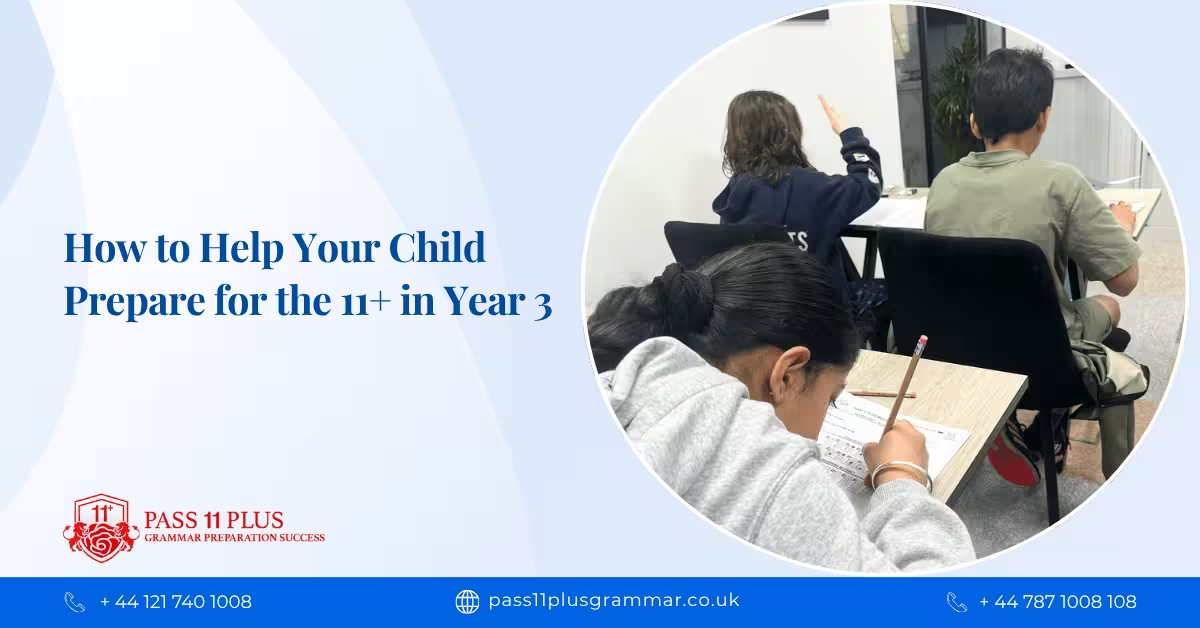
How to Help Your Child Prepare for the 11+ in Year 3
Published on
In Year 3, the best ways to prepare for the 11 plus are: build a daily reading habit using books slightly above your child's current level; practise mental maths and times tables for 10 to 15 minutes each day; introduce verbal and non-verbal reasoning gently with no pressure or time limits; and keep sessions short and consistent, 15 to 20 minutes a day is enough. There is no need for formal practice papers in Year 3. The goal at this stage is building strong, secure foundations across English, maths and reasoning before the intense preparation of Year 5 and 6 begins.
Most parents start thinking about the 11 plus in Year 5. The families who find that stage manageable almost always have one thing in common: they started earlier. Year 3 is not too soon. In fact, it is the ideal time. Here is exactly what good early preparation looks like and how to make it work for your child.
Why Year 3 is the right time to start
Here is the thing about the 11 plus that catches many families off guard. The skills it tests do not grow quickly. They accumulate. Reading ability, vocabulary, mental maths fluency, reasoning confidence - these are not things a child can pick up in a few weeks of revision. They are built over months and years of consistent practice and wide reading.
A child who starts building those foundations in Year 3 arrives at Year 5 with something that simply cannot be replicated last-minute: real confidence, genuine familiarity with the material and a solid base that holds up under the pressure of exam preparation. A child who starts in Year 5 has to learn the content, learn the question formats, learn exam technique and manage the pressure of a rapidly approaching deadline, all at the same time.
Starting in Year 3 does not mean pushing your child. It means giving them the gift of time. Time to read widely. Time to get comfortable with maths. Time to encounter reasoning questions in a relaxed, no-stakes environment. Time for good habits to become second nature before they need to matter.
What does the 11 plus actually test?
Before you can prepare for something, you need to understand what it covers. The 11 plus tests four core areas. English and maths are taught in school, but the 11 plus versions often go beyond what the standard curriculum covers. Verbal and non-verbal reasoning are not taught in school at all, which is exactly why early, gentle exposure to these subjects matters so much.
English
Reading, vocabulary, and writing
Reading comprehension
Vocabulary and word meaning
Grammar and punctuation
Creative or structured writing
Year 3 focus: Read widely every day. Talk about books. Build vocabulary naturally through reading and conversation.
Maths
Arithmetic and problem-solving
Mental arithmetic and the four operations
Times tables, all the way to 12
Fractions, decimals and percentages
Multi-step word problems
Year 3 focus: Secure the times tables. Practise mental arithmetic daily. Make numbers feel natural and fast.
Verbal Reasoning
Logic using words and language
Synonyms and antonyms
Letter and word codes
Word sequences and patterns
Sentence completion and logic
Year 3 focus: Not taught in school. Introduce a few question types calmly with no time limit. Familiarity is the goal.
Non-Verbal Reasoning
Logic using shapes and patterns
Shape sequences and patterns
Odd one out in visual sets
Matrices and analogies
Spatial awareness and rotation
Year 3 focus: Not taught in school. Puzzles, building toys and pattern games all build the underlying skills naturally at this age.
What good preparation looks like in Year 3
Good preparation in Year 3 looks nothing like exam preparation. There are no practice papers, no timed tests and no mock exams. Those come much later. What Year 3 preparation looks like is building strong habits across four areas, habits that feel so natural by Year 5 that your child does not even notice they are in preparation mode.
1. Build a daily reading habit - the single most valuable thing you can do
Reading is the foundation of 11 plus success. It builds vocabulary, comprehension, grammar instinct and general knowledge, all at once, without feeling like revision. A child who reads for 15 minutes every evening from Year 3 to Year 6 will have absorbed thousands of words, sentence structures and ideas that directly feed into their English and verbal reasoning performance.
The key is variety. Fiction is wonderful, but non-fiction, history books, science books and even quality newspapers build the kind of broad vocabulary that comprehension passages draw on. Push the level slightly, a book that feels a little challenging is more valuable than one that feels very easy. And talk about what your child reads. Ask what they think will happen next. Ask why a character made a particular choice. This habit of thinking about reading is exactly what comprehension questions require.
Practical tip: Put a book on their pillow every evening. That is all it takes. Children who read before bed read consistently, and consistency is everything at this stage.
2. Make mental maths a daily habit - 10 minutes is enough
The maths in the 11 plus requires speed as well as accuracy. Children who have to stop and count on their fingers for basic calculations will not have enough thinking time left for the more complex problem-solving questions. The solution is daily mental maths practice from Year 3, so that by the time the exam arrives, basic number work is completely automatic.
In Year 3, focus specifically on times tables. All of them, up to 12. Make them fun, songs, apps, quick-fire questions on the way to school, a times table chart on the bathroom wall. Ten minutes a day on mental arithmetic and tables builds the kind of automatic fluency that no amount of last-minute revision can replicate. Our free 11 plus practice papers include maths sections that give older children structured timed practice, but in Year 3, informal daily drill is the right approach.
3. Introduce verbal and non-verbal reasoning gently - no pressure, no time limits
Verbal and non-verbal reasoning are not taught in school. Most children have never seen these question types before they start 11 plus preparation, which is why the first encounter can feel strange or difficult even for very able children. The advantage of starting in Year 3 is that you have time to introduce these question types slowly, one at a time, in a completely relaxed environment.
Sit down with your child and work through a few questions together. Explain what each type involves. Celebrate the ones they get right. When they get one wrong, talk through why the correct answer makes sense rather than treating it as a failure. The goal at this stage is not correct answers - it is familiarity. A child who has seen 20 different reasoning question types in Year 3 finds them dramatically less daunting when they appear in Year 5 practice papers. Our 11 plus tutors always begin reasoning preparation with exactly this kind of calm, exploratory approach before introducing any time pressure.
Non-verbal reasoning at home: Puzzles, Lego, pattern games and building toys all develop the spatial and pattern-recognition skills that non-verbal reasoning tests. These activities are completely age-appropriate for Year 3 and build the underlying ability naturally.
4. Keep sessions short - 15 to 20 minutes a day is genuinely enough
In Year 3, more is not better. A child who is pushed to sit through an hour of 11 plus preparation will quickly come to dread the whole process. Dreading preparation in Year 3 means disengagement in Year 4, resistance in Year 5 and genuine anxiety in Year 6 - exactly the opposite of what you want.
Fifteen to twenty minutes of focused, enjoyable practice every day is enough. At this stage, the goal is habit formation and positive association with learning. If your child finishes their session feeling good about what they did, that session was a success. The content matters less than the habit. The habit is what carries them through the next three years of preparation.
5. Build a broad vocabulary every week
Vocabulary is tested in virtually every part of the 11 plus: synonyms and antonyms in verbal reasoning, word meaning in comprehension, precise language in creative writing, and grammar in the English paper. The best vocabulary is built through reading, conversation and actively noticing new words rather than memorising lists.
When your child encounters a word they do not know, in a book, on a sign, in conversation, make it a habit to look it up together and use it in a sentence. Keep a small notebook of new words. Play word games at the table. Scrabble, Boggle and crosswords are all genuinely effective vocabulary builders for Year 3 children, and they feel nothing like revision. A child who has been casually building vocabulary since Year 3 will arrive at the 11 plus with a word bank that comprehension passages and verbal reasoning papers cannot surprise.
11 Plus Tuition
Starting early and want expert support?
We help children from Year 3 onwards with tailored tuition and a clear preparation plan that grows with your child.
How to talk to your Year 3 child about the 11 plus
Most Year 3 children know that secondary school exists and that some schools are different from others. But they do not have strong feelings about it yet, and that is exactly the right starting point. The goal of any conversation about the 11 plus in Year 3 is to make preparation feel like a normal, unremarkable part of the week, not something frightening or high-stakes.
Children take their emotional cues from their parents. If you introduce the 11 plus as something stressful and important, it will feel that way to your child. If you introduce it as something interesting that they will be working towards gradually over the next few years, it usually stays that way throughout the preparation process.
If your child asks what the 11 plus is, a simple, calm explanation works best. Something like: "It is a test you will sit in a few years that helps you get into a secondary school you will really enjoy. We are going to do a little bit of work on it each week so it does not feel like a big surprise when the time comes." That is all they need to know in Year 3.
A simple Year 3 weekly routine
Sample weekly routine for Year 3 (total: around 20 minutes per day)
Every evening: 15 minutes of reading, a book slightly above current level. Talk about it briefly afterwards.
Monday, Wednesday, Friday: 10 minutes of mental maths, times tables, quick number questions, mental arithmetic drills.
Tuesday, Thursday: 10 to 15 minutes of reasoning, work through 4 to 5 verbal or non-verbal questions together, no time limit.
Weekend (optional): A word game (Scrabble, crossword, Boggle) or a puzzle. Fun, not formal. This is a bonus, not a requirement.
The 11 plus preparation roadmap - from Year 3 to exam day
Understanding where Year 3 sits in the full journey helps you keep the right perspective on what preparation should look like right now.
Year 3: Foundation stage - build habits, not exam skills
Daily reading, mental maths, gentle reasoning introduction, vocabulary building. No practice papers, no time limits, no pressure. This stage is entirely about forming good habits and positive associations with learning.
Year 4: Consolidation stage - strengthen the foundations
Continue reading and maths daily. Introduce more reasoning question types. Begin short, structured practice exercises. Start to identify which areas need more attention. Consider a diagnostic assessment to get a clear picture of 11 plus readiness.
Year 5: Preparation stage - targeted practice and exam familiarity
Begin proper 11 plus preparation with structured sessions covering all four subjects. Introduce timed practice. Use our free 11 plus practice papers weekly. Consider our 11 plus tuition programme if your child needs structured support across all subjects.
Year 6 Summer: Final preparation - polish, confidence and exam technique
Our 11 plus intensive summer course covers all four subjects in a structured, expert-led programme across the summer before the exam. Full timed practice, exam technique and confidence building before September.
Sept/Oct Year 6: Exam stage - perform with confidence
Your child sits the 11 plus exam. A child who has been preparing steadily since Year 3 walks into this stage feeling familiar, confident and calm rather than overwhelmed. Our 11 plus mock exams in the final weeks replicate real exam conditions so there are no surprises on the day.
Final thoughts
The families who find Year 5 and 6 manageable almost always started earlier than the families who find it overwhelming. Not because they worked harder. Because they gave their children time. Time to read widely. Time to get comfortable with maths. Time to encounter new ideas and question types without pressure.
Year 3 is the right time to start. Not because the exam is close, but precisely because it is not. That distance is your most valuable resource. Use it well, fifteen minutes a day, consistently, calmly, and your child will arrive at Year 5 with something that no amount of last-minute preparation can replicate: genuine foundations, real confidence and a healthy relationship with learning.
Frequently Asked Questions
How can I help my child prepare for the 11+ in Year 3?
In Year 3, the best ways to prepare for the 11 plus are: build a consistent daily reading habit using books slightly above your child's current level; practise mental maths and times tables for 10 to 15 minutes each day; introduce verbal and non-verbal reasoning question types gently with no pressure or time limits; keep sessions short (15 to 20 minutes) and consistent; and frame preparation as a normal, interesting part of the week.
Is Year 3 too early to start 11 plus preparation?
No. Year 3 is not too early, as long as the preparation is age-appropriate. In Year 3, preparation means building strong foundations through daily reading, regular maths practice and gentle exposure to reasoning, not drilling exam papers. The skills that matter most in the 11 plus accumulate slowly over time, and starting in Year 3 gives your child the most valuable resource of all: time.
What subjects should a Year 3 child focus on for the 11 plus?
In Year 3, focus on English (daily reading and vocabulary building), maths (mental arithmetic and times tables), verbal reasoning (gentle introduction to question types; this is not taught in school) and non-verbal reasoning (puzzles and pattern games build the underlying skills naturally at this age). Verbal and non-verbal reasoning are not part of the standard school curriculum, which is why early exposure matters.

Mr Singh
Founder, Pass 11 Plus Grammar
Mr Singh is the founder of Pass 11 Plus Grammar, with over 30 years of teaching experience. Having overcome academic setbacks himself, he is passionate about ensuring no child struggles alone. His approach focuses on personalised support, strong foundations, and building confidence. He has helped students achieve outstanding results in 11+ and GCSE examinations
Loading related posts…