Loading page…
How to Use Mock Tests for 11 Plus Preparation
Published on
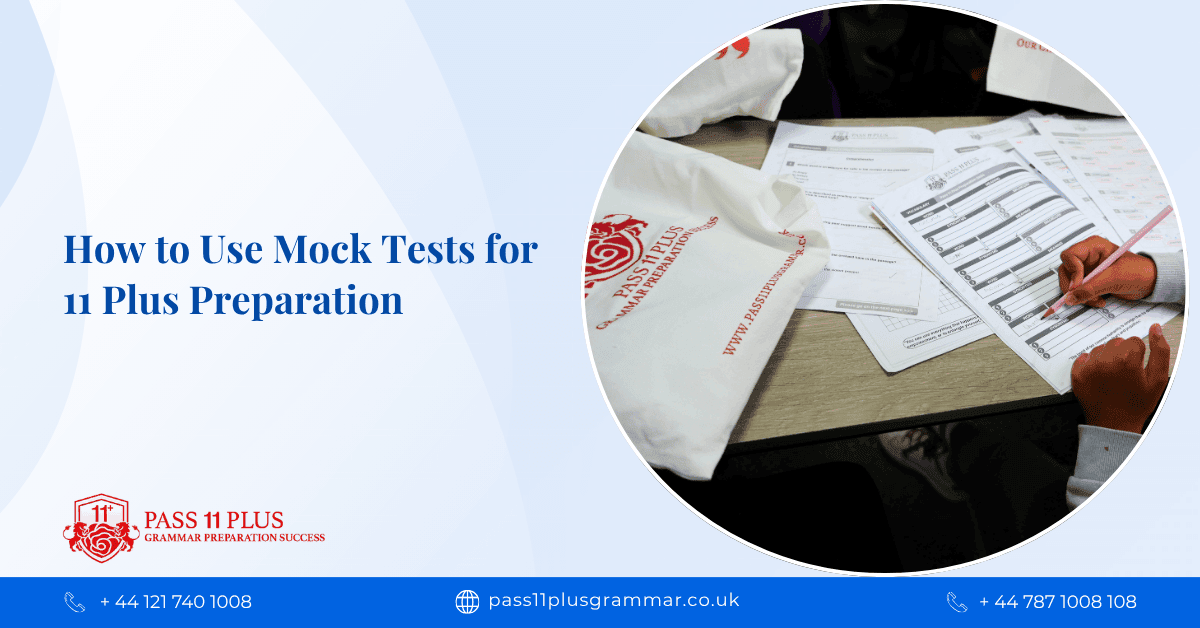
Mock tests are practice exams that replicate the format, timing, and question types of the real 11 plus. They build exam confidence, improve time management, and help identify gaps in knowledge. But they work best as a supplement to curriculum learning, not a replacement for it. Aim for one to two mock tests per month during preparation, increasing to one per week in the final six weeks before the exam.
Mock tests are one of the most powerful tools in your 11 plus preparation toolkit. But most families use them in the wrong way. This guide explains exactly how to use them effectively, when to start, how many to do, and the one mistake that holds most children back.
What are 11 plus mock tests and familiarisation papers?
Mock tests:
Mock tests are practice exams created to replicate the format, timing, and question types of the real 11 plus. They are not official papers, but they are designed to mirror the real exam as closely as possible. For mock tests to be genuinely useful, they need to be accurate; quality varies widely across free resources available online, and a poorly designed paper can create false expectations rather than proper preparation. They work best when sat under proper timed exam conditions, just like the real thing.
Familiarisation papers:
Familiarisation papers are sample questions published by an exam board, school or local authority to show children what to expect. GL Assessment publishes a handful of familiarisation papers. CEM does not publish practice materials and changes its exam format each year to discourage teaching to the test. Always check your target school's website for any published sample materials.
Not sure which exam your child will face? Our 11 plus tuition programmes are tailored to your specific target school and region, so your child is always practising with the right material.
How do mock tests improve your child’s exam performance
Done well, mock tests do much more than just give your child extra practice questions. Here are the four most important things they achieve.
1. They reduce mental overload on exam day
For many children, the 11 plus will be the first time they sit a timed exam. Without preparation, they will spend precious mental energy working out how the paper is laid out, what the instructions mean and how to pace themselves. A child who has regularly sat accurate mock tests under exam conditions already knows exactly what to do. They can focus entirely on answering the questions, not navigating the format. This reduction in mental overload directly leads to better results.
2. They build confidence and reduce exam anxiety
The unknown is frightening for children. Exam nerves are completely natural, but they get in the way of performance. Our brains simply do not work as well when we are stressed. Regular practice under test conditions removes the element of surprise. By the time your child sits the real exam, they have already done it many times before. That familiarity transforms the experience from something scary into something manageable.
3. They develop real exam technique
Knowing the content is only half the battle. Time management, knowing when to move on, when to check back, how to handle a question you are unsure about, and how to use the answer sheet efficiently, all of these skills can only be developed through practice under real-time pressure. Children who sit regular mock tests develop these habits naturally over time. Children who only do untimed practice exercises often struggle with pacing when it matters most.
4. They give you a clear picture of where your child stands
A well-marked mock test shows you more than a score. It shows you exactly which topics your child is confident in and which ones need more work. Looking at this data over several mock tests also shows you whether your child is improving and how quickly. This kind of targeted insight is far more useful than a general sense that "they need to do more maths." Our 11+ mock exams are marked and reviewed so you get a clear breakdown of results and know exactly what to focus on next.
⚠ Limited spaces available
Does your child know enough to pass the 11+?
We mark every paper and give you a detailed breakdown by topic, so you never have to guess what your child should be working on next.
The biggest mock test mistake parents make
Here is something that surprises many families: doing too many mock tests is one of the most common preparation mistakes.
It makes intuitive sense to think that the more practice papers your child does, the better they will perform. But this is not how learning works, especially for children.
Mock tests are taken in exam conditions. That means your child cannot stop asking for help or looking something up. They cannot see their score as they go, which means they cannot correct their misunderstandings in the moment. They just answer questions, make mistakes, and move on. Repeating that process over and over without addressing the underlying gaps does not improve the gaps. It can actually reinforce them.
Think of it this way. Mock tests are a thermometer, not a medicine. They tell you the temperature. They do not bring it down.
How to use mock tests the right way
The most effective approach treats mock tests as one part of a broader preparation plan, not the whole plan. Here is how the balance should look.
Step 1: Master the curriculum first
The bulk of your child's preparation time should be spent learning and consolidating the actual content tested in the 11 plus. That means working through English comprehension and writing, maths topics, verbal reasoning question types and non-verbal reasoning patterns, systematically and thoroughly.
Research shows that study sessions of 20 to 30 minutes a day lead to better focus and retention than long, infrequent sessions. A good approach is to rotate subjects across the week, so your child covers something different each day. By the end of the Easter holidays in Year 5, the goal is to have worked through every question type in the curriculum at least once.
You can supplement this with our free 11 plus practice papers, which are a great way to practise individual topics and question types without the pressure of a full timed test.
Step 2: Introduce mock tests once foundations are solid
Once your child has covered the curriculum content and is feeling reasonably confident, introduce full-time mock tests. This is typically from the summer term of Year 5 onwards. Starting mock tests before the foundations are in place can be demoralising and counterproductive.
When sitting a mock test, recreate exam conditions as closely as possible. Find a quiet space, set a timer, use the right type of answer sheet, and make sure your child works through the paper without any help. The more realistic the conditions, the more useful the practice.
Step 3: Always review the results together
The review after a mock test is just as important as the test itself. Without a proper debrief, the learning opportunity is wasted. We cover exactly how to do this well in the next section.
If your child is working with one of our 11 plus tutors, they will help you get this balance right and adjust it as the exam approaches.
How many mock tests should your child do?
Here is a simple schedule that works well for most families preparing for the 11 plus.
Stage | Recommended approach |
Year 5 (Sept to Easter) | Focus on curriculum learning. Avoid full mock tests at this stage. Use topic-based practice questions and our free practice papers to build skills gradually. |
Year 5 (Summer term) | Introduce one mock test per month once the curriculum content is mostly covered. Review results carefully and return to any topics that need work. |
Year 6 (Sept to July) | One to two mock tests per month. Continue curriculum revision alongside. Track progress and identify any remaining weak areas to address. |
Final six weeks before the exam | Increase to one mock test per week. Focus heavily on exam technique, pacing and confidence. Keep curriculum revision light at this stage. |
How to review mock test results with your child
The debrief after a mock test is where the real learning happens. Always take at least ten minutes to sit down with your child after a practice paper and go through the results together. Here is how to make the most of it.
1. Look at the detail, not just the score
The overall score tells you very little on its own. What matters is which specific topics your child struggled with. Were the errors in a particular area of maths? Were the comprehension questions harder than the vocabulary questions? This kind of detailed breakdown tells you exactly what to work on next.
2. Go through every wrong answer
Do not skip this step. For every question your child got wrong, work through the correct answer together and make sure they understand why. Ask them to explain their reasoning. This is where genuine learning happens, and it turns the mock test from a score into a lesson.
3. Ask these questions during the debrief
"Is there a different way you could have solved this problem?"
"What was tricky about this question?"
"Was that the quickest way to get to the answer?"
"How would you explain this to someone else?"
"What would you do differently next time?"
"Which part are you most proud of in this paper?"
4. Celebrate effort, not just results
This is particularly important. If you only praise your child for high scores, you inadvertently teach them to fear low scores. And fear leads to anxiety, which leads to worse performance. Instead, celebrate the process: the effort they put in, the mistakes they identified, the improvement from the last test, the questions they found difficult but pushed through anyway. A child who has a healthy relationship with getting things wrong will always outperform a child who is afraid to make mistakes.
Final thoughts
Mock tests are an essential part of 11 plus preparation, but they are not the whole story. The families who get the best results are the ones who use mock tests at the right time, in the right way, and in the right proportion alongside solid curriculum learning.
At Pass 11 Plus Grammar, we review every result carefully. Whether your child needs structured tuition, realistic mock exams or a focused final push before the exam, we have the right support ready for where they are right now.
Frequently Asked Questions
When should my child start doing 11 plus mock tests?
Your child should start mock tests once they have covered the majority of the 11 plus curriculum, typically from the summer term of Year 5 onwards.
How many mock tests should my child do?
One to two mock tests per month is a good target during the main preparation period. In the final six weeks before the exam, increase this to one mock test per week.
Should my child do mock tests under real exam conditions?
Yes, always. The whole point of a mock test is to simulate the real exam experience as closely as possible. That means a quiet space, a strict timer, the correct answer format, and no help during the test. The more realistic the conditions, the more effective the practice.

Mr Singh
Founder, Pass 11 Plus Grammar
Mr Singh is the founder of Pass 11 Plus Grammar, with over 30 years of teaching experience. Having overcome academic setbacks himself, he is passionate about ensuring no child struggles alone. His approach focuses on personalised support, strong foundations, and building confidence. He has helped students achieve outstanding results in 11+ and GCSE examinations
Loading related posts…