Loading page…
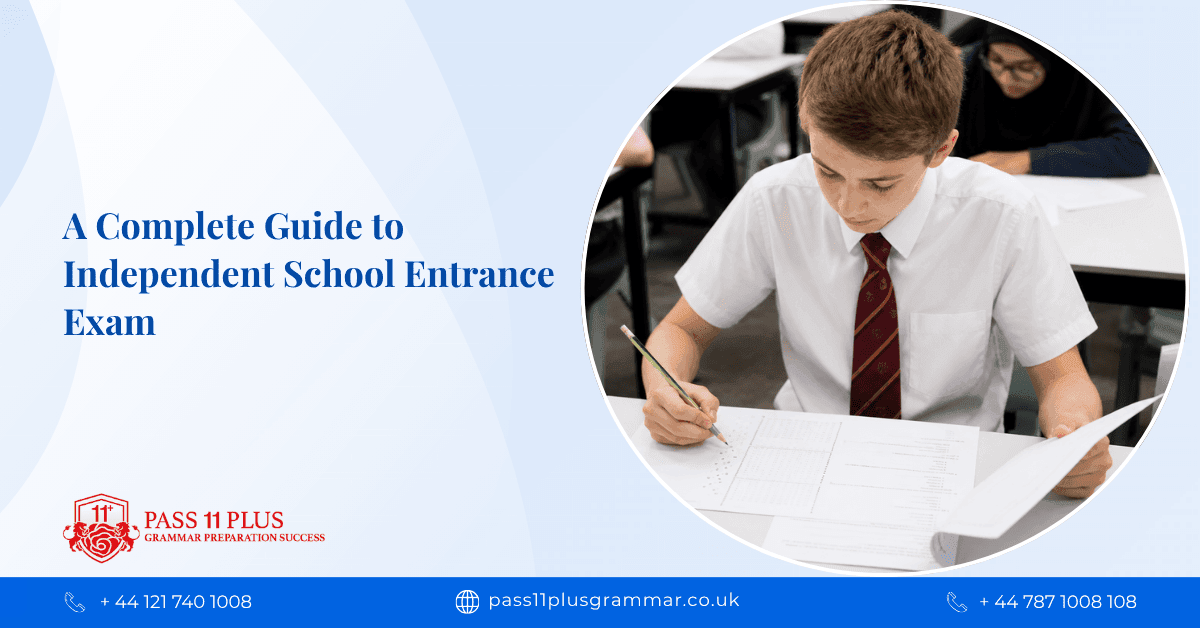
A Complete Guide to Independent School Entrance Exam
Published on
Are you thinking about applying to an independent school? This guide covers everything you need to know, including the different types of entrance exams, what each one tests, how the process works, and how to prepare your child with confidence.
What are independent school entrance exams?
Independent school entrance exams are tests used by private schools to select pupils for entry, most commonly at 11+ or 13+. They may be set by an external exam board, such as ISEB, GL Assessment, or Quest Admissions, or by the school itself. Most schools also include an interview and a school reference as part of the process. There are approximately 1,500 senior independent schools in the UK, and many have entrance exams.
How independent school entrance exams differ from grammar school 11+ exams
You might have heard both grammar schools and independent schools refer to their entrance process as the "11 plus." But while the name is the same, the two processes are actually quite different. Understanding this distinction saves a lot of confusion.
Feature | Grammar School 11+ | Independent School Entrance |
Exam dates | Fixed by region, usually in September or October | Each school sets its own dates, often Nov to Jan |
Exam format | Standardised within each region or consortium | Varies by school, ISEB, GL, Quest, or own papers |
Interview | Rare, only at a few schools | Very common, most schools include one |
Extra assessment | Uncommon | Many schools hold an assessment day, group activity, or creative writing task |
Cost | Free to sit | Registration fee applies |
Pass mark | Set by the school or the consortium | Set by individual school, varies significantly |
Types of independent school entrance exams
There is no single "independent school entrance exam." Different schools use different systems. Here are the main ones you need to know about.
ISEB Common Pre-Test
An online, age-standardised test taken in Years 6 or 7, testing English, maths, verbal reasoning and non-verbal reasoning in multiple-choice format. The test can only be sat once per academic year, and results are shared with all schools the child has applied to. Around 79 schools currently use it, including some of the most selective schools in the UK.
ISEB Common Entrance
Common Entrance is taken at 11+ (Year 6) or 13+ (Year 8) for entry to senior independent schools. ISEB sets the syllabuses, but answers are marked by the senior school the child is applying to, and each school sets its own pass mark. At 11+, the core subjects are English, maths, and science. At 13+, a wider range of subjects can be added.
School-set entrance exams
Many independent schools, including some of the most prestigious, write and mark their own entrance papers entirely. These often include written English, maths, and comprehension, plus additional elements like creative writing, an interview, and an assessment day. Quest Admissions and GL Assessment are also widely used as school-set alternatives.
Quest Admissions
Quest Admissions exams are split into two parts, covering English, maths, verbal reasoning, non-verbal reasoning, puzzles, and creative comprehension. The test uses adaptive and non-adaptive questions to assess how your child thinks, rather than just what they know. Over 160 schools now use Quest, including Harrow, Dulwich College, and Wellington College.
Common Academic Scholarship Exam (CASE)
The most academically able children may take Common Academic Scholarship Exams (CASE) or the senior school's own scholarship exams instead of Common Entrance. Scholarship exams can include papers in, for instance, Latin and Greek, and are often taken earlier than Common Entrance. These sit alongside bursary applications for families who also need financial support.
What subjects are tested in independent school entrance exams?
Across all formats and exam boards, the core subjects that appear in virtually every independent school entrance exam are:
English
Maths
Verbal Reasoning
Non-Verbal Reasoning
Science (13+)
Creative Writing
Puzzles (Quest)
Creative Comprehension (Quest)
At 13+, the subject range expands significantly to include humanities, modern languages, and classical subjects. The exact combination depends entirely on your target school, which is why checking their admissions page directly is always the first step.
Key dates and timeline for independent school entry
Unlike grammar schools, which tend to follow a fixed regional timetable, independent school entrance exams happen throughout the autumn and winter. Here is a general timeline for 11+ entry in September 2027.
Year 5 (spring-summer): Attend open days and research target schools. Make a shortlist early.
Year 6 (September-October): Register with target schools
Year 6 (October-December): Stage 1 assessments - ISEB Pre-Test, Cambridge Select Insight, Quest or school-specific online tests.
Year 6 (December–January): Stage 1 results released. Invitations to Stage 2 sent out.
Year 6 (January-February): Stage 2 written papers and interviews at the school.
Year 6 (February-March): Offers of places made.
Year 6 (March): Deadline to accept offers.
September (Year 7): Term begins.
How to prepare your child for independent school entrance exams
The most important thing to know is this: preparation for independent school entrance exams is not just about practice papers. It is about building genuine skills, intellectual curiosity and exam confidence over time. Here is how to do it well.
1. Research your target school's specific exam format first
Does your target school use ISEB, Quest, GL Assessment or its own papers? Does it include an interview? A creative writing task? An assessment day? The answers to these questions should shape your entire preparation plan. It is a good idea to contact your target schools directly and ask how they structure their exam and what to expect.
2. Start at least 12 months before the exam
Begin preparing in Year 5, ideally in the spring or summer term. Starting early gives your child time to build skills steadily without last-minute pressure. Short, focused sessions of 20 to 30 minutes every day are far more effective than long infrequent revision weekends. Our 11 plus tuition is structured around exactly this gradual, progressive approach.
3. Build strong foundations in English and maths before anything else
Before introducing timed practice papers, make sure your child is confident in KS2 English and maths, comprehension, grammar, vocabulary, arithmetic, problem-solving and data handling. These subjects appear in every independent school entrance exam at every level. Gaps here will show up everywhere.
4. Make reading a daily habit
Wide, varied reading is the single most effective preparation for English comprehension, creative writing and verbal reasoning all at once. Encourage your child to read for 15 to 20 minutes every day, fiction, non-fiction, and different genres. Discussing what they read builds the analytical skills that written papers reward directly.
5. Practise with realistic mock exams
Once your child is confident with the content, introduce timed mock practice to build exam technique and time management. Our 11+ mock exams are designed to replicate the real exam experience, so your child goes in feeling familiar and prepared, not anxious and uncertain.
6. Prepare for the interview as a separate stage
The interview is part of the process at most independent schools, and it deserves its own preparation. Practise open discussion at home: ask your child what they think about things they have read, watched or experienced. The interview rewards genuine curiosity and the ability to think out loud. It cannot be scripted, but it can absolutely be prepared for.
7. Get specialist support tailored to your target school
Different schools test different things. A tutor who knows the specific format your child will face can provide targeted preparation that generic resources simply cannot match. Our 11 plus tutors have experience preparing children for the full range of independent school entrance exams, from ISEB to Quest to school-set papers. For a focused final push, our 11 plus summer intensive course gives your child a structured, concentrated boost in the weeks before the exam.
Final thoughts
Independent school entrance exams are more varied and more manageable than many parents initially think. The key is understanding that there is no single process. Different schools test different things in different ways, and preparation that is tailored to your specific target school will always outperform generic revision.
At Pass 11 Plus Grammar, we have been helping families navigate the full range of independent school entrance exams. Whether your child is in Year 5 and just getting started, or in Year 6 and needs a focused final push, we have the right support built around where they are right now.
Frequently Asked Questions
What are independent school entrance exams?
Independent school entrance exams are tests used by private schools to select pupils for entry, most commonly at 11+ or 13+. They may be set by an external board such as ISEB, GL Assessment or Quest Admissions, or by the school itself.
Are independent school entrance exams the same as grammar school 11+ exams?
No. Both may be called 11+ exams, but they differ significantly. Independent schools can set their own exam format and deadline dates throughout the year, whereas most grammar schools hold exams in September. Independent schools may also include additional assessments such as a creative writing task or an interview; only a few grammar schools have second-stage exams, and interviews are rare.
Do all independent schools use entrance exams?
Not every independent school uses entrance exams, but those that do might use them at several entry points. For some schools, the test might be just to get an idea of attainment level rather than to decide whether a child should be offered a place. Independent schools with their own junior schools will often use internal exam results and school reports to offer places to existing pupils without a formal external exam.

Mr Singh
Founder, Pass 11 Plus Grammar
Mr Singh is the founder of Pass 11 Plus Grammar, with over 30 years of teaching experience. Having overcome academic setbacks himself, he is passionate about ensuring no child struggles alone. His approach focuses on personalised support, strong foundations, and building confidence. He has helped students achieve outstanding results in 11+ and GCSE examinations
Loading related posts…