Loading page…
Top 11 Plus Exam Techniques Every Parent Should Know

Published on
The most effective 11 plus exam techniques are: read every question twice before answering, manage time by checking the clock at the halfway point, underline key words in each question, skip and return to difficult questions rather than getting stuck, always make an educated guess on multiple choice rather than leaving a blank, and keep focus on your own paper throughout. These techniques can be taught and practised, and they make a measurable difference to scores.
Knowing the content is only half the battle. The children who perform best in the 11 plus are not always the most knowledgeable; they are the ones who apply the right 11+ exam techniques at the right moment. This guide covers everything your child needs to know, before, during, and after each paper.
Why exam technique matters as much as knowledge
Here is something that surprises many parents. Two children can have exactly the same level of knowledge and come out of the same 11 plus exam with significantly different scores. The difference is almost always 11 plus exam technique.
The 11 plus is a timed test. There is pressure, there is a clock, and there are questions deliberately designed to be harder than what children typically see at primary school. In that environment, children who have practised specific exam techniques, how to manage their time, when to move on, how to approach tricky questions, consistently outperform children who have only focused on learning content.
Every year, children lose marks not because they do not know the answer, but because they misread the question, ran out of time on easier questions after spending too long on a hard one, or left a multiple-choice question blank when any guess would have been better than nothing.
The good news is that 11 plus exam technique is completely teachable. These are not innate skills; they are habits that can be built through regular, well-structured practice. Our 11 plus mock exams are designed specifically to give children the chance to practise all of these techniques under realistic timed conditions before the actual exam day.
The 8 most effective 11 plus exam techniques
1. Read the question twice before writing anything
In a time-pressured exam, children often skim-read questions and launch straight into an answer. This leads to misinterpretation, especially in comprehension and maths, and costs marks on questions your child actually knows the answer to.
Teach your child to read every question once to understand what is being asked, then read it a second time to check they have not missed anything. In the second read, they should underline or circle the key words, the ones that tell them what the question is really asking for.
This is particularly important for questions that include words like "not," "except," "most likely," or "which two", these small words change the entire answer required, and they are easy to miss on a fast first read.
2. Know your time budget before the exam starts
Before your child sits the exam, make sure they know exactly how long each paper lasts and roughly how many seconds they have per question. This calculation is simple but powerful: if a paper is 50 minutes and has 60 questions, that is just under a minute per question. Knowing this stops children from spending three minutes on a question they should have moved on from after one.
In the exam room, encourage your child to check the clock at regular intervals, not obsessively, but deliberately. A good rule of thumb is to check at the halfway point. If they are halfway through the questions when halfway through the time, they are perfectly on track. If they have only answered a third of the questions at the halfway point, they need to pick up speed.
Different exam boards structure their papers differently. Some GL Assessment papers include individually timed sections, so children are moved on automatically. Others require children to manage the whole paper themselves. Always check the specific format for your target school. This is one of the areas our 11 plus tutors focus on heavily when preparing children for their specific exam.
3. Skip and return - never get stuck on one question
This is one of the most valuable 11+ exam techniques to practise. When a child encounters a question they find very difficult, the natural instinct is to stay with it until they work it out. But in a timed exam, this can be devastating. Spending five minutes on one hard question while twenty easier ones sit unanswered at the end of the paper is one of the most common reasons children underperform relative to their ability.
Teach your child to make a small mark next to any question they want to come back to: a star, a dot or a small circle in pencil next to the question number. Then they move on immediately to the next question. If they have time at the end of the paper, they go back to their marked questions. If they do not have time, they at least answered all the questions they were confident on.
This technique needs to be practised before the exam. Children who are trying it for the first time on the real day will find it uncomfortable; it feels like "giving up." Build the habit through regular timed practice with our free 11+ practice papers, so it feels natural and automatic by exam day.
4. Always guess on multiple choice - never leave it blank
The 11 plus does not penalise wrong answers. There are no marks deducted for an incorrect multiple-choice answer. This means that leaving a question blank is always the worst possible choice; it guarantees zero marks, whereas a guess gives at least a chance of being right.
Teach your child a simple elimination strategy. First, cross out any options that are obviously wrong. Then, from the remaining options, choose the one that feels most likely. Even a random guess from five options gives a 20% chance of the correct answer. Narrowing it down to two or three options can push those odds to 33% or 50%.
This does not mean your child should rush to guess early in the paper. The right approach is to attempt every question properly, then use the elimination and guess strategy only for questions that they genuinely do not know the answer to. But it does mean they should never finish the paper with blanks on the answer sheet.
5. Check the answer sheet format before starting
Different 11 plus exams use different answer formats. Some use a separate multiple-choice answer sheet where answers are entered by filling in a bubble or circle. Others ask children to write answers directly in the question booklet. Some computer-based exams use drag and drop or auto-complete formats. If your child is not familiar with the format, they can lose marks simply by filling in the answer in the wrong place, even if they know the correct answer.
Before the exam starts, your child should look at the answer sheet format (or the on-screen interface) and confirm they understand exactly how to record their answers. The invigilator will give instructions at the start of the exam; these must be listened to carefully. And if your child is taking a paper-based exam with a separate answer sheet, teach them to double-check that each answer is entered in the row matching the question number.
6. Show your working in maths - always
In the maths papers of school-set exams and Common Entrance, marks are not only awarded for the correct final answer. They are also awarded for method, showing a clear, logical working-out process, even if the final answer is wrong.
This means a child who writes down the correct method but makes an arithmetic error at the last step can still score partial marks. A child who writes only a wrong final answer with no working scores nothing. Teach your child to write their working clearly on the scrap paper or in the space provided, and never to cross out working that led somewhere logical, even if they think it is wrong.
For multiple-choice maths questions on GL Assessment papers, showing working on scrap paper is still valuable; it makes the checking process faster and more reliable if your child has time to review their answers at the end.
7. Keep your eyes on your own paper throughout
For many children, the 11 plus will be the first time they have taken an exam in a room full of other children, all working at the same time. It is natural to look up and wonder what others are doing; are they writing more? Are they finishing faster? Is everyone else finding it easy?
These moments of comparison are almost always counterproductive. They waste time, generate anxiety and give no useful information. Teach your child that what other people are doing in the exam room is completely irrelevant to their own performance. The only things they should be focused on are the clock and their own question paper.
Candidates who are seen repeatedly looking at other children's papers can be flagged by invigilators, which adds unnecessary stress. Build the habit of focused, head-down work through regular timed practice sessions at home where there are no distractions allowed during the allocated time.
8. Use any remaining time to check not to change
If your child finishes the paper with time remaining, they should use it wisely. First, go back to any questions they marked for review and attempt those. Then, if there is still time left, review all answers, but with an important rule: only change an answer if there is a clear, logical reason to do so.
Research consistently shows that first instincts on exam questions are more often right than the second-guessing that happens when children have time to overthink. A child who changes answers nervously, without a specific reason, tends to swap correct answers for incorrect ones more often than the reverse. Teach your child to change an answer only if they have spotted a definite mistake, not because they have talked themselves out of their original choice.
What to do the night before and morning of the 11 plus exam
Many families focus all their energy on the months of preparation and then underestimate how much the 24 hours immediately before the exam matter. Here is what the research and experience consistently show.
The night before
Do not do intensive revision the night before the exam. Trying to cram new content at this stage does not improve performance and almost always increases anxiety. Your child's brain needs rest, not more information.
Pack the bag together: pencils, rubber, ruler, water bottle, analogue watch and any other permitted items
Confirm the exam location and what time your child needs to arrive
Do something enjoyable and relaxing, a favourite film, a board game, or a walk
Have an early, normal dinner, nothing too heavy or unfamiliar
Get to bed at a reasonable time and avoid screens for at least an hour before sleep
Remind your child that they have prepared well and that you are proud of them whatever happens
The morning of the exam
Mornings before big events can be stressful. Keep the routine as normal as possible. A proper breakfast, something your child usually enjoys and that releases energy slowly, is genuinely important. Arriving early at the exam centre removes the anxiety of rushing, so build in more time than you think you need for the journey.
How to practise 11 plus exam techniques at home
The most important thing to understand about 11 plus exam techniques is that they cannot be taught in a lecture or a booklet. They have to be practised repeatedly, under conditions that closely resemble the real exam. Here is how to do that effectively at home.
Always practise under timed conditions
Untimed practice papers have their place in the early stages of preparation; they help your child learn the content without time pressure. But as the exam approaches, every practice session should be timed. The habits your child builds during practice are exactly what they will default to under pressure. If they have never practised skipping and returning to questions, they will not do it naturally in the exam room.
Recreate the exam environment
This means sitting at a desk or table, in a quiet space, without a phone, without background TV, without mum or dad hovering nearby. From around age 9, it can be very helpful to simulate the exam environment and focus on speed and precision. The 11 plus may be the first formal exam your child sits, so helping them not to be fazed by the environment is a real benefit.
Review technique as well as answers after each practice
After every timed practice session, do not only look at which answers were wrong. Ask your child how their time management felt. Did they finish? Did they run out of time at the end? Were there questions they skipped and came back to? Were there questions they spent too long on? This review builds awareness of technique as a separate skill from knowledge.
Our free 11+ practice papers are a great starting point for building this habit at home. And when your child is ready for a full-length, marked experience under genuine exam conditions, our 11 plus mock exams replicate the real test as closely as possible and come with a detailed breakdown of results by subject and question type.
For personalised, expert support on both exam technique and content preparation, our 11 plus tutors work with children at every stage, building good habits early and sharpening technique in the final weeks before the exam. Our 11 plus summer courses are specifically designed for the critical preparation period immediately before the September exam, combining focused revision with repeated timed practice under realistic conditions.
Final thoughts
The best-prepared children in the 11 plus are not always the ones with the most knowledge. They are the ones who apply the right 11 plus exam techniques at the right time, managing their time intelligently, reading questions carefully, skipping and returning to hard questions, and never leaving a blank on a multiple-choice paper.
At Pass 11 Plus Grammar, we build 11 plus exam technique into every aspect of our preparation programmes, from weekly tuition sessions and free practice papers through to full mock exams and summer courses. Your child will go into the exam day not just knowing the content but knowing exactly what to do with it.
Frequently Asked Questions
What are the best 11 plus exam techniques?
The most effective 11 plus exam techniques are: reading every question twice and underlining key words, managing time by checking the clock at regular intervals, skipping hard questions and coming back to them at the end, always making an educated guess on multiple choice rather than leaving a blank, showing working in maths for potential partial marks, and keeping focus on your own paper throughout.
How should my child manage time in the 11 plus exam?
Before the exam, your child should know the time allowed for each paper and roughly how many seconds they have per question. In the exam, they should check the clock at the halfway point. If they are halfway through the questions at the halfway time mark, they are on track. If not, they need to pick up the pace. Teach them to move on quickly from questions that feel too hard rather than getting stuck.
How can I help my child practise 11 plus exam techniques at home?
Practise all exam techniques under timed conditions that closely replicate the real exam environment. After each practice session, review technique as well as answers, discuss time management, whether questions were skipped and returned to, and whether any multiple-choice questions were left blank.
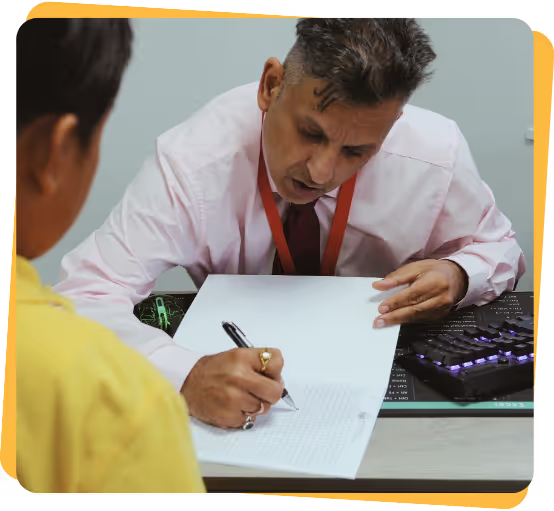
Mr Singh
Founder, Pass 11 Plus Grammar
Mr Singh is the founder of Pass 11 Plus Grammar, with over 30 years of teaching experience. Having overcome academic setbacks himself, he is passionate about ensuring no child struggles alone. His approach focuses on personalised support, strong foundations, and building confidence. He has helped students achieve outstanding results in 11+ and GCSE examinations
Loading related posts…