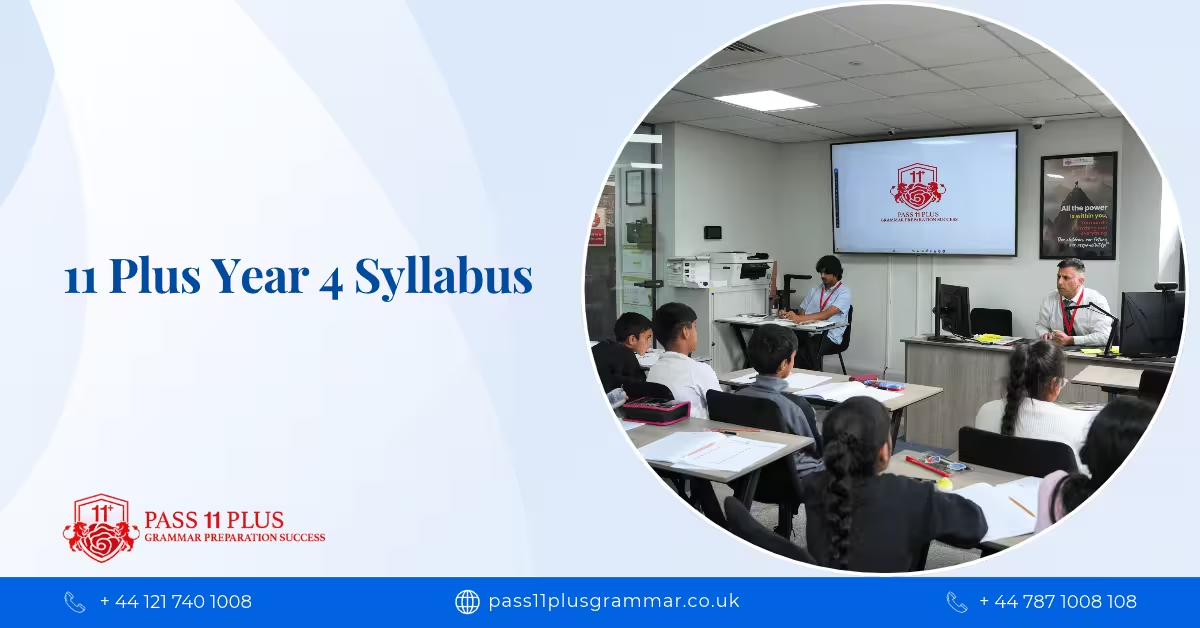
11 Plus Year 4 Syllabus
Published on
There is no single official 11 plus syllabus. Different areas and schools use different tests, and most are based on the Key Stage 2 National Curriculum. So the 11 plus Year 4 syllabus is really the Year 4 maths and English curriculum, plus gentle introductions to verbal and non-verbal reasoning. The key skills are times tables up to 12 x 12, place value, fractions and decimals, wide reading, spelling and grammar. Year 4 is about strong basics and happy habits, not timed exam papers.
What does your Year 4 child need to know for the 11 plus? This guide explains the 11 plus Year 4 syllabus. You will see what is in maths, English and reasoning, what is not needed yet, and a gentle plan for the year.
What is the 11 plus Year 4 syllabus?
Many parents ask us for "the 11 plus syllabus for Year 4". It is a very sensible question, but the answer is a little different from what people expect. There is no official list of topics that every 11 plus test must follow.
What we do have is the National Curriculum. The government sets out what every child in England should learn each year, and most 11 plus tests build on the Key Stage 2 curriculum. So when we talk about the 11 plus Year 4 syllabus, we mean the Year 4 learning that gives your child the best base.
Year 4 children are around 8 and 9 years old. For most of them, the 11 plus test is about two years away, in September of Year 6. That is plenty of time to learn calmly. Our approach to 11 plus preparation Year 4 follows the curriculum first, then adds gentle practice with the question styles.
Is there an official 11 plus syllabus for Year 4?
No. The 11 plus is not one national exam. Grammar schools and independent schools each choose their own tests, so subjects, formats and levels differ. Here is what is helpful to know.
Question | Answer |
Is there one official 11 plus syllabus? | No. Each area or school chooses its own test |
What are tests based on? | Mostly the Key Stage 2 National Curriculum. Questions can be harder than normal schoolwork |
Which year's content is tested? | It varies. For example, ISEB says its maths test is based on the National Curriculum up to the end of Year 5 |
Which subjects are included? | English and maths are common. Many tests also include verbal and non-verbal reasoning |
Please check the schools you are interested in for their own subjects and format when your child is a little older.
This is why the best Year 4 plan is to learn the Year 4 curriculum well, and to read a lot. Strong foundations help with every kind of test.
11 Plus Tuition
Is your Year 4 child ready for 11+ preparation?
Our 11 plus tutors help Year 4 children strengthen English, Maths, and reasoning skills while building a strong foundation for grammar school entrance exams.
11 plus Year 4 maths syllabus
This is what the National Curriculum asks Year 4 children to learn in maths. These skills are the base for 11 plus maths, so they are the best things to practise.
Topic | What Year 4 children learn |
Times tables | Recall multiplication and division facts up to 12 x 12 by the end of Year 4 |
Place value | Four-digit numbers, counting in multiples of 6, 7, 9, 25 and 1000, and rounding to the nearest 10, 100 or 1000 |
Negative numbers and Roman numerals | Counting backwards through zero, and reading Roman numerals to 100 |
Calculation | Multiplying two and three digit numbers by one digit, factor pairs and mental methods |
Fractions and decimals | Equivalent fractions, tenths and hundredths, and linking them to decimals and money |
Measures | Perimeter of rectilinear shapes, area by counting squares, time and money |
Shape and position | Comparing shapes and angles, symmetry, and coordinates on a grid |
Data | Reading and drawing bar charts and time graphs |
If your child feels wobbly on anything, start with the times tables. The curriculum says Year 4 children should have memorised the tables up to 12 x 12 and show fluency, and it makes every other maths topic easier.
11 plus Year 4 English syllabus
In Years 3 and 4, the National Curriculum asks children to learn lots about reading, spelling and grammar. Here are the main areas.
Area | What Year 4 children learn |
Reading | Enjoying a wide range of fiction, poetry, plays and non-fiction, getting to know fairy stories, myths and legends, and using dictionaries to check word meanings |
Comprehension | Discussing books, finding the main ideas, using clues and explaining what they think |
Spelling | The Year 3 and 4 spelling word list, homophones and using the first two or three letters to look words up in a dictionary |
Apostrophes | The possessive apostrophe with plural nouns, such as "the girls' coats" |
Sentences | Fronted adverbials, such as "Later that day," with a comma after them, and expanded noun phrases |
Speech | Using and punctuating direct speech with inverted commas |
Word types | Nouns, pronouns, determiners, adverbials and conjunctions that show time and cause |
For 11 plus English, vocabulary is king. A child who reads widely will meet far more words than a child who does not. That is why daily reading is the most useful "syllabus" item of all.
11 plus Year 4 verbal reasoning syllabus
Verbal reasoning uses words and letters. It is not part of the National Curriculum, and not every 11 plus test includes it. Children usually meet it for the first time when they prepare for the 11 plus.
In Year 4, you do not need to practise exam questions. Just play with words. Here are some good ideas.
Same or opposite? Say a word, and your child gives a word with the same or the opposite meaning.
Odd one out: Show four words and ask which one does not belong, and why.
Word games: Crosswords, word searches, anagrams and "20 questions" all help.
Secret codes: Make a simple letter code and swap messages.
11 plus Year 4 non-verbal reasoning syllabus
Non-verbal reasoning uses shapes and patterns. Like verbal reasoning, it is not taught in the National Curriculum, and not every test uses it. For Year 4, play is the best approach.
Pattern games: Make a pattern with beads or counters and ask, "What comes next?"
Jigsaws and tangrams: They help children spot shapes and fit pieces together.
Building with blocks: Build a model, then draw it from above or from the side.
Spot the difference: Look closely at two pictures and find what has changed.
Symmetry fun: Fold paper, cut shapes and talk about reflections. Symmetry is part of Year 4 maths too.
What Year 4 children do not need yet
It is just as helpful to know what to leave for later. Here are things Year 4 children do not need.
Not needed in Year 4 | Why |
Long timed practice papers | Timed papers are more useful in Year 5, once the basics are strong |
Year 6 topics | Learn Year 4 and Year 5 content first |
Formal mock exams | Mocks work best after topics have been learned, usually later in Year 5 or in Year 6 |
Heavy study every day | Short, regular sessions with rest days work better |
When your child is ready, our 11 plus mocks give them a real taste of exam conditions, so they learn to pace themselves and stay calm. For now, keep it playful.
Year 4 multiplication tables check and the 11 plus
Year 4 children in England also take a short on-screen check on their times tables. It has 25 questions on the 2 to 12 times tables, with 6 seconds for each question, and there is no pass mark. In 2027, the check window starts on Monday 7 June 2027 and lasts two weeks.
It is separate from the 11 plus, but it matters for your plan. Quick recall of times tables helps in almost every maths question, so practising for the check also helps your child later. Short, playful games work best, and the government has a free "try it out" area so your child can see how the check looks.
How to practise the 11 plus Year 4 syllabus
Practice does not have to be long or boring. Here are five easy ways to build the syllabus into daily life.
1. Start with a free check
Try our 11+ free practice papers to see which topics feel easy and which need more time. Keep it untimed and friendly.
2. Look at the question styles
Our 11+ past papers show how questions are worded in real tests. In Year 4, use them for a quick look and some untimed practice, and save timed papers for Year 5.
3. Play, read and talk
Cook with fractions, play times table games, read every day and chat about what you read. Real life makes the syllabus stick.
4. Keep an "I can" list
Write down what your child can do, such as "I know my 7 times table". Ticking things off builds confidence.
5. Use the summer well
The summer holiday before Year 5 is a good time to fill gaps. Our 11 plus intensive summer course brings key topics together in a focused, friendly way.
How to check your child's schools
Because there is no single syllabus, a quick check of each school you like is worth the time.
1. Make a list of schools
Include grammar schools and independent schools you might apply to.
2. Find each school's test details
Look for the subjects, format, timings and any familiarisation papers on the school or area website.
3. Note key dates
Registration windows can be short. Many tests are in September of Year 6, so for a child in Year 4 now that is around autumn 2028.
4. Match your practice
Use the school's own papers where they exist, and build the skills they test.
How Pass 11 Plus Grammar helps Year 4 children
Many Year 4 children do well with the school curriculum and a little practice at home. But extra help can be a good idea when a child keeps getting stuck on the same topics, loses confidence, or when parents are short on time.
At Pass 11 Plus Grammar, our Year 4 11 plus tuition follows the curriculum first. We build strong maths and English foundations in a friendly, step by step way, so children feel proud and confident.
If you would like friendly advice, you can meet our 11 plus tutors in Birmingham, and we will happily talk through your options. Our online tuition is also open to families across the UK.
Final thoughts
The 11 plus Year 4 syllabus is simpler than it sounds. There is no single official list, so focus on what the National Curriculum asks of Year 4: times tables up to 12 x 12, strong number skills, spelling and grammar, and lots of reading. Add gentle word and pattern games, and save timed papers and mocks for later.
There is no need to rush, and no need to worry. Calm, steady steps now make Year 5 and Year 6 much easier. At Pass 11 Plus Grammar, we are always here to help when you are ready.
Frequently Asked Questions
What is the 11 plus Year 4 syllabus?
There is no single official 11 plus syllabus. The tests are based on the Key Stage 2 National Curriculum, so the Year 4 syllabus is really the Year 4 maths and English curriculum plus gentle introductions to verbal and non-verbal reasoning. Key areas include times tables up to 12 x 12, place value, fractions and decimals, spelling, grammar and wide reading.
What maths should a Year 4 child know for the 11 plus?
By the end of Year 4, the National Curriculum expects pupils to know the times tables up to 12 x 12, round numbers to the nearest 10, 100 and 1000, read Roman numerals to 100, multiply two and three digit numbers by one digit, work with equivalent fractions, tenths and hundredths, and find perimeter and area. These are the best foundations for 11 plus maths.
What English should a Year 4 child know for the 11 plus?
Year 4 English covers wide reading, using a dictionary, the Year 3 and 4 spelling word list, fronted adverbials with commas, the possessive apostrophe with plural nouns, and punctuating direct speech. A strong vocabulary built through daily reading is the most important preparation for 11 plus English.
Do Year 4 children need to do verbal and non-verbal reasoning?
Reasoning is not part of the National Curriculum, and not every 11 plus test includes it. In Year 4, simple word games, puzzles and pattern games are enough to introduce it gently. Check the schools you are interested in to see which subjects they test.

Mr Singh
Founder, Pass 11 Plus Grammar
Mr Singh is the founder of Pass 11 Plus Grammar, with over 30 years of teaching experience. Having overcome academic setbacks himself, he is passionate about ensuring no child struggles alone. His approach focuses on personalised support, strong foundations, and building confidence. He has helped students achieve outstanding results in 11+ and GCSE examinations
Loading related posts…