Loading page…
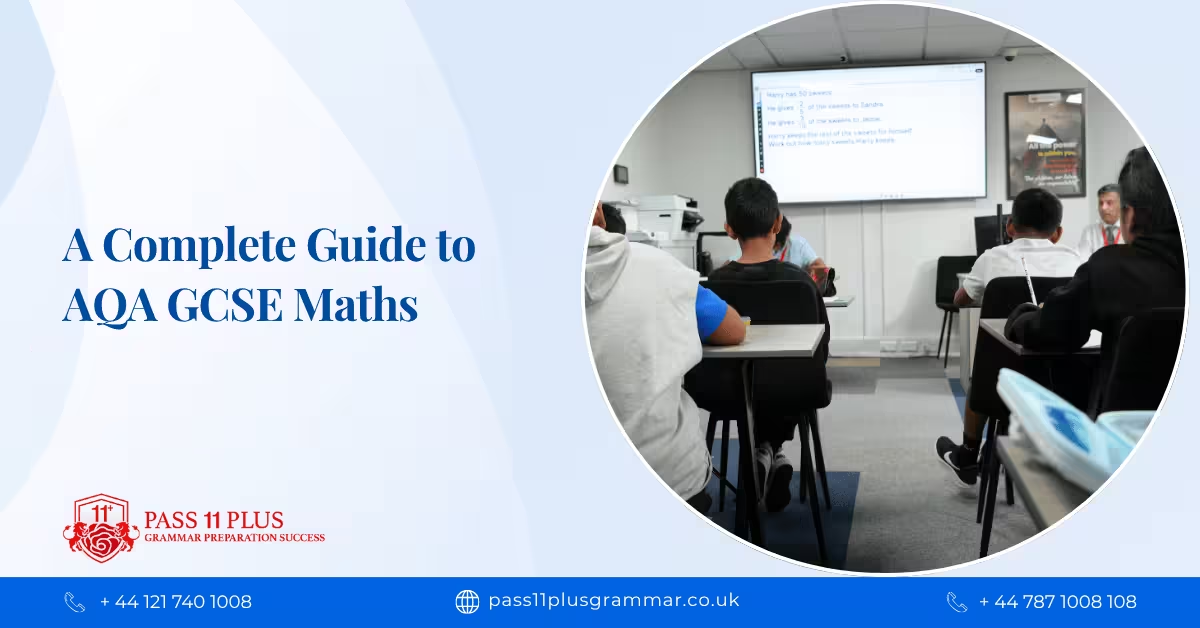
A Complete Guide to AQA GCSE Maths
Published on
AQA GCSE Maths is assessed across three exam papers: one non-calculator and two calculator, each worth 80 marks, 1 hour 30 minutes long, and contributing an equal third of the final grade. The AQA Maths GCSE syllabus covers six topic areas: number, algebra, ratio and proportion, geometry and measures, probability and statistics, and content from any area can appear on any paper. Foundation tier covers grades 1 to 5, while the Higher tier covers grades 3 to 9, with schools placing students based on Year 9 performance. A formula sheet is provided in every exam, confirmed through the 2025 to 2027 series, and grade boundaries are set fresh after each series rather than fixed in advance.
Every exam board tests Maths a little differently, and knowing exactly what to expect removes a huge amount of unnecessary stress. Here is a complete, easy to follow guide to the AQA GCSE Maths, covering everything from paper structure to what to pack on exam day.
AQA GCSE Maths specification
Every exam board tests GCSE Maths slightly differently, which is exactly why understanding your specific board's format matters far more than generic revision advice. AQA is one of the largest exam boards for GCSE Maths in England, and its specification follows a clear, consistent structure across both tiers.
Before diving into the detail, it helps to know the shape of the whole thing. Three papers, six topic areas, two tiers, and a marking system that rewards clear working just as much as correct final answers. Once this structure is familiar, revision becomes far more targeted.
AQA Maths GCSE exam format
There are three papers, sat on separate days, usually spread across the exam period in May and June. Every topic on the specification can appear on any of the three, and many questions deliberately combine topics.
Paper | Details |
Paper 1 | Non-calculator. Written exam, 1 hour 30 minutes, 80 marks, worth a third of the grade. |
Paper 2 | Calculator allowed. Written exam, 1 hour 30 minutes, 80 marks, worth a third of the grade. |
Paper 3 | Calculator allowed. Written exam, 1 hour 30 minutes, 80 marks, worth a third of the grade. |
That gives 240 marks in total and four and a half hours of examination. Students with 25 per cent extra time get 1 hour 53 minutes per paper.
What the paper physically looks like
An instructions page where students fill in their details and read the instructions and advice.
The question booklet, with space to write answers and show working underneath each question.
Additional pages at the back for extra working. If your child uses these, they must write the question number in the left hand margin, or the examiner may not connect the working to the question.
Foundation or Higher tier in AQA GCSE Maths
The format of both tiers is identical: three papers, 80 marks each, 90 minutes each. What differs is the difficulty of the questions and the grades available.
Foundation tier
Covers the essential core content
Questions are more accessible throughout
Grade 5 is the highest available
Boundaries sit much higher in percentage terms
Better route for a secure grade 4 or 5
Higher tier
Adds harder algebra, geometry and functions
Required for grade 6 and above
A grade 3 is available if a student narrowly misses a 4
Boundaries sit much lower in percentage terms
Needed for A-Level Maths
Schools normally decide the tier based on performance in Year 9, and students can be moved up or down during Year 10 or Year 11. All three papers must be sat at the same tier. A student cannot do Higher for one paper and Foundation for another.
In practice, the students who suffer most are capable ones placed on Higher who spend the last third of each paper unable to start a question. Confidence drains, and marks they could have picked up earlier go with it. Tier choice is a conversation worth having in Year 10, not in April of Year 11, and it is one of the first things we look at in our GCSE Maths tuition.
What each AQA GCSE Maths exam paper actually looks like
Every paper follows the same basic layout, an instructions page for personal details and guidance, a question booklet where answers and working are written, and additional pages for extra working space if needed.
Question difficulty increases steadily through each paper. Early questions are short and worth just one or two marks, often simple recall or single step arithmetic, such as converting a fraction to a decimal or calculating a straightforward percentage. These are designed to build confidence early on.
Mark range | What the question typically involves |
1 mark | Simple recall, single step arithmetic, quick fact questions |
2 to 5 marks | A few more steps, some intermediate working, method marks available |
6 to 8+ marks | Multi step reasoning combining several topics, often asking students to show, explain, prove or justify |
For the higher mark questions especially, showing full working is essential. Writing the question number clearly in the margin also matters, since additional working pages are only credited correctly when properly labelled.
The topics covered in the AQA Maths GCSE syllabus
The full AQA GCSE Maths syllabus is organised into six broad topic areas, each covering a wide range of specific skills and concepts.
Number: Units of measure, fractions, prime numbers, standard form and estimation.
Algebra: Expanding and simplifying expressions, solving equations, plotting and interpreting graphs.
Ratio, proportion and rates of change: Compound units, scale diagrams, direct and inverse proportion.
Geometry and measures: Angle properties, coordinate axes, rotation, reflection, translation and enlargement.
Probability: The probability scale, tree diagrams, combined and mutually exclusive events.
Statistics: Interpreting and constructing charts and graphs, understanding correlation and population data.
Students taking Further Maths alongside the core GCSE will also meet additional topics such as functions, coordinate geometry, calculus and matrix transformations, though these sit outside the standard GCSE Maths specification itself.
What examiners are really looking for
Examiners marking AQA GCSE Maths papers are not simply checking whether a final answer is correct. Every question is designed to test one or more of three assessment objectives, which together reveal how well a student can genuinely apply maths, not just recall it.
AO1, applying standard techniques: This covers using mathematical skills and methods accurately, correct use of formulae, and clear working. Students are still rewarded for demonstrating the correct method even where a calculation slip occurs.
AO2, reasoning, interpreting and communicating: This is about explaining why something works, not just how to do it. Interpreting graphs, comparing results, and presenting logical, well-structured reasoning all sit here.
AO3, solving problems in context: This focuses on applying maths to real life or unfamiliar situations, choosing the right method, linking different topic areas, and making sensible, well-reasoned decisions along the way.
The clearest path to strong marks is approaching every question step by step, showing working clearly, and checking that answers genuinely make sense within the context of the question.
How AQA GCSE Maths grade boundaries work
Grade boundaries for AQA Maths are not fixed in advance. They are set after each exam series, based on how difficult that year's papers turned out to be and how the whole national cohort performed, so that a given grade represents a consistent standard year on year.
Recent boundaries give a useful general guide. In recent years on Higher tier, grade 9s have generally sat between roughly 214 and 219 marks out of 240, grade 8s between about 184 and 191, and grade 7s between around 157 and 164. A standard pass at grade 4 on Higher has typically landed in the low 60s. On Foundation tier, grade 5 has generally required around 186 to 188 marks, with grade 4 sitting somewhere between 150 and 160.
These figures shift a little each year, and the exact 2026 boundaries will not be known until results are published. Treat recent years as a helpful planning guide rather than a fixed target, and always check AQA's own published grade boundaries once results are released.
Is there a formula sheet for AQA Maths GCSE
Yes, a formula sheet is provided in every AQA GCSE Maths exam, and this has been confirmed to continue through the 2025, 2026 and 2027 series.
The sheet covers formulae for:
Perimeter, area and volume
The quadratic formula
Pythagoras' theorem and trigonometry
Coordinate geometry
What to bring to an AQA GCSE Maths exam
Feeling calm and ready on exam day starts with having the right equipment sorted well in advance, not scrambled together the morning of the exam.
1. Core equipment for every paper
A black pen, with spares, a pencil, ruler, rubber, sharpener, protractor and compass for geometry questions.
2. A scientific calculator for Papers 2 and 3
It must meet exam board regulations, be in good working order with fresh batteries, and be genuinely familiar to use before exam day itself.
3. Practical extras
A clear pencil case, an unlabelled bottle of water, a jumper in case the hall is cold, and glasses or any medication packed the night before.
4. Comfortable, practical clothing
If non-uniform is allowed, choosing something relaxed and comfortable helps keep focus fully on the paper rather than on feeling fidgety or distracted.
GCSE Maths Tuition
Master AQA GCSE Maths with confidence
Our GCSE Maths tutors know every paper, tier and topic in the AQA specification, inside and out.
How to revise for AQA GCSE Maths
Maths is the subject where students most often believe they simply cannot do it. Almost always, that belief traces back to one or two missing foundations from Year 8 or 9 rather than any lack of ability.
1. Fix the foundations before anything else
Fractions, negative numbers, percentages and rearranging formulae underpin an enormous share of the paper. A student shaky on these finds every later topic harder than it needs to be, and no amount of revising circle theorems fixes that.
This is why we begin with a diagnostic rather than a lesson plan. The topics a student says they find hard and the topics the assessment shows they find hard are rarely the same list.
2. Weight your time by the specification
Use the weightings table above. On Higher, algebra deserves roughly twice the time of geometry. On Foundation, Number and Ratio deserve half the total. Revising in book order gives equal time to unequal topics.
3. Practise non-calculator arithmetic deliberately
Paper 1 is a third of the grade and the paper students underprepare for most. Ten minutes of long multiplication, long division and fraction work several times a week costs almost nothing and protects a third of the marks.
4. Do unfamiliar problems, not just more exercises
Because AO2 and AO3 are 60 per cent of Higher tier, the skill that needs training is choosing a method for a problem you have not seen. Sitting with a hard question for five minutes before looking anything up is genuinely part of the revision, not a waste of time.
5. Keep a mistakes book
Every wrong question goes in one notebook, with the correct approach and why they slipped. Then go back to it two or three weeks later and attempt those same questions again. It is the most personalised revision resource a student will ever own, because it contains only the things they cannot yet do.
6. Practise the back half of the paper
Many students run out of steam by question 15 and never practise questions 16 to 25 at all. That is exactly where the grade 6 to 9 marks sit, and where most candidates give up. Start a revision session at the back of a past paper occasionally.
7. Start in Year 10
Not because anyone should be revising for two years, but because Year 11 disappears faster than expected. Keeping condensed notes as you go and never letting a topic pass half understood turns Year 11 into revision rather than emergency learning.
How Pass 11 Plus Grammar supports AQA GCSE Maths students
We have been preparing students for exams for over thirty years, from our centre in Edgbaston and online for families further afield. Maths is the subject we are asked about most, and the pattern is remarkably consistent.
1. We start with a diagnostic, not a lesson plan
Before teaching anything, we find the gaps. Usually they sit further back than anyone expects, in fractions, negatives, percentages or rearranging, and they are quietly costing marks in every topic built on top of them.
2. We teach to the actual specification
AQA 8300, weighted the way Ofqual weights it, with tier appropriate content. Not a generic maths curriculum with the exam board's name on the front.
3. Exam technique alongside content
Method marks, showing working, command words, timing and never leaving a blank. Students frequently discover they knew far more than their mock grade suggested and were losing marks on presentation.
4. Honest advice on tier
If a student is better served by a secure grade 5 on Foundation than a fragile 4 on Higher, we will say so. That conversation belongs in Year 10, not April of Year 11.
5. Regular progress reporting
Specific, in plain language, and well before a mock result tells you the same thing. If something is not working you will hear it from us first.
Our GCSE Maths tutors are subject specialists who know AQA's papers, mark schemes and recurring traps in detail. Families come to us through our wider GCSE tuition programmes, and if you are local, our GCSE tuition in Birmingham runs from our Edgbaston centre with online lessons available anywhere in the UK.
For further GCSE guides and revision advice, Pass GCSE is entirely dedicated to GCSE preparation.
Final Thoughts
Understanding the AQA GCSE Maths specification is a great first step, and knowing exactly where your child stands against it is the next one. That is where a genuine, honest assessment makes the real difference.
At Pass 11 Plus Grammar, our tutors have spent over 30 years preparing students specifically for AQA GCSE Maths, with a 97% success rate behind every paper we set. Our sessions are built entirely around the real specification, not a generic approximation of it.
Get started today and see what focused GCSE Maths tuition can really do for your child's grade.
Frequently Asked Questions
What is the AQA GCSE Maths specification?
The AQA GCSE Maths specification is the official syllabus set by AQA, covering six main topic areas, number, algebra, ratio and proportion, geometry and measures, probability and statistics. It is assessed across three exam papers, one non calculator and two calculator, each worth 80 marks and contributing an equal third of the final grade.
How many papers are there in AQA GCSE Maths?
There are three papers in AQA GCSE Maths, and each one is worth a third of the final grade. Paper 1 is non-calculator, Papers 2 and 3 both allow a calculator. Every paper lasts 1 hour 30 minutes and is worth 80 marks, giving a total of 240 marks. All three papers are sat at the same tier, either Foundation or Higher, and any topic from the specification can appear on any of the three papers.
What topics are on the AQA GCSE Maths syllabus?
The AQA GCSE Maths syllabus covers six topic areas: Number, Algebra, Ratio, proportion and rates of change, Geometry and measures, Probability, and Statistics. The weightings are set by Ofqual and differ by tier. On Foundation the split is roughly Number 25%, Algebra 20%, Ratio 25%, Geometry 15%, and Probability and Statistics 15%. On Higher it becomes Number 15%, Algebra 30%, Ratio 20%, Geometry 20%, and Probability and Statistics 15%.
What is the difference between Foundation and Higher tier in AQA GCSE Maths?
Foundation tier covers grades 1 to 5 and tests the core content. Higher tier covers grades 4 to 9 and adds harder material, particularly in algebra, geometry and functions. The format is identical: three papers, 80 marks each, 90 minutes each. Students must sit all three papers at the same tier. Schools usually decide the tier based on performance in Year 9, and a student can be moved between tiers during Year 10 or 11.
Can you resit AQA GCSE Maths?
Yes. There is a November resit series for GCSE Maths every year, and students can also resit the following summer alongside the main cohort. If a student does not achieve grade 4 and stays in education or training after 16, they are required to continue studying maths until they reach grade 4 or turn 18.

Mr Singh
Founder, Pass 11 Plus Grammar
Mr Singh is the founder of Pass 11 Plus Grammar, with over 30 years of teaching experience. Having overcome academic setbacks himself, he is passionate about ensuring no child struggles alone. His approach focuses on personalised support, strong foundations, and building confidence. He has helped students achieve outstanding results in 11+ and GCSE examinations
Loading related posts…