Loading page…
How to Revise for Maths GCSE: 7 Tips That Actually Work
Published on
Revising for Maths GCSE does not have to feel overwhelming. The key is to focus on the right techniques rather than spending hours on ineffective study. Maths is a subject where practice, consistency, and understanding matter more than anything else. If you build strong habits early, you can improve steadily and feel more confident going into your exams.
This guide breaks down 7 practical tips that will help you revise smarter, strengthen your understanding, and perform better in your Maths GCSE.
7 Best Ways to Revise for GCSE Maths
1. Use Active Recall Instead of Passive Reading
One of the biggest mistakes students make is simply reading notes or watching videos. This feels productive, but it does not train your brain for exams.
Active recall forces you to retrieve information from memory, which strengthens learning.
Try this:
Create flashcards for formulas and key rules
Use the blurting technique by writing everything you remember about a topic
Teach a concept to a friend or family member
This method is especially useful if you are figuring out how to revise for maths GCSE more effectively.
2. Practise Past Papers Consistently
Past papers are one of the most powerful revision tools. They help you understand exactly how questions are asked in exams.
Benefits include:
Familiarity with exam format
Improved time management
Identification of weak areas
Increased confidence
If you want structured support with exam-style practice, our GCSE maths revision courses provide guided past-paper training with expert feedback.
3. Use Spaced Repetition to Remember More
Spaced repetition means revisiting topics over time rather than cramming everything at once.
For example:
Review a topic the next day
Revisit it after a week
Test yourself again after a month
This technique helps move information into long-term memory, which is essential for maths exams.
4. Create a Realistic Revision Timetable
A clear plan removes stress and ensures you cover all topics before the exam.
Your timetable should:
Prioritise weaker topics
Break revision into manageable sessions
Include regular breaks
Stay flexible
If you prefer guided learning instead of planning everything yourself, our GCSE revision courses offer a structured approach that keeps students on track.
5. Master Your Calculator Skills
Many students underestimate how important calculator skills are. Knowing how to use your calculator properly can save time and prevent errors.
Make sure you practise:
Trigonometric functions like sin, cos, and tan
Standard form calculations
Fractions and powers
Prime factorisation
This is particularly important when learning to revise for GCSE maths, where efficiency matters.
6. Practise Daily in Short Sessions
Cramming rarely works for maths. Instead, aim for short, consistent revision sessions.
A good routine could be:
20 to 30 minutes of daily practice
Mixed topic questions
Quick review of previous topics
Daily practice helps build confidence and keeps concepts fresh in your mind.
7. Focus on Understanding, Not Just Memorising
Memorising formulas is helpful, but it is not enough. You need to understand how and why methods work.
To improve understanding:
Work through examples step by step
Break complex topics into smaller parts
Analyse your mistakes carefully
If you need personalised support, our GCSE tutors help students strengthen their understanding and improve faster.
How to Revise for GCSE Maths Higher
If you are aiming for higher-tier papers, your revision needs to go beyond the basics. Focus on multi-step problem solving, algebra, and unfamiliar question types. For structured support, our GCSE maths revision courses help students tackle higher-level topics with expert guidance and targeted practice.
Practise harder exam questions regularly
Focus on topics like quadratic equations and trigonometry
Work under timed conditions
Review mark schemes to understand how answers are graded
Higher-tier success comes from strong problem-solving skills, not just memorising methods.
⚠ Limited Spaces Available
Is Your Child Struggling to Get the Maths Grade They Need?
Our GCSE Maths revision courses in Birmingham cover everything from algebra to geometry, taught by expert tutors who know exactly what examiners are looking for. Small groups, focused teaching, real results.
Starting From
£125
per day
Final Thoughts
If you are still wondering how to revise for GCSE maths, the answer is simple: practise regularly, focus on understanding, and use effective revision techniques.
With consistency and the right support, achieving a strong Maths GCSE grade is completely within reach. At Pass 11 Plus Grammar, we support students with structured learning, expert guidance, and targeted practice to help them build confidence and achieve their best results.
Frequently Asked Questions
What should I revise for Maths GCSE?
Focus on key topics such as algebra, number, ratio, geometry, and statistics. Make sure you understand core concepts, practise problem-solving, and regularly attempt past papers to cover the full syllabus.
Can I revise for Maths GCSE in 3 months?
Yes, 3 months is enough if you revise consistently. Focus on your weak areas, practise daily, and use past papers regularly. A structured plan can lead to significant improvement in this time.
How to effectively revise GCSE Maths?
Revise actively by practising questions, not just reading notes. Use past papers, review mistakes, and revisit topics regularly. Short, consistent study sessions are more effective than last-minute cramming.
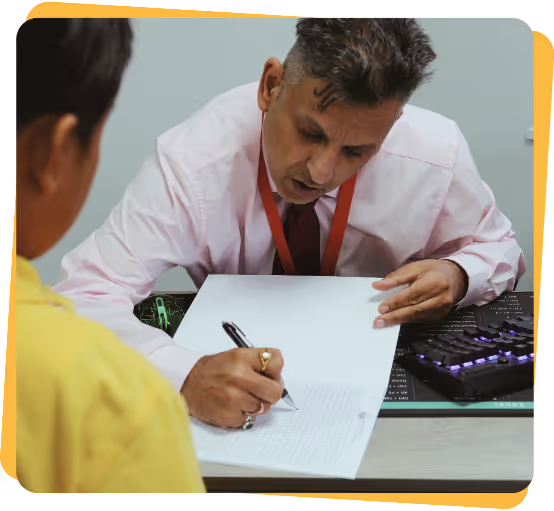
Mr Singh
Founder, Pass My GCSE
Mr Singh is the founder of Pass My GCSE, with over 30 years of teaching experience. Having overcome academic setbacks himself, he is passionate about ensuring no child struggles alone. His approach focuses on personalised support, strong foundations, and building confidence. He has helped students achieve outstanding results in 11+ and GCSE examinations
Loading related posts…