Loading page…
Are Year 11 Mocks Harder Than GCSE? The Honest Answer
Published on
Picture this. You walk into your Year 11 mock exam feeling ready. You open the paper. Your stomach drops. Some questions look strange, others feel really tough, and you start wondering, "Why is this so much harder than I thought it would be?"
If that sounds like you, you are not alone. Almost every Year 11 student has asked the same question at some point: Are mocks harder than the real GCSEs?
The short answer might surprise you. Let us break it down in the simplest way possible so you know exactly what to expect, and how to come out on top.
What are GCSE mocks?
A quick refresher before we answer the big question
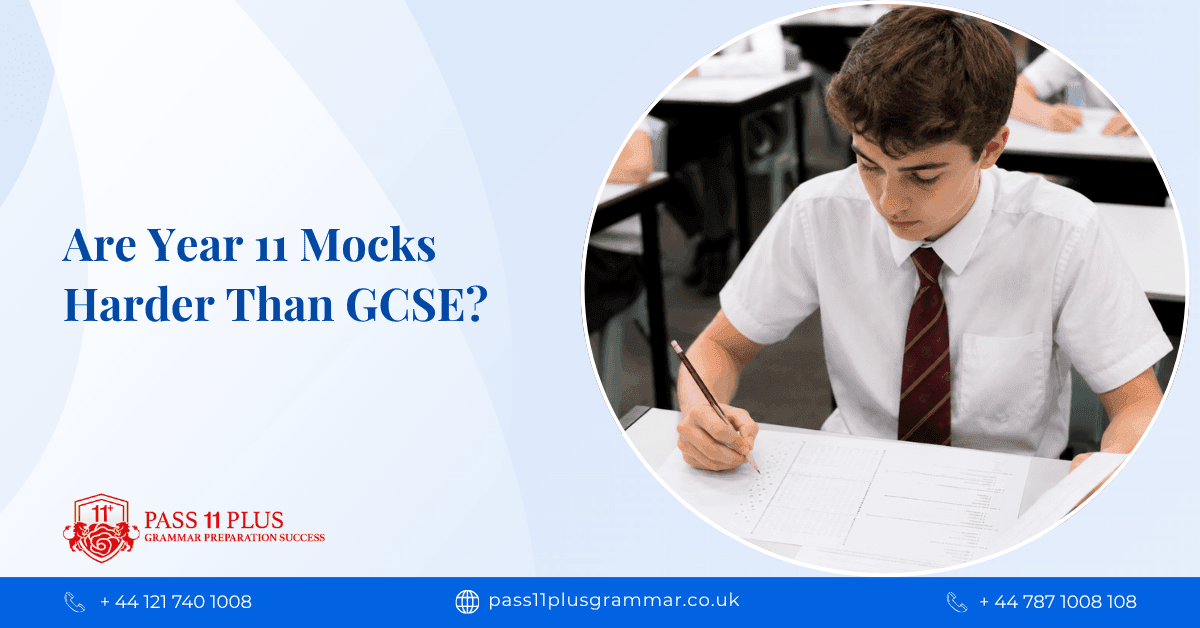
GCSE mocks are practice exams that your school runs before the real GCSEs in May and June. Most students sit them between November and February of Year 11, although many schools also run a smaller set at the end of Year 10.
They are taken in proper exam conditions. Silent halls. Timed papers. Strict teachers walking up and down. The idea is to give you a real taste of exam day before the big one arrives.
Are Year 11 mocks really harder than GCSEs?
Here is the honest truth. Mocks are not officially harder than the real GCSEs. The papers themselves are usually past GCSE papers, written by the same exam boards (AQA, Edexcel, OCR, WJEC and Eduqas).
But almost every Year 11 student will swear blind that mocks felt harder. So if the paper is the same, why does it feel so much tougher?
The answer is not about the paper. It is about you, the timing, and the marking. Let us look at the four real reasons mocks feel like a punch in the face.
Reason One: You Have Not Finished Learning Yet
Half the syllabus is still missing from your brain. When you sit your mocks, you are still in the middle of learning the syllabus. There are usually whole topics your class has not covered yet, so when you spot them in the paper, they feel impossible.
By the time May and June roll around, you will have learned everything. Those same scary questions will feel much easier, because you will actually know the answers.
Reason Two: Tougher Grade Boundaries
Teachers mark mocks harder on purpose. This is the secret that no one tells you. Real GCSE grade boundaries are set after thousands of students have sat the paper. The exam board looks at how everyone did and decides what counts as a 9, 8, 7 and so on. The boundaries are usually pretty fair.
But teachers often set higher grade boundaries for mocks. They do this on purpose to push you to work harder. So you might get the exact same marks in your mock and your final GCSE, but score a grade 5 in the mock and a grade 7 in the real exam.
Reason Three: Less Revision Time
You have done far less prep than you will by May. By the time the real exam day arrives, you will have spent months revising, doing past papers, learning exam tricks, and getting feedback. During your mocks, you have done much less of that.
That extra revision time between January and May makes a huge difference. Students often jump a full grade or even two between their mocks and their real GCSE results.
Reason Four: The Pressure Feels Brand New
First-time nerves make everything harder. For most students, mocks are the first taste of proper exam conditions. The silence. The watchful teachers. The ticking clock. Your heart pounds. Your brain freezes. It is no surprise that everything feels harder when your nerves are working overtime.
By the real GCSE, you will have done it once already. You will know what to expect. The fear shrinks every time you sit a paper.
Mocks vs real GCSEs at a glance: A side by side comparison
Year 11 Mocks | Real GCSEs |
Set by your school teachers | Set by the exam board |
Often use past GCSE papers | Include brand new questions |
Marked by your teachers | Marked by official examiners |
Usually have tougher grade boundaries | Use fairer national grade boundaries |
May include topics you have not fully learned yet | Cover the full syllabus you have studied |
Do not affect your final GCSE grade | Count toward your final grade and future opportunities |
Why are 11 plus mocks harder than GCSE?
Tough mocks are actually a gift
Some teachers really do pick the trickiest past papers or set strict boundaries. They are not trying to be mean. They want you to see your weak spots clearly before it is too late. A shocking mock result often makes students take revision seriously, which leads to far better final grades.
So if your mock felt brutal and your score made you want to cry, that is your school doing its job. Use it as a wake-up call, not a final verdict.
A low mock grade is not your future
If your mocks felt rough and your grades were lower than you hoped, do not panic. A lower mock grade does not lock in a lower GCSE grade. Many students go from grade 5s and 6s in mocks to grade 7s, 8s and even 9s in the real exam.
Your mock is a map, not a sentence. It shows you where you are, what is missing, and what to work on. The students who use that map well are the ones who win on results day.
How To Use Your Mock Results
Turn a scary score into a top grade
Look at every question you got wrong and find out why.
Make a list of weak topics for each subject.
Spend your revision time on the weak topics, not the easy ones.
Practice past papers in timed conditions every weekend.
Ask your teacher or tutor to explain anything that still feels confusing.
Sleep well, eat well, and stay calm. Burnout helps no one.
A Note for Younger Students & Parents
Exam confidence starts long before Year 11 - Mock exams are not just a Year 11 thing. Students sitting the 11 plus also face mock exams, and the lessons are exactly the same: practice under proper conditions, learn from your mistakes, and build exam confidence step by step.
If your child is preparing for the 11 plus, our 11 plus tuition programme helps them get used to exam-style questions right from the start. Our expert 11 plus tutor team guides them through every topic with patience and clear explanations. We also offer 11+ free practice papers so you can start at home for nothing, and for serious preparation, our 11 plus intensive summer course and 11 plus mock exams make sure students walk into the real test feeling fully ready.
The earlier students get used to mocks, the less scary they feel later on. By the time GCSE mocks arrive in Year 11, those students often breeze through because they have been doing it for years.
Do mocks affect my final GCSE grade?
No. Your mock results do not count towards your final GCSE grade in normal circumstances. They only matter in emergencies, for example if you cannot sit the real exam due to illness or another serious reason. They also help shape your predicted grades for college and sixth form applications.
Frequently Asked Questions
Why are mock grade boundaries higher than real GCSEs?
Teachers set tougher boundaries to push students to revise harder. Real GCSE boundaries are set by the exam board after looking at how thousands of students performed, which usually makes them more generous.
I failed my mocks. Should I be worried?
Not at all. A failed mock is a warning sign, not a final result. You still have months to improve. Use the mock to spot your weak topics, build a clear revision plan, and ask for help where you need it.
How much can I improve between mocks and real GCSEs?
Loads. Students often improve by one or two full grades between mocks and the real exam, sometimes more. With focused revision and proper exam practice, the jump can be huge.
Should I use past papers to prepare?
Yes, absolutely. Past papers are the single best revision tool. Sit them in timed conditions, mark them honestly, and look at every mistake. This is how top students train themselves for the real thing.

Mr Singh
Founder, Pass 11 Plus Grammar
Mr Singh is the founder of Pass 11 Plus Grammar, with over 30 years of teaching experience. Having overcome academic setbacks himself, he is passionate about ensuring no child struggles alone. His approach focuses on personalised support, strong foundations, and building confidence. He has helped students achieve outstanding results in 11+ and GCSE examinations
Loading related posts…