Loading page…
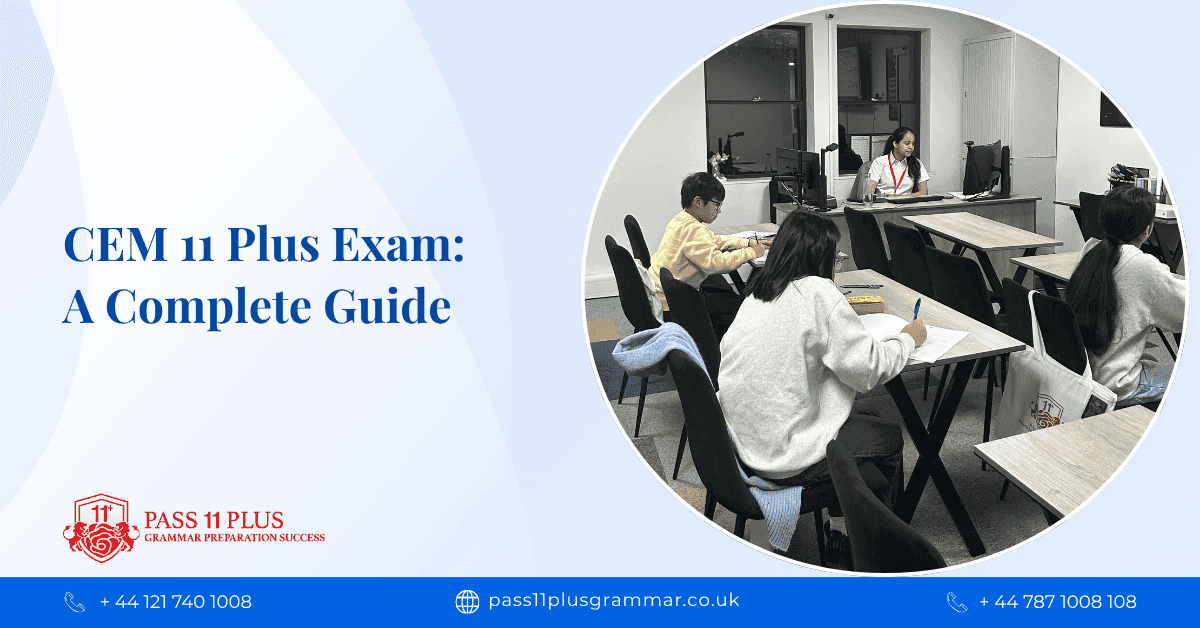
CEM 11 Plus Exam: A Complete Guide
Published on
Every parent wants the best for their child. And if grammar school is on your radar, you have almost certainly come across the term "CEM 11 plus" and wondered what it actually means for your child's preparation.
The good news? You are in the right place. With over 30 years of experience helping children across Birmingham and beyond pass their 11 plus, we know this exam inside out. This guide gives you everything you need to understand the CEM 11 plus, from what it is to how your child can walk into exam day feeling calm and fully prepared.
What is the CEM 11 plus exam?
CEM stands for the Centre for Evaluation and Monitoring, a part of Cambridge Assessment. For years, it was one of the two major providers of grammar school entrance tests in England, alongside GL Assessment.
Here is something important to know. In late 2022, CEM moved away from providing standard paper-based 11 plus exams. GL Assessment has since become the primary provider for most grammar schools. So if your child is sitting an 11 plus this year, there is a strong chance it will be a GL paper.
That said, CEM-style assessments are still used by some schools and regions, and the reasoning skills they test overlap significantly with GL.
What does the CEM 11 plus exam format cover?
This is where the 11+ CEM exam stands apart. Unlike GL, CEM does not publish a fixed syllabus or official practice papers. That is a deliberate choice. The exam is designed to test a child's natural reasoning ability rather than their ability to memorise a set format.
In practice, this means the structure can vary between schools and even year to year. But based on real feedback from families who have sat the exam, here is what children are typically tested on:
Verbal Reasoning - logical thinking through language, vocabulary and word patterns.
Non-Verbal Reasoning - analysing shapes, patterns and sequences without words.
English - comprehension, spelling, word recognition and decoding.
Maths - mental arithmetic, general problem-solving and numerical reasoning.
In terms of structure, papers often mix subjects. One paper might combine English and verbal reasoning. Another might pair maths with non-verbal reasoning. Some schools use four separate papers; others focus on just two disciplines. Both multiple-choice and written answers have appeared. Timings per section are tight, so children need to think quickly and manage their time well.
That unpredictability is exactly why broad, consistent preparation for the CEM 11+ exam matters so much.
CEM vs GL: The key difference
The biggest practical difference? GL publishes official past papers and follows a predictable, subject-separated format. CEM does not publish past papers, mixes subjects across papers, and is known for tighter time pressure. Both test similar skills, but the experience of sitting each exam feels quite different.
We have put together a full breakdown in our CEM vs GL guide if you want to go deeper on this.
How is the CEM 11 plus scored?
All marks from each paper are combined into a total score. Subjects may be weighted differently depending on the school. The final result is age-standardised, which levels the playing field for children born later in the academic year.
There is no universal pass mark. Each grammar school sets its own threshold based on available places and how competitive that year's applicants are. As a general target, a Standardised Age Score (SAS) of 120 or above puts children in a strong position for most grammar schools.
How to prepare for the CEM 11 plus test
Here is the truth that every parent needs to hear. The fact that CEM does not publish official practice papers does not mean that preparation cannot make a real difference. It absolutely can. It just needs to be broader and smarter than simply drilling past papers.
Here is how we approach it with our students at Pass 11 Plus Grammar.
Start earlier than you think
The ideal time to begin is the summer term of Year 4 or early Year 5. If your child is still in Year 3, brilliant. Our 11 plus year 3 programme introduces verbal and non-verbal reasoning early, giving children a genuine head start before the pressure of Year 5 kicks in.
Already in year 4 or year 5? There is still plenty of time. Our structured lessons in English, Maths, verbal and non-verbal reasoning are designed to meet children exactly where they are and build from there.
Build core knowledge before timed practice
One of the most common mistakes we see is jumping straight into timed practice papers. If the underlying knowledge is shaky, timed tests simply reinforce the gaps rather than close them. We always build strong curriculum foundations first, then layer in exam technique and timed conditions gradually.
Work on time management
The CEM 11+ exam's mixed papers and tight section timings mean children who have not practised pacing themselves can drop marks even on questions they know the answers to. Regular timed practice and 11 plus mock exams are essential in the final stretch of preparation.
Keep the experience positive
This matters just as much as any revision strategy. A child who feels confident and supported on exam day will always outperform one who has crammed but is running on anxiety. At Pass 11 Plus Grammar, we work hard to build genuine confidence alongside academic skill, because both matter on the day.
Ready to take the next step?
Every child's path to grammar school looks a little different. What stays the same is this: the right support, started at the right time, makes a real difference.
Our experienced tutors at Pass 11 Plus Grammar have spent over 30 years helping children secure places at Birmingham's leading grammar schools. We offer both in-person tuition from our Edgbaston centre and online 11 plus tuition for families further afield.
Get in touch with us today and let's build a preparation plan that gives your child the very best chance of success.
You may also like:
Frequently Asked Questions
How long is the CEM 11+ exam?
The CEM 11+ exam typically comprises two papers, each around 45 minutes long, making the total exam time approximately 90 minutes, though this can vary depending on the school.
How many questions are in the CEM 11+ exam?
There is no fixed number of questions, but papers often include multiple short sections with dozens of questions, typically adding up to around 150-200+ questions overall depending on the format.
What is the maximum mark for the 11+ CEM exam?
The maximum standardised score typically ranges up to around 140-142 per paper, with scores adjusted for age. The average is set at 100, and most results fall between 70 and 140+.

Mr Singh
Founder, Pass My GCSE
Mr Singh is the founder of Pass My GCSE, with over 30 years of teaching experience. Having overcome academic setbacks himself, he is passionate about ensuring no child struggles alone. His approach focuses on personalised support, strong foundations, and building confidence. He has helped students achieve outstanding results in 11+ and GCSE examinations
Loading related posts…