Loading page…
11 Plus Creative Writing Topics with Prompts
Published on
Creative writing can feel like the most unpredictable part of the 11 Plus. Maths has formulas, reasoning has patterns, but creative writing depends on imagination, structure, and expression. Many parents search for 11 plus creative writing topics because they are unsure what their child might face in the exam.
The good news is that creative writing follows clear patterns. Once children understand common themes and practise regularly, they feel far more confident.
In this guide, we will explore useful topics for creative writing for 11 plus, along with prompts and tips to help your child practise effectively.
Common 11 Plus Creative Writing Topics with Examples
1. Adventure-Based Topics
Adventure themes are very common in creative writing. These questions test imagination, pacing, and description.
Example Prompts
Write a story about a mysterious door that appears in your garden.
Describe a time when your character gets lost in an unfamiliar place.
Write about a journey that takes an unexpected turn.
Your character finds a map hidden inside an old book. What happens next?
A school trip goes wrong. Tell the story from your character’s point of view.
You wake up and realise you are the only person left in your town.
We encourage students to practise building tension slowly rather than rushing into action. In our structured sessions, we guide children on how to plan before writing so their stories stay organised and engaging.
2. Descriptive Writing Topics
Some exams focus more on description than storytelling. These topics for creative writing for 11 plus require strong vocabulary and imagery.
Example Prompts
Describe a storm arriving in your town.
Write about an abandoned house at night.
Describe a busy marketplace from your character’s perspective.
Describe a winter morning when everything seems silent.
Write about a beach just before sunset.
Describe a place that makes your character feel nervous.
Descriptive writing improves gradually over time. That is why we begin strengthening these skills early through our 11 plus preparation year 3 programme, where we focus on vocabulary building and sentence variety.
3. Emotional and Character-Based Topics
Many creative writing topics for 11 plus explore feelings or personal growth.
Example Prompts
Write about a time your character felt proud.
Describe a friendship that changed unexpectedly.
Write a story about overcoming fear.
Tell a story about a secret your character is afraid to reveal.
Write about a moment when everything changed.
Describe how your character reacts after making a mistake.
Children often struggle because they jump straight into events without building character. During our 11 plus preparation year 4 sessions, we help students develop stronger character voices and emotional depth so their writing feels authentic.
4. Picture-Based Topics
Some grammar schools provide an image as a prompt. These creative writing topics for 11 plus test interpretation and imagination.
Typical Image Themes
A lonely lighthouse
A hidden pathway in the woods
A strange object found in a classroom
A small boat drifting in the middle of a quiet lake.
A cracked mirror reflecting something unusual.
A child standing outside a locked gate. What is happening?
Planning prevents rushed and unclear stories.
Common Mistakes to Avoid
Understanding what to avoid is just as important as practising topics.
Children often:
Forget to plan
Write without paragraphs
Use simple vocabulary repeatedly
End stories abruptly
In our 11 plus preparation year 5 programme, we focus on refining structure, strengthening endings, and improving vocabulary choice. By this stage, students are preparing more exam-aware pieces and learning how to adapt to different prompts confidently.
How to Practise Creative Writing Effectively
Searching for 11 plus creative writing topics is helpful, but practice must be structured.
Here is a simple weekly practice model:
Choose one prompt.
Spend five minutes planning.
Write for 25 minutes under timed conditions.
Review and edit for vocabulary and punctuation.
Get feedback.
Feedback is where real improvement happens. Children often repeat the same mistakes if no one explains how to refine their work.
That is why guided support makes a difference. We work closely with students to improve clarity, structure, and creative expression rather than just encouraging more writing.
What Makes a High-Scoring Creative Writing Piece?
High-scoring responses usually include:
Clear structure
Interesting vocabulary used naturally
Varied sentence lengths
Strong opening and satisfying ending
Accurate spelling and punctuation
Children do not need complicated words. They need confidence, planning, and clear expression.
When students understand the marking criteria, creative writing becomes far less intimidating.
Final Thoughts
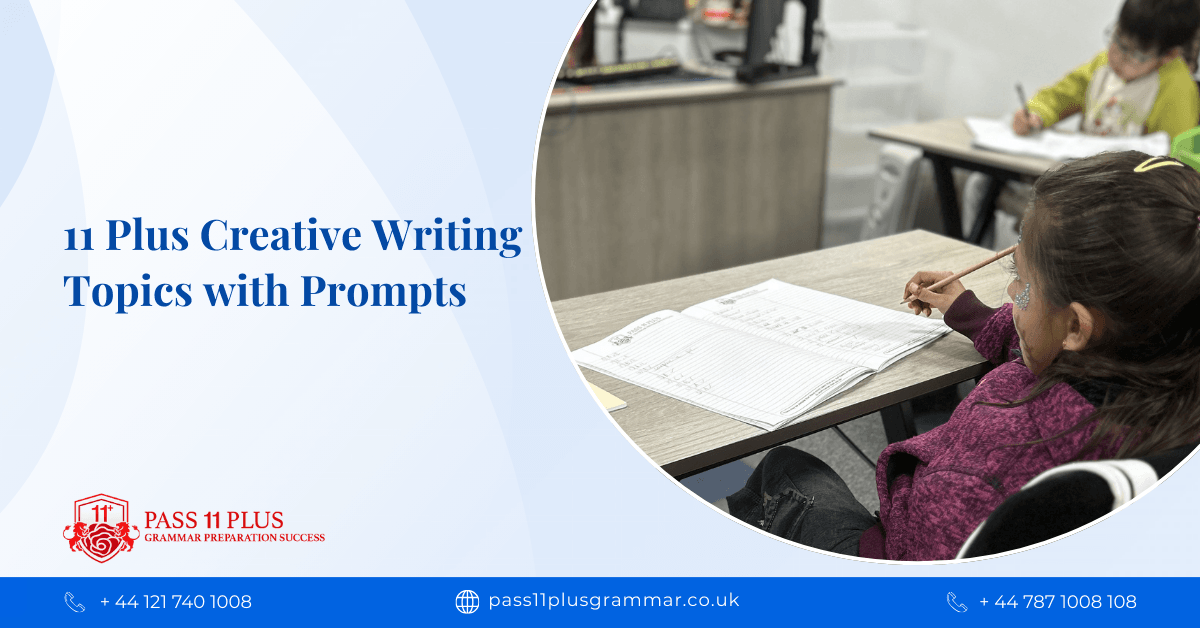
Creative writing can feel confusing at first. Many children just sit there, looking at the page, unsure how to begin. They might have ideas in their head, but putting them into words feels harder than it sounds. That is completely normal.
The shift usually happens when they learn how to plan properly. Once they know how to structure a beginning, build the middle, and close the story confidently, everything feels more manageable. It stops being guesswork and starts becoming a skill they can practise and improve.
That is exactly what we focus on. At Pass 11 Plus Grammar, our tutors do not just ask students to write more stories. We show them how to think before they write. Over time, the blank page feels less intimidating. And that quiet confidence is what really prepares them for the exam.
If you would like to see how we can support your child’s writing step by step, contact us and let’s talk about the next steps together.
Frequently Asked Questions
What are some good creative writing topics?
Good creative writing topics usually involve adventure, mystery, friendship, or an unexpected event.
What to include in 11+ creative writing?
In 11+ creative writing, children should include a clear beginning, middle, and ending, strong vocabulary, descriptive detail, and accurate punctuation.
How long should 11+ creative writing be?
Most 11+ creative writing tasks are about one page long, written in 30 to 45 minutes. It is more important to write clearly and tell a good story than to write a lot.

Mr Singh
Founder, Pass My GCSE
Mr Singh is the founder of Pass My GCSE, with over 30 years of teaching experience. Having overcome academic setbacks himself, he is passionate about ensuring no child struggles alone. His approach focuses on personalised support, strong foundations, and building confidence. He has helped students achieve outstanding results in 11+ and GCSE examinations
Loading related posts…