Loading page…
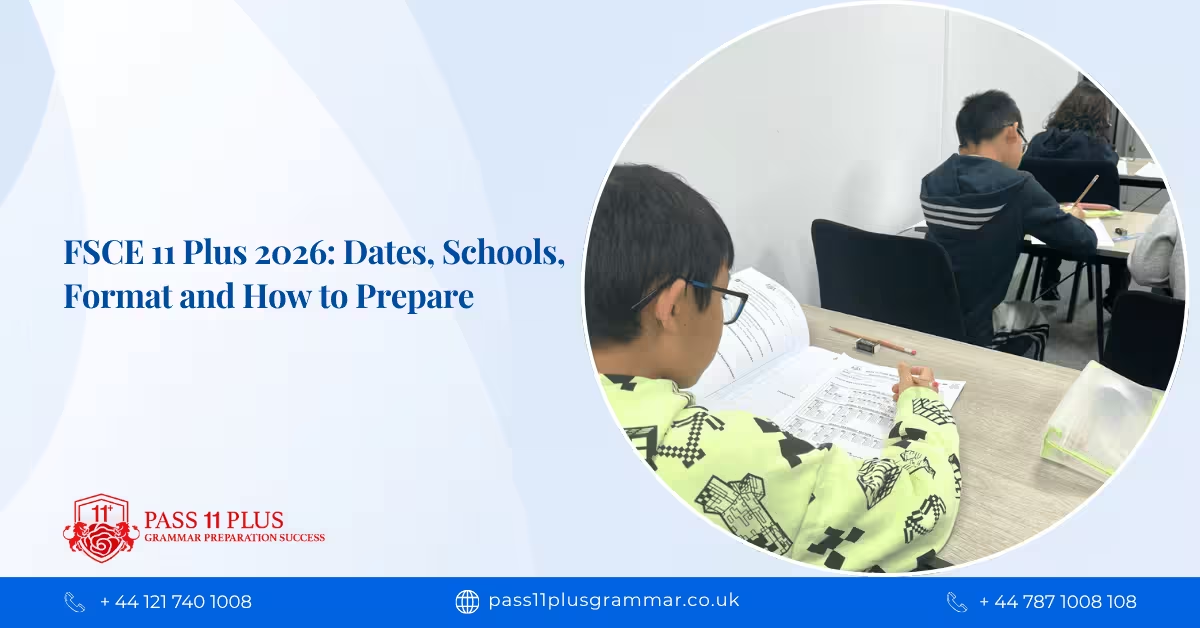
FSCE 11 Plus 2026: Dates, Schools, Format and How to Prepare
Published on
The FSCE 11 plus (Future Stories Community Enterprise) is a grammar school entrance exam created in 2022. It is taken on paper and tests English, maths and creative writing, based on the Year 5 Key Stage 2 curriculum. Most schools use two or three papers: a multiple-choice paper, a free response paper and sometimes a creative writing paper. Reading School uses a four-paper extended format. There is no fixed pass mark, each school sets its own qualifying standard each year. Ten grammar schools across England used the FSCE for 2027 entry, including schools in Berkshire, Cumbria, Essex, Lancashire, North Yorkshire and West Yorkshire.
The FSCE 11 plus is one of the fastest-growing grammar school entrance exams in England. If your child is aiming for a school that uses it, this guide covers everything, what the FSCE 11+ actually is, which schools use it, what each paper covers, how scoring works, what the pass mark means and how to prepare your child from Year 4 onwards.
Key facts
Created by: Future Stories Community Enterprise (FSCE), linked to Reading School
Year created: 2022
Exam format: Paper-based (not computer-based)
Core subjects: English, maths and creative writing
Curriculum basis: Key Stage 2 content up to end of Year 5
Papers: Typically 2 to 3 papers (Reading School uses 4)
Pass mark: No fixed mark - set by each school individually
Marking: Multiple-choice marked by OMR; scores are age-standardised
Creative writing: Only marked if eligible score is met on academic papers
Schools using FSCE: 10 schools for 2027 entry (growing year on year)
What is the FSCE 11 plus?
The FSCE 11 plus is a Year 7 entrance test created by Future Stories Community Enterprise, an organisation linked to Reading School in Berkshire. FSCE launched the exam in 2022 as an alternative to the traditional 11 plus formats used by GL Assessment and CEM.
The key difference is in the philosophy behind the test. The FSCE was designed to be a fairer and more accessible assessment by focusing on what children have already learned at school rather than on specialist skills like verbal reasoning and non-verbal reasoning that need to be separately taught. This means your child is tested on their genuine academic ability using the Key Stage 2 curriculum they have been studying throughout primary school, not on question types that most schools never teach.
The exam is taken on paper in a supervised setting. Instructions for each section are given via a pre-recorded voice recording, which tells your child the page number to turn to, the section name and number, how to answer the questions (with an example), how much time they have and when to start and stop. At least one invigilator is present throughout.
Why is the FSCE growing so quickly?
Grammar schools across England have been looking for entrance exams that feel fairer to children from all backgrounds. The FSCE's focus on curriculum knowledge, rather than specialist reasoning preparation, reduces the advantage held by children who have been intensively coached in verbal and non-verbal reasoning from an early age. This has made it increasingly popular with schools that want to identify genuinely able children rather than the best-prepared ones.
Which schools use the FSCE 11+?
Ten grammar schools used the FSCE 11 plus for 2027 entry. The number is growing year on year. Ermysted's Grammar School, Queen Elizabeth Grammar School Penrith and Clitheroe Royal Grammar School are among the most recent additions to the group.
Reading School - Berkshire (Uses the extended 4-paper FSCE format)
Queen Elizabeth Grammar School, Penrith - Cumbria (New for 2027 entry)
Chelmsford County High School for Girls - Essex (Standard FSCE format)
Ermysted's Grammar School - North Yorkshire (New for 2027 entry)
Heckmondwike Grammar School - West Yorkshire (Standard FSCE format)
Lancaster Girls' Grammar School - Lancashire (Standard FSCE format)
Skipton Girls' High School - North Yorkshire (Standard FSCE format)
North Halifax Grammar School - West Yorkshire (Standard FSCE format)
The Crossley Heath School - West Yorkshire (Standard FSCE format)
Clitheroe Royal Grammar School - Lancashire (New for 2027 entry)
Always check the school's own website. The FSCE group is growing and exam arrangements can change year on year. Before building your child's preparation plan, confirm which papers your target school uses and check their specific admissions timeline. Some schools combine FSCE papers with their own additional assessment components.
What is the FSCE 11 plus exam format?
Most schools using the FSCE 11+ use either two or three papers. The standard format is the same across all schools in the group, though Reading School uses a more extended four-paper version. Here is how each paper works.
Paper 1 - Multiple-Choice Paper
Used by all FSCE schools. Contains a mixture of English and maths questions. Your child selects the best answer - A, B, C or D, on a separate answer sheet. The answer sheet is marked electronically using Optical Mark Recognition (OMR). Only marks made in the correct boxes on the answer sheet are counted. Work done elsewhere in the question booklet is not seen by the marker.
English questions: comprehension, vocabulary, spelling (missing letters)
Maths questions: based on Year 5 Key Stage 2 curriculum
Separate multiple-choice answer sheet
Paper 2 - Free Response Paper
Also covers English and maths, but requires written answers rather than multiple-choice selections. Your child writes their answers in the spaces provided on the answer sheet. This paper tests the same subject knowledge as Paper 1 but in a format that allows your child to show their working and write fuller responses.
English and maths free-response questions
Answers written directly on the answer sheet
Work in the question booklet is not marked
Paper 3 - Creative Writing Paper (some schools only)
Not all FSCE schools include a creative writing paper. Where it is included, your child responds to a prompt with an extended piece of original writing. Planning time is built into the test before writing begins, your child is given space to plan their ideas in the question booklet, but this planning is not marked. Only the writing on the answer sheet is assessed.
Critically, the creative writing paper is only marked for children who have already achieved the eligible score on the academic papers (Papers 1 and 2). This means strong performance in the first two papers is essential.
Planning time provided (not marked)
Extended piece of original writing responding to a prompt
Only marked if eligible score met on Papers 1 and 2
How the recording works on exam day
Instructions are delivered via a pre-recorded voice. At the start of each section it tells your child the page number, the section name, an example of how to answer, the time available and when to start. Your child's name, primary school, date of birth and test date are pre-printed on the answer sheets. If anything is incorrect, your child raises their hand and an invigilator corrects it.
What subjects does the FSCE 11 plus test?
The core subjects tested in the FSCE 11+ are English, maths and creative writing. These are the same across all schools in the group. From September 2025, some schools' papers also draw on a wider range of KS2 subjects. Nothing tested goes beyond what children will have covered in primary school by the end of Year 5.
English
Reading comprehension (fiction and non-fiction passages)
Vocabulary (synonyms and word meaning)
Spelling (missing letters questions)
Grammar and punctuation (some schools)
Maths
Number and place value
All four operations
Fractions, decimals and percentages
Measurement, geometry and statistics
Multi-step word problems
Creative Writing
Respond to a written prompt
Planning time before writing begins
Marked for creativity, structure, vocabulary and accuracy
Only assessed if eligible score met on academic papers
Broader KS2 (some schools)
Art and design, computing, D&T
Geography and history
Languages, music, PE
Science
Up to end of Year 5 content only
English: What the questions look like
The English section of the FSCE draws on three main question types. Reading comprehension asks your child to read a passage, fiction or non-fiction, and answer questions that test understanding, inference and analysis. Vocabulary questions test word knowledge directly, for example asking your child to identify a synonym for a given word from four options. Spelling is assessed through missing letters questions, where your child sees a word with some letters removed and must identify the complete, correctly spelled word in context.
Strong reading habits are the most effective long-term preparation for all three English question types. A child who reads widely every day builds vocabulary, comprehension and spelling recognition naturally. Targeted practice with our free 11 plus practice papers then applies those skills in an exam-style format.
FSCE maths topics in full
The FSCE maths papers are based on the Year 5 Key Stage 2 curriculum. This is the full list of topics your child needs to be confident with. Nothing goes beyond what they will have been taught at school by the end of Year 5.
Topic area | What is covered |
Number and place value | Rounding numbers, negative numbers, Roman numerals up to 1,000 |
Calculations | Addition, subtraction, multiplication and division; factors; prime numbers; square numbers; cube numbers |
Fractions | Comparing and ordering fractions; adding and subtracting fractions; multiplying fractions |
Decimals | Rounding decimals; ordering decimals with up to 3 decimal places; multiplying and dividing by powers of 10 |
Percentages | Introduction to percentages; knowing percentage and decimal equivalents of fractions |
Measurement | Converting units of measurement; perimeter, area and volume of rectangles |
Geometry | Properties of 2D and 3D shapes; calculating angles; reflection and translation |
Statistics | Reading and interpreting tables; reading and interpreting line graphs |
Reading School's extended FSCE format
Reading School in Berkshire uses a more extended version of the FSCE with four named papers rather than the standard two or three. Each paper has a distinct name and purpose.
Reading School - four FSCE papers
Adventure Paper: Multiple-choice questions drawn from KS2 subjects including English, maths, science, geography and history
Beacon Paper: Short written response questions across a similar range of KS2 subjects, requires written answers rather than multiple choice
Compass Paper: A second multiple-choice paper with a different subject focus from the Adventure Paper
Discovery Paper: A creative task assessing original thinking, imagination and problem-solving, goes beyond standard creative writing
How is the FSCE 11 plus scored?
The FSCE 11 plus uses a two-stage marking process that is important for parents to understand.
In the first stage, the multiple-choice answer sheets are marked electronically using Optical Mark Recognition (OMR). This scanning technology reads the marks your child has made on their answer sheet and produces raw scores. These raw scores are then age-standardised, adjusted to account for the fact that children in the same year group can have birthdays up to 12 months apart. Standardisation makes the comparison fair regardless of when your child was born.
In the second stage, children who have achieved the school's eligible score on the academic papers (Papers 1 and 2) have their creative writing paper assessed by examiners. Children who did not meet the eligible threshold on the academic papers do not have their creative writing assessed at all.
What is the FSCE 11 plus pass mark?
There is no single fixed pass mark for the FSCE 11 plus. Each school in the group sets its own qualifying standard, called an eligible score each year, based on the number of selective places available and the results achieved by children who sat the test that year.
This means the qualifying score can vary slightly from year to year depending on how competitive the cohort is. A score that was sufficient one year may not be in the following year if more high-performing children apply.
The goal is not to chase a specific number but to perform as strongly as possible across both academic papers. The higher the standardised score, the better the position your child is in for any school applying its own eligible score threshold.
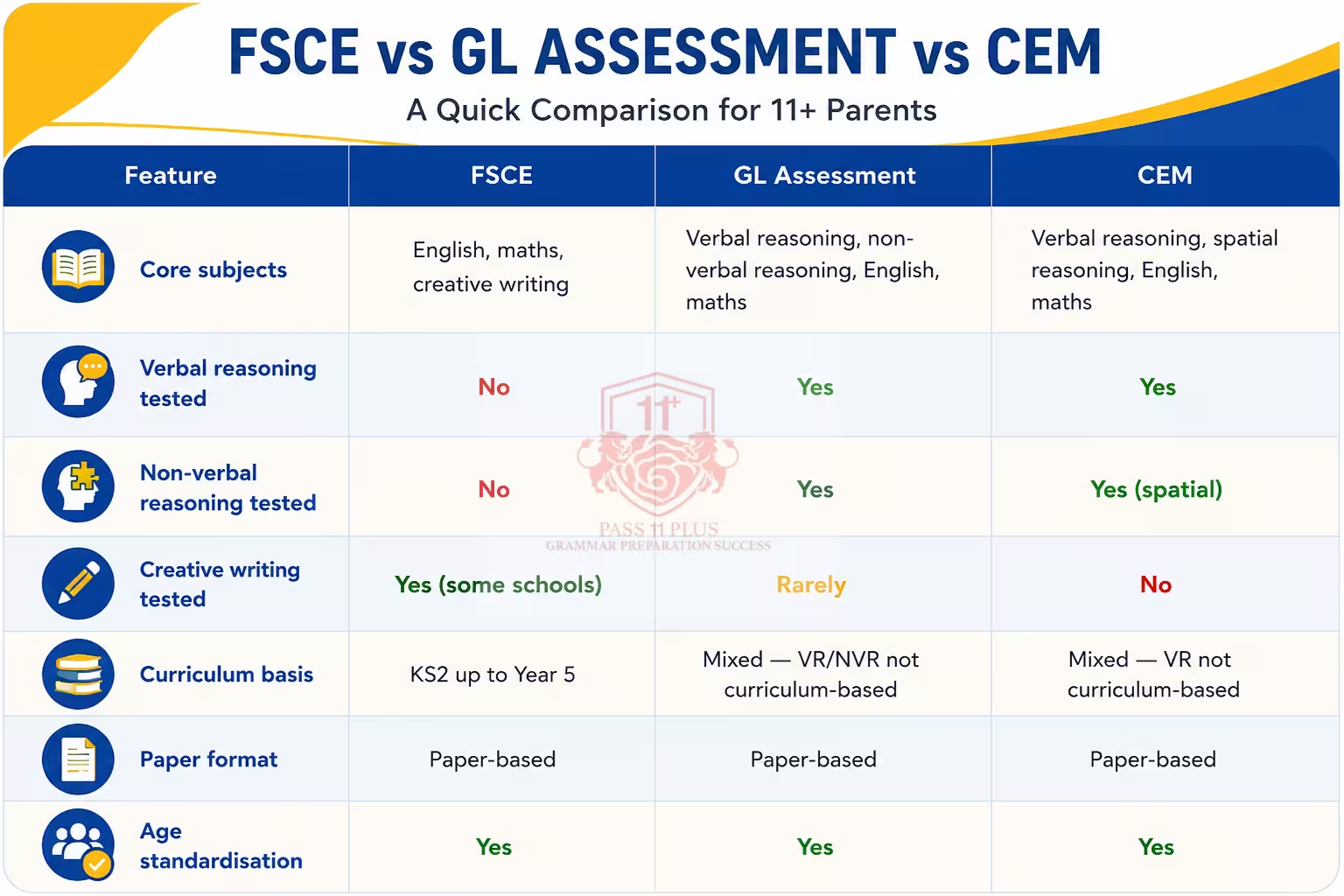
FSCE vs GL Assessment vs CEM - What is the difference?
If your child is applying to multiple grammar schools, some may use FSCE and others may use GL Assessment or CEM. Here is how the three formats compare.
Applying to FSCE and GL Assessment schools in the same year?
The preparation overlaps significantly in English and maths, since both test KS2 curriculum content. The main additional preparation needed for GL Assessment is verbal and non-verbal reasoning, which are not tested by FSCE. Our 11 plus tutors regularly help children prepare for multiple exam formats simultaneously and can build a plan that covers both efficiently.
How to prepare for the FSCE 11 plus
Because the FSCE tests curriculum knowledge rather than specialist reasoning skills, preparation looks different from traditional 11 plus preparation. The focus is on building deep, secure knowledge of the Year 5 KS2 curriculum in English and maths, alongside strong reading habits and regular creative writing practice.
1. Build confident, secure KS2 knowledge in English and maths
The FSCE tests what your child has already learned at school, which means the strongest preparation is simply knowing that content really well. Work through each of the maths topic areas in the table above and make sure your child is confident, not just vaguely familiar. In English, focus on reading comprehension, vocabulary and spelling since these are the three areas directly tested in the papers.
Use a little-and-often approach. Research consistently shows that 20 to 30 minute sessions are more effective for children this age than longer, infrequent ones. Short, focused practice every day builds the kind of deep, secure knowledge that holds up under exam conditions.
Start in Year 4 or early Year 5 - The maths topics in the FSCE are taught in school throughout Year 5. Starting preparation before Year 5 means your child can consolidate topics as they learn them in class rather than having to revise everything in a rush before the exam.
2. Read widely every day - it builds every part of English at once
Reading is the single most effective form of FSCE English preparation. A child who reads for 10 to 15 minutes every day across a variety of genres builds vocabulary, comprehension, inference skills and spelling awareness simultaneously, all tested directly in the FSCE English papers.
Mix fiction and non-fiction. Try different authors, different topics and different text types. The comprehension passage in the FSCE could be fiction or non-fiction, so exposure to both matters. When your child reads, talk about what they have read, what did the author mean by this phrase? Why do you think the character made that choice? These conversations build exactly the kind of inference and analysis skills that comprehension questions test.
3. Practise creative writing regularly with planning time built in
The FSCE creative writing paper rewards children who plan before they write, use precise and ambitious vocabulary, vary their sentence structures, show emotions through actions rather than just stating them, and use sensory language to bring their writing to life. These skills do not develop overnight. Regular practice from Year 4 or Year 5, even one short timed writing session per week, builds the confidence and instinct that shows up on exam day.
Always practise planning separately before writing. In the exam, planning time is given but the planning is not marked. Children who skip the planning stage almost always produce less structured, weaker writing. Make planning a non-negotiable habit.
Remember the two-stage marking rule - The creative writing paper is only assessed for children who met the eligible score on the academic papers. Focus on English and maths first. Creative writing is the finishing layer, not the foundation.
4. Practise under timed conditions using FSCE-format papers
Knowing the content is not the same as performing well under exam pressure. Children who have never sat a timed paper in an exam-style setting often find the time pressure on exam day much harder to manage than expected. Introduce timed practice from early in the preparation process so that working at pace becomes normal and comfortable before September.
Our free 11 plus practice papers include English and maths content directly relevant to the FSCE format. For a more intensive preparation experience closer to the exam, our 11 plus mock exams replicate real exam conditions with detailed feedback on every section, so you always know which areas to focus on next.
5. Use the summer wisely - the exam comes quickly in September
The FSCE 11 plus exam typically takes place in the first few weeks of September, which means the summer holidays are the final and most important preparation window of the year. This is not the time to take a complete break from preparation, but it is also not the time to burn your child out with six weeks of intensive cramming.
Our 11 plus intensive summer course gives your child focused, expert-led preparation across all core FSCE subjects during the summer break, covering English, maths and creative writing in structured daily sessions with regular timed practice built in. Children arrive at the exam feeling prepared and confident rather than anxious.
6. Get one-to-one support targeted to the FSCE format
Because the FSCE tests curriculum knowledge rather than reasoning skills, the preparation gaps are often different from traditional 11 plus preparation. One child might have a weak fractions foundation that is holding back their maths score. Another might have strong comprehension but poor spelling. A third might write imaginatively but without structure.
Our 11 plus tutors start with a full diagnostic assessment and build a preparation plan specifically around the FSCE subjects and your child's individual gaps. Every session is focused on what will make the biggest difference to their score, not generic revision that covers ground they already know well. Our 11 plus tuition programme includes all core FSCE subjects across English, maths and creative writing, designed around your target school and your child's current level.
Final thoughts
The FSCE 11 plus is one of the most interesting developments in grammar school admissions in England in recent years. By focusing on curriculum knowledge rather than specialist reasoning skills, it offers a genuinely different type of assessment, one that rewards children who have been well taught and who read widely, rather than those who have been most heavily coached in reasoning techniques.
Ten schools used FSCE for 2027 entry. More will join. If any of your target schools are in the group, now is exactly the right time to understand the format and build a preparation plan that works for your child.
Frequently Asked Questions
What is the FSCE 11 plus?
The FSCE 11 plus is a Year 7 grammar school entrance exam created by Future Stories Community Enterprise, linked to Reading School in Berkshire, in 2022. It is taken on paper and tests English, maths and creative writing, based on the Key Stage 2 curriculum up to the end of Year 5. It was designed as a fairer alternative to traditional 11 plus formats because it focuses on what children have already been taught at school rather than on specialist reasoning skills.
Which schools use the FSCE 11 plus?
For 2027 entry, ten grammar schools used the FSCE 11 plus: Reading School (Berkshire), Queen Elizabeth Grammar School Penrith (Cumbria), Chelmsford County High School for Girls (Essex), Ermysted's Grammar School (North Yorkshire), Heckmondwike Grammar School (West Yorkshire), Lancaster Girls' Grammar School (Lancashire), Skipton Girls' High School (North Yorkshire), North Halifax Grammar School (West Yorkshire), The Crossley Heath School (West Yorkshire) and Clitheroe Royal Grammar School (Lancashire).
What does the FSCE 11 plus exam include?
Most FSCE schools use two or three papers. Paper 1 is a multiple-choice paper covering English and maths. Paper 2 is a free response paper also covering English and maths. Some schools include Paper 3, a creative writing paper with planning time built in. Reading School uses an extended four-paper format with papers named Adventure, Beacon, Compass and Discovery. Instructions are delivered via a pre-recorded voice recording throughout the exam.
How is the FSCE 11 plus different from GL Assessment and CEM?
The FSCE tests English and maths from the KS2 curriculum rather than verbal reasoning and non-verbal reasoning. It also includes a creative writing paper, which most GL Assessment and CEM exams do not. The FSCE is designed to be more curriculum-based and accessible, reducing the advantage of specialist reasoning coaching. Children applying to both FSCE and GL Assessment schools need to add verbal and non-verbal reasoning to their preparation on top of the FSCE curriculum subjects.
When should my child start preparing for the FSCE 11 plus?
Start in Year 4 or early Year 5, at least 12 months before the September exam. The FSCE maths topics are taught in Year 5, so starting before Year 5 lets your child consolidate topics as they learn them in class. English and creative writing skills build slowly over time through daily reading, regular writing practice and consistent vocabulary building.

Mr Singh
Founder, Pass 11 Plus Grammar
Mr Singh is the founder of Pass 11 Plus Grammar, with over 30 years of teaching experience. Having overcome academic setbacks himself, he is passionate about ensuring no child struggles alone. His approach focuses on personalised support, strong foundations, and building confidence. He has helped students achieve outstanding results in 11+ and GCSE examinations
Loading related posts…