Loading page…
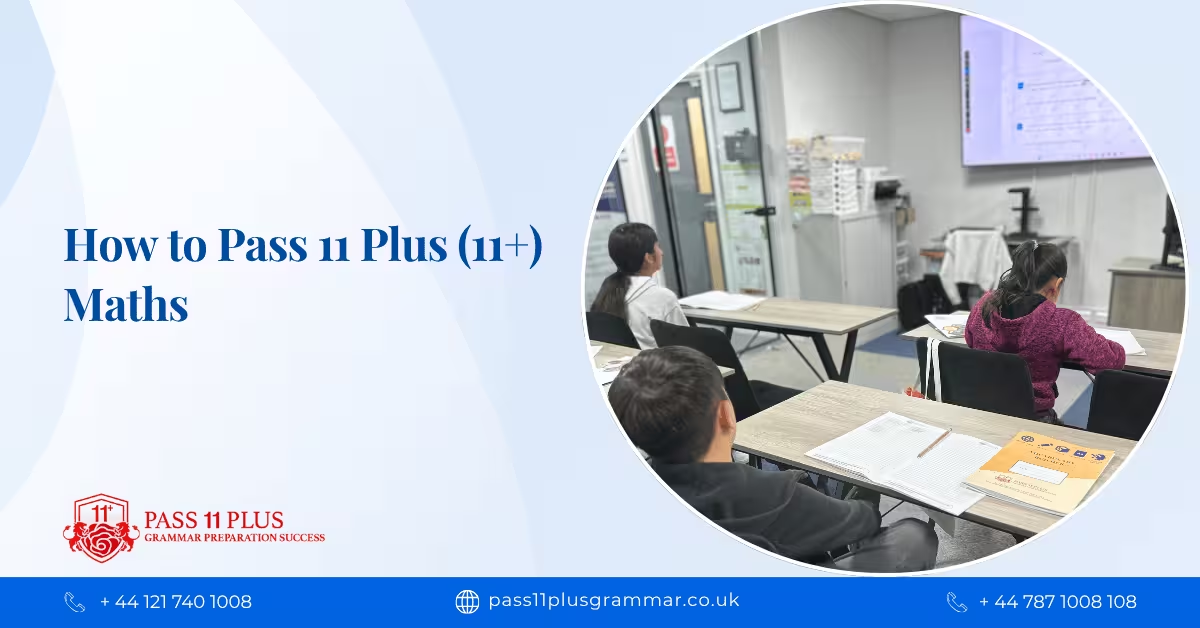
How to Pass 11 Plus (11+) Maths
Published on
To pass 11 plus Maths, build strong mental arithmetic and times tables, learn the method behind every topic rather than memorising individual answers, practise word problems regularly, and use good exam technique, clear working, reading questions carefully, using correct units, and checking answers before moving on.
11 plus Maths trips up a lot of children, not because the topics themselves are impossibly hard, but because the exam tests something slightly different to ordinary school maths: speed, accuracy, and the ability to spot which method a tricky question actually needs.
Here's a clear breakdown of exactly what the exam covers, where students most often lose marks, and how to prepare properly.
At Pass 11 Plus Grammar, we've guided thousands of families through exactly this process, with over 30 years of experience. Here's what genuinely makes the difference.
The core skills every 11 plus Maths topic depends on
Before diving into individual topics, it's worth being honest about what really underpins strong 11 plus Maths performance: mental arithmetic. Quick, accurate addition and subtraction, a rock-solid grasp of times tables, and comfort with fractions and decimals show up again and again across almost every topic in the exam. This is exactly why our year 3 11 plus tuition and year 4 11 plus tuition programmes focus so heavily on these foundations, well before formal exam topics are introduced.
Beyond the maths itself, the exam also rewards a set of exam technique habits that are easy to overlook:
Clear, legible working, not just a final answer
Reading the question fully before starting to solve it
Writing down the correct units of measurement
Leaving the answer clearly in the answer space
Checking work over before moving to the next question
These habits sound simple, but they're consistently where students lose easy, avoidable marks.
The full topic list for 11 plus Maths
Area | What it covers |
Number | Place value, the four operations, negative numbers, rounding, decimal places, sequences, factors, multiples, primes, squares and cubes, finding missing numbers. |
Fractions, Decimals & Percentages | The four operations with fractions, mixed numbers, converting and ordering between fractions, decimals and percentages, and percentage increase. |
Ratio | Simplifying ratios, sharing a number in a given ratio, and unequal shares expressed as fractions. |
Measurement | Converting metric units, imperial measurement knowledge, perimeter and area, volume of cuboids, and measuring time and temperature. |
Geometry | Properties of 2D and 3D shapes, angle rules, transformations, coordinates on a grid, and drawing nets of cubes and cuboids. |
Algebra | Forming and simplifying expressions, solving simple equations, and visual or logic-based puzzles. |
Probability | Expressing basic probability as a fraction, and understanding a probability line. |
Statistics | Reading line graphs, distance-time tables, pie charts, tally and frequency tables, and calculating averages: mode, range, mean and median. |
This is exactly the breadth of topics covered in our structured 11 plus tuition, taught in the right order so nothing feels rushed or skipped.
Topics that consistently cause the most trouble
Every child is different, but a handful of topics consistently trip up students year after year. Giving these areas extra attention pays off disproportionately well.
Nets of cubes and cuboids. Visualising a 3D shape unfolded into 2D takes real practice, not just theory.
Properties of 2D and 3D shapes. Confusing similar-sounding shape names or properties costs easy marks.
Forming algebraic expressions. Translating a worded description into a correct expression is a skill in itself.
Ratio word questions. Especially unequal sharing problems, where setting up the ratio correctly matters as much as the calculation.
Reading pie charts. Converting between percentages, angles and actual quantities trips up even confident students.
How much Maths practice is actually enough for 11 plus?
More practice isn't always better practice. A child working through the same easy questions repeatedly builds speed but not real understanding, while a child jumping straight to the hardest questions without solid foundations often ends up frustrated and discouraged.
A better approach mixes three levels: a few quick, confidence-building questions to warm up, a solid block of questions at the child's current working level, and a small number of genuinely stretching questions to build toward the next level. This balance, repeated consistently across the weeks, tends to produce far stronger results than long, unstructured practice sessions.
How to tackle word problems, the biggest mark-loser
Long, multi-step word questions cause more mark loss than any single topic area. The key is breaking a question down methodically rather than diving straight in. Before solving, it helps to ask:
What topic or method is this question likely testing?
What is the key numerical information I need?
What information can I safely ignore?
What order should I complete the steps in?
Laying out each step clearly, in order, doesn't just help an examiner follow the working. It genuinely helps your child think more methodically through later, harder word problems too.
11 PLUS MATHS
Want a clear plan for 11 plus Maths success?
Book a free consultation with Pass 11 Plus Grammar and get an honest assessment of exactly where to focus.
A simple year-by-year 11 plus Maths preparation plan
Year group | Focus |
Year 3 | Gentle number confidence and times tables through year 3 11 plus tuition, no formal testing. |
Year 4 | Consolidating times tables and mental maths fluency through year 4 11 plus tuition. |
Year 5 | Covering the full topic list above through year 5 11 plus tuition, alongside free 11+ practice papers. |
Year 6 | Timed practice, regular 11 plus mocks, and our 11 plus intensive summer course to consolidate everything before exam day. |
Most experienced tutors recommend beginning structured preparation somewhere between 12 and 18 months before the exam, giving enough time to cover every topic properly without rushing.
How Pass 11 Plus Grammar helps students master 11 plus Maths
Our experienced tutors, widely regarded among the best 11 plus tutors in Birmingham, teach every topic method first, then build genuine exam technique on top of it, rather than encouraging students to memorise question types. Every student's plan reflects their specific gaps, identified through proper assessment rather than a generic worksheet pack.
As preparation progresses, regular 11 plus mocks show exactly how those skills hold up under real timed pressure, while our 11 plus intensive courses give a focused, concentrated boost in the school holidays. Between sessions, our 11+ practice papers keep skills sharp and build genuine confidence. Get in touch with us today.
Frequently Asked Questions
How can I pass 11 plus Maths?
To pass 11 plus Maths, build strong mental arithmetic and times tables, learn the method behind every topic rather than memorising answers, practise word problems regularly, and use good exam technique such as clear working, reading questions carefully, and checking answers.
What Maths topics do students find hardest in the 11 plus?
Common trouble spots include nets of cubes and cuboids, properties of 2D and 3D shapes, forming algebraic expressions, ratio word questions and reading pie charts. These areas benefit from extra, focused practice.
How should my child approach 11 plus Maths word problems?
Break the question down before starting. Identify which topic or method the question is testing, highlight the key numbers, ignore irrelevant information, and work out the right order of steps. Laying out working clearly also makes it easier to check the answer at the end.

Mr Singh
Founder, Pass 11 Plus Grammar
Mr Singh is the founder of Pass 11 Plus Grammar, with over 30 years of teaching experience. Having overcome academic setbacks himself, he is passionate about ensuring no child struggles alone. His approach focuses on personalised support, strong foundations, and building confidence. He has helped students achieve outstanding results in 11+ and GCSE examinations
Loading related posts…