Loading page…
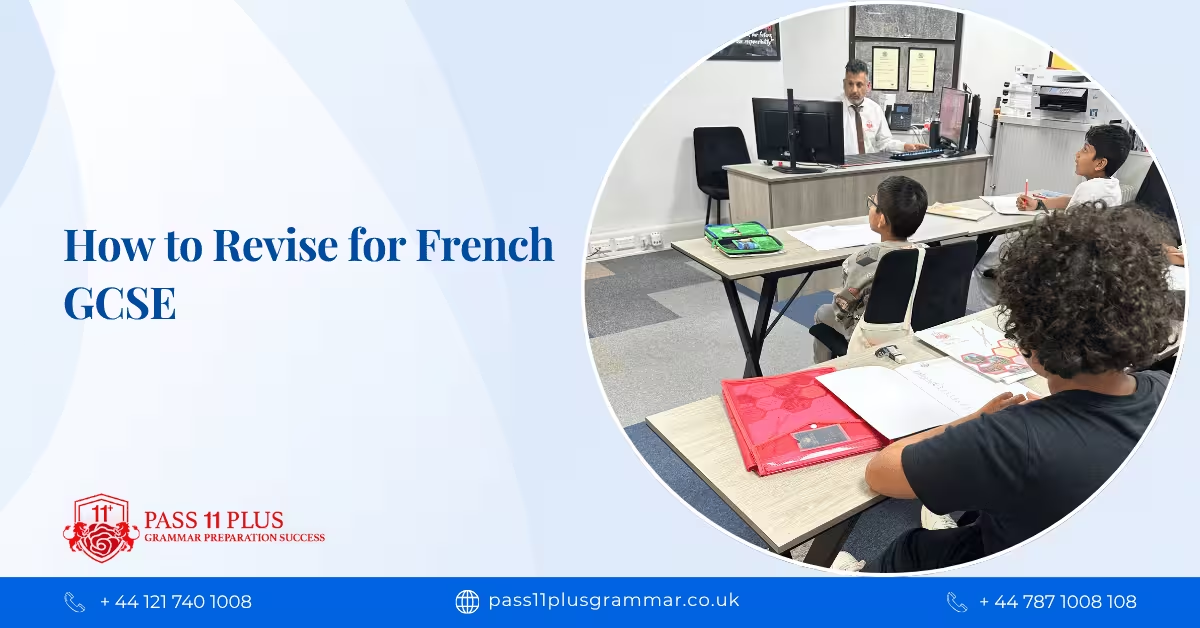
How to Revise for French GCSE
Published on
The most effective way to revise for French GCSE is to build a weekly plan that covers vocabulary, grammar and all four skills, listening, speaking, reading and writing, rather than focusing heavily on just one. Use active recall, testing yourself rather than simply rereading notes, and spaced repetition, revisiting topics at increasing intervals, since these two techniques build vocabulary into genuine long-term memory far more effectively than passive review. Practise every skill actively too, since watching French television or reading French articles alone, while pleasant, is a fairly passive way to prepare. Starting eight to ten weeks before exams gives enough time to properly cover everything.
Vocabulary lists, verb tables, four separate skills to juggle, it is genuinely a lot. Here is a clear guide to how to revise for French GCSE, built around what actually helps information stick and skills genuinely improve.
Understanding the four skills GCSE French actually tests
Before building a revision plan, it genuinely helps to understand exactly what you are preparing for. GCSE French is assessed across four separate exams: listening, speaking, reading and writing, each worth an equal 25 percent of the final grade.
Each exam covers a handful of broad themes, such as free time and technology, family and relationships, or education and future plans, though the exact themes vary slightly between exam boards. What is being tested throughout is not just how much vocabulary you know, but how well you can understand, respond to and produce French accurately under exam conditions.
We build this understanding into every session of our GCSE French tuition, since a student who understands exactly what each exam is looking for revises far more effectively than one working through content in a general, unfocused way.
Foundation or Higher Tier GCSE French
GCSE French is offered at Foundation and Higher Tier, and knowing which one you are entered for should genuinely shape your revision plan, not just your exam day expectations.
Foundation Tier covers grades 1 to 5, and Higher Tier covers grades 4 to 9. Higher Tier brings noticeably harder questions, longer required word counts for writing, and higher expectations around grammar range and vocabulary sophistication. Revising with the wrong tier's expectations in mind wastes valuable time either underpreparing or overpreparing for content that will not actually appear.
If you are unsure which tier you have been entered for, or whether it is still the right fit, it is worth checking with your teacher well before exams, since the content and expected standard genuinely differ between the two.
Building a GCSE French weekly revision plan that covers everything
One of the most common mistakes is treating French revision as one vague task, simply writing revise French on a timetable without any real structure behind it. GCSE French genuinely rewards a more deliberate approach, since there is a large amount of content and four distinct skills to build.
1. List every topic you need to cover
Most students end up with around eight to ten broad topics, such as school, holidays, or the environment. Seeing the full list upfront prevents any one area from being quietly neglected.
2. Assign one topic to each week
During that week, focus that topic's vocabulary across all four skills, while continuing to review general vocabulary and grammar from topics covered in earlier weeks.
3. Rotate which skill gets extra focus
Spread listening, speaking, reading and writing practice across different days within the week, rather than practising the same skill repeatedly and neglecting another entirely.
4. Add full past papers as exams approach
In the final few weeks, layer in complete timed past papers alongside your regular weekly plan, to build genuine exam familiarity and pacing.
Active recall and spaced repetition for GCSE French vocabulary
Not all revision methods are equally effective, and GCSE French in particular rewards techniques that genuinely test memory rather than simply exposing you to information again.
Active recall
Cover vocabulary and try to recall it from memory
Translate an English sentence into French without looking
Conjugate verbs aloud from memory, across tenses
Spaced repetition
Return to old topics while studying new ones
Mix older and newer vocabulary in every test session
Review flashcards on a structured, repeating schedule
Flashcards genuinely combine both techniques well, with French on one side and English on the other, tested actively rather than flipped through passively. Reviewing them on a structured, repeating schedule builds far more reliable long-term recall than an occasional read-through.
How to revise for the French listening GCSE exam
Watching French television or listening to French music is enjoyable and genuinely useful for general exposure, but it tends to be a fairly passive way to prepare on its own.
Turn listening into an active task. Listen to a short French passage, then summarise the main points in English afterwards. For dictation-style practice, listen to short French sentences and write down exactly what you hear. Both approaches force genuine, active processing rather than passive background listening.
How to revise for the French speaking GCSE exam
It might sound obvious, but speaking practice needs to involve genuinely speaking out loud. Rehearsing answers silently in your head, or only writing them down, does not build the fluency or confidence the actual exam requires.
Practise describing a simple photo out loud, exactly as the photo card task requires.
Create and perform a short role-play conversation on a specific scenario, ideally with someone else taking the other part.
Build a list of likely conversation questions for each topic and practise answering them in real detail, out loud.
Time yourself speaking on a topic. It is completely normal to struggle to fill the time at first, and this improves naturally with practice.
How to revise for the French reading GCSE exam
As with listening, reading French blogs, articles or social media is a pleasant way to build general exposure, but it needs an active element added to genuinely build exam skill.
Read a short French text and summarise the key information in English, rather than simply reading through and moving on. Practising gap fill and multiple choice style questions specifically also builds familiarity with exactly how reading questions tend to be phrased and structured in the real exam.
How to revise for the French writing GCSE exam
Writing revision genuinely needs to be tailored to your tier, since Foundation and Higher writing tasks differ meaningfully in length and complexity expected.
1. Practise writing to realistic word counts and timings
Foundation tasks are typically shorter, around 50 words, while Higher tasks can reach around 150 words. Timing yourself while writing builds genuine exam pace over repeated practice.
2. Build a personal bank of ambitious language
Collect connectives, opinion phrases, justifications, time phrases and a few higher level expressions you can use confidently, then deliberately work them into every piece of practice writing.
3. Cover at least three different time frames for higher marks
Referring to the past, present and future within a piece of writing, rather than staying in one tense throughout, is genuinely expected for the strongest grades.
4. Build a personal accuracy checklist
Create a short list of things to check every time: spellings, accents, verb tenses, adjective agreement, and use it consistently across every piece of practice writing.
Our GCSE French tutors review writing against exactly this kind of accuracy checklist, alongside the official mark scheme, so students know precisely where marks are being gained or lost.
GCSE French tuition
Revise French GCSE with a plan that covers all four skills
Our GCSE French tutors build listening, speaking, reading, writing and real exam technique into every session, whatever tier you are aiming for.
Using past papers and mark schemes properly
Past papers reveal exactly how questions are phrased, which topics recur, and how marks are actually awarded. Completing them under proper timed conditions builds the speed and accuracy needed on the real exam day, particularly for writing.
Do not just mark a paper; review it properly. Mark schemes often include model answers showing exactly what top band responses look like. Going through your own answers against this detail, rather than just checking a final score, is what genuinely turns practice into improvement.
Our GCSE tuition builds this kind of structured, marked past paper practice into every subject, not just French, since the habit of reviewing properly rather than simply completing papers is what actually drives progress.
Staying motivated without burning out
Revising for GCSE French is genuinely a marathon, not a sprint, and staying motivated over several weeks is one of the real, honest challenges of the whole process.
Breaking revision down into what needs doing today, rather than dwelling on everything still ahead, makes the whole task feel far more manageable. Tracking completed topics gives a genuine sense of progress, and short, focused revision bursts with proper breaks tend to outperform long, unbroken sessions. Sleep, food and rest all genuinely affect memory too, and none of these should be sacrificed during a busy revision period.
If your family is nearby, our GCSE tutors in Birmingham would love to help build a realistic, well-structured plan for French alongside your other subjects. For wider GCSE guides and revision advice beyond French, our sister site Pass GCSE is entirely dedicated to GCSE preparation.
Final thoughts
So, how do you revise for French GCSE? Not through hours of passive rereading, but through a structured weekly plan, genuine active recall and spaced repetition, and deliberate, focused practice across all four skills. Small, consistent, active sessions beat long, unfocused ones almost every time.
With the right structure and a bit of consistency, French can shift from a source of stress into one of the more rewarding subjects to prepare for, since progress here tends to feel genuinely visible week to week. We would love to help your child build exactly that kind of confidence.
Frequently Asked Questions
How do I revise for French GCSE?
Revise for French GCSE by building a weekly plan that covers vocabulary, grammar and all four skills, listening, speaking, reading and writing, rather than focusing on just one. Use active recall and spaced repetition to build vocabulary into long-term memory, and practise each skill actively rather than passively, since simply rereading notes or watching French television alone is not enough.
How to revise for GCSE French speaking specifically?
French Speaking practice needs to be genuinely spoken aloud, not just written down or rehearsed silently. Practising role plays, describing photo cards out loud, and answering general conversation questions within realistic time limits all build the confidence and fluency needed for the actual exam.
When should I start revising for GCSE French?
Starting around eight to ten weeks before exams gives enough time to properly cover all four skills, revisit topics through spaced repetition, and complete a reasonable number of past papers. Starting earlier is always better, but a focused, structured plan can still make a real difference even with less time available.
What is the difference between Foundation and Higher Tier for GCSE French?
Foundation Tier covers grades 1 to 5 with more accessible questions, while Higher Tier covers grades 4 to 9 with noticeably harder content and higher expectations, including longer required word counts for writing tasks and more demanding vocabulary and grammar throughout.

Mr Singh
Founder, Pass 11 Plus Grammar
Mr Singh is the founder of Pass 11 Plus Grammar, with over 30 years of teaching experience. Having overcome academic setbacks himself, he is passionate about ensuring no child struggles alone. His approach focuses on personalised support, strong foundations, and building confidence. He has helped students achieve outstanding results in 11+ and GCSE examinations
Loading related posts…