Loading page…
How to Revise for GCSE German
Published on
To revise for GCSE German, stop re-reading and start testing yourself. The method that works is simple: take one topic per week, practise all four skills within that week, and keep going back over old vocabulary with flashcards.
Ten minutes every day beats two hours on a Sunday. German vocabulary sticks through frequency, not intensity. Start eight to ten weeks before your exams, do past papers under the clock, and check every answer against the mark scheme.
Hours spent reading notes, highlighting vocabulary and copying out verb tables, and it still vanishes the moment the exam starts. Sound familiar? This guide shows you how to revise for GCSE German properly, with a realistic weekly plan and separate step-by-step advice for the speaking, writing, reading and listening exams.
Understand the GCSE German exam structure first
Before you revise anything, know what you are revising for. A surprising number of students lose marks simply because they did not know how one of the four papers was built.
25% Listening: Comprehension in German plus a dictation task
25% Speaking: Role play, reading aloud, photo card and conversation
25% Reading: Comprehension plus translation into English
25% Writing: Short and extended writing plus translation into German
Because each paper carries the same weight, the fastest way to lift your grade is usually to attack your weakest skill rather than polish your strongest. Being excellent at reading and poor at speaking costs you far more than being solidly good at both.
What changed in the new specification
The GCSE German course was updated for first teaching in 2024, with first exams sat in summer 2026. If you are looking at older revision advice online, check the date, because several things are different now:
All exam questions and instructions are in English, not German.
There is a defined vocabulary list. AQA expects 1,200 words at Foundation tier and a further 500 on top for Higher. That is a lot, but it also means the learning has a finish line.
Dictation is part of the listening paper. You write down German sentences exactly as you hear them, with marks for accurate spelling.
Reading aloud is part of the speaking test. You read a short German text out loud and are marked on pronunciation.
One more thing that catches students out every year. The speaking exam is not sat with the other papers. It usually happens in a window during April and May, weeks before the written exams. That means your speaking revision has to peak early. Ask your teacher for the date now and work backwards from it.
How to make a German GCSE revision plan that works
When students ask us how to revise for German GCSE, this is usually the part they are missing. Writing "revise German" on a timetable is not a plan. It is a wish. Here is how to build something you will actually follow.
1. List your topics
Take them from your exam board specification, not your exercise book. You should end up with around eight to ten, covering things like school, family and friends, the environment, media and free time.
2. Give each topic a week
One topic per week, and within that week touch all four skills. This is the trick that makes German revision manageable, because you are revising content and skills at the same time rather than treating them as two jobs.
3. Be honest about the hard ones
Easy topics can be doubled up in a single week. Difficult ones deserve two weeks. Spending your time on the topics you already know is the most comfortable way to waste an evening.
4. Keep general vocabulary running daily
Ten minutes every day, drawn from all topics rather than just this week's. This is what stops earlier topics leaking away while you focus on new ones.
5. Front load your speaking
Because the speaking exam comes first, weight your early weeks towards it. Once it is done, hand that slot over to whichever skill you feel weakest in.
6. Add a past paper slot from week four
One timed paper a week, rotating through the four skills, so nothing on exam day is unfamiliar.
The best revision techniques for GCSE German
Two techniques do most of the heavy lifting in language revision. Everything else is a variation on them.
1. Active recall: pull it out, do not put it in
Active recall means testing yourself rather than looking at information again. It feels harder than re-reading, and that is exactly the point. The more work your brain does to retrieve something, the better it stores it.
For German, that looks like:
Covering a vocabulary list and writing out what you remember, using look, say, cover, write, check
Writing an English sentence and translating it into German without looking anything up
Conjugating verbs from memory across several tenses, said out loud so you get speaking practice too
Quick test:
Close your book and write down ten German words from the topic you revised yesterday. If you manage three, you were re-reading, not revising.
2. Spaced repetition: go back just before you forget
Ticking a topic off feels final. It is not. A topic revised once in February will be gone by May unless you return to it.
Revisit a word or a grammar point after three days, then ten days, then a month. Each visit takes less time than the last and lasts longer. In practice this means testing yourself on old vocabulary alongside new every time you sit down, and revising holidays while your class is doing the world of work.
3. Flashcards, used properly
Flashcards combine both techniques above, which is why they are the single best tool for German. German on one side, English on the other, for single words and whole phrases.
The one rule: try to recall the answer before you flip the card. Flicking through a deck reading both sides is not revision, it is browsing. Digital tools such as Anki and Quizlet handle the spacing automatically, and paper cards work perfectly well if you sort them into piles by how well you know them.
4. Mind maps from memory, then corrected
Put a topic in the middle, then branch out with nouns, verbs, adjectives and useful phrases you can remember. You can do the same with a speaking or writing question, branching into what you could include.
Here is the step most people skip: Once you have done it from memory, open your notes and add what you missed in a different colour. Those coloured additions are your actual revision list.
5. Past papers and mark schemes
Papers show you how questions are worded, which topics keep reappearing and how marks are handed out. Doing them under timed conditions builds the speed you need, especially for writing.
Then mark your own work against the mark scheme. Mark schemes often include model answers showing what a top band response looks like, which teaches you to think like the examiner. They are written for examiners rather than students, so ask your teacher if anything is unclear.
How to revise for GCSE German speaking
There is one rule here and everything follows from it. You have to speak out loud.
Saying answers in your head does not prepare your mouth for German sounds, and writing them down does not either. It feels awkward talking to an empty room. Do it anyway, because the first time you say a German sentence aloud should not be in the exam.
1. The photo card task
Find simple images online, anything with people doing something, and practise describing them in German. Start with what you can see, then move to what you think is happening, then to your own opinion about it.
Build a set of phrases you can use with any photo at all. Things that mean "in this photo there is", "in the background", "it looks like" and "I think that" will carry you through almost any image you are given.
2. The role play task
Write out a conversation between two people in a realistic scenario, such as at a hotel reception or in a shop, then perform it aloud.
If you have a revision partner, take turns playing each role. If you are on your own, record one side on your phone, play it back, and respond in the gaps. It sounds odd and it works surprisingly well.
3. The general conversation task
Your teacher will usually give you a list of likely questions for each topic. Answer them out loud, in as much detail as you can manage, and push yourself past the minimum every time.
The habit that lifts marks most: never give a short answer. Add a reason, then an opinion, then a different time frame. One sentence becomes three, and your range of language goes up with it.
4. The reading aloud task
Practise reading short German sentences out loud every day. They can come from anywhere: your textbook, a German news site, the back of a packet. It does not matter if you fully understand them, because this task is marked on pronunciation.
Focus on the sounds English speakers get wrong most: ch, z, w, v, r, and the umlauts in ü, ö and ä. Get those five or six right and your accent improves immediately.
Speaking is also the skill where practising against a real person makes the biggest difference, because a recording cannot ask you a follow up question you were not expecting. That weekly conversation practice is the core of our GCSE German tuition, and it is usually where we see nervous students turn a corner.
How to revise for GCSE German writing
Writing is the most controllable paper of the four, because you decide what goes on the page. That makes it the easiest place to gain marks, provided you prepare the right way.
Know your word counts and your timings
Practise writing to the exact length your tier requires, with a clock running:
Task length | Time to aim for |
Around 40 to 50 words | 15 minutes |
Around 90 to 100 words | 20 minutes |
Around 150 words | 30 minutes |
Add a minute to each for checking. Going over time at first is normal and gets better quickly with practice.
Build your personal phrase bank
This is the single highest value thing you can do for German writing. Make a list of at least three of each of the following, choosing ones you can use confidently and spell correctly:
Pick 3 Connectives: Words that join your ideas together
Pick 3 Opinion phrases: Ways of saying what you think
Pick 3 Justifications: Ways of explaining why
Pick 3 Time phrases: Last week, usually, next year
Pick 3 Intensifiers: Very, quite, extremely, really
Pick 3 Impressive structures: Your best grammar, ready to deploy
Then get as many of them as possible into every piece you write. Because these phrases work on any topic, you are effectively preparing marks in advance regardless of what the question turns out to be.
Use a checklist every single time
Before you hand in any practice piece, run through the same list:
Have I covered every bullet point in the question?
Are my spellings right?
Have I used at least three time frames?
Do all my nouns have capital letters?
Is my word order correct, especially the verb position?
Have I included phrases from my personal list?
For the translation into German, take short sections of simple English text and translate them. It does not need to be an official translation exercise. Any few sentences will do, and the practice transfers directly.
How to revise for German reading GCSE
Reading German blogs and news sites feels like revision. Mostly it is not, because it is passive. Your eyes travel over words you half recognise and nothing gets stored.
Make it active instead:
1. Translate short sections into English
Pick any German text and translate a paragraph properly, in writing. This directly rehearses one of the exam tasks and exposes exactly which words you do not know.
2. Read and summarise without looking back
Read a short passage, put it face down, then write the main points in English. This tests comprehension rather than word spotting.
3. Practise the exact question formats
Multiple choice, gap fill, short answer and inference questions all need different approaches. Search for German gap fill or German multiple choice to find interactive practice, and use past papers for the real thing.
4. Collect every unknown word
Any word you had to guess goes straight onto a flashcard. Your reading practice then feeds your vocabulary revision automatically.
5. Learn to cope with unknown words
You will meet words you have never seen. Practise working out meaning from the rest of the sentence rather than freezing. German compound nouns often break down into words you do know.
How to revise for the GCSE German listening exam
Listening is the skill students avoid most and worry about most. That is not a coincidence. It is also the one that improves fastest once you do it regularly.
Watching German television with subtitles is enjoyable but passive. Try these instead:
1. Listen and summarise
Play a short clip and write the main points in English. Searching for slow news in German gives you audio at a manageable speed.
2. Practise the dictation
Play short German sentences and write down exactly what you hear, spelling included. Any German audio works, and this is the only real way to prepare for this task.
3. Use past paper audio
The most valuable resource of all, because exam recordings have their own pace, accent range and question rhythm.
4. Listen to the same clip three times
First for the gist, second for details, third to check. This mirrors how you should work in the exam itself.
5. Read the questions first
In the exam you get time before the audio starts. Use it to work out exactly what information you are hunting for.
6. Do a little every week
Even ten minutes. The gap between students who practise listening weekly and those who do not is very visible by May.
GCSE German tuition
Is your child struggling with GCSE German speaking or writing?
Our GCSE German tutors build vocabulary systematically, drill all four skills weekly, and report honestly on progress
German vocabulary and grammar
Everything in the four papers rests on these two. You cannot technique your way around missing vocabulary.
Vocabulary
Under AQA's specification you are expected to know 1,200 words at Foundation tier and a further 500 at Higher. That sounds enormous until you do the arithmetic. Learning ten words a day gets you through the Foundation list in four months.
The defined list is genuinely good news. Unlike the old course, there is a finish line, and it is published. Download it from your exam board, work through it in chunks, and tick off what you know.
Grammar
German grammar has a reputation, and some of it is deserved. But a handful of things account for most marks:
Verb conjugation in three tenses. Present, past and future, for the verbs you actually use. Everything else is a bonus.
Word order. The verb goes second in a main clause and to the end after certain conjunctions. Getting this right lifts accuracy marks across every written answer.
Cases. Nominative, accusative, dative and genitive. Learn them one at a time rather than trying to absorb the whole table at once.
Noun genders. Learn der, die or das with the noun from the very first time you meet it. Learning a noun without its gender means learning it twice.
Capital letters on nouns. Small thing, easy mark, forgotten constantly under pressure.
Foundation or Higher tier: what changes in your revision
You must sit the same tier across all four skills, so this is one decision rather than four. It changes what you should be practising.
Foundation tier
Grades 1 to 5 available
Smaller vocabulary list to learn
Shorter writing tasks
More accessible questions throughout
Capped at grade 5
Good route to a secure pass
Higher tier
Grades 4 to 9 available
Extra 500 words of vocabulary
Extended writing of around 150 words
Faster and denser listening audio
Needed for grade 6 and above
Required for A Level German
Tailor your writing practice to your tier in particular, because the tasks are genuinely different lengths and styles. Practising 150 word essays when you are sitting Foundation is not a useful use of your evening.
How Pass 11 Plus Grammar helps students with GCSE German
We have been preparing students for exams for over thirty years, from our centre in Edgbaston and online for families further afield. Languages are the subject where regular expert contact makes the most visible difference, for one simple reason: a student cannot mark their own speaking or writing.
1. Weekly speaking practice with a real person
Role plays, photo cards, conversation questions and reading aloud, with immediate feedback on pronunciation and range. This is the part students cannot do alone and it is where most of the improvement comes from.
2. Written work marked against the real mark scheme
Not just corrected for errors, but marked the way an examiner would, showing exactly which sentence would have earned another mark and why.
3. Exam board specific preparation
AQA, Edexcel, Eduqas and WJEC differ in task types and word counts. We teach to the paper your child will actually sit, using the right vocabulary list.
4. Structured vocabulary and grammar building
Working through the defined list systematically rather than hoping it gets absorbed, with regular testing so nothing quietly leaks away.
5. Honest progress reporting to parents
Specifics about what is improving and what is not, in plain language, well before a mock result tells you the same thing.
Our GCSE German tutors are specialists rather than generalists covering every subject, and they work with students across all four skills rather than just the ones that are easy to teach. Families across the city come to us through our wider GCSE tuition programmes, and German is one of the subjects where we most often see a grade move within a term.
If you are local, our GCSE tuition in Birmingham runs from our Edgbaston centre, and we teach online for families anywhere in the UK.
Final thoughts
Learning how to revise for GCSE German comes down to a few habits rather than a secret. Test yourself instead of re-reading. Do a little every day rather than a lot once a week. Take one topic at a time and hit all four skills within it. Speak out loud, even when it feels ridiculous.
And if speaking or writing is the part that has got away from your child, that is exactly where we can help. Get in touch with us today.
Frequently Asked Questions
How do you revise for GCSE German?
Revise GCSE German by testing yourself rather than re-reading. The most effective approach is to pick one topic per week, work on all four skills within that week, and keep revisiting vocabulary from earlier topics using flashcards.
How do you revise for the GCSE German speaking exam?
To revise for the GCSE German speaking exam, you have to speak out loud. Saying answers in your head or writing them down does not prepare your mouth for the sounds. Practise each task type separately: describe photos you find online, act out role plays with a partner or by recording both sides, answer general conversation questions in as much detail as you can, and read short German sentences aloud daily for pronunciation.
How do you revise for the GCSE German writing exam?
To revise for the GCSE German writing exam, practise writing to the exact word counts and times your tier requires, roughly 15 minutes for a 40 to 50 word answer, 20 minutes for 90 to 100 words, and 30 minutes for 150 words. Build a personal list of at least three connectives, three opinion phrases, three justifications, three time phrases and three impressive structures, then use them in every piece you write.
How do you revise for the German reading GCSE exam?
To revise for the German reading GCSE exam, make it active rather than passive. Reading German websites is pleasant but does little on its own. Instead, translate short sections of German text into English, read a short passage and summarise it in English without looking back, and practise the specific question formats from past papers, including multiple choice, gap fill and translation.
How do you revise for the GCSE German listening exam?
To revise for the GCSE German listening exam, use short clips and do something with them. Listen to a passage and summarise the main points in English, or write down what you hear word for word to prepare for the dictation task. Searching for slow news in German gives you clips at a suitable speed. Past paper audio is the most valuable resource because exam recordings have their own pace and accent range.
When should I start revising for GCSE German?
At least eight to ten weeks before your exams, and earlier if you can. German cannot be crammed the night before because there is a large amount of vocabulary and four separate skills to develop.
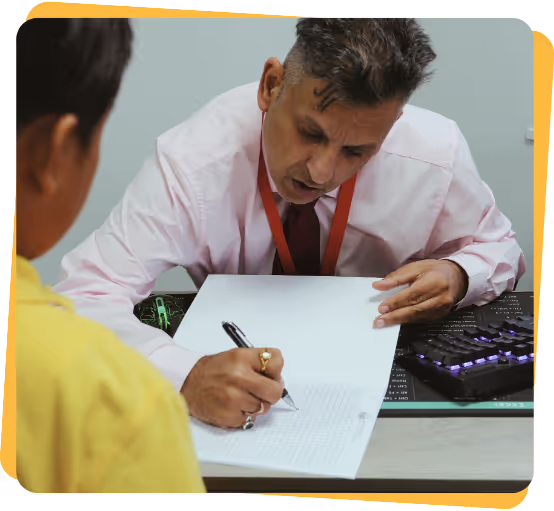
Mr Singh
Founder, Pass 11 Plus Grammar
Mr Singh is the founder of Pass 11 Plus Grammar, with over 30 years of teaching experience. Having overcome academic setbacks himself, he is passionate about ensuring no child struggles alone. His approach focuses on personalised support, strong foundations, and building confidence. He has helped students achieve outstanding results in 11+ and GCSE examinations
Loading related posts…