Loading page…
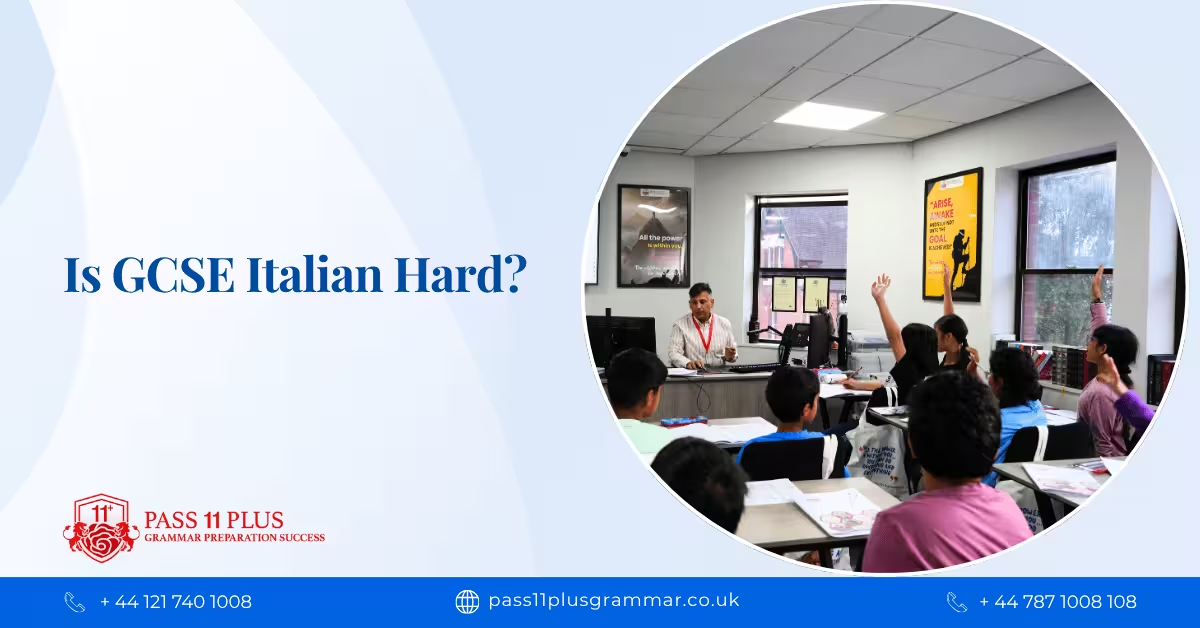
Is GCSE Italian Hard?
Published on
GCSE Italian is not considered one of the harder GCSE subjects overall. Compared to most other GCSEs, and even compared to some other languages, it tends to be seen as approachable, mainly because its spelling is largely phonetic and it shares a good amount of vocabulary with English through shared Latin roots. The real challenge for many families is not the language itself, but simply finding a school that offers it, since it is a smaller subject than French or Spanish.
If you or your child are weighing up GCSE Italian and wondering how tough it really is, here is a clear, honest answer. We will look at what the exam actually tests, why Italian is often seen as one of the more approachable language options, and what genuinely makes it tricky for some students.
What does GCSE Italian actually test?
GCSE Italian, whether taken through AQA or Pearson Edexcel, is built around four separate skills, each carrying exactly the same weight towards the final grade. Listening, speaking, reading and writing are each worth 25 percent, so a genuinely balanced result across all four areas matters far more than being brilliant in just one.
The course is organised around a set of broad themes, covering everyday topics like identity, culture, local and international life, and future study or work. Within these themes, students build vocabulary and grammar they apply flexibly across genuinely varied topics and question types, rather than simply reciting memorised phrases.
Is GCSE Italian hard compared to other GCSEs?
The short, honest answer is no, not compared to most other GCSEs. Students considering GCSE Italian are often surprised at just how approachable the language feels once they get started, particularly if they already have some background in French or Spanish.
Part of this comes down to Italian's genuinely consistent spelling system. Words in Italian are, for the most part, pronounced exactly the way they are written, which removes a layer of difficulty that trips many students up in subjects like French or English itself. Combined with a large amount of shared vocabulary with English, thanks to common Latin roots, many students find the early stages of learning Italian noticeably quicker to pick up than other language options.
Why GCSE Italian is often seen as one of the easier languages
Language learning difficulty is genuinely relative, and this matters when comparing Italian to subjects like German or even French. Italian's grammar does include noun genders and regular verb conjugation patterns, which do need dedicated learning, but it avoids some of the trickier features found elsewhere.
Italian does not have a case system that changes word endings based on grammatical role, unlike German
Spelling closely follows pronunciation, unlike French, where written and spoken forms often differ noticeably
Many everyday Italian words closely resemble their English equivalents, thanks to shared Latin origin
None of this means GCSE Italian requires no effort. Grammatical gender still needs memorising alongside each noun, and verb conjugations across different tenses still take genuine, repeated practice. It simply means the overall learning curve tends to feel gentler than some of the alternative language options available at GCSE.
How GCSE Italian grade boundaries work
Like every GCSE, Italian is graded on the 9 to 1 scale, with grade 9 the highest and grade 4 counting as a standard pass, grade 5 as a strong pass. Since raw marks across listening, speaking, reading and writing are not always out of the same total, exam boards scale each component so it contributes its intended 25 percent share to the overall subject mark.
Once marking is complete, senior examiners set grade boundaries based on the total scaled mark and how the whole cohort performed that year. As one recent example, AQA's June 2026 Higher tier boundaries required 133 out of 240 scaled marks, around 55 percent, for a grade 7, showing how boundaries reflect a considered, evidence based judgement each year rather than a fixed percentage.
GCSE Italian tuition
Give your child the confidence to pass GCSE Italian
From core vocabulary to exam technique, our specialist GCSE Italian tutors cover exactly what the exam demands.
How to make GCSE Italian easier to pass
1. Lean into the vocabulary overlap with English
Spotting shared Latin roots between English and Italian words genuinely speeds up vocabulary learning, so make this an active strategy rather than an incidental bonus.
2. Practise all four skills evenly
Since listening, speaking, reading and writing are each worth 25 percent, uneven preparation across the four areas is a common and avoidable cause of a lower grade.
3. Treat grammatical gender as a habit, not a rule
Learning nouns alongside their gender from day one, rather than adding it later, builds accuracy far more naturally over time.
4. Seek out extra resources proactively
Since Italian has fewer school resources than French or Spanish, actively seeking out past papers, audio material and specialist support pays off more than it would for a more widely taught subject.
5. Choose the right tier honestly
A confident Foundation grade 5 is a stronger outcome than a stressful Higher tier result well below target, so tier choice should reflect genuine readiness.
Getting the right support for GCSE Italian
Because fewer schools teach Italian in depth, many families find that outside support makes a real, practical difference, not because the language itself is especially hard, but because classroom time and resources can be more limited than for other languages.
1. Work with a specialist, not a generalist
Our GCSE Italian tutors understand exactly where students tend to lose marks, and focus preparation squarely on those gaps rather than repeating what a student already knows.
2. Get a structured, subject specific plan
Our GCSE Italian tuition is built around all four skill areas equally, so revision time reflects exactly how the exam is actually weighted.
3. Keep the wider subject picture in mind
If your child is juggling Italian alongside other GCSEs, our GCSE tuition in Birmingham provides consistent, well rounded support across the full subject timetable.
4. Explore support across every GCSE subject
Our GCSE tuition programmes cover far more than languages, giving families one consistent place to turn to across the whole GCSE journey.
For more detailed guides on GCSE subjects, grade boundaries and results, our sister site Pass GCSE is entirely dedicated to GCSE preparation and results.
Whatever stage of preparation your child is at, our GCSE tuition team is here to help turn GCSE Italian from an unfamiliar option into a genuine strength.
Final thoughts
So, is GCSE Italian hard? Genuinely, no, not compared to most other GCSE subjects. Its phonetic spelling and vocabulary overlap with English make it one of the more approachable language options available, provided students still put in proper, balanced effort across listening, speaking, reading and writing. The real challenge tends to be access rather than difficulty, since fewer schools teach it in depth compared to French or Spanish.
With the right structure and support, GCSE Italian can go from feeling like an unusual choice to one of the more rewarding results on results day. We would love to help your child get there with confidence. Get in touch with us today.
Frequently Asked Questions
Is GCSE Italian hard?
GCSE Italian is not considered one of the harder GCSE subjects overall. Its spelling is largely phonetic, meaning words are usually pronounced the way they look, and it shares a good amount of vocabulary with English through shared Latin roots. The bigger challenge tends to be finding a school that teaches it, rather than the language itself.
Is GCSE Italian easier than French, Spanish or German?
GCSE Italian is often seen as comparably approachable to Spanish, and generally more accessible than German, mainly because of its consistent, phonetic spelling and simpler verb patterns compared to German's case system. It does still include grammatical gender and verb conjugation, so genuine effort is still required.
What grade do you need to pass GCSE Italian?
GCSE Italian is graded on the standard 9 to 1 scale used across all GCSEs, with grade 4 counting as a standard pass and grade 5 considered a strong pass. Grade boundaries are set after marking each year, based on how the whole cohort performed.

Mr Singh
Founder, Pass 11 Plus Grammar
Mr Singh is the founder of Pass 11 Plus Grammar, with over 30 years of teaching experience. Having overcome academic setbacks himself, he is passionate about ensuring no child struggles alone. His approach focuses on personalised support, strong foundations, and building confidence. He has helped students achieve outstanding results in 11+ and GCSE examinations
Loading related posts…