Loading page…
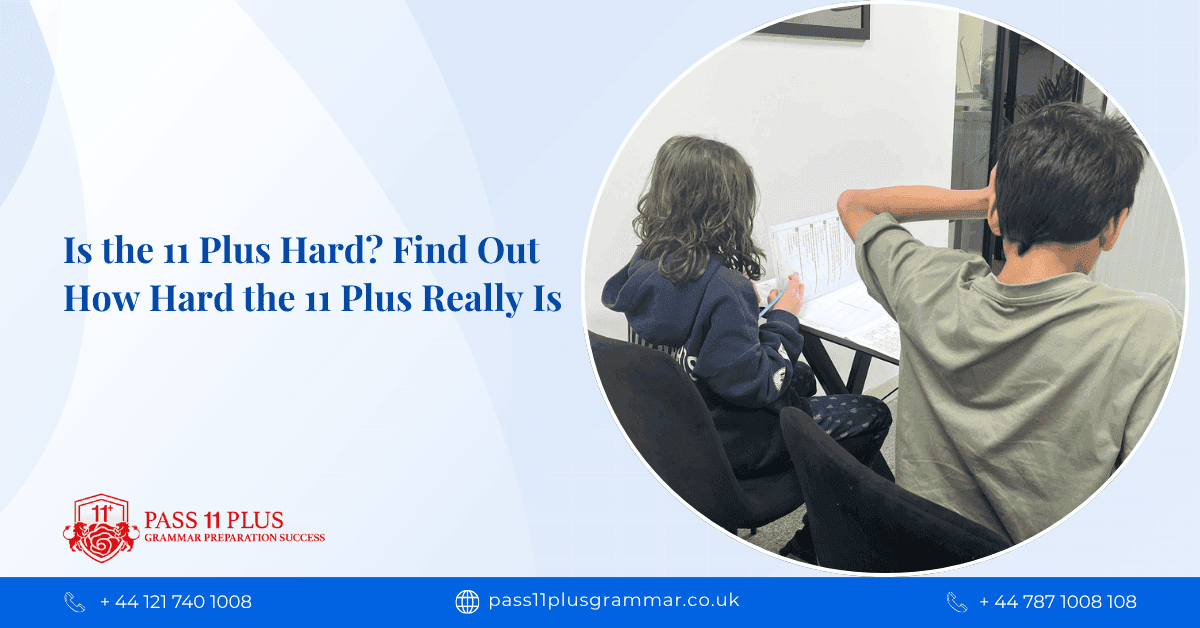
Is the 11 Plus Hard? Find Out How Hard the 11 Plus Really Is
Published on
Yes, the 11 plus is genuinely hard. It tests four subjects, two of which are not taught in school. It is sat under strict time pressure. And your child is competing against a large group of well-prepared children for a very small number of grammar school places. Around 100,000 children sit the 11 plus every year in England, and only the highest scorers receive grammar school places. In competitive areas like Birmingham, only around 10 to 20% of applicants are successful. But here is the equally important truth: the 11 plus is hard for the unprepared, not for the well-prepared. Children who start early, cover all four subjects and build genuine exam technique consistently achieve the scores they need.
Every parent of a Year 4 or Year 5 child asks this question sooner or later. And we are going to give you the honest, straight-talking answer rather than the reassuring one. Because your child deserves preparation based on reality, not wishful thinking.
Why is the 11 plus hard? The real reasons
When parents ask us how hard is the 11 plus, they usually expect us to say something reassuring. We would rather give you the honest version, because understanding why the exam is hard is the first step to making sure your child is ready for it.
There are four main reasons the 11 plus is hard.
Reason 1: Two of the four subjects are not taught in school
The 11 plus tests English, Maths, Verbal Reasoning and Non-Verbal Reasoning. English and Maths are familiar. Verbal Reasoning and Non-Verbal Reasoning are not taught as part of the national curriculum, which means many children have never seen these question types before they start preparing for the exam. Walking into the 11 plus without practising Verbal and Non-Verbal Reasoning is like sitting a French exam without ever having studied French.
Reason 2: Everything is done under strict time pressure
A child who can answer questions correctly when given unlimited time is a very different thing from a child who can answer them correctly in seconds, with a clock counting down and an invigilator in the room. The 11 plus is a timed exam, and the time limits are tight. Many children who know the content perfectly still underperform because they have not practised working at exam pace. Time management is a skill on its own, and it takes deliberate practice to develop.
Reason 3: The Maths goes beyond Year 6 school content
The Maths paper in the 11 plus is not simply a summary of what your child has covered in school up to Year 6. It frequently includes questions on topics that are more advanced than the standard curriculum and presents familiar topics in unfamiliar formats. Problem-solving, multistep questions, algebraic thinking and data interpretation all appear in ways that children who have only done school Maths are not always ready for.
Reason 4: The competition is fierce
This is the part most people do not talk about honestly. Even if your child answers questions correctly, they are not competing against a fixed standard. They are competing against every other child sitting the exam. In Birmingham, thousands of children apply for a few hundred grammar school places. Many of those children have been working with specialist tutors for one, two or even three years. A child who is bright but underprepared is competing against children who have been thoroughly prepared. That gap is real, and it matters.
How hard is the 11 plus by subject?
Not all four subjects are equally challenging. Here is an honest breakdown of how hard each part of the 11 plus exam really is, and why.
English
Reading comprehension, vocabulary, grammar, punctuation and spelling. Children are familiar with English from school, but the 11 plus demands a higher level of precision and vocabulary range than most children naturally achieve at Year 6. Wide reading from an early age makes a significant difference here. Comprehension questions also test inference and analysis, which go beyond simply finding answers in the text.
Maths
Maths is familiar from school, but the 11 plus version goes beyond the standard Year 6 curriculum. Questions are often presented in unfamiliar formats and require multi-step logical thinking rather than straightforward calculation. Children also need to complete Maths questions at a speed that leaves no time to double-check every answer. This combination of content and pace is what makes the Maths paper harder than it first appears.
Verbal Reasoning
Verbal Reasoning is hard because most children have never seen it before. It tests things like word connections, analogies, letter sequences, code words and logical language puzzles. The question formats are unusual, the time limits are tight, and strong general reading ability alone is not enough. Children need specific practice with these question types to perform well, which is why this subject catches so many unprepared children off guard.
Non-Verbal Reasoning
Non-Verbal Reasoning is the subject most children find most unfamiliar. It uses shapes, patterns, sequences and spatial logic to test abstract thinking, none of which are taught at state primary schools. Children who encounter NVR for the first time in the exam room are at a serious disadvantage. The good news is that NVR is a learnable skill. With dedicated practice, children typically improve faster in NVR than in any other 11 plus subject.
How hard is the 11 plus to pass?
There is no single, fixed pass mark for the 11 plus nationally. Each grammar school sets its own qualifying threshold each year, based on the number of available places and how the cohort performs. This means the pass mark moves up and down slightly from year to year.
As a general guide, children typically need to score around 80% or above on the raw paper to reach the qualifying threshold. In standardised score terms, most grammar schools require a score of around 111 to 121 or higher, depending on how competitive that particular school is.
Here is where it gets even more challenging: qualifying does not guarantee a place. At oversubscribed grammar schools, even children who meet the qualifying score may not receive an offer if there are more qualified applicants than available places. In those cases, secondary criteria like distance from the school or catchment area determine who gets in.
Why the pass mark changes every year
Each year, the difficulty of the exam paper is assessed alongside the scores of all candidates. If a particular year's paper turns out to be slightly easier, the pass mark is set higher to ensure that the same proportion of children qualify. If the paper is harder, the pass mark is adjusted downward slightly. This standardisation process means the exam is always fair to the children sitting it that year, but it also means there is no fixed score your child can aim for with certainty.
How hard is the 11 plus compared to SATs?
Parents often ask us whether the 11 plus is harder than SATs. The honest answer is yes, significantly so, and for several important reasons.
Factor | SATs | 11 Plus |
What is tested | What children have been taught at school up to Year 6 | Four subjects, two of which are not taught in school |
Time pressure | Moderate, children have time to work through questions | Strict time limits, pace is a significant factor |
Competition | No competition, results do not compare children to each other | Competitive ranking, children are scored against each other |
Consequences | Used for teacher assessment, no impact on secondary school | Determines which secondary school your child attends |
Preparation needed | Minimal, school curriculum covers the content | Significant, especially for Verbal and Non-Verbal Reasoning |
Pass or fail? | No pass or fail, children receive a scaled score | Pass or fail with real consequences for school placement |
SATs measure what children have learned. The 11 plus measures how well children perform against each other in a competitive, timed environment that includes subjects school has never taught them. These are fundamentally different challenges, and treating the 11 plus like an extended SATs paper is one of the most common preparation mistakes families make.
Is the 11 plus getting harder?
This is a question we hear more and more from parents, and it deserves an honest, nuanced answer.
The 11 plus exam content itself has not become fundamentally harder in recent years. The subjects tested, the format of the questions and the general level of the papers have remained broadly consistent. Exam boards deliberately try to maintain the same level of difficulty from year to year so that results remain comparable.
However, the effective difficulty of earning a grammar school place has increased significantly, for two main reasons.
First, more families are now investing in professional tuition earlier and for longer. The standard of preparation among applicants has risen across the board. This means that a child who would have been competitive five years ago with modest preparation now needs to work harder to stand out.
Second, grammar schools themselves are evolving in what they look for. Beyond raw scores, many schools now value well-rounded students who can demonstrate critical thinking, creative writing ability and breadth of learning. The bar for what constitutes a genuinely strong application has risen, even if the exam papers themselves have not dramatically changed in content.
How hard is the 11 plus for different children?
The honest answer is that it varies enormously, and the single biggest factor is not natural ability. It is preparation.
For academically strong, well-prepared children
For a child who is naturally strong across all four subjects and has been preparing consistently from Year 4, the 11 plus is challenging but very manageable. These children typically find the exam format familiar by the time they sit it, manage their time well, and walk out of the exam room feeling confident. The difficulty they experience is a productive difficulty, the kind that motivates improvement rather than causes panic.
For bright children who have not seen the question types before
This is where the exam is genuinely hard and catches families off guard. A child who is academically very able but has never practised Verbal Reasoning or Non-Verbal Reasoning can perform well below their potential on those papers simply because the question types are unfamiliar. Ability alone is not enough. Familiarity with the exam format is essential, and that only comes from practice.
For children who struggle with time pressure
Some children know the material perfectly but freeze or slow down under timed conditions. This is a different kind of hard, and it is one of the most important things to address through preparation. Building timed practice into revision from early on, and eventually sitting full mock exams, is the most effective way to overcome this challenge. Our 11 plus mock exams are designed specifically to build this kind of exam resilience.
For children starting preparation late
A child starting preparation in Year 6, weeks before the September exam, faces a genuinely difficult task regardless of their natural ability. There is simply not enough time to learn unfamiliar subjects, build exam technique, develop time management skills and reach a competitive score. This is why starting in Year 4 or early Year 5 makes such a significant difference. Earlier preparation does not mean more pressure. It means more time to build skills gradually and confidently.
How to make the 11 plus less hard for your child
Understanding how hard is the 11 plus is one thing. Doing something about it is another. Here is what actually makes the difference between a child who finds the exam overwhelming and one who walks in feeling ready.
1. Start earlier than you think you need to
The most common regret we hear from parents is starting too late. Year 4 or early Year 5 is the ideal time to begin. This gives your child time to learn unfamiliar subjects gradually, build confidence without pressure, and reach a consistently high level well before the September exam arrives. Our 11 plus tuition is available from Year 3 upward, covering all four subjects with experienced specialist tutors.
2. Cover all four subjects, especially the ones school does not teach
Every child preparing for the 11 plus should be working on Verbal Reasoning and Non-Verbal Reasoning alongside English and Maths. These are not extras. They make up a significant portion of the exam, and children who have not practised them are at a serious disadvantage. Our free 11+ practice papers include all four subjects and are available to download right now at no cost.
3. Build exam technique, not just knowledge
Knowing the content and knowing how to perform under exam conditions are two different things. Good exam technique means knowing when to move on from a difficult question, how to use process of elimination in multiple choice, how to manage time across a paper, and how to stay calm under pressure. These skills can be taught, but they need to be practised repeatedly in realistic conditions. Our 11 plus tutors build exam technique into every session alongside subject knowledge.
4. Use an intensive course to accelerate progress
For children who need a focused boost in a short period of time, particularly in the summer before the September exam, our 11 plus intensive summer course is an outstanding option. Daily structured lessons covering all four subjects, with timed practice built in from day one, can make a significant difference to your child's score in the weeks before the real exam.
5. Sit a full mock exam before the real thing
One of the most effective ways to make the 11 plus less hard on the real day is to make it familiar. Our 11 plus mock exams replicate the real exam format as closely as possible, with two full timed papers and detailed subject-by-subject feedback. Children who have sat a mock exam consistently perform better on the real day because the environment, the format and the time pressure are no longer frightening unknowns.
So, is the 11 plus hard? Here is the final word
Yes, it is hard. It tests subjects school does not teach, under time pressure, against well-prepared competition. But hard and impossible are very different things.
At Pass 11 Plus Grammar, we have been helping children make the 11 plus manageable. The 11 plus is hard. We make it manageable. Get in touch today and let us start building your child's preparation plan.
Frequently Asked Questions
How hard is the 11+ exam?
The difficulty depends on how prepared your child is. For a well-prepared child who has covered all four subjects and practised under timed conditions, the exam is challenging but manageable.
Is the 11 plus getting harder every year?
The exam content has not become fundamentally harder, but the competition for places has increased significantly.
Why is the 11 plus so hard?
The 11 plus is hard because it tests four subjects under strict time pressure, and your child is competing against thousands of well-prepared children for a very small number of grammar school places.

Mr Singh
Founder, Pass 11 Plus Grammar
Mr Singh is the founder of Pass 11 Plus Grammar, with over 30 years of teaching experience. Having overcome academic setbacks himself, he is passionate about ensuring no child struggles alone. His approach focuses on personalised support, strong foundations, and building confidence. He has helped students achieve outstanding results in 11+ and GCSE examinations
Loading related posts…