Loading page…
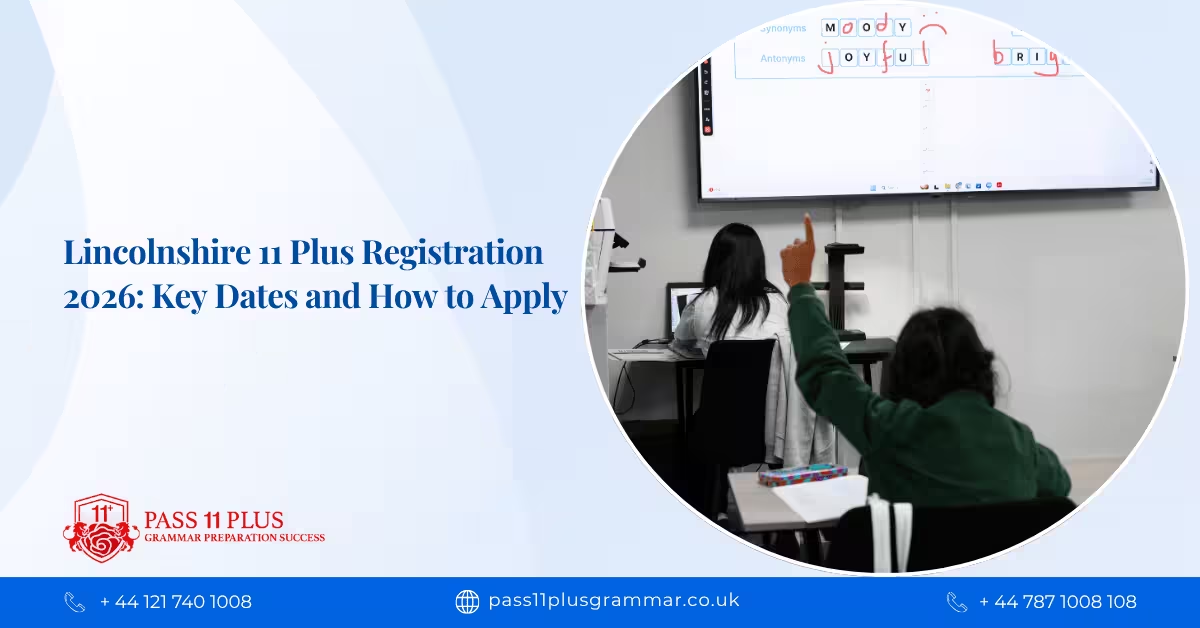
Lincolnshire 11 Plus Registration 2026: Key Dates and How to Apply
Published on
The Lincolnshire 11 plus registration 2026 opened on 7th January 2026 and closed on 31st March 2026. The exam takes place across two separate days in September 2026. The qualifying pass mark is a combined standardised score of 220 out of a maximum of 282. The exam covers Verbal Reasoning and Non-Verbal and Spatial Reasoning only, set by GL Assessment. Results are released on 9th October 2026, and the Common Application Form must be submitted by 31st October 2026.
Lincolnshire has one of the largest grammar school systems in England, with 15 schools across the county all using the same entrance exam. This guide covers everything you need to know about the Lincolnshire 11 plus, from confirmed 2026 dates to the exam format, the pass mark, and how to prepare your child properly.
All 15 grammar schools in Lincolnshire
There are 15 grammar schools in the Lincolnshire Consortium of Grammar Schools. All 15 use the same entrance test, so your child registers once and can be considered for multiple schools with a single exam sitting.
Co-educational grammar schools
Bourne Grammar School
King Edward VI Grammar School, Louth
King Edward VI Academy, Spilsby
Queen Elizabeth's Grammar School, Alford
Queen Elizabeth's Grammar School, Horncastle
Queen Elizabeth's High School, Gainsborough
Skegness Grammar School
Boys' grammar schools
Boston Grammar School
Carre's Grammar School
Spalding Grammar School
The King's School Grantham
Girls' grammar schools
Boston High School for Girls
Kesteven and Grantham Girls' School
Kesteven and Sleaford High School
Spalding High School
Lincolnshire 11 plus exam dates 2026
7th January 2026: Lincolnshire 11 plus registration opens via any participating school's website
31st March 2026: Lincolnshire 11 plus registration closes. Late registrations are not accepted
11th or 12th September 2026: Lincolnshire 11 plus Paper 1: Verbal Reasoning (80 questions, 50 minutes). Exact day varies by school
18th or 19th September 2026: Lincolnshire 11 plus Paper 2: Non-Verbal and Spatial Reasoning (70 questions, timed sections). Exact day varies by school
9th October 2026: Lincolnshire 11 plus results day. Results sent to parents
31st October 2026: Deadline to submit Common Application Form (CAF) to your home local authority
1st March 2027: National Offer Day. School places confirmed
How to register for the Lincolnshire 11 plus exam
Registration for the Lincolnshire 11 plus is straightforward but must be completed within the January to March window each year. Here is exactly what you need to do.
Who needs to register?
Every child who wants to sit the Lincolnshire Consortium 11 plus must be registered by a parent or guardian. There is no automatic registration system. This applies to children attending any school, whether state or independent, inside or outside Lincolnshire.
How to register
Registration is completed online via the website of any of the 15 participating Lincolnshire Consortium grammar schools. You do not need to register through the website of each individual school you are interested in. One registration through any participating school's website covers all 15 schools in the Consortium. You will need your child's name, date of birth, current school and your contact details. Registration is free of charge.
Do I need to register separately for each school?
No. One registration covers all 15 schools in the Lincolnshire Consortium. After results are released in October, you list your preferred schools on the Common Application Form in order of preference. The registration itself does not commit you to applying to any particular school.
Can I apply to Lincolnshire grammar schools from outside the county?
Yes. The Lincolnshire 11 plus is open to children from anywhere in England. Out-of-county applicants register through the same portal. After results, they must submit their Common Application Form to their home local authority, not to Lincolnshire County Council, and list Lincolnshire grammar schools among their preferences. Check each school's admissions policy for any priority given to in-county applicants.
The Lincolnshire 11 plus exam format explained
The Lincolnshire 11 plus is set by GL Assessment and is very different from grammar school exams in areas like Sutton, which tests English and Maths. The Lincolnshire exam tests only Verbal Reasoning and Non-Verbal and Spatial Reasoning. It does not directly test English or Maths.
This is an important detail. The skills tested in the Lincolnshire 11 plus are not covered by the standard primary school curriculum. Children who begin the exam without specific preparation in these areas will encounter question types they have never seen before.
The two papers are sat on separate days, a week apart, both in September of Year 6.
Verbal Reasoning
80 questions in 50 minutes. Split into around 15 sections of five to six questions each, covering the same question type within each section.
Common question types include:
Synonyms, antonyms and vocabulary connections
Anagrams, jumbled words and missing letters
Letter and number codes and sequences
Logic problems using letters, numbers and symbols
Word analogies and odd one out
Non-Verbal and Spatial Reasoning
70 questions across 5 timed sections of around 14 questions each. Each section is timed at approximately 7 minutes, and your child cannot move on until told to do so by the invigilator.
Common question types include:
Three NVR sections: pairing shapes, solving sequences and matrices, shape codes
Two spatial reasoning sections: rotations, reflections, folding, shape parts
All questions use visual information only; no words or numbers required
Both papers are multiple-choice. Your child marks their answers on a separate pre-printed answer sheet using a pencil. Answer sheets are marked using Optical Mark Recognition (OMR) technology for consistent and accurate results. There is a short unmarked practice exercise at the start of each paper to help children understand the format before the scored questions begin.
The Lincolnshire 11 plus pass mark and highest possible score
The qualifying pass mark for the Lincolnshire 11 plus is a combined standardised score of at least 220 across both papers.
What is the highest 11 plus score in Lincolnshire?
Each of the two GL Assessment papers produces a Standardised Age Score (SAS) on a scale from 69 to 141. The maximum score on each individual paper is 141. Since there are two papers, the maximum combined total score in the Lincolnshire 11 plus is 282. The qualifying threshold of 220 therefore represents roughly 78% of the maximum possible combined score.
Combined score | What it means |
260 to 282 | Exceptional. Top performers nationally. Very competitive at the most selective Lincolnshire schools. |
240 to 259 | Well above the pass mark. Strong candidate at all 15 Lincolnshire Consortium grammar schools. |
220 to 239 | Meets the qualifying pass mark. Eligible for a grammar school place. Does not guarantee one. |
Below 220 | Below the qualifying threshold. Grammar school eligibility not met through the Consortium. |
Reaching a combined score of 220 makes your child eligible. But all 15 Lincolnshire grammar schools receive more eligible applicants than they have places available. When this happens, schools apply their own admissions oversubscription criteria, which typically include factors like distance from the school, catchment area, and siblings already attending. The higher your child's score above the qualifying threshold, the stronger their position becomes.
How the Lincolnshire 11 plus is scored
After both papers are sat in September, answer sheets are collected and marked using Optical Mark Recognition (OMR) technology, which reads and scores each multiple-choice answer electronically. This process is fast, accurate and consistent across all candidates.
Raw scores, the total number of questions answered correctly, are then converted into Standardised Age Scores (SAS). Age standardisation is the process that makes the exam fair to all children regardless of when they were born.
What is age standardisation and why does it matter?
A child born in September starts the school year at almost 11 years old. A child born in August starts it days before their 10th birthday. Over a school year this difference in age and experience is significant. Without age standardisation, older children would have a built-in advantage simply because of their birthday.
Age standardisation adjusts each child's raw score based on their exact age in years and months at the time of the exam. This means a child born in August who scores the same number of correct answers as a child born in September will receive a higher standardised score, reflecting the fact that they achieved the same result at a younger age. The national average SAS is always 100, regardless of birth month.
The standardised scores from both papers are then combined into a total score. A combined score of 220 or above earns your child eligible status for a Lincolnshire Consortium grammar school place.
What happens after Lincolnshire 11 plus results day
Results are sent to parents on 9th October 2026. This gives you just over three weeks before the Common Application Form deadline of 31st October. Here is what to do next.
If your child achieves a combined score of 220 or above
Your child is eligible to be considered for a place at a Lincolnshire grammar school. List your preferred schools on your Common Application Form in genuine order of preference and submit it to your home local authority by 31st October 2026. Check each school's individual admissions policy before finalising your choices, as oversubscription criteria differ between schools and some give priority to children living in their catchment area.
If your child scores below 220
Grammar school eligibility through the Lincolnshire Consortium has not been met. You can use the Common Application Form to apply to non-selective secondary schools in your area. Your child can still have an excellent secondary school experience and achieve strong academic results outside the grammar school system.
Can you request a remark?
If you believe there may have been a marking error, contact the admissions team at your preferred school for details of the remark or appeal process. Appeals against admissions decisions can also be made to an independent panel if your child qualified but was not offered a place at your preferred school due to oversubscription.
How to prepare your child for the Lincolnshire 11 plus
The Lincolnshire 11 plus tests only Verbal Reasoning and Non-Verbal Reasoning, two subjects that are not part of the national curriculum. Children who have never practised these question types will encounter completely unfamiliar material in the exam room. This is why specific, structured preparation is so important, and why starting early makes such a significant difference.
Start tuition early and focus on Verbal and Non-Verbal Reasoning specifically
Because the Lincolnshire exam tests subjects school does not teach, preparation needs to begin well before the exam, ideally in Year 4 or early Year 5. Children who encounter these question types for the first time in Year 6 are at a significant disadvantage. Our 11 plus tuition covers both Verbal Reasoning and Non-Verbal Reasoning in structured sessions that build skills progressively over time. We also note that the Lincolnshire registration window opens unusually early in January, making an early tuition start even more important so your child is ready when the exam window arrives.
Work with a specialist 11 plus tutor who knows GL Assessment
A specialist tutor identifies exactly which Verbal Reasoning and Non-Verbal Reasoning question types your child finds most challenging and builds a targeted plan to address them. Our 11 plus tutors have over 30 years of experience preparing children for GL Assessment exams. They know the specific question formats used in the Lincolnshire test and the strategies that make the biggest difference to scores in each section.
Practise regularly at home with free practice papers
Regular timed practice at home between sessions is one of the most effective ways to build the speed and accuracy your child needs for the Lincolnshire exam. Our free 11+ practice papers include Verbal Reasoning and Non-Verbal Reasoning papers in the GL Assessment format, available to download at no cost right now. Practice under timed conditions from early on so the pace of the real exam feels familiar rather than stressful.
Encourage wide reading every day
Wide reading will not teach your child Verbal Reasoning question types directly, but it builds the vocabulary, language confidence and comprehension ability that underpins strong Verbal Reasoning performance. Children who read broadly, across different genres and including non-fiction, consistently perform better on the Verbal Reasoning paper than those who do not. Even 10 to 15 minutes of reading every day makes a meaningful difference over a year of preparation.
Book an intensive summer course and sit a full mock exam
The summer holiday before the September exam is the ideal time for a concentrated final boost. Our 11 plus intensive summer course covers both GL Assessment subjects in small groups with experienced tutors, with timed practice built into every session. Follow this with one of our 11 plus mock exams, which replicate the real exam format and provide detailed subject-by-subject feedback so your child walks into September knowing exactly where they stand.
Final thoughts
The Lincolnshire 11 plus is one of the most distinctive grammar school exams in England. It tests only Verbal Reasoning and Non-Verbal Reasoning, two subjects school does not teach, across two separate papers on two separate September days. The qualifying pass mark is 220 out of a maximum of 282. And the registration window opens in January, earlier than almost any other grammar school area in the country.
At Pass 11 Plus Grammar, our expert tutors cover both Verbal Reasoning and Non-Verbal Reasoning in depth. Get in touch today and let us help your child prepare properly for the Lincolnshire 11 plus.
Frequently Asked Questions
When does Lincolnshire 11 plus registration open?
For 2027 entry, the Lincolnshire 11 plus registration opened on 7th January 2026 and closed on Tuesday 31st March 2026. For 2028 entry, registration is expected to open in January 2027, following the same annual pattern. This is significantly earlier than most other grammar school areas in England, so families must plan ahead accordingly.
What is the highest 11 plus score in Lincolnshire?
The Lincolnshire 11 plus consists of two GL Assessment papers, each producing a standardised score on a scale from 69 to 141. The maximum score on each individual paper is 141. Since both papers are combined, the highest possible total score in the Lincolnshire 11 plus is 282. The qualifying pass mark of 220 represents approximately 78% of this maximum.
How do I register for the Lincolnshire 11 plus?
Registration is completed online via the website of any of the 15 participating Lincolnshire Consortium grammar schools. One registration covers all schools. There is no automatic registration system, so every family must actively register their child during the January to March window each year. Registration is free.

Mr Singh
Founder, Pass 11 Plus Grammar
Mr Singh is the founder of Pass 11 Plus Grammar, with over 30 years of teaching experience. Having overcome academic setbacks himself, he is passionate about ensuring no child struggles alone. His approach focuses on personalised support, strong foundations, and building confidence. He has helped students achieve outstanding results in 11+ and GCSE examinations
Loading related posts…