Loading page…
Online 11 Plus Tutor

Published on
An online 11 plus tutor teaches live lessons over video, covering the four areas tested by grammar schools: English, Maths, Verbal Reasoning and Non-Verbal Reasoning, plus Creative Writing where the school asks for it.
Done properly, it works just as well as sitting in a classroom. What decides results is not the screen. It is whether the teaching is live rather than recorded, whether it is built around your child's actual exam board, and whether there is enough timed practice and marked feedback between lessons.
Searching for an online 11 plus tutor throws up hundreds of options and very little clarity. This guide explains how online 11+ tuition actually works, whether it matches in-person teaching, what a good tutor should be covering, and how our live online lessons prepare children across the UK for GL, CEM and ISEB grammar school exams.
What does an online 11 plus tutor actually do?
The phrase covers a lot of very different things, which is part of the confusion. Some services are a library of videos. Some are an app with practice questions. Some are a real teacher in a real lesson.
A proper online 11 plus tutor does five things:
1. Finds the starting point
An honest assessment of where your child is now, across all four exam areas. Not where they say they are, and not where their school report says. Where the questions say.
2. Teaches the content and the technique
Grammar school exams test reasoning and speed, not just knowledge. A good tutor teaches how to spot a question type, how to eliminate wrong answers, and when to move on.
3. Sets and marks work every week
Homework that is set but never marked teaches a child nothing. Marking is where the tutor finds out what has actually landed.
4. Builds exam stamina with timed practice
The 11+ is as much a test of working quickly and accurately under pressure as it is of ability. That has to be rehearsed, not hoped for.
5. Keeps parents informed
You should never have to guess how it is going. Regular, specific feedback about strengths and gaps is part of the job, not an extra.
Is an online 11 plus tutor as good as one in-person?
For most children, yes. This is the question every parent asks, and the honest answer has some nuance in it.
What actually produces results is the quality of teaching, the structure of the programme and the volume of marked, timed practice. None of those three things depend on the tutor being in the same room.
Where online wins
No travel, so no lost hour in traffic
Access to specialist tutors wherever you live
Easier to fit around siblings and work
Lessons can be rescheduled more easily
Children who are shy often speak up more
Where in-person wins
Very young or easily distracted children
Children who need close supervision
Real exam hall experience for mocks
Handwriting and paper work is watched directly
Homes with no quiet space available
In our experience, the deciding factor is rarely the child's ability. It is the setup at home and the child's age. A Year 5 child at a desk with the door shut and no phone in the room will get everything out of an online lesson. A Year 3 child at the kitchen table with a younger sibling running past will not, however good the tutor is.
Whichever route you take, the underlying programme should be identical. Our 11 plus tuition follows the same structured curriculum and exam board specific preparation online as it does in our Edgbaston centre. The delivery changes. The teaching does not.
What our online 11 plus tuition covers
Grammar school entrance exams test five things, and a child needs to be solid in all of them. Being excellent at Maths and weak at Non-Verbal Reasoning is how strong children miss out.
Mathematics: Number work, arithmetic, algebra, geometry and mathematical reasoning
English: Reading comprehension, grammar, vocabulary and spelling
Verbal Reasoning: Word relationships, analogies, code breaking and logical thinking
Non-Verbal Reasoning: Pattern recognition, spatial awareness and visual problem solving
Creative Writing: Storytelling, essay writing and structuring under time pressure
Exam technique: Timing, question spotting, elimination and staying calm
Two of these deserve special mention, because they are the two parents most often underestimate.
Non-Verbal Reasoning
Children see nothing like it at primary school, so it feels alien the first time. The good news is that it is highly learnable. Once a child can recognise the twelve or so recurring pattern types, scores usually climb quickly. It rewards practice more than almost any other section.
Creative Writing
Not every school includes it, but where it does appear it carries real weight and it is the hardest section to improve without a specialist reading the work. A child cannot mark their own story. This is one area where a live tutor giving specific written feedback week after week makes a visible difference.
How our online 11 plus lessons work
Here is what a term with us actually looks like, so you know exactly what you are signing up for.
1. Free assessment first: Before anything is booked, we assess your child's current level across all four areas and talk through your target schools, timelines and which learning format suits you.
2. A personalised plan: We build a preparation plan around the gaps we found and the exam board your target schools actually use. No generic one size fits all scheme of work.
3. Live weekly lessons: Small group lessons taught live by a specialist tutor, with your child expected to answer questions, not just watch.
4. Homework set and marked: Weekly work goes home, comes back, and gets marked properly with comments rather than ticks.
5. Timed practice throughout: Practice papers and exam style assessments under real timing, so exam pace becomes normal rather than frightening.
6. Progress reports to parents: Written feedback covering strengths, areas to improve and clear next steps, plus direct access to the tutor to discuss it.
7. Mocks as the exam approaches: Full mock exams to test everything together under pressure and show exactly where the remaining marks are.
Which exam boards our online 11 plus tutors prepare for
This is the single most important question to ask any tutor, and a surprising number of parents do not know to ask it.
The 11+ is not one exam. Different areas and different schools use different providers, and they test the same knowledge in noticeably different ways. A child drilled for the wrong format will underperform even with strong subject knowledge.
Exam board | What to know |
GL Assessment | Widely used by grammar schools including across the West Midlands. Question types are well defined and highly practisable, which rewards familiarity. |
CEM | Historically designed to be harder to tutor for, with a broader vocabulary demand and a mixed format. Preparation focuses on breadth and pace. |
ISEB | Common Pre-Test used by many independent schools, taken on screen, usually in Year 6 or Year 7 for later entry. |
School set papers | Some independent and grammar schools write their own. Past papers from that specific school are essential here. |
We prepare children for GL Assessment, CEM and ISEB, and lessons are built around the actual paper your child will sit rather than a generic 11+ curriculum. If you are not sure which board your target schools use, that is one of the first things we work out with you at the free assessment.
Online 11 plus tutoring
Book a free 11+ assessment for your child
Find out exactly where your child stands and what their preparation should look like, with no cost and no obligation.
Online 11 plus tutoring by year group
The right preparation looks completely different depending on when you start. Here is how we structure it.
Year 3: Building the foundations
No exam pressure at all at this stage. Our Year 3 11 plus tuition focuses on early exposure to reasoning question types, strong reading habits, vocabulary building and secure arithmetic. Children who start here find Year 5 far calmer than those who do not.
Sessions are short and enjoyable by design. The goal is confidence and curiosity, not exam drilling at eight years old.
Year 4: Structured learning begins
Our Year 4 11 plus tuition focuses on proper structured lessons across English, Maths, Verbal Reasoning and Non-Verbal Reasoning. Children meet every question type they will face, without the clock yet being the main event.
This is the sweet spot for starting. There is enough time to fix genuine gaps rather than paper over them, and enough runway that nothing has to be rushed.
Year 5: Exam-focused preparation
The most common starting point, and it works well. Our Year 5 11 plus tuition lessons move to exam focused strategies with regular timed practice, past paper work and mock exams built into the year.
Because the 11+ usually falls in September of Year 6, Year 5 is effectively the final full year of preparation. Everything sharpens: pace, accuracy, technique and stamina.
Year 6 and beyond
For children who have sat the 11+, we move on to our Year 6 SATs tuition and early secondary foundations. We also prepare students for 12+ and 13+ entry, which is a genuine second chance at a selective school place that many families do not realise exists.
If your child is already in Year 5 and you are starting late, an 11 plus intensive summer course is often the fastest way to close ground. Concentrated teaching over consecutive days covers a great deal in a short time and gives us a very clear picture of what still needs work before the exam.
Eight things to look for in an online 11 plus tutor
Use this as a checklist when you are comparing providers. It is the same list we would use ourselves.
1. Live lessons, not recordings
Ask directly. A library of videos and a quiz bank is a resource, not tuition, and it is often priced as though it were the latter.
2. Exam board specific preparation
GL, CEM and ISEB differ meaningfully. Confirm the tutor prepares for the one your target schools actually use.
3. Small class sizes
Ask for the number. If a provider will not tell you, that is your answer.
4. An assessment before you commit
Any tutor who can plan your child's preparation without first finding out what they can do is guessing.
5. Marked homework, not just set homework
Marking is where learning happens. Check it is included rather than an optional extra.
6. Regular timed mock exams
Stamina and pacing cannot be taught in theory. They have to be practised under the clock.
7. Written progress reports
You should get specifics about strengths and gaps, not general reassurance that everything is going well.
8. Clear pricing with no hidden extras
Ask what is included. A low hourly rate that excludes materials, marking and mocks often costs more in the end.
If you would like to talk any of this through with someone who does it every day, our 11 plus tutors in Birmingham teach both online and at our Edgbaston centre, and are happy to give a straight answer even if the answer is that we are not the right fit for your child.
How much does an online 11 plus tutor cost?
Prices vary enormously, and the headline hourly rate is genuinely misleading on its own.
Three things drive the cost:
Factor | What it means for the price |
One-to-one or small group | One-to-one costs considerably more per hour. Small group lessons deliver most of the same benefit at a fraction of the cost, provided the group really is small. |
Tutor experience | A qualified specialist who knows your exam board inside out costs more than a generalist, and is usually worth it. |
What is included | Materials, marking, progress reports and mock exams are sometimes bundled and sometimes charged separately. This is where the real difference in total cost appears. |
We give families a clear and honest breakdown of package and pricing at the free assessment, before anything is booked. No hidden fees and no pressure to sign up on the call.
Setting your child up to succeed online
The tutor controls the teaching. You control the environment, and it makes more difference than most parents expect. Five things do almost all the work:
1. A desk, not a bed or a sofa
Posture affects attention more than it should. A proper chair and a clear surface change how a child works.
2. Headphones and a closed door
Headphones cut background noise and pull a child into the lesson. A closed door tells the rest of the house that this hour is real.
3. No phone or tablet in the room
Beyond the one they are learning on. A second screen splits attention even when it is face down and silent.
4. Paper, pencil and a printer
The 11+ is a handwritten exam. Working on paper during online lessons keeps the right habits in place.
5. Nearby for the first few sessions
Not hovering, just within earshot while your child settles into the format. Most children need this for two or three lessons and then not at all.
Online, in person or hybrid: Which suits your child?
We offer all three, and we would rather place a child in the right format than sell them the convenient one.
1. Choose online if you live anywhere in the UK: You want specialist teaching without travel, and have a quiet space at home
2. Choose in person if you live near Birmingham: Your child is young, easily distracted, or benefits from a classroom setting
3. Choose hybrid if both options work for you: Weekly lessons online, with intensive courses and mocks in-person
4. Still unsure - Start with the assessment: We will give you an honest recommendation based on what we see
Hybrid is what a growing number of our families choose, and there is a good reason for it. Week-to-week teaching works beautifully online. But there is real value in a child sitting at least one mock in a proper exam room, with an invigilator, in silence, surrounded by other children. The first time that happens should not be exam day.
How to get started with Pass 11 Plus Grammar for online 11 plus tutoring
We have been preparing children for grammar school entrance for thirty years, from our centre in Edgbaston and online for families across the UK. Starting is simple.
1. Book a free assessment
No cost and no obligation. We look at where your child is now across all four exam areas.
2. Talk through your target schools
Which schools, which exam board, and what the timeline realistically needs to look like from where you are today.
3. Get a personalised plan
A preparation plan built around your child's actual gaps, plus an honest package and pricing breakdown.
4. Choose your format
Online, in person at Edgbaston, or hybrid. Same curriculum, same tutors, same exam board specific preparation.
5. Start, and keep going steadily
Weekly lessons, marked homework, timed practice and regular reports, with mocks as the exam approaches.
Final thoughts
Choosing an online 11 plus tutor comes down to fewer questions than the search results suggest. Are the lessons live? Are they built around your child's actual exam board? Is the class small enough that your child gets noticed? Is the homework marked, and do you get told honestly how it is going?
We have been preparing children for grammar school entrance for thirty years, and we teach online across the UK as well as in person in Edgbaston. If you would like to know where your child currently stands and what a realistic plan looks like from here, book a free assessment. There is no cost, no obligation, and you will get an honest answer either way. Get in touch with us today.
Frequently Asked Questions
What does an online 11 plus tutor do?
An online 11 plus tutor teaches live lessons over video, covering the four areas tested in grammar school entrance exams: English, Maths, Verbal Reasoning and Non-Verbal Reasoning, plus Creative Writing where the school requires it. A good online 11 plus tutor does more than deliver content. They assess where a child is starting from, set and mark weekly work, run timed practice under exam conditions, and report back to parents on progress.
Is an online 11 plus tutor as good as one in person?
For most children, yes, provided the lessons are live and taught by a specialist rather than pre-recorded. What decides results is the quality of the teaching, the structure of the programme and the amount of timed practice, not whether the tutor is in the room. Online tuition also removes travel time and opens up specialist tutors to families who do not live near a good centre.
How much does an online 11 plus tutor cost?
Costs vary widely depending on whether lessons are one-to-one or in a small group, how experienced the tutor is, and whether materials, marking and mock exams are included. Group online lessons are considerably cheaper than one-to-one. When comparing prices, check what is actually included, because a lower hourly rate that excludes marking, resources and mock exams often works out more expensive overall.
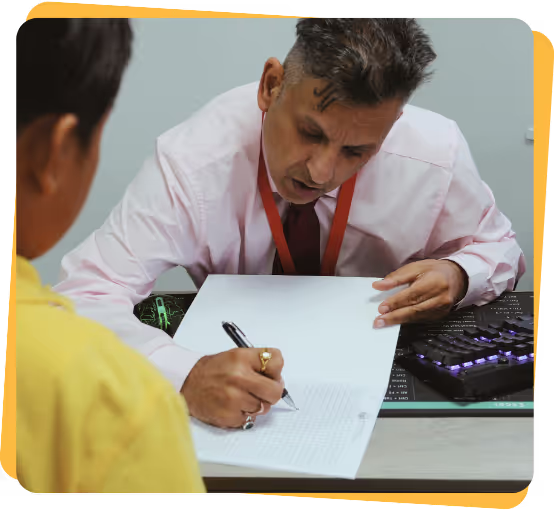
Mr Singh
Founder, Pass 11 Plus Grammar
Mr Singh is the founder of Pass 11 Plus Grammar, with over 30 years of teaching experience. Having overcome academic setbacks himself, he is passionate about ensuring no child struggles alone. His approach focuses on personalised support, strong foundations, and building confidence. He has helped students achieve outstanding results in 11+ and GCSE examinations
Loading related posts…