Loading page…
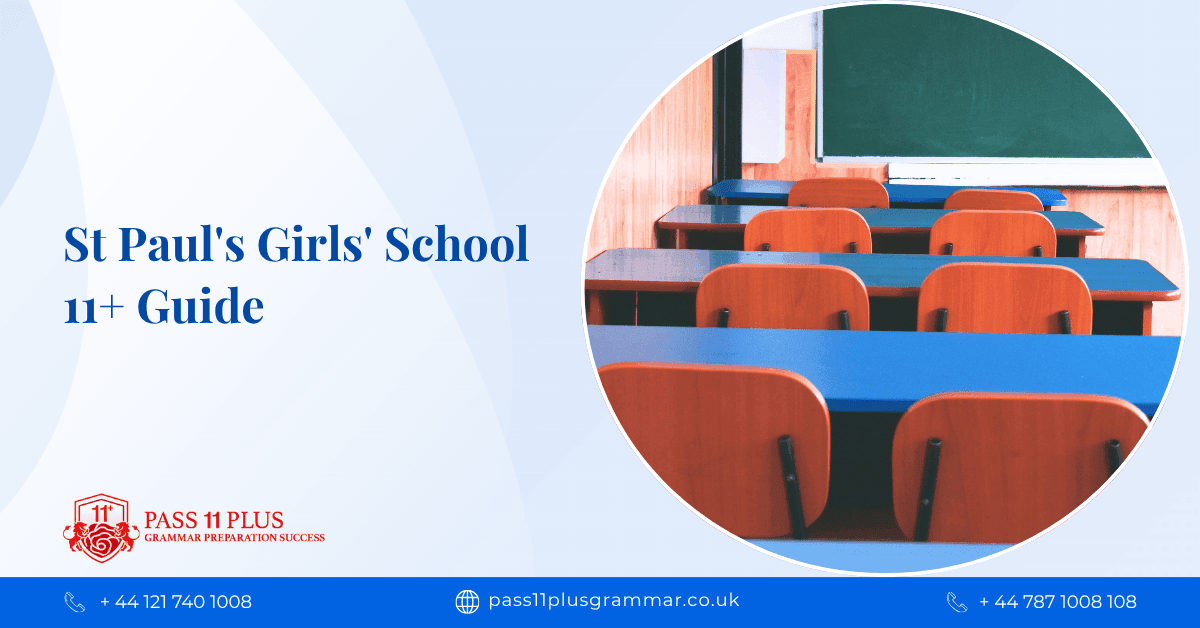
St Paul's Girls' School 11+ Guide
Published on
If your daughter is bright, curious, and loves learning, and you're considering the very best independent schools in London, then St Paul's Girls' School has almost certainly made your list. And for good reason. But with one of the most competitive 11+ admissions processes in the country, knowing exactly what to expect is essential.
This is your complete guide to the St Paul's Girls' School 11+: how admissions work, what the exams test, when to apply, what the interview involves, and how to help your daughter prepare with confidence.
Key Information
Address: Brook Green, Hammersmith, London W6 7BS
School type: Independent day school for girls
Age range: 11-18
Year 7 places: Up to 115
Open days: September and October, Year 6
Selection process: Cambridge Select Insight, written tests, interview and school reference
About St Paul's Girls' School
St Paul's Girls' School, affectionately known as SPGS, is a private day school for girls aged 11 to 18, located in Brook Green, Hammersmith, West London. It was founded in 1904 and has spent over a century building one of the most remarkable academic reputations of any school in the UK.
What sets SPGS apart is its culture. There is no school uniform, very few rules, and a strong emphasis on independent thinking, debate and creativity. The curriculum includes a real-world research programme and regular lectures from guest speakers. Co-curricular life, music, drama, sport and STEM, is exceptional, and nearly half of all students receive Oxbridge offers each year.
It is a school for girls who are not just academically able but genuinely curious about the world around them.
Key Dates for St Paul's Girls' School 11+ (2026 Entry)
9th June 2026: Applications for 2026 entry open
6th November 2026: Application and registration deadline (including bursary applications)
16th/17th November 2026: ISEB Common Pre-Test at SPGS
Late November 2026: ISEB results sent out
5th December 2026: Written examinations (English, Maths, Comprehension)
16th/24th January 2027: Interviews for shortlisted candidates
12th February 2026: Offers sent to families
2nd March 2027: Deadline to accept offers
St Paul's Girls' School Admissions Process
The St Paul's Girls' School admissions process for 11+ entry comprises three distinct stages. Understanding each one clearly is the first step in preparing effectively.
Stage 1: ISEB Common Pre-Test
Every applicant must complete the ISEB Common Pre-Test as the first stage of the St Paul's Girls' School admissions process. This is a computer-based, adaptive assessment, meaning the questions adjust in difficulty based on how your daughter answers, and it is designed to measure academic potential rather than what she has simply memorised at school.
The test covers four key areas:
Verbal Reasoning: testing language skills, word patterns, and the ability to think logically with words
English: reading comprehension and vocabulary
Maths: numerical reasoning across Key Stage 2 topics
Non-Verbal Reasoning: pattern recognition and spatial thinking using shapes and diagrams
The ISEB Pre-Test can be sat at St Paul's Girls' School itself, at your daughter's current school if it is an approved ISEB centre, or at another approved ISEB test centre, including centres overseas, which is helpful for international applicants. Results are sent out in late November, and successful candidates are then invited to sit the Stage 2 written examinations.
Stage 2: Written Examinations in English, Maths and Comprehension
This is where the St Paul's Girls' School 11+ gets truly distinctive. The written papers are unlike those at most other selective schools, and that's deliberate. SPGS is not just testing what your daughter knows; it's testing how she thinks.
There are three written papers, all sat at the school in early January.
English (1 hour 15 minutes): The English paper involves the close reading of a passage of literary prose. Your daughter will answer a series of questions, up to ten, which gradually increase in the length of response required.
There is no separate creative writing section. However, at least one question will ask your daughter to use her imagination, for example, writing from the perspective of a character in the text. Questions range from extracting information and analysing language to forming personal opinions and making hypotheses. Importantly, the answer cannot always be found in the text itself. SPGS wants to see genuine thinking, not just comprehension.
Mathematics (1 hour 15 minutes): The maths paper is split into sections and covers topics up to Key Stage 2 of the National Curriculum. But don't be fooled by that description, the level of challenge goes well beyond what most children will encounter in school.
Section A includes straightforward arithmetic as well as problem-solving questions. Section B is far more unusual: questions are multi-part and will often introduce a new concept to your daughter and then ask her to apply it. The aim is not just to test technique, but genuine mathematical insight. Working out must always be shown; incorrect answers without supporting work receive no credit.
General Comprehension (unique to SPGS): This paper is truly one of a kind. Each paper has a theme; past themes have included food, clothing, ships and shipping, and Richard III. Your daughter is given a range of materials related to that theme, which might include a scientific extract, a historical document, an artwork, a graph, or a poem. Questions span science, history, art, and beyond.
Stage 3: Interview
Candidates who are shortlisted after the written papers are invited back to SPGS for a 20-minute interview in mid-January.
The interview is conducted by one senior member of staff and focuses on creativity, engagement, and the capacity for independent thought. It is a conversation, not a formal interrogation. Interviewers often ask about family life, favourite subjects, books, hobbies, and what your daughter enjoys outside of school.
The final offers are made in February, and families typically have until March to confirm acceptance.
How to Prepare for the St Paul's Girls' School
This is where many families feel most uncertain, and it's understandable. The SPGS 11+ is genuinely demanding. But the good news is that with the right approach and enough time, your daughter can walk into that exam room feeling ready.
1. Start Early - But Don't Rush
Most families begin structured preparation in Year 4 or early Year 5. This doesn't mean drilling practice papers from age eight. It means building strong foundations in reading, maths, and thinking, the skills that underpin every single part of the SPGS exam.
A good preparation timeline looks something like this:
Year 4: Read widely, build curiosity, encourage creative thinking
Year 5: Introduce structured English and maths practice; begin verbal and non-verbal reasoning
Year 6 (September-November): Focused revision for Stage 1; timed practice; mock CEM tests
Year 6 (November-January): Prepare for written papers; practise reading complex texts; build mathematical reasoning
2. Read Everything
The SPGS English and comprehension papers both demand a child who is genuinely comfortable with complex, literary language. The best preparation is simply to read widely and often. Fiction, non-fiction, biographies, science books, newspapers, variety matters. The more your daughter reads, the richer her vocabulary, and the more natural it becomes to analyse and interpret what she's reading.
3. Build Genuine Maths Confidence
The SPGS maths paper is not about speed, it's about thinking. Your daughter needs to be confident with all Key Stage 2 topics, but more importantly, she needs to be comfortable tackling unfamiliar problems and showing her reasoning step by step. Puzzles, logic games, and multi-step problem-solving are all brilliant preparation.
4. Develop Broad General Knowledge
The SPGS general comprehension paper draws on science, history, art, geography, and more. Children who read about the world around them, not just school topics, have a real advantage here. Encourage your daughter to be curious about everything.
5. Practise Under Timed Conditions
Sitting a full practice paper under exam conditions is one of the most valuable things your daughter can do. It builds stamina, teaches time management, and exposes any weak areas before the real thing. Our 11 plus mock exams are designed to replicate the style and challenge of papers used by highly selective schools like SPGS, giving your daughter a realistic and confidence-building experience ahead of exam day.
6. Work With a Specialist Tutor
The SPGS 11+ has quirks that a general tutor may not be familiar with, particularly the comprehension paper and the unusual style of the maths Section B. Working with an expert 11 plus tutor who has specific experience with top London independents can make a significant difference. Our tutors understand exactly what SPGS is looking for, and they tailor sessions to build the skills and mindset your daughter needs.
7. Consider an Intensive Course
If your daughter is in Year 6 and time is running short, don't panic. Our 11 plus intensive courses are structured to make the most of the time available, covering key subject areas, building exam technique, and boosting confidence in a focused and efficient way.
⚠️ Limited Spaces Available
Want Your Child to Revise Smarter This Holiday?
Our intensive courses in Birmingham are designed to make the most of every school holiday. Expert tutors, small groups and a structured approach that builds real confidence fast.
The SPGS Interview: What to Expect and How to Prepare
Many parents find the interview stage the most nerve-wracking part of the St Paul's Girls' School 11+, but it really doesn't need to be. SPGS is not looking for a perfectly rehearsed, polished performance. They are looking for a genuine, curious, engaged young person who is excited about learning.
Typical interview topics include:
Family life and what your daughter enjoys doing at weekends
Her favourite subjects at school and why
Books she has read recently
Hobbies and activities outside of school
What she finds interesting or challenging
The best preparation is simply to have these kinds of conversations at home, regularly and naturally. Encourage your daughter to share opinions, explain her thinking, and speak clearly about things she genuinely cares about. A child who lights up when talking about a book she loved, or a science project she found fascinating, is exactly what SPGS wants to see.
Is St Paul's Girls' School Right for Your Daughter?
SPGS is academically exceptional, but it's also a very particular kind of school. It thrives on girls who are intellectually curious, who enjoy discussing ideas, and who relish the freedom to think independently. The lack of uniform and the school's liberal culture mean it suits children who are self-motivated and who learn best in an environment of mutual respect rather than strict structure.
If your daughter loves to ask questions, read beyond the curriculum, debate big ideas, and challenge herself, she would likely flourish at St Paul's Girls' School.
If you're also exploring grammar school options as part of your search, our grammar school admissions guide is a brilliant place to start. Understanding the full landscape of selective education helps you make the right choice for your daughter's future.
Final Thoughts
St Paul's Girls' School is one of the most exciting and rewarding schools a girl can attend, but earning a place takes real preparation and the right support. At Pass 11 Plus Grammar, we know exactly what SPGS is looking for, and we're here to help your daughter get there. If St Paul's Girls' School is the dream, let's work together to make it happen.
Frequently Asked Questions
Is St Paul's Girls' School hard to get into?
Yes, SPGS is one of the most competitive independent schools in the UK. It accepts around 110 girls a year at 11+, and successful candidates typically score in the top 5% nationally.
What is the entrance exam for St Paul's Girls' School?
The 11+ admissions process has three stages: the ISEB Common Pre-Test (a computer-based cognitive ability assessment), followed by written papers in English, Maths and Comprehension, and finally a 20-minute interview for shortlisted candidates.
Is St Paul's Girls' School a good school?
Yes, SPGS is widely regarded as one of the best schools in the UK. It was named the Sunday Times Independent School of the Year for Academic Excellence in 2025.
Mr Singh
Founder, Pass My GCSE
Mr Singh is the founder of Pass My GCSE, with over 30 years of teaching experience. Having overcome academic setbacks himself, he is passionate about ensuring no child struggles alone. His approach focuses on personalised support, strong foundations, and building confidence. He has helped students achieve outstanding results in 11+ and GCSE examinations
Loading related posts…