Loading page…
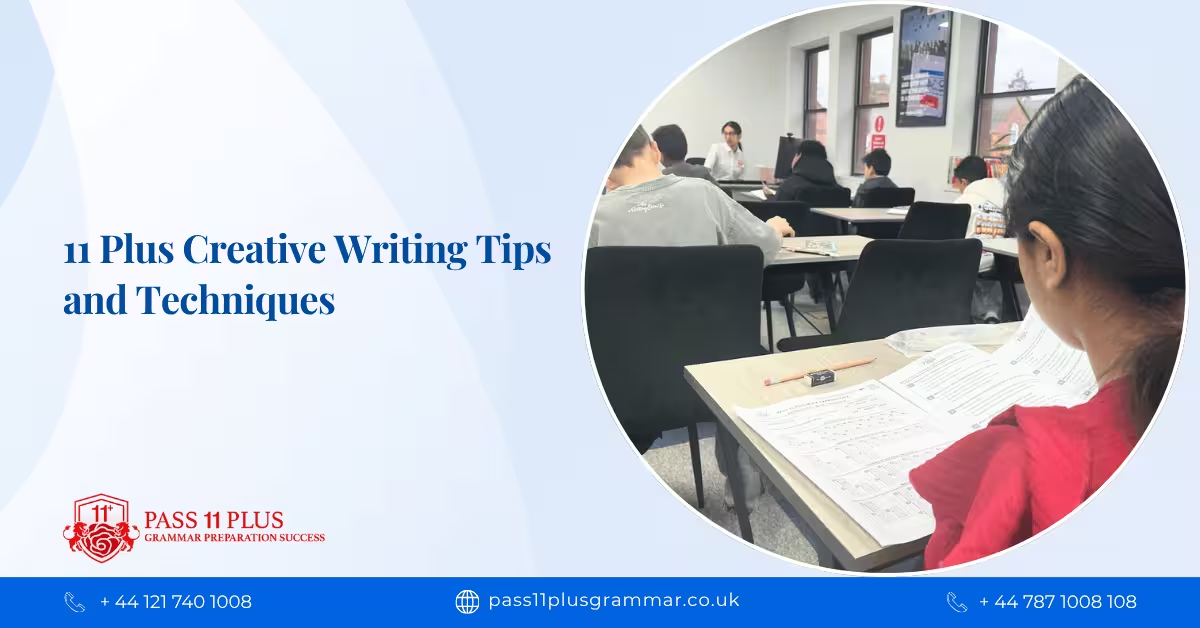
11 Plus Creative Writing Tips and Techniques
Published on
The best creative writing tips for 11 plus are: always plan first (at least five minutes mapping out beginning, middle and end); use precise vocabulary rather than the first word that comes to mind; vary sentence lengths for rhythm and impact; show emotions through actions rather than just stating feelings; use sensory language to bring your setting to life; check accuracy at the end; and practise under timed conditions regularly. Quality always beats quantity. Examiners reward focused, well-crafted writing over length.
Creative writing is one of the most rewarding parts of the 11 plus, but also one of the hardest to prepare for. These 11 plus creative writing tips will help your child plan better, write more vividly, avoid the most common mistakes and perform with confidence in the exam room.
Not every 11 plus exam includes a creative writing task. The standard GL Assessment and CEM papers do not. However, many grammar schools in Kent, Essex and West Yorkshire set their own creative writing papers, and most selective independent schools include creative writing in their entrance exams. If your child's target school includes a written task, preparation makes a significant difference to the marks they earn.
What do examiners look for in 11 plus creative writing?
Before looking at the tips, it helps to understand how creative writing is marked. Examiners look for four things in almost every school's mark scheme.
Structure
Clear beginning, middle and end
Paragraphs used purposefully
Ideas develop logically
Satisfying conclusion
Creativity and content
Original, imaginative ideas
Engaging plot or description
Convincing characters
Controlled tone and atmosphere
Vocabulary
Precise and ambitious word choices
Figurative and sensory language
Varied and appropriate language
Avoids repetition
Accuracy
Correct spelling throughout
Accurate punctuation
Grammatically correct sentences
Varied sentence structures
Quality beats quantity every time. Examiners at most selective schools specifically reward the quality of writing rather than how much has been written. A tightly written, well-structured piece of 300 words will always outscore a rambling, rushed piece of 600 words. Teach your child to write less and say more.
7 creative writing tips for the 11 plus
1. Always plan before you write
Most 11 plus creative writing tasks last 30 to 45 minutes. That feels short, but it is enough time to write a well-structured piece if your child plans first. Encourage them to spend at least five minutes before writing anything, mapping out their beginning (who, where, when), middle (the main event or tension) and end (resolution or final image). A plan takes five minutes to make and saves twenty minutes of going in the wrong direction.
Try this: Write the words "Beginning / Middle / End" on scrap paper. Under each heading, jot one sentence about what will happen. That is your plan. Now write.
2. Open with a line that pulls the reader in
The first line of a piece of creative writing sets the tone for everything that follows. A strong opening earns the examiner's attention immediately. Instead of starting with "One day..." or "My name is...", which are the most common openings and the most forgettable, encourage your child to open in the middle of the action, with a striking image, or with an unexpected statement that makes the reader want to know more.
Weak opening: "One day, Sam went to the forest."
Strong opening: "The trees had eyes. Sam was certain of it."
3. Use precise vocabulary, not the first word you think of
Examiners reward ambitious vocabulary used accurately in context. The difference between a good piece of writing and an outstanding one is often a single, precise word choice. Train your child to pause before writing a noun, verb or adjective and ask: is there a better word? Not a harder word for the sake of it, a more accurate one. "He trudged through the mud" is more precise than "he walked through the mud." "She gazed" is more powerful than "she looked." Our free 11 plus practice papers include English writing tasks to practise this habit regularly.
4. Show emotions, do not just name them
Telling the reader "she was scared" is far less effective than showing them what scared looks like. This is the most common piece of advice given to young writers, and it is the one most often ignored under exam pressure. Teach your child to describe the physical signs of an emotion, the racing heart, the dry mouth, the frozen feet, rather than labelling the emotion directly. This technique immediately makes writing feel more real and more engaging.
Telling: "He was terrified."
Showing: "His hands shook. His breath came in short, sharp bursts. He could not move."
5. Vary your sentence lengths
Writing that uses only long sentences feels slow and difficult to read. Writing that uses only short sentences feels choppy and abrupt. The best writers mix both deliberately. A long sentence builds atmosphere and draws the reader in. Then a short one hits. This combination creates rhythm, pace and impact, and it is exactly what examiners reward under the "sentence variety" criterion in mark schemes.
Try this: After two long descriptive sentences, write one sentence of four words or fewer. Read the three sentences aloud. Notice the effect.
6. Use sensory language to bring your writing to life
Most children describe what they can see. The best writers also describe what they can hear, smell, feel, and taste. Using all five senses pulls readers directly into the scene. Fog that "smells of old wood and river water" is more vivid than fog that "is thick and grey." Rain that "hammers the window like stones" is more engaging than rain that "falls heavily." Encourage your child to pick one or two senses beyond sight and use them deliberately in each scene they write.
7. Leave two minutes to check your work
Accuracy is worth significant marks in every creative writing mark scheme. Two minutes of checking at the end of a creative writing task can recover marks lost to simple errors, a missing comma, a misspelled word, a capital letter used in the wrong place. Teach your child to read their writing back silently in their head at the end, listening for anything that sounds wrong. In our 11 plus mock exams, we build checking time into every timed writing session so this habit becomes automatic well before exam day.
11 plus tuition
Want expert support with 11 plus creative writing?
We cover creative writing, comprehension, vocabulary and grammar as part of our English tuition programme - tailored to your child's target school.
How to build creative writing skills over time
Exam technique alone is not enough. The children who perform best in creative writing tasks are the ones who have been writing regularly for months before the exam. Here is how to consistently build those skills.
Read widely and often
Reading is the single most effective way to improve creative writing. Children who read across a range of genres absorb vocabulary, sentence structures and storytelling techniques without realising it. If your child enjoys a book, ask them why, what makes the descriptions vivid? Why does a particular scene feel tense? Analysing good writing teaches children how to replicate it. Our 11 plus tutors always begin English preparation with a conversation about what your child reads and enjoys, because reading habits are the clearest predictor of writing ability.
Keep a vocabulary notebook
Every new word your child encounters in their reading should go into a dedicated notebook, along with its definition and an example sentence they wrote themselves. A child who has been collecting and using ambitious vocabulary since Year 4 will write naturally at the level that earns top marks. This habit also directly supports verbal reasoning performance, since vocabulary is tested across both English and reasoning papers.
Write regularly under timed conditions
Creative writing under time pressure feels very different from writing at home with no clock. A child who has only written in relaxed conditions often freezes in the exam room. Practising timed writing tasks from early in preparation, even just one 20-minute piece per week, builds the pace and decisiveness that exams demand. Our 11 plus intensive summer course includes timed creative writing sessions every day across the summer, with expert feedback on each piece.
Start in Year 4 or Year 5. Creative writing skills grow slowly. A child who starts practising structured, timed writing in Year 4 has time to make mistakes, get feedback and genuinely improve before it counts. Our 11 plus tuition builds English skills, including creative writing, progressively from the very first session, so your child arrives at the exam with months of real writing experience behind them.
Final thoughts
Creative writing is one of the areas where a child can genuinely improve the most through structured, consistent practice. The seven tips in this guide cover both the exam technique and the craft skills your child needs. Use them together, plan every piece, open strongly, choose words carefully, show rather than tell, vary sentences, use the senses and always check the work.
The children who do best in 11 plus creative writing are not necessarily the most naturally talented writers. They are the ones who have practised regularly, received honest feedback and learned from it. Start early, write often and treat every practice piece as a chance to get a little better.
Frequently Asked Questions
What are the best 11 plus creative writing tips?
The best 11 plus creative writing tips are: always plan for at least five minutes before writing; open with a line that hooks the reader immediately; use precise and ambitious vocabulary; show emotions through actions rather than naming them; vary sentence lengths for rhythm; use sensory language beyond just sight; and leave two minutes at the end to check accuracy. Practise under timed conditions regularly so these techniques feel natural on exam day.
What do examiners look for in 11 plus creative writing?
Examiners look for four things: structure (a clear beginning, middle and end with purposeful paragraphs), creativity (original ideas, convincing characters, controlled atmosphere), vocabulary (precise, varied and ambitious word choices used accurately in context), and accuracy (correct spelling, punctuation and grammar with varied sentence structures).
Which grammar schools include creative writing in their 11 plus?
Creative writing is not included in standard GL Assessment or CEM papers. However, many individual grammar schools include it in their own tests. These include Kent grammar schools (40-minute creative writing exercise as part of the Kent Test), Essex CSSE schools, and schools in West Yorkshire, Berkshire, Devon, Lancashire and North Yorkshire that use Future Stories Community Enterprise papers. Many selective independent schools also include creative writing in their entrance exams.

Mr Singh
Founder, Pass 11 Plus Grammar
Mr Singh is the founder of Pass 11 Plus Grammar, with over 30 years of teaching experience. Having overcome academic setbacks himself, he is passionate about ensuring no child struggles alone. His approach focuses on personalised support, strong foundations, and building confidence. He has helped students achieve outstanding results in 11+ and GCSE examinations
Loading related posts…