Loading page…
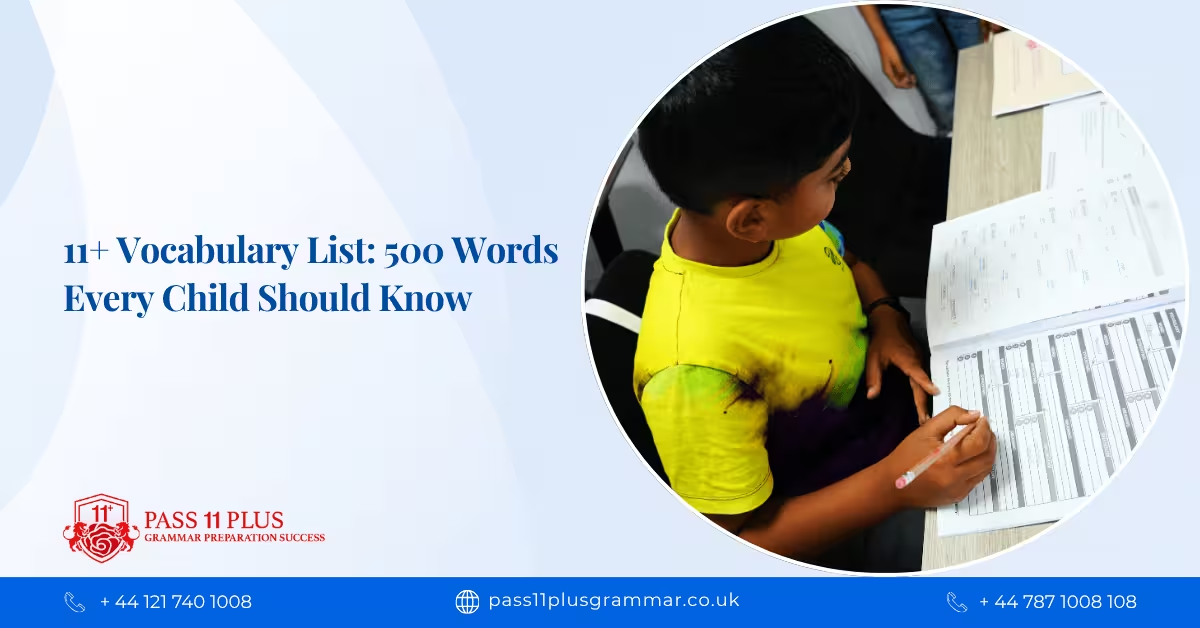
11+ Vocabulary List: 500 Words Every Child Should Know
Published on
The 11 plus vocabulary list covers words well beyond everyday primary school language. Both GL Assessment and CEM test vocabulary through synonym and antonym questions in verbal reasoning, comprehension passages in English, and creative writing tasks. There is no single official list published by either exam board. The best approach is to learn words grouped by theme: emotions, character, nature, movement, persuasion, science, history and the arts, so your child understands how words connect to each other rather than memorising isolated definitions.
This guide gives you 500 carefully chosen words across 10 themes, plus synonym and antonym pairs, word root shortcuts, and a seven-step plan for building vocabulary from Year 4 onwards.
Vocabulary is tested in almost every part of the 11 plus, from verbal reasoning synonym and antonym questions to English comprehension and creative writing. This is our complete 11 plus vocabulary list of 500 words, organised by theme, covering both GL Assessment and CEM exam boards, with tips on how to actually learn and use every word on it.
Why vocabulary matters so much in the 11 plus
Here is something many parents do not realise until quite late in the preparation process. Vocabulary is not just tested in the English paper. It is tested everywhere. A child with a strong vocabulary has an advantage in verbal reasoning, comprehension, creative writing and even the way they interpret maths word problems. Vocabulary knowledge is the single most transferable skill in the 11 plus.
Both GL Assessment and CEM expect children to understand and use words well beyond the Key Stage 2 curriculum. These are not trick words. They are words that well-read, intellectually curious children encounter naturally through books, conversation and learning about the world. The problem is that children who have not been exposed to these words, even very bright children, will find verbal reasoning questions on synonyms and antonyms surprisingly difficult, simply because the words are unfamiliar.
Vocabulary builds on itself. A child who understands the word "tenacious" is also more likely to understand "tenacity," "tenaciously" and "untenable." A child who knows the Latin root "bene" (meaning good) can decode "beneficial," "benevolent," "benefactor" and "benediction" even if they have never seen those words before. This is why learning vocabulary through themes and roots is so much more powerful than learning lists of unconnected words.
11 plus vocabulary list - 500 words by theme
This vocabulary list for 11 plus contains 500 words organised into 10 themes. Each theme covers words that appear regularly in GL Assessment and CEM papers, and in comprehension passages and creative writing tasks across all grammar school regions.
Do not try to learn all 500 at once. Work through one theme at a time, spending a week or two on each group. Read each word in a sentence, look up any definitions you are not sure about, and encourage your child to use new words in their own writing and conversation.
1. Emotions and feelings
Words for how characters feel - essential for comprehension and creative writing
amused
empathetic
exultant
resolute
anxious
desolate
dismayed
irritable
sullen
elated
melancholy
apprehensive
forlorn
jubilant
despondent
perturbed
wistful
indignant
serene
turbulent
remorseful
elusive
conflicted
nostalgic
anguished
bewildered
disgruntled
restless
wretched
triumphant
bashful
radiant
pensive
agitated
sheepish
wary
baffled
composed
fraught
disconcerted
petrified
euphoric
humiliated
mortified
overwhelmed
resigned
suspicious
thunderstruck
vexed
zestful
Exam tip: Comprehension questions often ask "how does the character feel at this point?" Your child should pick the most precise word rather than a vague one. "Apprehensive" is more precise than "scared." "Melancholy" is more precise than "sad."
2. Character and personality
Words for describing people - frequent in verbal reasoning and comprehension
astute
diligent
tenacious
taciturn
selfless
ingenious
resourceful
visionary
intrepid
cantankerous
impeccable
jocular
meticulous
obstinate
scrupulous
vehement
zealous
diffident
gregarious
stoic
volatile
prudent
audacious
frugal
benevolent
callous
candid
crafty
duplicitous
earnest
fervent
forthright
imperious
inquisitive
judicious
magnanimous
naive
obsequious
pedantic
querulous
reckless
sanguine
sanctimonious
shrewd
steadfast
sulky
timid
wily
virtuous
vain
Exam tip: In verbal reasoning, synonym questions on character words are very common. Know the differences between similar words: "astute" (clever and perceptive), "shrewd" (clever in a practical way), "wily" (clever in a cunning way). These are synonyms but carry different shades of meaning.
3. Nature, weather and landscape
Comprehension passages frequently use natural settings - know the vocabulary
verdant
majestic
serene
tempestuous
foamy
briny
canopy
scorching
drizzle
chilly
barren
lush
arid
murky
tranquil
desolate
ethereal
pristine
rugged
sweeping
cascading
billowing
dappled
gnarled
parched
shimmering
smouldering
sodden
sweltering
withered
abundant
bleak
blustery
cavernous
craggy
dewy
glacial
looming
luminous
misty
overcast
placid
radiant
rippling
rustling
stagnant
stark
sultry
thunderous
torrential
Exam tip: In creative writing, the examiner rewards specific, precise descriptive words. "Verdant meadow" is far stronger than "green field." "Tempestuous sea" shows vocabulary range in a way "rough sea" does not.
4. Movement and action
Precise movement words improve creative writing scores significantly
trudge
scurry
stagger
lunge
dart
glide
wander
creep
stumble
waver
propel
ascend
linger
saunter
stride
meander
scramble
swagger
tiptoe
vault
plunge
reel
swoop
lurk
prowl
skulk
bound
clamber
crawl
dither
edge
flail
flinch
hasten
hover
hurtle
limp
lurch
plod
retreat
shuffle
sidle
slither
spin
sprint
stalk
stomp
teeter
thrash
weave
Exam tip: Movement words are one of the fastest ways to improve creative writing marks. A child who writes "he walked" gets fewer marks than one who writes "he trudged" or "he skulked" or "he staggered." Encourage your child to collect and practise movement words specifically.
5. Persuasion, argument and communication
Words for how people convince, debate and express ideas, common in both papers
advocate
assert
convince
refute
rebuke
contradict
counterargument
justify
persuade
exaggerate
emphasise
proclaim
dispute
challenge
criticise
negotiate
deliberate
postulate
speculate
vindicate
denounce
decry
endorse
implore
accuse
concede
convey
debate
deflect
discredit
dismiss
elaborate
elicit
exhort
lecture
manipulate
mediate
murmur
mutter
oppose
placate
propose
provoke
ramble
retort
snarl
stipulate
urge
verify
warn
Exam tip: In comprehension passages, identifying how a character is speaking (murmuring vs proclaiming vs snarling) tells you a lot about their emotional state. Understanding these words helps children answer inference questions much more accurately.
11 Plus Tuition
Want expert support with 11 plus English and verbal reasoning?
We cover vocabulary, synonyms, antonyms, comprehension and creative writing as part of every tuition programme, targeted to your child's specific exam board.
6. Conflict, challenge and resilience
Narrative passages regularly feature tension and struggle - know these words
adversity
resilient
endure
persist
rivalry
strive
relentless
determined
hardship
peril
turmoil
devastation
collapse
escalate
perish
wreckage
overcome
withstand
prevail
surrender
confront
defiance
disobedient
empower
retaliate
sabotage
undermine
jeopardise
aggressive
belligerent
combative
contentious
defiant
ferocious
fierce
formidable
hostile
menacing
oppressive
ruthless
tenacious
turbulent
unyielding
vigorous
volatile
vulnerable
wretched
courageous
forbearing
perseverance
7. Leadership, power and morality
Historical and political comprehension passages use these words heavily
charismatic
decisive
steadfast
authoritative
influential
commanding
mentor
delegate
impartial
integrity
righteous
lawful
deceit
disloyal
manipulation
traitor
corrupt
tyrannical
dictatorial
oppressive
autocratic
dominant
sovereign
supreme
subservient
compliant
docile
subversive
treacherous
conspire
betray
allegiance
loyalty
magnanimous
merciful
noble
principled
unjust
virtuous
wicked
reformist
revolutionary
radical
progressive
conservative
moderate
conciliatory
diplomatic
assertive
passive
8. Science, discovery and the environment
Non-fiction comprehension passages often have a science or nature angle
biodiversity
ecosystem
erosion
sustainable
renewable
conservation
adaptation
organism
groundbreaking
revolutionary
pioneer
breakthrough
hypothesis
theory
observation
logical
analytical
systematic
empirical
objective
photosynthesis
atmosphere
precipitation
magnitude
innovative
artificial
device
mechanism
fundamental
complex
intricate
phenomenon
significant
negligible
profound
substantial
fluctuate
diminish
accelerate
accumulate
deplete
generate
harness
mitigate
monitor
preserve
restore
transform
vital
irreversible
9. History, society and culture
Many comprehension passages are set in historical or social contexts
civilisation
dynasty
monarchy
parliament
revolution
era
medieval
sovereignty
alliance
treaty
truce
campaign
equality
protest
reform
transformative
heritage
ancestry
folklore
festivity
multicultural
urbanisation
diverse
inclusive
commemorate
repercussion
consequence
trigger
abolish
colonise
emancipate
liberate
oppress
persecute
subjugate
tyrannise
aristocracy
democracy
republic
feudal
imperial
indigenous
nomadic
prehistoric
propaganda
regime
uprising
epidemic
famine
migration
10. The arts, literature and imagination
Literary terms and creative vocabulary strengthen both English papers
imagery
foreshadow
metaphor
simile
tone
atmosphere
narrative
perspective
symbolism
contrast
monologue
portrayal
dramatic
whimsical
inventive
imaginative
resonate
harmony
rhythm
melody
abstract
symmetry
texture
depict
eloquent
poignant
evocative
vivid
haunting
lyrical
melancholic
satirical
allegorical
didactic
epistolary
ironic
paradoxical
rhetorical
subjective
thematic
alliteration
hyperbole
onomatopoeia
personification
protagonist
antagonist
subplot
resolution
climax
denouement
Exam tip: Knowing literary terms helps children identify techniques in comprehension passages and describe them accurately. "The author uses personification to make the storm seem threatening" earns more marks than "the storm is described as if it is alive."
How vocabulary is tested in GL Assessment and CEM
Understanding how vocabulary is tested helps you prepare for the right things. Here is exactly what your child will face in each part of the exam.
Synonyms and antonyms
Choose the word closest in meaning to a given word
Choose the word most opposite in meaning
Select the best word to complete a sentence
Find the word that belongs to a group
Example: Which word is closest in meaning to "tenacious"? Options: fragile, persistent, weary, hasty, cheerful
Odd one out
Identify the word that does not belong in a group
Find the pair of words that share a connection
Spot the word with a different connotation from the rest
Group words by category or relationship
Example: Which word is the odd one out? resolute, steadfast, tenacious, timid, determined
Comprehension vocabulary
Understand the meaning of a word in context
Rephrase a sentence using different words
Explain what a word or phrase suggests about a character
Select the word that best fits a gap in a passage
Example: What does the word "desolate" suggest about the character's feelings at this point in the story?
Creative writing vocabulary
Use precise and varied vocabulary in own writing
Avoid repetition by choosing alternatives
Match vocabulary to tone (formal, informal, descriptive)
Use ambitious language to impress the examiner
Instead of "he walked slowly," a child with strong vocabulary might write "he trudged" or "he meandered" or "he shuffled."
GL Assessment vs CEM: GL Assessment verbal reasoning papers test vocabulary more directly through dedicated synonym, antonym and word-connection question types. CEM papers embed vocabulary testing within reading comprehension and cloze exercises, making the vocabulary feel more contextual. There is no officially published word list for either board. A broad, theme-based vocabulary preparation programme works well for both.
Key synonym and antonym pairs to know
Synonym and antonym questions are among the most common question types in 11 plus verbal reasoning papers. Knowing word pairs, not just isolated definitions, is what makes these questions fast to answer. Here are 18 high-frequency words with their closest synonym and opposite.
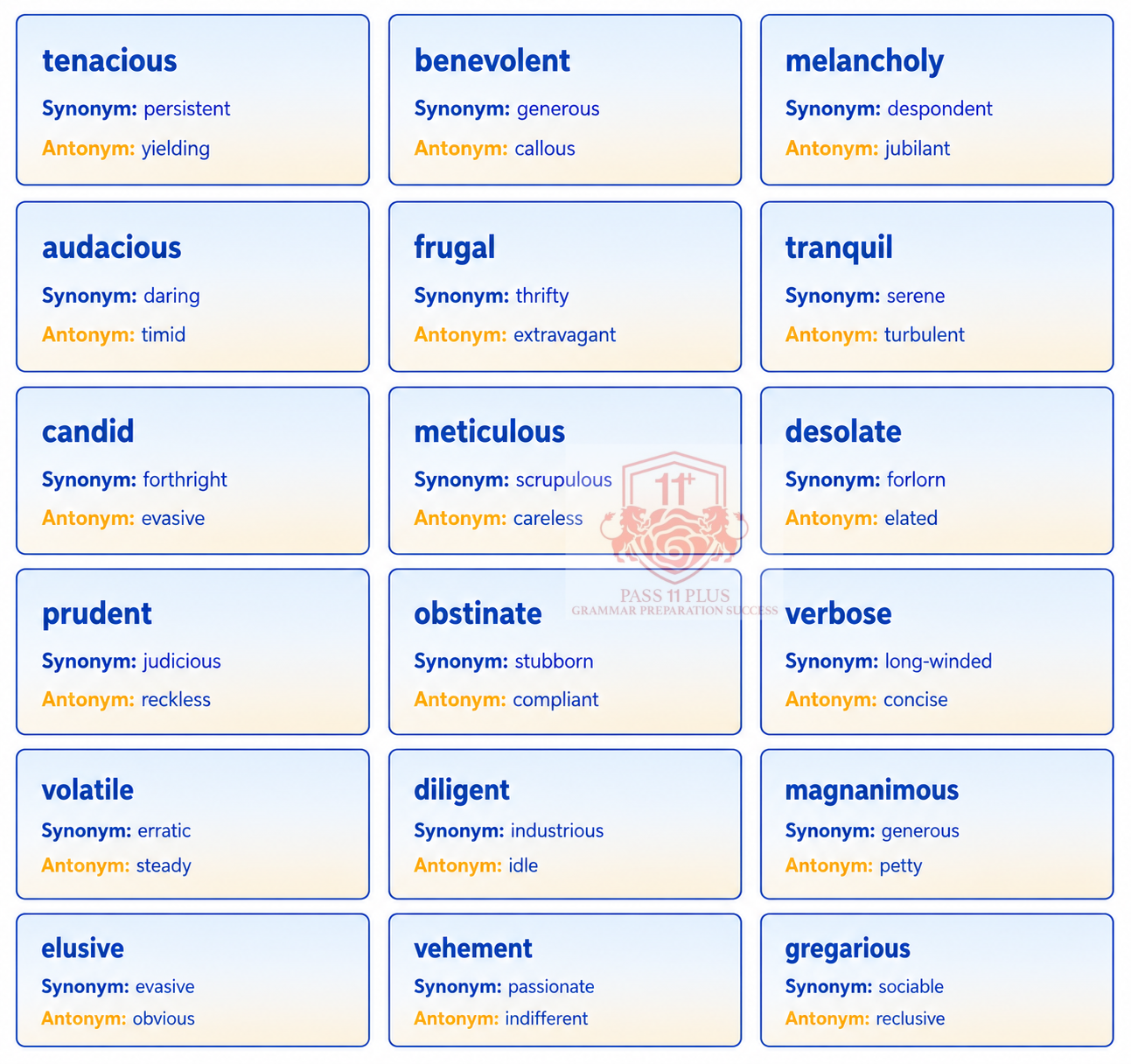
Practise both directions. Your child should be able to find synonyms and antonyms for each word. In verbal reasoning, questions come from both angles. A child who knows "tenacious" means persistent should also know its opposite is something like "yielding" or "spineless."
Word roots that unlock hundreds of words at once
This is the single biggest shortcut in 11 plus vocabulary preparation. Many English words come from Greek and Latin roots. A child who knows 20 key roots can decode hundreds of unfamiliar words they have never seen before, including words that are not on any vocabulary list.
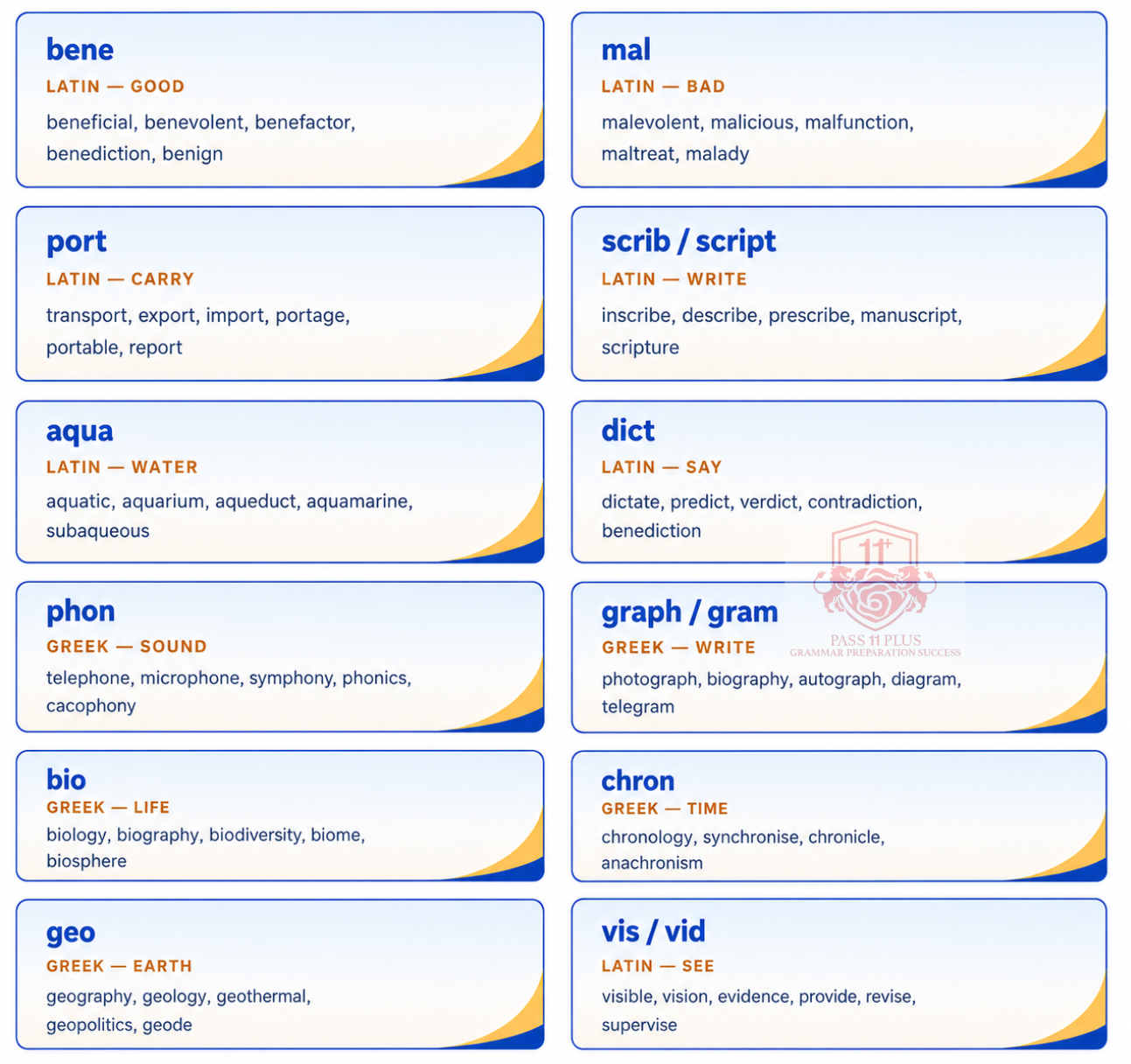
One root, many words. If your child knows that "mal" means bad, they can work out that "malevolent" (mal + volent, meaning "wishing bad") describes someone who wishes harm. They can decode "malicious," "maltreat" and "malady" even without having seen those words before. Spend five minutes a week on one new root and the payoff builds fast.
7 ways to build your child's vocabulary before the exam
The vocabulary list for 11 plus is only useful if your child actually learns the words on it. Here is a practical seven-step approach that works for children from Year 4 onwards.
1. Read widely every day - it is the most natural way to build vocabulary
Children who read regularly across a variety of genres build vocabulary faster than those who do not. Written language uses far more words than spoken language, and reading exposes your child to words in context, which is the most effective way to absorb their meaning. Aim for at least 15 minutes of reading a day, mixing fiction, non-fiction, history, science and current events. Our 11 plus tutors always recommend building a reading habit in Year 4 as the single most valuable vocabulary investment a family can make.
2. Learn words in themed groups, not random lists
Random word lists are hard to remember because nothing connects the words to each other. When your child learns 50 emotion words together, the words reinforce each other. They start to see that "forlorn," "desolate" and "despondent" are all in the same family, and that knowing one makes the others easier to remember and distinguish.
3. Study Greek and Latin word roots
As shown in the section above, learning 20 key roots gives your child a tool for decoding hundreds of words they have never seen before. This is especially valuable in verbal reasoning, where unfamiliar words appear regularly. Spend five minutes a week on one new root and test your child on words built from it at the end of the week.
4. Keep a personal vocabulary notebook
When your child comes across a new word, in a book, in a comprehension passage or in a practice paper, they write it in their notebook with the definition, a synonym, an antonym and one example sentence they wrote themselves. Writing the sentence is key. It forces your child to understand the word deeply enough to use it, not just recognise it.
5. Play word games to make learning enjoyable
Scrabble, Boggle, crosswords and word searches all build vocabulary in a low-pressure, engaging way. Vocabulary quiz apps and card games designed for 11 plus preparation are also useful. The goal is to make word learning feel normal and enjoyable rather than like revision, so that it happens naturally and consistently over months.
6. Use new words in real conversation and writing
The most reliable way to make a word truly stick is to use it out loud or in writing. When your child learns "tenacious," encourage them to use it naturally in conversation over the next few days. When they are writing a story for school, encourage them to reach for three words from their vocabulary list. Words that have been actively used are far more securely stored than words only passively read.
7. Practise synonym and antonym questions regularly under timed conditions
Knowing a word is not the same as being able to retrieve it quickly under exam pressure. Use our free 11 plus practice papers to give your child regular timed exposure to synonym, antonym and word-connection questions in the GL Assessment format. Doing one paper per week builds the retrieval speed that makes vocabulary useful on exam day, not just in theory. Our 11 plus mock exams also include full verbal reasoning papers with vocabulary sections, giving your child experience of performing at pace in real exam conditions.
Start in Year 4. Vocabulary is built slowly through repeated exposure over months and years, not through last-minute cramming. A child who learns 10 new words a week from the start of Year 4 will have a vocabulary of over 500 above-average words before they sit the exam in September. Our 11 plus intensive summer course builds vocabulary practice into every English session in the final weeks before the exam, but the best results always come to children who started building their word bank early.
Final thoughts
A strong 11 plus vocabulary list is not a document to be memorised in one sitting. It is a resource to be worked through slowly, one theme at a time, over the course of a year or more.
Use the 500 words in this guide as a foundation. Add your child's own discoveries from their reading. Build a personal vocabulary notebook. Practise synonyms and antonyms regularly. And start early, in Year 4 if possible, so that by the time September arrives, the words feel like old friends rather than strangers on a page.
Frequently Asked Questions
What kind of vocabulary is tested in the 11 plus?
The 11 plus tests vocabulary in several ways. In verbal reasoning, children select synonyms and antonyms, spot the odd word out, and find connections between word pairs. In English comprehension, children must understand words in context. In creative writing, children are assessed on vocabulary range and precision. Both GL Assessment and CEM draw on words well beyond everyday primary school language.
Is the 11 plus vocabulary list the same for GL Assessment and CEM?
There is no officially published vocabulary list for either exam board. Both GL Assessment and CEM draw on advanced English vocabulary beyond the Key Stage 2 curriculum, and the words overlap significantly. GL Assessment tests vocabulary more directly through synonym and antonym questions. CEM embeds vocabulary testing within comprehension and cloze exercises.
What is the best way to learn vocabulary for the 11 plus?
The best ways are: read widely every day; learn words in themed groups rather than random lists; study Greek and Latin word roots; play word games; keep a personal vocabulary notebook with definitions, synonyms and example sentences; use new words in real conversation and writing; and practise synonym and antonym questions regularly under timed conditions.
When should a child start learning 11 plus vocabulary?
Start in Year 4 or early Year 5, at least 12 months before the exam. Vocabulary is built slowly through repeated exposure over time, not through last-minute cramming. A child who reads widely and learns 10 new words a week from Year 4 will have a working vocabulary of 500 or more above-average words by the time they sit the exam.

Mr Singh
Founder, Pass 11 Plus Grammar
Mr Singh is the founder of Pass 11 Plus Grammar, with over 30 years of teaching experience. Having overcome academic setbacks himself, he is passionate about ensuring no child struggles alone. His approach focuses on personalised support, strong foundations, and building confidence. He has helped students achieve outstanding results in 11+ and GCSE examinations
Loading related posts…