Loading page…
11 Plus Exam Questions: Examples and Answers for Maths, English, Verbal and Non-Verbal Reasoning
Published on
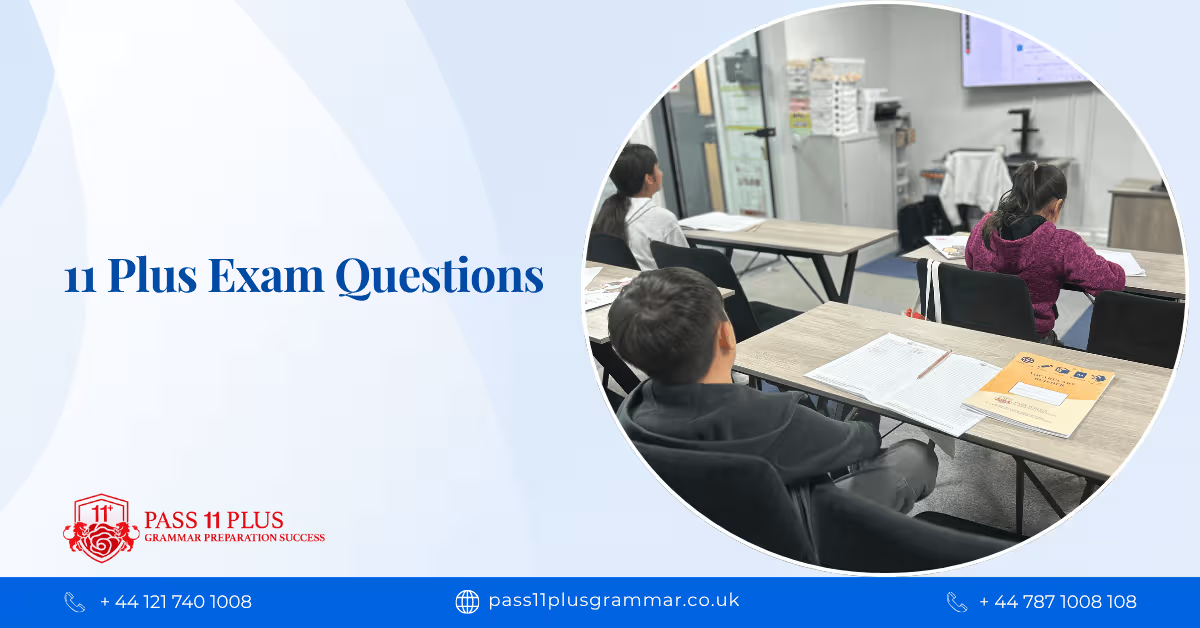
11 plus exam questions are short, fast and mostly multiple choice. A full GL Assessment 11 plus has around 260 questions across four papers: roughly 50 maths questions in 50 minutes, 50 to 56 English questions in 45 to 50 minutes, 80 verbal reasoning questions in 50 minutes, and 80 non-verbal reasoning questions in four timed sections. Many schools use only two or three of these papers. Individually the questions are not hard, because they sit at the top end of the Key Stage 2 curriculum. The difficulty is speed, and the fact that verbal and non-verbal reasoning are never taught in primary school.
Most parents have never seen a real 11 plus paper, so the exam feels like a mystery. This guide takes the mystery away. Here are example 11 plus exam questions across all four subjects, every single one with a worked answer, plus exactly how many questions your child will face and how hard they really are.
What do 11 plus exam questions actually look like?
Let us start by clearing up the biggest worry parents have. 11 plus exam questions are not trick questions. They are not designed to catch your child out, and they are not university level maths hidden in a primary school paper.
Almost every question is short. Many are one line long. Your child reads it, works it out, and shades a box on an answer sheet. Then they do it again, around 260 times across a full set of papers.
That is really the whole story. The 11 plus is not a test of deep knowledge. It is a test of how quickly and accurately a child can apply what they already know, over and over, under a clock.
Our 11 plus tuition is built around exactly these question types. We teach the content first, then the method for each question type, then the speed. In that order, every time, because doing it in any other order simply creates anxious children.
How many questions are there in the 11 plus exam?
This is one of the most common questions we get asked, and the honest answer is that it depends on which papers your child's school sets. But here are the typical numbers.
Paper | Questions |
Maths | Around 50 |
English | Around 50 to 56 |
Verbal reasoning | Around 80 |
Non-verbal reasoning | Around 80, in four sections of 20 |
All four papers | Around 260 |
Most grammar schools do not use all four papers. A very common combination is maths, English and verbal reasoning, which brings the total down to around 180 questions. Some schools use maths and English only, at around 100 questions. Others use all four.
CEM style papers work differently again. Instead of one long paper per subject, they use several short timed sections that mix subjects together, so the count varies a lot between regions.
Are 11 plus questions always multiple choice?
Mostly, yes. GL Assessment papers, which most grammar schools now use, are almost entirely multiple choice. Your child reads the question in the booklet and shades a box on a separate answer sheet.
Some regions and independent schools use what is called standard format, where children write their answer in the space provided. CSSE in Essex uses written answers only and adds a full creative writing task.
The multiple-choice format brings one enormous advantage, and it is the single easiest mark to gain in the whole exam.
The other thing that catches children out is the answer sheet itself. It sounds trivial, but every year some children lose serious marks by shading the wrong row after skipping a question. Practising with a real answer sheet, not just writing in a book, is essential. Our 11 plus mock exams use proper answer sheets under full exam conditions for exactly this reason.
11 plus maths questions: 10 examples with answers
Maths is the most widely used 11 plus paper, so it is where most families start. The 11 plus exam questions maths section covers the Key Stage 2 curriculum, with a heavy emphasis on number and on problem solving.
The ten questions below sit at the upper end of the difficulty your child should expect. If they can handle these, they are in good shape. Do not worry if they cannot do all of them yet, because no child is expected to get everything right.
1. What is 148.7 + 36.4 + 9.85?
Answer: 194.95
Line up the decimal points before adding. 148.7 plus 36.4 is 185.1, then add 9.85 to get 194.95. The trap here is the different numbers of decimal places, so write 148.70 and 36.40 to keep the columns tidy.
2. How many square centimetres are there in 12.5 square metres?
Answer: 125,000 square centimetres
One square metre is 100cm by 100cm, which is 10,000 square centimetres. So 12.5 times 10,000 gives 125,000. Children who multiply by 100 instead of 10,000 get this wrong, so drawing the square once is worth it.
3. Write 54/12 as a mixed number in its simplest form.
Answer: 4 and a half
12 goes into 54 four times with 6 left over, giving 4 and 6/12. Then simplify 6/12 to 1/2. Two steps, and children often stop after the first one.
4. What is -15 + 9 - 6 + 20?
Answer: 8
Work strictly left to right. -15 plus 9 is -6. Then -6 minus 6 is -12. Then -12 plus 20 is 8. A number line drawn quickly in the margin prevents almost every mistake here.
5. Find the missing number in this sequence: 4, 11, 18, 25, ?
Answer: 32
The gap between each pair of numbers is 7. So the next term is 25 plus 7, which is 32. Always write the differences underneath the sequence before answering.
6. A car park holds 450 cars. 288 of them are silver. What percentage of the cars are not silver?
Answer: 36 percent
First find how many are not silver: 450 minus 288 is 162. Then 162 divided by 450 is 0.36, which is 36 percent. The trap is answering for the silver cars instead. Underlining the word "not" in the question is a habit worth building.
7. What is the digit in the thousandths place in 47,308.4526?
Answer: 2
After the decimal point the places run tenths, hundredths, thousandths, ten thousandths. So 4 is tenths, 5 is hundredths and 2 is thousandths. Place value questions like this appear in almost every paper.
8. How many factors does the number 36 have?
Answer: 9 factors
They are 1, 2, 3, 4, 6, 9, 12, 18 and 36. List them in pairs working inwards: 1 and 36, 2 and 18, 3 and 12, 4 and 9, then 6 which pairs with itself. Square numbers always have an odd number of factors.
9. You are facing north-east. You turn 135 degrees clockwise, then 180 degrees anticlockwise. Which direction are you now facing?
Answer: North
North-east is 45 degrees. Turning 135 degrees clockwise takes you to 180 degrees, which is south. Turning 180 degrees anticlockwise from there brings you back to 0 degrees, which is north. Sketching a compass rose takes five seconds and saves the mark.
10. A rectangle has a perimeter of 44cm. Its length is 4cm longer than its width. What is its area?
Answer: 117 square centimetres
Perimeter 44 means length plus width is 22. If the length is 4 more than the width, then twice the width plus 4 equals 22, so the width is 9cm and the length is 13cm. Area is 9 times 13, which is 117 square centimetres. This is a classic three step problem.
If your child needs to build these habits from scratch, working through free 11+ practice papers with the answer key beside you is the fastest way to see where the marks are being dropped.
11 plus English questions: 10 examples with answers
Primary schools cover most of the English curriculum well, but 11 plus English questions still catch children out because they demand more precision and more speed than classroom work. The paper mixes comprehension with spelling, punctuation, grammar and vocabulary.
1. In this sentence, which words are adjectives? The old wooden gate creaked in the bitter wind.
Answer: old, wooden, bitter
All three describe a noun. "Old" and "wooden" describe the gate, and "bitter" describes the wind. Children often add "creaked", but that is a verb telling us what the gate did.
2. Change this sentence into a question: He lost his keys last night.
Answer: Did he lose his keys last night?
Note that the verb changes from "lost" to "lose" once "did" is added. Writing "Did he lost" is the most common slip in this question type.
3. Put the commas in the correct places: For the picnic we packed sandwiches crisps grapes and a flask of tea.
Answer: For the picnic we packed sandwiches, crisps, grapes and a flask of tea.
Commas separate items in a list, and in British usage the final "and" replaces the last comma. Do not add a comma before "and" unless the exam board specifically teaches the Oxford comma.
4. Which word is an antonym of "scarce"?
Options: rare, limited, plentiful, sparse
Answer: plentiful
Three of the four options are synonyms of scarce, which is a very common trap. Read every option before choosing, because the odd one out is the answer.
5. Which conjunction fills the gap? She had no sooner entered the house ___ the phone rang.
Answer: than
"No sooner" is always paired with "than", never with "when". This is a fixed pairing that simply has to be learnt, in the same way as "hardly" pairs with "when".
6. What is the meaning of the prefix "post"?
Answer: after
As in postpone, postscript and post-war. Knowing thirty common prefixes and suffixes lets a child work out the meaning of hundreds of unfamiliar words, which is why prefix work pays off far beyond spelling questions.
7. Which of these is spelled correctly?
Options: neccessary, necesary, necessary, necassary
Answer: necessary
One c and two s letters. A useful memory hook is that a shirt has one collar and two sleeves. Spelling questions in GL papers usually give four near identical options, so children must slow down and look letter by letter.
8. Punctuate this sentence correctly: the boy who won the race is my cousin
Answer: The boy who won the race is my cousin.
A capital letter and a full stop, and nothing else. No commas are needed because "who won the race" tells us which boy, so it is essential to the meaning. Some papers include a question like this deliberately, to see whether children add punctuation that is not needed.
9. How many syllables are in the word "communication"?
Answer: 5
Com, mu, ni, ca, tion. Have your child tap the beats on the desk or place a hand under the chin, since the chin drops once per syllable.
10. Read this line from a story, then answer the question below. Priya read the letter twice, folded it very carefully, and placed it at the bottom of the drawer. What does this suggest about how Priya feels?
Answer: That the letter matters to her and she wants it kept private
This is an inference question, and inference is the hardest part of 11 plus English. Nothing in the sentence states a feeling. The clues are "twice", "very carefully" and "the bottom of the drawer". Children must learn to answer what the words suggest, not what they say.
11 plus verbal reasoning questions: 10 examples with answers
11 plus verbal reasoning questions deserve special attention, because this subject is not taught in primary school at all. A bright child who has never seen a letter code question will freeze the first time they meet one, and then fly through them after a few weeks of practice.
That is the good news about verbal reasoning. It is the subject where focused practice produces the fastest visible improvement of any 11 plus paper.
1. Move one letter from the first word to the second word to make two new words. The letters must not be rearranged. BEAST, RIP
Answer: BEAT and RIPS
Take the S from BEAST, leaving BEAT, and add it to the end of RIP to make RIPS. Both new words must be real words, which is what rules out the other options.
2. If A = 2, B = 3, C = 4, and D = 6, what is (D divided by A) plus (C times B)?
Answer: 15
D divided by A is 6 divided by 2, which is 3. C times B is 4 times 3, which is 12. Then 3 plus 12 is 15. Substitute the numbers in first, then calculate. Doing both at once causes errors.
3. Which word goes with all three of these? FOOT, BASE, NET
Answer: BALL
Football, baseball and netball. Try the missing word at the end first, then at the beginning, and test it against every word before committing.
4. Find the letter that ends the first word and begins the second word: clim ( ? ) all
Answer: B
Climb and ball. Work through the alphabet quickly if nothing jumps out, but check both words each time. A letter that completes only one of the two is not the answer.
5. There is a six letter word hidden across two words in this sentence. Find it. We must plan Eton's visit for June.
Answer: PLANET
It is hidden in "plan Eton". Hidden words always run across the end of one word and the start of the next, never inside a single word. Teach your child to look at every word join in turn.
6. What is the next number in this sequence? 3, 6, 11, 18, 27,?
Answer: 38
The differences are 3, 5, 7 and 9, so they increase by 2 each time. The next difference is 11, and 27 plus 11 is 38. When the first set of differences is not constant, look at the differences between the differences.
7. Which is the odd one out? robin, sparrow, salmon, blackbird, wren
Answer: salmon
The other four are birds and salmon is a fish. Odd one out questions can be based on meaning, spelling or word structure, so if the meaning does not give an answer, look at the letters instead.
8. What comes next? AB, DE, GH, JK, ?
Answer: MN
Each pair skips one letter of the alphabet. After A and B comes C, which is skipped, then D and E, and so on. After J and K comes L, which is skipped, giving M and N. Writing the alphabet along the top of the page is allowed and saves a lot of time.
9. If SUNDAY is written in code as TVOEBZ, how would MONDAY be written?
Answer: NPOEBZ
Every letter moves forward one place in the alphabet. S becomes T, U becomes V, and so on. Apply the same rule to MONDAY: M becomes N, O becomes P, N becomes O, D becomes E, A becomes B, Y becomes Z.
10. Sam is taller than Ravi. Ravi is taller than Leo. Priya is shorter than Leo. Who is the tallest?
Answer: Sam
Put them in order as you read: Sam, then Ravi, then Leo, then Priya. Logic questions become easy once children learn to build the list on paper instead of holding it in their heads.
This is exactly the sort of gap our 11 plus tutors are trained to close. They teach the method for each of the twenty one standard question types, then drill them until recognition becomes automatic.
11 plus non verbal reasoning questions: 10 examples with answers
Non-verbal reasoning is the paper parents worry about most, and understandably so. The questions are made of shapes rather than words, they look strange at first glance, and there is nothing in the school curriculum that resembles them.
Here is the reassuring truth. 11 plus non verbal reasoning questions come in a small number of fixed types. Once your child recognises the type, the method is always the same. Children usually go from panicking to enjoying them within a month.
The six question types you will meet
Type | What your child has to do |
Odd one out | Find the shape that breaks the rule that the others all follow. |
Complete the series | Work out how the pattern changes step by step, then continue it. |
Analogies | Spot how the first shape becomes the second, then apply the same change. |
Matrices | Find the missing square in a grid by reading across and down. |
Code breakers | Work out which feature each code letter stands for, then code a new shape. |
Rotation and reflection | Decide which option is the same shape turned or flipped, not a different shape. |
Below are three worked visual examples, one each for the most common types, so you can see exactly how the thinking works.
Example 1
Odd one out
Which shape is the odd one out?
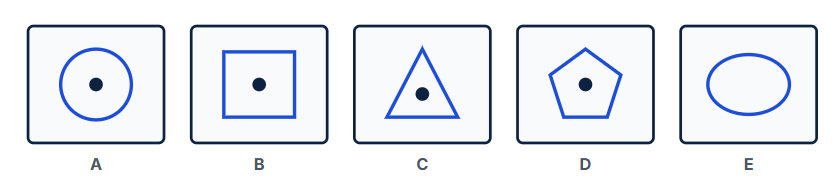
Answer: E
Every other shape contains a small dot. Shape E does not. The method is to check one feature at a time across all five shapes: first the dots, then the number of sides, then shading, then size. The first feature that does not match everywhere gives the answer.
Example 2
Complete the series
Which option comes next in the series?
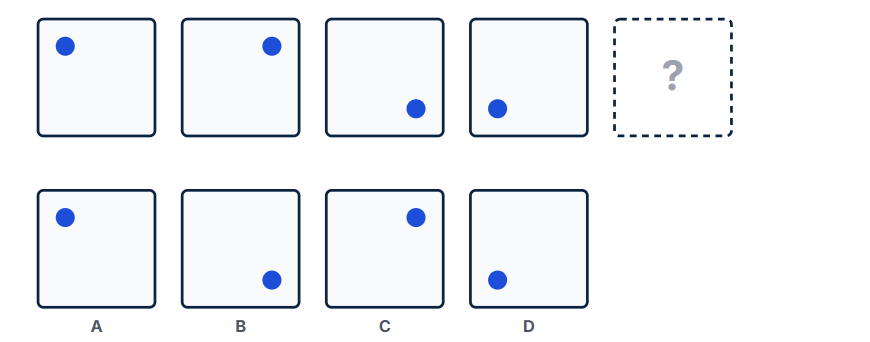
Answer: A
The dot travels clockwise around the corners: top left, top right, bottom right, bottom left, and then back to top left. Only option A has the dot in the top left corner. For any series question, describe the change out loud in words first. If your child can say "it moves one corner clockwise", they have already solved it.
Example 3
Analogy
The first shape changes into the second. Apply the same change to the third shape. Which option is correct?
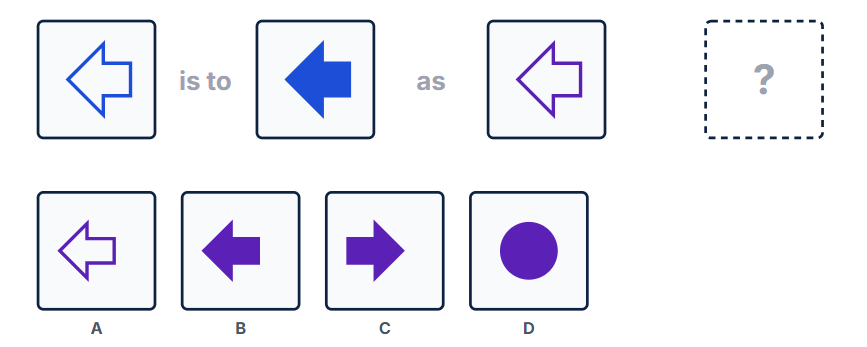
Answer: B
The only change between the first two shapes is that the arrow becomes shaded. Everything else stays identical, including the direction. So the third shape must be shaded but must keep pointing left. Option A is not shaded, option C has been flipped to point the other way, and option D is the wrong shape entirely. The golden rule for analogies is to change one thing only.
Non-verbal reasoning also rewards short, frequent practice more than any other paper. Ten questions a day beats eighty questions once a fortnight, every single time. Our free 11+ practice papers include non-verbal reasoning sections you can use for exactly this.
How hard are 11 plus exam questions really?
Now that you have seen real examples, you can probably answer this yourself. Individually, the questions are not frightening. A capable Year 6 child can do almost all of them given enough time.
The difficulty comes from somewhere else entirely.
1. Speed
Your child gets roughly 45 seconds per question. Reading, thinking, deciding and marking the answer sheet all have to happen inside that. Most children who underperform in the 11 plus knew the content perfectly well. They simply ran out of clock.
2. Timing in the school year
The exam is sat in September of Year 6, before school has taught most of the Year 6 curriculum. So a real share of the paper covers material your child has not yet met in class. That gap is precisely what preparation exists to fill.
3. Two subjects nobody teaches
Verbal and non-verbal reasoning are not on the primary curriculum. A child can be top of the class in maths and English and still score poorly, simply because they have never seen a code question or a matrix before.
4. Competition, not a pass mark
There is no fixed national standard to clear. In oversubscribed areas, places go to the highest scorers, so your child is effectively competing rather than passing. This is why aiming for comfortable rather than borderline matters.
Roughly one in five people in England live in an area with grammar schools, and around one child in four in those areas gains a place. That sounds daunting until you realise the deciding factor is almost never raw ability. It is preparation, and preparation is entirely within your control.
How to use 11 plus exam practice questions properly
Working through 11 plus exam practice questions is essential, but how you use them matters far more than how many you get through. Here is what actually works, based on what we see with families every year.
1. Diagnose before you drill
Do not start by buying ten workbooks. Start with one full paper, sat properly, marked honestly. Then map every wrong answer against the topic it came from.
You will almost always find that two or three specific topics are causing most of the lost marks. Fix those first. Our free 11+ practice papers come with full answer keys, so you can do this at your kitchen table in an afternoon.
2. Untimed first, timed later
Adding the clock before the knowledge is secure creates anxiety and careless mistakes, and it teaches children to guess rather than think. Learn the method. Practise it untimed. Then add timing. Then sit full papers.
3. Go through every wrong answer, out loud
A marked paper with a score at the top and nothing else is a wasted paper. The learning happens in the conversation afterwards.
For each mistake, ask one question: was this a careless slip, a gap in knowledge, or running out of time? Those three problems need three completely different fixes, and telling them apart is the most valuable thing a parent can do.
4. Short and often beats long and rare
Twenty focused minutes a day is worth more than a three hour session at the weekend. Children retain far more from regular short bursts, and the whole thing stays sustainable for the family.
Fifteen minutes of reading plus twenty minutes on one topic, Monday to Friday, with one timed section on Saturday and Sunday off. That is under three hours a week, and it covers an enormous amount over a school year.
5. Practise the exam, not just the questions
Sitting questions in a familiar kitchen is not the same as sitting them in a silent hall with a stranger reading out instructions and a separate answer sheet to fill in correctly.
Our 11 plus mocks replicate real conditions, right down to the answer sheets and the invigilation, and give you a full breakdown by topic afterwards. Children who have sat two or three mocks walk into the real exam calm, because nothing about the day surprises them.
6. Use the summer before the exam well
The summer holiday before Year 6 is the last long stretch of uninterrupted time you get. Used well, it is worth more than the whole of the autumn term.
Our 11 plus intensive summer course condenses full coverage of all four papers into focused days, with timed practice and daily feedback, so children arrive at the September exam sharp rather than rusty.
7. Get expert eyes on the stubborn topics
Some things are genuinely hard to teach at home. Inference, non-verbal codes and multi-step word problems all need someone who can explain them three different ways until one lands.
That is what our 11 plus tutors do every day. If you would rather have the entire journey mapped out for you, our 11 plus tuition programmes take your child through every question type step by step, with progress reports so you always know where things stand.
Your year by year plan
You do not need to be doing exam questions in Year 3. In fact, starting exam papers too early is one of the surest ways to put a child off. Here is how we spread the work.
Year 3: Build the foundations
Reading every day for pleasure. Times tables. Number bonds. Basic spelling patterns and the four parts of speech. No exam questions and no pressure at all. Our Year 3 11 plus tuition introduces early reasoning through puzzles and games, so children build the thinking skills long before they ever see a paper.
Year 4: Widen vocabulary and number fluency
Synonyms, antonyms, prefixes and suffixes. Fractions, decimals and percentages. First taste of verbal reasoning question types, untimed and treated as puzzles. Our Year 4 11 plus tuition introduces exam style formats gently, so that by Year 5 the layout is already familiar and only the content is new.
Year 5: Cover everything properly
This is the big year. All four papers, every question type, taught and practised. Untimed first, then timed sections from the spring term. Regular topic checks to catch gaps early. Our Year 5 11 plus tuition works through the complete question bank in a structured order, so nothing is left to chance and nothing is left to the last minute.
Year 6: Rehearse and refine
Full timed papers, exam technique, answer sheet practice and targeted work on whatever the mocks reveal. Once the 11 plus is done in the autumn, attention turns to SATs in the summer term. Our Year 6 SATs tuition covers both, so there is no gap between the entrance exam and the end of primary school.
Final thoughts
Now that you have worked through 11 plus exam questions, the exam should feel a lot less mysterious. There is no secret knowledge in there. No trick questions. Just short, quick problems drawn from the top end of primary school work, with two reasoning papers that nobody teaches in school.
If you would like a hand mapping it out for your child, we are here. We have been guiding families through this, and we would love to help. Get in touch with us today.
Frequently Asked Questions
How many questions are there in the 11 plus exam?
A full GL Assessment 11 plus containing all four papers has roughly 260 questions in total. Maths has around 50 questions in 50 minutes. English has around 50 to 56 questions in 45 to 50 minutes. Verbal reasoning has around 80 questions in 50 minutes. Non-verbal reasoning has around 80 questions split into four timed sections of 20.
Are 11 plus exam questions always multiple choice?
No, but most are. GL Assessment papers are almost entirely multiple choice with a separate answer sheet. Some regions and some independent schools use standard format papers where children write the answer in the space provided. CSSE in Essex uses written answers only.
When should my child start practising 11 plus exam questions?
Start with reading, vocabulary and number confidence in Year 3 and Year 4, without any exam pressure. Introduce real 11 plus style questions from the start of Year 5, untimed at first. Add timing from the second half of Year 5. Sit full timed papers and mock exams through Year 6 up to the exam.

Mr Singh
Founder, Pass 11 Plus Grammar
Mr Singh is the founder of Pass 11 Plus Grammar, with over 30 years of teaching experience. Having overcome academic setbacks himself, he is passionate about ensuring no child struggles alone. His approach focuses on personalised support, strong foundations, and building confidence. He has helped students achieve outstanding results in 11+ and GCSE examinations
Loading related posts…