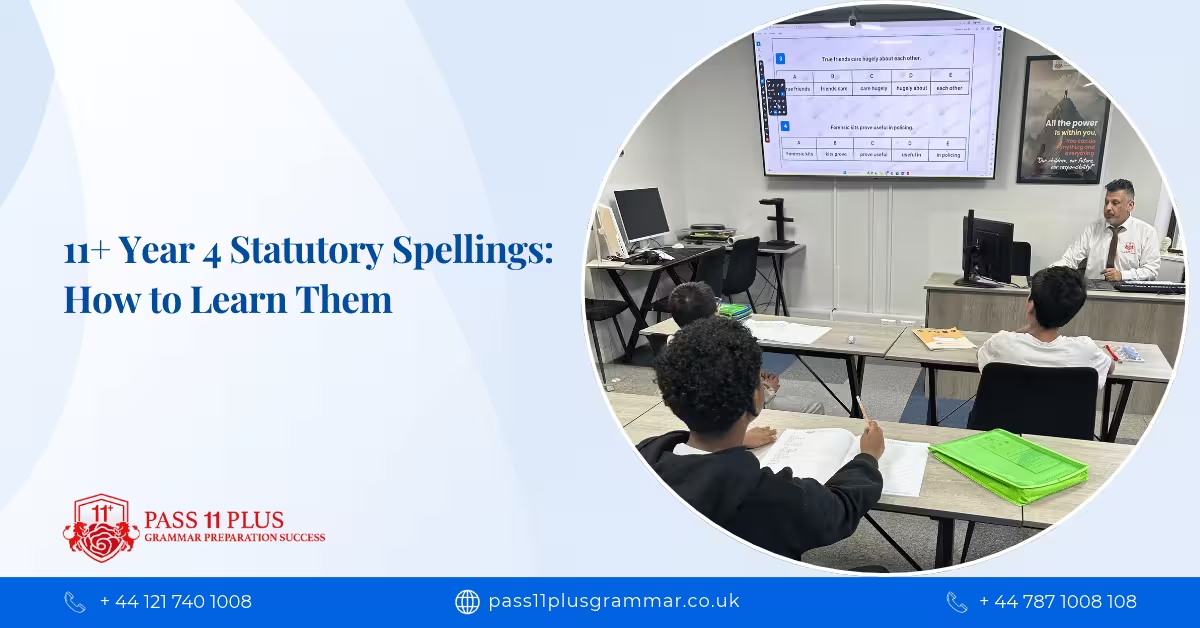
11+ Year 4 Statutory Spellings: How to Learn Them
Published on
The Year 4 statutory spellings are the 100 words in the Years 3 and 4 word list in the National Curriculum. There is no separate Year 4 only list. The best way to learn them is little and often: about 10 minutes a day, look, say, cover, write, check, memory tricks for the tricky parts, and regular re-testing. Learning 10 words a week covers the whole list in 10 weeks. Spelling matters for the 11+, because the official ISEB test checks spelling patterns, common exception words, prefixes and suffixes.
Spelling is a quiet superpower for the 11+. This guide explains the Year 4 statutory spellings: what they are, the full official word list, easy memory tricks, and a calm 10 week plan to learn them.
What are Year 4 statutory spellings?
"Statutory" simply means "required by the National Curriculum". In England, the government sets out a list of 100 words for Years 3 and 4 that children should learn to spell. The list is part of English Appendix 1: Spelling.
The official wording says the lists are a mixture of words that children often use in their writing and words that they often misspell. Some of the words look quite hard, but the National Curriculum says the 100 words in each list can easily be taught within the four years of Key Stage 2, alongside other words.
Here are three useful facts.
It is one list for two years. The Years 3 and 4 list is shared, so there is no separate Year 4 only list.
Schools have flexibility. Schools only have to teach the programme of study by the end of the key stage, so they may teach words earlier or later. Many aim for children to know the list by the end of Year 4.
There is a second list. Years 5 and 6 have their own list of another 100 words, so a strong start in Year 4 pays off.
Year 4 is also a great time to build 11+ foundations. Our approach to 11 plus preparation Year 4 includes spelling, vocabulary and reading, all taught in short, friendly steps.
Do statutory spellings matter for the 11+?
The 11+ does not test the word list as a fixed list, so your child will not be given the exact 100 words in an exam. But spelling still matters a lot, for three reasons.
Reason | What the official sources say |
Spelling is tested | The official ISEB framework says its English test checks knowledge of spelling patterns and common exception words. Many other 11+ English papers also include spelling, punctuation and grammar questions |
Word parts are tested | The ISEB framework also checks word meaning, word families, prefixes and suffixes. These are the same ideas that help children learn the statutory list |
It supports reading and writing | The National Curriculum says children should use spelling knowledge, including morphology and word history, to spell longer words and understand new words |
Put simply, a child who spells well reads well, writes well and understands new words more easily. That helps in comprehension, grammar and vocabulary questions across the whole 11+ English paper.
The official Year 3 and 4 statutory spelling list
Here is the full official word list, in the same order as the National Curriculum. A slash means two forms of a word are included, for example eight and eighth, and brackets show a linked word, for example accident and accidentally.
Words | Official list |
1 to 20 | accident(ally), actual(ly), address, answer, appear, arrive, believe, bicycle, breath, breathe, build, busy/business, calendar, caught, centre, century, certain, circle, complete, consider |
21 to 40 | continue, decide, describe, different, difficult, disappear, early, earth, eight/eighth, enough, exercise, experience, experiment, extreme, famous, favourite, February, forward(s), fruit, grammar |
41 to 60 | group, guard, guide, heard, heart, height, history, imagine, increase, important, interest, island, knowledge, learn, length, library, material, medicine, mention, minute |
61 to 80 | natural, naughty, notice, occasion(ally), often, opposite, ordinary, particular, peculiar, perhaps, popular, position, possess(ion), possible, potatoes, pressure, probably, promise, purpose, quarter |
81 to 100 | question, recent, regular, reign, remember, sentence, separate, special, straight, strange, strength, suppose, surprise, therefore, though/although, thought, through, various, weight, woman/women |
Source: National Curriculum in England, English Appendix 1: Spelling, Word list for Years 3 and 4 (100 entries).
Print the list, stick it on the fridge, and tick words off as your child learns them.
11 Plus Tuition
Help your child master 11+ spellings in Year 4
Our 11 plus tutors help year 4 children improve spelling accuracy, expand vocabulary and build strong English skills through structured preparation.
Tricky Year 4 statutory spellings and memory tricks
Some words in the list are trickier than others. Here are memory tricks for the ones children find hardest. The National Curriculum itself suggests links between words, such as business and busy, disappear and appear, bicycle and cycle, medicine and medical, and opposite and oppose.
Word | Memory trick |
busy, business | Business is busy plus ness. Change the y to an i. |
disappear | dis plus appear. Just one s, then two p's. |
bicycle | bi (two) plus cycle. |
medicine | It is related to medical, so it uses a c for the s sound. |
opposite | It is related to oppose, so the first sound is an o. |
February | Say it slowly: Feb-ru-ar-y. There is an r after the b. |
library | Say it slowly: li-brar-y. There is an r in the middle. |
separate | There is "a rat" in sepaRATe. |
island | An island is a piece of land in water: is plus land. |
knowledge | know plus ledge. The k is silent. |
answer | The w is silent. Say "an-sw-er" in a silly voice. |
heard, heart | Both hide the word ear. You hear with your ear. |
build, guard, guide | Each has a u you cannot hear. Say "bu-ild" and "gu-ard" when you spell. |
address, possess, occasion | Count the doubles: aDDreSS, poSSeSS (four s's), oCCaSion (double c, single s). |
different | Say three beats: dif-fer-ent. Two f's, then er, then ent. |
thought, though, through, enough | The ough pattern has many sounds. Learn each word separately and write the ough part in a bright colour. |
caught, naughty | Both use augh and sound like "ort". Learn them as a pair. |
weight, eight, reign | These say "ay" with ei or eigh. Link them: eight, weight. |
strength, length | Both end in ngth. Say streng-th and leng-th. |
potatoes | Add es to make the plural, like tomatoes. |
woman, women | Woman has an a. Women has an e, but says "wimmin". |
How to learn Year 4 statutory spellings: 10 simple methods
You do not need long lessons. These ten ideas fit into daily life.
1. Little and often
Ten minutes a day beats an hour on Sunday. The brain remembers best when it meets a word again and again over several days.
2. Break words into beats
Clap the syllables. Dif-fer-ent has three beats. Lib-rar-y has three beats. Spelling each beat is easier than the whole word.
3. Use a silly voice
Say tricky words the way they are spelt: Wed-nes-day, Feb-ru-ary, kuh-nowledge. It helps your child remember the silent or hidden letters.
4. Find the word inside the word
Hunt for smaller words: there is an ear in heard and heart, a rat in separate and land in island.
5. Link words in a family
Business comes from busy, disappear from appear, bicycle from cycle and medicine from medical. The National Curriculum itself uses these links as spelling help.
6. Use rainbow writing
Write the word in pencil, then trace over it in different colours, using one colour for the tricky part. Colour makes the hard part stand out.
7. Play spelling games
Try hangman, word searches, a spelling bee, Scrabble tiles, or a quick bingo. Games make practice feel like fun.
8. Write dictated sentences
The National Curriculum asks children to write dictated sentences from memory. Read a sentence aloud and ask your child to write it, then check every word.
9. Test again after a few days
Test on Monday, again on Friday, and again after two weeks. Words that stay correct over time are truly learnt.
10. Celebrate progress
Keep a chart of words learnt and give a sticker or tick for each one. Success builds confidence.
Look, say, cover, write, check: A step-by-step method
This classic method works for almost every word. Follow the steps for each new word, three or four times, then move on.
1. Look
Look at the word carefully. Notice the tricky part, such as the silent letter or the double letter. Trace it with your finger.
2. Say
Say the word out loud in beats, for example Feb-ru-ar-y or dif-fer-ent. Then say it in a silly voice, such as 'kuh-nol-ledge'.
3. Cover
Cover the word so you cannot see it.
4. Write
Write the word from memory, slowly and neatly, in joined handwriting if possible.
5. Check
Uncover the word and check every letter. If there is a mistake, circle the tricky part and try again.
6. Use it
Write the word in a sentence. Better still, ask someone to read out a sentence for you to write from memory.
A 10 week Year 4 statutory spelling plan
Here is a simple plan that covers the full list in 10 weeks, with 10 words a week in the official order. If that feels too fast, learn 5 words a week over 20 weeks instead.
Week | Words to learn |
Week 1 | accident(ally), actual(ly), address, answer, appear, arrive, believe, bicycle, breath, breathe |
Week 2 | build, busy/business, calendar, caught, centre, century, certain, circle, complete, consider |
Week 3 | continue, decide, describe, different, difficult, disappear, early, earth, eight/eighth, enough |
Week 4 | exercise, experience, experiment, extreme, famous, favourite, February, forward(s), fruit, grammar |
Week 5 | group, guard, guide, heard, heart, height, history, imagine, increase, important |
Week 6 | interest, island, knowledge, learn, length, library, material, medicine, mention, minute |
Week 7 | natural, naughty, notice, occasion(ally), often, opposite, ordinary, particular, peculiar, perhaps |
Week 8 | popular, position, possess(ion), possible, potatoes, pressure, probably, promise, purpose, quarter |
Week 9 | question, recent, regular, reign, remember, sentence, separate, special, straight, strange |
Week 10 | strength, suppose, surprise, therefore, though/although, thought, through, various, weight, woman/women |
Here is a simple weekly routine.
Day | What to do (about 10 minutes) |
Monday | Look at the 10 new words. Pick the tricky part of each word and talk about a memory trick |
Tuesday | Look, say, cover, write, check for the first five words |
Wednesday | Look, say, cover, write, check for the next five words |
Thursday | Write all 10 words in sentences |
Friday | A friendly mini test, with words read out as a dictated sentence |
Weekend | Play a spelling game and revisit any tricky words |
Spelling rules that help with the Year 4 list
The National Curriculum for Years 3 and 4 teaches spelling rules as well as words. Knowing the rules helps children spell the statutory list and many other words too.
Rule | Examples and guidance |
Prefixes dis and mis | They are added without changing the root word: disappear, disagree, misbehave, misspell. |
Prefix in | In means not. It becomes il before l, im before m or p, and ir before r: illegal, impossible, irregular. |
Other prefixes | re (again or back), sub (under), inter (between), super (above), anti (against), auto (self): redo, submarine, international, supermarket, antiseptic, autograph. |
Suffix ly | Add ly straight on to most words: sadly, completely, finally. If the word ends in y after a consonant, change y to i: happily, angrily. If it ends in le, change le to ly: gently, simply. |
Endings that sound like zhuh or chuh | The zhuh sound is always sure: measure, treasure, pleasure. The chuh sound is often ture: creature, furniture, picture, adventure. |
Endings that sound like shun | Often tion, sometimes sion, ssion or cian: invention, expansion, expression, musician. |
Suffix ous | Used for words like famous, various, serious, curious, dangerous. |
Possessive apostrophe with plurals | Put the apostrophe after the plural: girls', boys'. For irregular plurals, add 's: children's, men's. |
Homophones | Words that sound the same but are spelt differently: brake and break, here and hear, meat and meet, plain and plane, rain, rein and reign, whose and who's. |
Fun spelling games for Year 4 children
Games make practice feel like play. Here are some easy ideas.
Hangman: Use words from the list and guess letters one by one.
Spelling bee: Take turns to spell words out loud, like a real bee.
Scrabble or letter tiles: Build words from the list with tiles or magnetic letters.
Word search and crosswords: Make your own with the week's words.
Spelling bingo: Call out words and let your child cross them off a grid.
Chalk or water painting: Write giant words on the patio with chalk or a wet brush.
Spot the mistake: Write a sentence with one wrong spelling and ask your child to find it.
From spelling list to 11+ English practice
Once your child knows the words, you can use them to build wider 11+ English skills.
Activity | What it builds |
Choose the correct spelling | Looks like a typical 11+ spelling question and builds careful checking |
Spot and fix the mistake in a sentence | Proofreading, which helps in writing and in spelling and punctuation questions |
Use each word in a sentence | Vocabulary and meaning, which supports comprehension |
Find word families and prefixes | Word knowledge that the ISEB framework lists for vocabulary questions |
Dictated sentences | Memory, handwriting and accuracy, all in one |
How Pass 11 Plus Grammar helps with Year 4 spelling and 11+ English
Spelling is one of the quiet skills that make a big difference in the 11+. Our Year 4 11 plus tuition teaches spelling rules, word families and memory tricks, and links them to vocabulary, grammar and comprehension.
We start with a gentle check to see which words and rules need work.
We teach in short, friendly steps, with games and lots of praise.
We practise dictation and proofreading, which helps in school and in 11+ English.
We keep you updated with simple ideas for home.
If you live in Birmingham or the West Midlands, our 11 plus tutors in Birmingham can help your child build strong foundations early, in a calm and steady way.
Final thoughts
The Year 4 statutory spellings are a friendly list of 100 words that gets easier with a good method. Learn a few words a week, use look, say, cover, write, check, add memory tricks, and test again after a few days. Add games and dictated sentences, and your child will feel proud as the ticks grow.
There is no need to rush, and no need to worry. Calm, steady steps now make Year 5 and Year 6 much easier. At Pass 11 Plus Grammar, we are always here to help when you are ready.
Frequently Asked Questions
What are the Year 4 statutory spellings?
The Year 4 statutory spellings are the 100 words in the Years 3 and 4 word list in the National Curriculum, English Appendix 1: Spelling. The list covers words that children often use in their writing and often misspell, such as business, library, February, thought and woman. The list is shared across Years 3 and 4, so there is no separate list for Year 4 alone.
How many statutory spellings does a Year 4 child need to learn?
The Years 3 and 4 list has 100 words. The National Curriculum says the 100 words in each list can easily be taught within the four years of Key Stage 2, alongside other words. Schools may teach them across Years 3 and 4 and can introduce them earlier or later, so check your child's school plan.
Are the Year 4 statutory spellings tested in the 11+?
The 11+ does not test the word list as a fixed list, but spelling matters. The official ISEB framework says its English test checks knowledge of spelling patterns and common exception words, along with prefixes, suffixes and word families. Many other 11+ English papers also include spelling, punctuation and grammar questions, so secure spelling helps.
How can Pass 11 Plus Grammar help with Year 4 spelling and 11+ English?
Our tutors teach spelling rules, word families and memory tricks, practise dictation and proofreading, and link spelling to vocabulary and comprehension. Our Year 4 11 plus tuition builds these skills in short, friendly lessons, so children feel calm and confident.

Mr Singh
Founder, Pass 11 Plus Grammar
Mr Singh is the founder of Pass 11 Plus Grammar, with over 30 years of teaching experience. Having overcome academic setbacks himself, he is passionate about ensuring no child struggles alone. His approach focuses on personalised support, strong foundations, and building confidence. He has helped students achieve outstanding results in 11+ and GCSE examinations
Loading related posts…