Loading page…
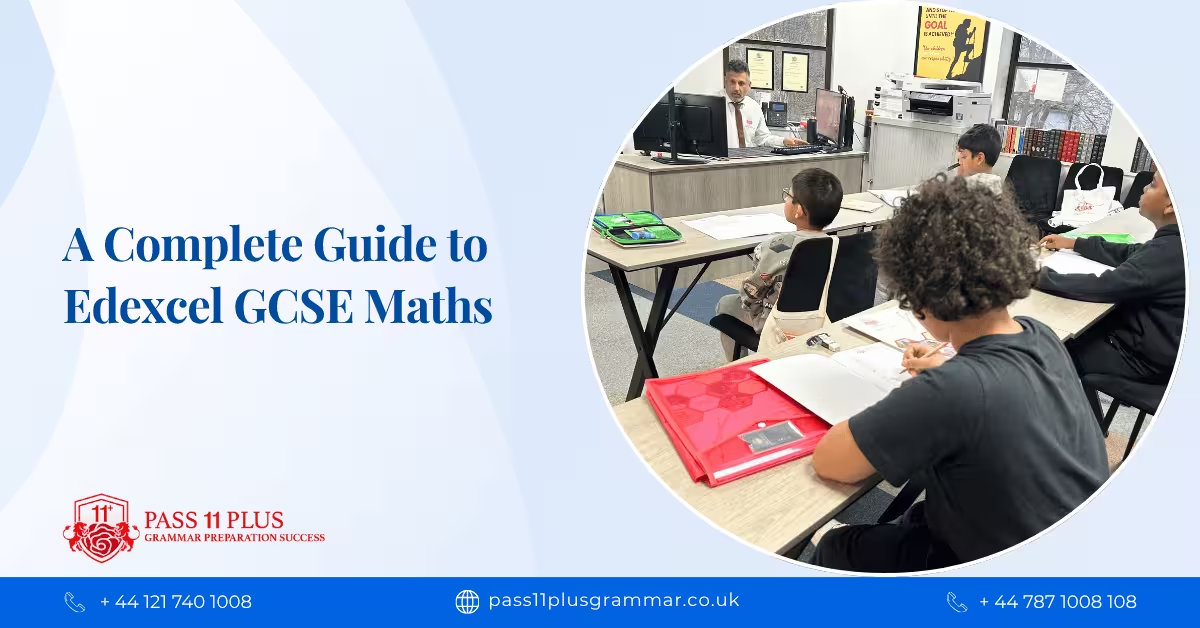
A Complete Guide to Edexcel GCSE Maths
Published on
The Edexcel GCSE Maths is assessed across three exam papers: one non-calculator and two calculator, each worth 80 marks, 1 hour 30 minutes long, and contributing an equal third of the final grade. The Edexcel Maths GCSE topic list covers six areas: number, algebra, ratio and proportion, geometry and measures, probability and statistics, and content from any area can appear on any paper. Foundation tier covers grades 1 to 5, while the Higher tier covers grades 3 to 9, with schools placing students based on Year 9 performance in maths. Yes, there is a formula sheet for GCSE Maths Edexcel, called the Exam Aid booklet, confirmed through the 2025 to 2027 series, and grade boundaries are set fresh after each series rather than fixed in advance.
Every exam board tests Maths a little differently, and knowing exactly what Pearson Edexcel expects removes a huge amount of unnecessary stress. Here is a complete, detailed guide to the Edexcel GCSE Maths, covering everything from paper structure to the full topic list.
Understanding the Edexcel GCSE Maths specification
Every exam board tests GCSE Maths slightly differently, which is exactly why understanding your specific board's format matters far more than generic revision advice. Pearson Edexcel is one of the largest exam boards for GCSE Maths in England, and its specification follows a clear, consistent structure across both tiers.
Before diving into the detail, it helps to know the shape of the whole thing. Three papers, six topic areas, two tiers, and a marking system that rewards clear working just as much as correct final answers. Once this structure is familiar, revision becomes far more targeted and far less overwhelming.
Edexcel Maths GCSE exam format
There are three papers in Edexcel GCSE Maths, and this applies to both Foundation and Higher tier equally.
Paper | Details |
Paper 1 | Non-calculator. 1 hour 30 minutes, 80 marks, a third of the grade. |
Paper 2 | Calculator allowed. 1 hour 30 minutes, 80 marks, a third of the grade. |
Paper 3 | Calculator allowed. 1 hour 30 minutes, 80 marks, a third of the grade. |
Edexcel also offers Further Maths as part of its International GCSEs, which some schools make available alongside the standard GCSE Maths qualification. It is worth checking with your school whether this is an option available to you.
What each Edexcel GCSE Maths exam paper actually looks like
Every paper follows the same basic layout, an instructions page for personal details and guidance, a question booklet where answers and working are written, and additional pages for extra working space if needed.
What kinds of questions appear on the papers
Question difficulty increases steadily through each paper, with early questions designed to build confidence before the harder, multi-step questions arrive later on.
Mark range | What the question typically involves |
1 mark | Simple recall, single-step arithmetic, quick fact questions, such as writing a fraction as a decimal or calculating a simple percentage |
2 to 5 marks | A few more steps, some intermediate working, method marks available alongside marks for the final answer |
6, 7, 8+ marks | Multi-step reasoning combining several topics, often asking students to show, explain, prove, or justify their thinking |
For the higher mark questions especially, laying out a clear, complete method matters just as much as reaching the right answer. Sometimes these questions also expect an alternative approach to be considered, or reasoning to be explained clearly rather than simply calculated.
Foundation or Higher tier in Edexcel GCSE Maths
Both tiers have exactly the same format. What changes is how hard the questions are and which grades are possible.
Foundation tier (Grades 1 to 5)
Core content only
More structured, step by step questions
Grade 5 is the highest available
Needs a much higher percentage of marks
Often the safer route to a secure 4 or 5
Higher tier (Grades 4 to 9)
Adds harder algebra, geometry and functions
Needed for grade 6 and above
A grade 3 is allowed for a narrow miss
Below that, the result is a U
Usually needed for A Level Maths
Schools usually place students based on Year 9 results, and students can move tiers during Year 10 or 11. All three papers must be sat at the same tier.
The tier decision in real numbers: In June 2026, a grade 4 on Edexcel Higher needed just 50 marks out of 240, about 21 per cent. On Foundation, the same grade 4 needed 151 out of 240, about 63 per cent. That does not make Higher the easy option. Higher questions are much harder, and a student who can barely start most of them risks a U, because Higher only goes down to grade 3. The right tier is the one where your child can work steadily for 90 minutes without losing heart.
Tier choice is one of the most important decisions in GCSE Maths and one of the least discussed at home. It is one of the first things we look at in our GCSE Maths tuition, ideally in Year 10 rather than in the spring of Year 11.
The full Edexcel GCSE Maths topic list
The complete Edexcel GCSE Maths topics list is organised into six broad areas, each covering a wide range of specific skills and concepts that students need a thorough understanding of to achieve top marks.
Number: Measures and accuracy, fractions, decimals and percentages, and number structure and calculation.
Algebra: Notation, vocabulary and manipulation, graphs, solving equations, and sequences.
Ratio, proportion and rates of change: Using scale diagrams, reducing ratios, and related calculations.
Geometry and measures: Properties and constructions, measuring and calculation, and vectors.
Probability: Constructing possibilities for experiments, recording, describing and analysing relative frequencies.
Statistics: Analysing population statistics, interpreting charts and graphs, and related data skills.
Edexcel GCSE Maths topics in detail
Number
Place value, ordering, rounding and estimating
Fractions, decimals and percentages, and converting between them
Factors, multiples, primes, HCF and LCM, and prime factor decomposition
Powers, roots and the laws of indices
Standard form
Error intervals, upper and lower bounds
Higher only: surds, fractional and negative indices, recurring decimals to fractions
Algebra
Notation, simplifying and substituting
Expanding brackets and factorising
Linear equations and inequalities
Rearranging formulae
Sequences and the nth term
Straight line graphs, gradient and y = mx + c
Simultaneous equations and quadratic equations
Real life graphs, such as distance time graphs
Higher only: algebraic fractions, completing the square, functions and inverse functions, iteration, algebraic proof, equation of a circle, quadratic inequalities, graph transformations
Ratio, proportion and rates of change
Simplifying ratios and sharing in a ratio
Percentage change, reverse percentages and compound interest
Direct and inverse proportion
Speed, density and pressure
Scale drawings, maps and unit conversions
Higher only: proportion equations, growth and decay, gradients and areas under graphs as rates of change
Geometry and measures
Angles, parallel lines and polygons
Area, perimeter and volume, including circles, prisms and cylinders
Transformations: reflection, rotation, translation and enlargement
Constructions, loci and bearings
Pythagoras' theorem and right angled trigonometry
Similarity and congruence
Higher only: sine and cosine rules, area of a triangle using sine, circle theorems, vectors and vector proof, 3D trigonometry, similar areas and volumes
Probability
The probability scale and listing outcomes
Relative frequency and expected results
Two way tables and sample spaces
Tree diagrams and Venn diagrams
Higher only: conditional probability and set notation in harder problems
Statistics
Sampling and collecting data
Mean, median, mode and range, including from tables
Charts and graphs, including pie charts and time series
Scatter graphs and correlation
Comparing distributions
Higher only: cumulative frequency, box plots and histograms
What examiners are really looking for
Examiners marking Edexcel GCSE Maths papers are not simply checking whether a final answer is correct. They want to see how a student thinks, with clear working, sensible explanations and answers that show genuine understanding, not just a memorised process.
Every question tests one or more of three assessment objectives, which together reveal how well a student can genuinely apply maths, not just recall it.
AO1, use and apply standard techniques: Accurately recalling facts, terminology and definitions, using notation correctly, and carrying out routine procedures or multi-step tasks accurately.
AO2, reason, interpret and communicate mathematically: Making deductions and inferences, constructing a clear chain of reasoning, interpreting information accurately, and critically evaluating a given way of presenting information.
AO3, solve problems with maths in context: Translating a real world or unfamiliar problem into a mathematical process, connecting different areas of maths, interpreting results in context, and evaluating both the method used and the solution reached.
The clearest path to strong marks is approaching every question step by step, showing working clearly, and checking that answers genuinely make sense within the context of the question, rather than simply reaching for a remembered formula.
How Edexcel GCSE Maths grade boundaries work
Grade boundaries for Edexcel Maths are not fixed in advance. They are set after each exam series, based on how difficult that year's papers turned out to be and how the whole national cohort performed, so that a given grade represents a consistent standard year on year.
Recent boundaries give a useful general guide. In the June 2025 series, Higher tier grade 9 required 217 marks out of 240, grade 8 needed 186, grade 7 needed 156, and a standard pass at grade 4 needed 53. On Foundation tier, grade 5 required 175 marks out of 240, and grade 4 required 144.
These figures shift a little each year, and the exact boundaries for a future series will not be known until results are published. Treat recent years as a helpful planning guide rather than a fixed target, and always check Edexcel's own published grade boundaries once results are released.
Is there a formula sheet for GCSE Maths Edexcel?
Yes, Edexcel provides a formula sheet, known as the Exam Aid booklet, to all students during GCSE Maths exams, at both Foundation and Higher tier. The Department for Education has confirmed that formula sheets will continue to be provided for the 2025, 2026 and 2027 series.
What the Exam Aid booklet covers: It includes formulas for areas, volumes, circles, Pythagoras' theorem, compound interest and probability. Students do not need to memorise these specific formulas from scratch, though genuine understanding of how and when to apply each one still matters enormously for the higher mark questions.
Where to find Edexcel GCSE Maths past papers
Practising with genuine past papers and mark schemes is one of the most effective ways to prepare for GCSE Maths. Past papers show exactly how questions are phrased, exactly how marks are awarded, and build real confidence with exam timing and structure well before it counts.
Official Edexcel past papers and mark schemes are published directly on Pearson's own website, and working through several recent series gives a genuinely realistic sense of the style and difficulty to expect. Alongside these, our GCSE Maths past papers resource is a useful additional source of structured practice material.
GCSE MATHS TUITION
Master the Edexcel GCSE Maths with confidence
Our GCSE Maths tutors know every paper, tier and topic in the Edexcel specification, inside and out.
How to prepare for the Edexcel Maths GCSE
1. Fix the foundations first
Fractions, negative numbers, percentages and rearranging formulae appear everywhere. A student shaky on these finds every later topic harder than it should be.
2. Revise by weighting
On Higher, give algebra about twice the time of probability. On Foundation, Number and Ratio deserve half of all revision time.
3. Protect Paper 1
Ten minutes of written arithmetic a few times a week keeps non-calculator skills sharp. It is a third of the grade for very little effort.
4. Practise unfamiliar problems
Because reasoning and problem solving are 60 per cent of Higher, sitting with a hard question for five minutes before looking anything up is real revision, not wasted time.
5. Keep a mistakes book
Every wrong question goes in one notebook with the right method and why it went wrong. Revisit it every couple of weeks. It is the most personal revision resource your child will ever have.
6. Practise the back of the paper
Most students run out of steam around question 15 and never practise the final questions. That is where the grade 6 to 9 marks are. Sometimes start a session from the back.
7. Start in Year 10
Not heavy revision, just never letting a topic pass half understood. It turns Year 11 into revision rather than emergency learning.
Is the Edexcel GCSE Maths specification changing?
Not for students on the course now. After the Curriculum and Assessment Review, new national curriculum content is expected from September 2028, with updated GCSEs from around 2029. Students sitting Edexcel GCSE Maths in 2027 and 2028 will use the current 1MA1 specification.
How Pass 11 Plus Grammar supports Edexcel GCSE Maths students
1. A diagnostic before any teaching
We find the real gaps first. They usually sit further back than anyone expects, in fractions, negatives or rearranging, and they drag down every topic built on top of them.
2. Taught to the 1MA1 specification
Edexcel's content, weighted the way Ofqual weights it, practised with Edexcel style questions and mark schemes.
3. Exam technique built in
Method marks, command words, timing and the non-calculator paper, taught alongside the maths itself.
4. Honest advice on tier
If a secure grade 5 on Foundation is a better bet than a fragile 4 on Higher, we will tell you, and early enough to act on it.
5. Clear progress reports
Specific updates in plain language, so you hear how things are going from us long before a mock result tells you.
Our GCSE Maths tutors are specialists who know Edexcel's papers and mark schemes inside out. Families join us through our wider GCSE tuition programmes, and if you are local, our GCSE tuition in Birmingham runs from our Edgbaston centre with online lessons available anywhere in the UK. For further GCSE guides and revision advice, our sister site Pass GCSE is entirely dedicated to GCSE preparation.
Final thoughts
Understanding the Edexcel GCSE Maths specification is a great first step, and knowing exactly where your child stands against it is the next one. That is where a genuine, honest assessment makes the real difference.
At Pass 11 Plus Grammar, our tutors have spent over 30 years preparing students specifically for Edexcel GCSE Maths, with a 97% success rate behind every paper we set. Our sessions are built entirely around the real specification, not a generic approximation of it.
Get started today and see what focused, specification-aware GCSE Maths tuition can really do for your child's grade.
Frequently Asked Questions
What is the Edexcel GCSE Maths specification?
The Edexcel GCSE Maths specification is the official syllabus set by Pearson Edexcel, covering six main topic areas: number, algebra, ratio and proportion, geometry and measures, probability and statistics. It is assessed across three exam papers, one non-calculator and two calculator, each worth 80 marks and contributing an equal third of the final grade.
How many papers are there in Edexcel GCSE Maths?
There are three papers in Edexcel GCSE Maths. Paper 1 is non-calculator; Papers 2 and 3 allow a calculator. Each paper lasts 1 hour 30 minutes, is worth 80 marks, and counts for a third of the final grade, for a total of 240 marks. All three papers must be sat at the same tier, and any topic on the specification can appear on any paper.
What is the difference between Foundation and Higher tier in Edexcel Maths GCSE?
Foundation tier covers grades 1 to 5 and focuses on essential topics needed for further study, work and everyday life. Higher tier covers grades 3 to 9 and includes more advanced content, such as more complex algebra, higher-level geometry and deeper functions. Schools place students into a tier based on Maths attainment in Year 9, though this can be adjusted during Year 10 or 11.

Mr Singh
Founder, Pass 11 Plus Grammar
Mr Singh is the founder of Pass 11 Plus Grammar, with over 30 years of teaching experience. Having overcome academic setbacks himself, he is passionate about ensuring no child struggles alone. His approach focuses on personalised support, strong foundations, and building confidence. He has helped students achieve outstanding results in 11+ and GCSE examinations
Loading related posts…