Loading page…
How to Fill 11 Plus Answer Sheets Correctly
Published on
When preparing for the 11+ exam, students learn English, maths, verbal and non-verbal reasoning. But one detail that is often overlooked is how to manage the 11 plus answer sheets properly. These sheets are not like regular test booklets. They require accuracy, attention and calm execution on the day of the exam.
Using the correct technique can save valuable marks. Even if a child knows the right answer, a wrongly filled answer sheet can mean the scanner does not recognise the response.
At Pass 11 Plus Grammar, we help children practise not only question solving but also exam execution so that nothing feels unfamiliar on the real day.
Understanding the 11+ Answer Sheet Format
In most grammar school 11+ exams, including those set by GL Assessment, the test is delivered in two parts:
A question booklet containing all the test questions
A separate answer sheet where answers are recorded
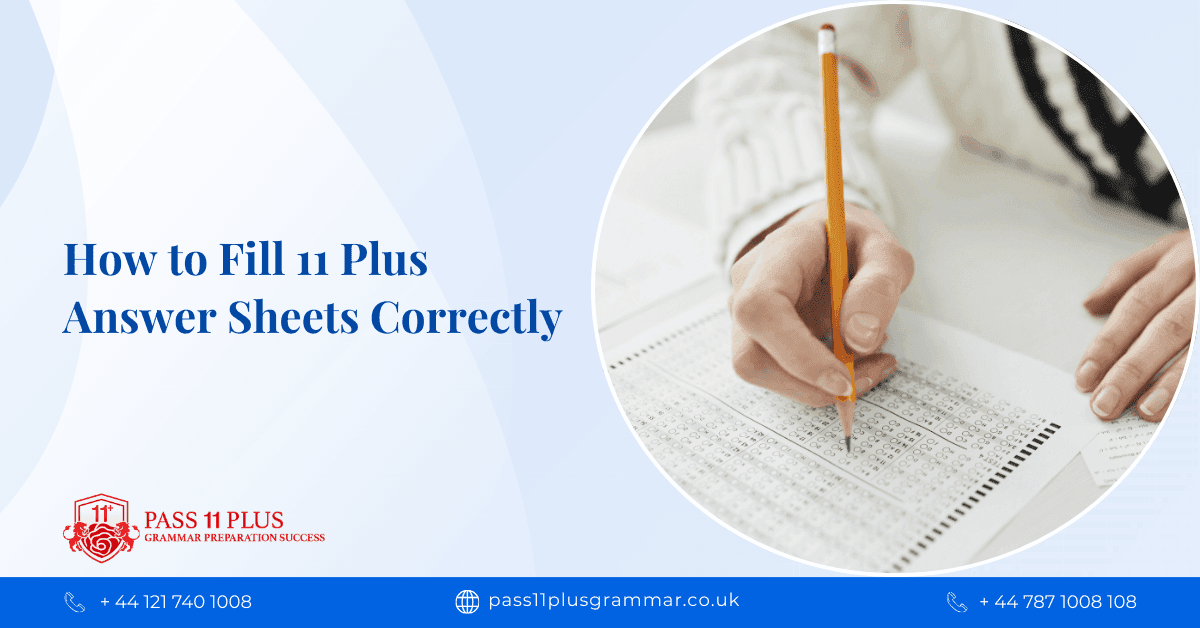
The answer sheet lists question numbers alongside multiple-choice options. Your child must pick the correct letter and mark it clearly using a pencil.
Practice early with this format so that by the time the exam comes, the process feels automatic rather than new.
At Pass 11 Plus Grammar, we introduce answer sheet practice early in our structured preparation programmes. Whether students are starting with 11 plus preparation year 3, building skills through 11 plus preparation year 4, or preparing seriously in 11 plus preparation year 5, we ensure they become fully comfortable with the 11 plus answer sheet format long before exam day. Familiarity removes unnecessary anxiety.
Why Correct Marking Matters
Many 11+ exam providers use Optical Mark Recognition (OMR) technology to read answer sheets. An OMR scanner can only detect certain kinds of markings. If your child:
Circles answers instead of marking them correctly
Shades faintly or sloppily
Leaves stray marks or scribbles
The scanner might not register the answers at all. This means marks can be lost even when the child knew the correct answer.
This makes mastering the answer sheet technique just as important as understanding questions.
Step-by-Step Guide to Filling 11 Plus Answer Sheets
Here is a clear, practice-focused approach your child can use:
1. Write Personal Details First
Before starting the test, your child should clearly complete the top section of the answer sheet with:
Their name
Candidate number
Date of birth
Make sure this is legible and accurate so there are no administrative errors.
2. Use a Pencil and Make Horizontal Marks
Every correct response should be marked with a horizontal line through the box next to the chosen letter (A, B, C, D or E). Do not shade, cross, circle or tick because these can confuse the scanner.
A neat, horizontal line inside the correct box is the safest way to ensure the mark is recognised.
3. Match Answers to the Right Question
A common error is filling an answer on the wrong question number. If your child skips a question in the booklet and forgets to skip it on the answer sheet, all subsequent answers will shift out of alignment.
Encourage them to:
Stay calm
Track question numbers carefully
Check alignment regularly as they go
This habit is crucial, especially toward the end of the paper when time pressure builds.
4. Correcting a Mistake
If your child changes their mind about an answer:
Completely erase the original mark so no trace remains
Carefully place a clean horizontal line next to the new answer
Using a good quality eraser and practising this in mocks prevents smudges or faint remnants that scanners may misread.
5. Use the Question Booklet for Notes
Your child can do working out, notes and rough work in the question booklet, but never on the answer sheet. Any marks on the answer sheet other than the intended responses may cause scanning issues.
Keeping the answer sheet clean and clear is vital.
Regular exposure makes a real difference. That is why our students practise using realistic sheets during our 11 plus mocks. We recreate exam conditions so children experience the timing, pressure and answer sheet process exactly as they would in the real test. This helps eliminate simple alignment or marking mistakes.
Common Answer Sheet Mistakes to Avoid
Here are typical ways students unintentionally lose marks:
Marking answers in the wrong format (e.g., circles, ticks)
Misaligning answers because of skipped questions
Leaving irregular marks that scanners cannot read
Filling answers in the booklet instead of on the answer sheet
Effective practice helps reduce these errors dramatically during the real exam.
Benefits of Practising with Real Answer Sheets
Repetition builds confidence. The more your child works with realistic 11+ answer sheets, the more second nature it becomes to:
Mark answers accurately
Manage pacing
Stay calm under timed conditions
One of the advantages of our guided 11+ lessons and mock practice is that students regularly practise with sheets that mimic the real exam. This makes exam day feel familiar rather than intimidating.
For students who need focused preparation closer to the exam, our intensive courses combine high-level question practice with detailed answer sheet technique training. We do not just teach how to solve questions. We teach how to execute answers accurately under time pressure.
Integrating Answer Sheet Practice into Preparation
Good technique needs regular practice. Consider these tips:
Include answer sheet practice in every mock test
Time sessions to mirror real exam conditions
Review answer sheet errors with your child after each practice run
Encourage calm and steady pacing rather than rushed shading
Practice not only improves speed and accuracy but also builds confidence that your child can handle the real answer sheet on the day.
Final Thoughts
Filling in 11 plus answer sheets correctly takes attention, care and routine. Even the most confident child can lose easy marks if they are not familiar with the answer sheet format or shading requirements.
Remember that the exams are often marked by OMR technology. This means the scanner needs neat, horizontal marks inside the correct box to register answers accurately.
At Pass 11 Plus Grammar, we focus on both content and exam technique so that students are not only prepared for questions but also for the physical act of marking answers under timed conditions.
You may also like:
Frequently Asked Questions
Do all 11 Plus exams use a separate answer sheet?
Not all, but many grammar schools using GL Assessment format require answers to be recorded on a separate 11+ answer sheet that is machine marked.
Can my child use a pen on the 11 plus answer sheet?
No. Most schools require a pencil because sheets are scanned electronically. Pen marks may not be accepted or may be difficult to correct.
How should mistakes be corrected on an 11 plus answer sheet?
The original mark must be fully erased so no trace remains, then the new answer should be clearly marked in the correct box.

Mr Singh
Founder, Pass My GCSE
Mr Singh is the founder of Pass My GCSE, with over 30 years of teaching experience. Having overcome academic setbacks himself, he is passionate about ensuring no child struggles alone. His approach focuses on personalised support, strong foundations, and building confidence. He has helped students achieve outstanding results in 11+ and GCSE examinations
Loading related posts…