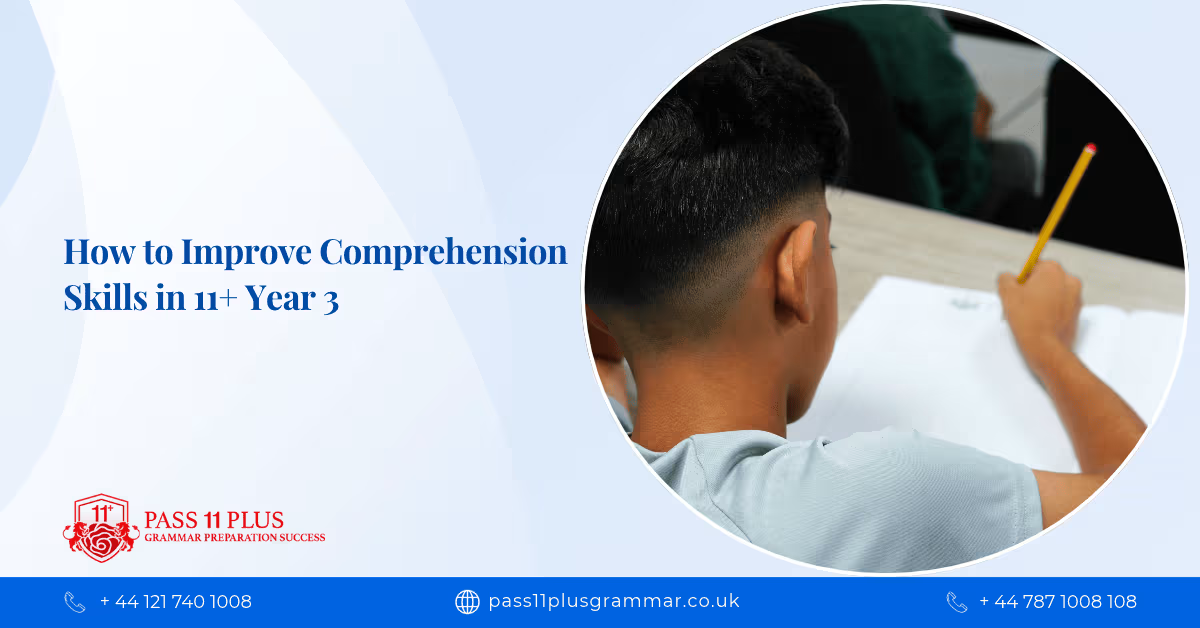
How to Improve Comprehension Skills in 11+ Year 3
Published on
To improve comprehension skills in 11+ Year 3, read with your child every day, talk about the story, and practise four skills: finding facts, using clues, learning word meanings and telling the main idea. Keep practice short, about 10 to 15 minutes a few times a week, and make it fun. Year 3 is about building a love of reading, not exam pressure.
Want to help your Year 3 child get better at reading and understanding? This guide shares simple, friendly ways to improve comprehension skills for the 11+, with fun activities, an example you can try today and a weekly plan.
What is 11+ comprehension in Year 3?
Comprehension simply means understanding. In an 11+ comprehension task, a child reads a passage and answers questions to show they understood it. The passage can be a story, a piece of non-fiction or a poem.
In Year 3, your child is not facing the real 11+ yet. Most children sit it in Year 6. Year 3 is the time to build strong reading habits that make the later years easier. Think of it like learning to ride a bike with stabilisers on.
The government's national curriculum also says that, in Years 3 and 4, teaching should focus on comprehension, not just on reading words. Children are taught to check that a text makes sense, ask questions, work out how characters feel, predict what will happen and sum up main ideas. These are exactly the skills the 11+ tests later on.
Why comprehension skills matter for 11+ Year 3
Comprehension is a big part of the English side of the 11+. The passage is usually one your child has never seen before, and the test is timed. That is a very different feeling from reading a favourite book at bedtime.
A good reader who understands quickly has a big advantage. They can find answers faster and feel calmer. Comprehension also helps in other parts of the exam, because reasoning and maths word problems all depend on understanding what you read.
Key comprehension skills for 11+ Year 3 children
There are four main skills to practise. Here they are in simple words, with an example of each.
1. Finding fact: Spotting an answer that is written in the text
Example: “What colour was the kite?”
2. Using clues (inference): Working out something the text does not say directly
Example: "How did Mia feel when the string slipped?"
3. Word meanings: Understanding words from the sentence around them
Example: "What does the word suddenly mean?"
4. Main idea: Saying in one sentence what the passage is about
Example: "What is this story mostly about?"
8 Simple ways to improve comprehension skills in Year 3
You do not need to be a teacher. These small habits make a big difference over time.
1. Read together every single day
Aim for 15 to 20 minutes. Take turns reading aloud, or let your child listen while you read. Listening to books that are a little harder than they can read alone builds vocabulary and understanding.
2. Talk about what you read
Ask simple questions as you go. Who is this? Where are they? What do you think will happen next? Talking about a book is one of the best ways to build understanding.
3. Build a bigger vocabulary
Pick one new word from each reading session. Say what it means, use it in a sentence, and check it in a dictionary. The national curriculum for Years 3 and 4 also asks children to explain the meaning of words in context.
4. Teach your child to be a clue detective
Many 11+ questions ask children to work out something the text does not say out loud. Ask, "How do you know?" and help your child point to the words that show it. This is called inference, and it is a key Year 3 skill.
5. Practise finding facts in the text
Show your child how to read the question first, then hunt for the answer in the passage. Underline the words that match. This builds the habit of using the text, not guessing.
6. Read lots of different kinds of writing
Mix up stories, poems, fairy tales, myths, plays and non-fiction. The 11+ passage can be fiction, non-fiction or poetry, so children who have met all of these feel less surprised on test day.
7. Practise telling the main idea
After a chapter or a page, ask your child to tell you what it was about in one sentence. This builds the skill of summing up, which is tested in comprehension questions.
8. Add short, timed practice slowly
The 11+ is timed, so a little speed practice helps over time. In Year 3, keep it light. Try a short passage with a gentle timer and focus on understanding, not rushing.
11 Plus Tuition
Help your child build strong 11+ comprehension skills from Year 3
Our 11 plus tutors help Year 3 children develop reading, vocabulary and inference skills with structured English preparation.
Try this Year 3 comprehension example
Here is a tiny passage we wrote for you. Read it with your child, then try the questions.
The Lost Kite
Mia and her dad walked to the park with a bright red kite. The wind was strong, so the kite shot up into the sky. Suddenly, the string slipped from Mia's hand. Mia's face fell, and she looked down at her shoes. Dad smiled and said, "Let's go and find it together."
Question | Answer and skill |
1. What colour was the kite? | Red. This is finding a fact. |
2. Why did the kite shoot up into the sky? | Because the wind was strong. This is finding a fact and a reason. |
3. How did Mia feel when the string slipped? | Sad or upset. The clues are "her face fell" and "she looked down at her shoes". This is using clues. |
4. What does "suddenly" mean? | Quickly and without warning. This is a word meaning. |
Notice question 3. The story never says "Mia felt sad". Your child has to use the clues. Always ask, "How do you know?" and let them point to the words.
Fun 11+ comprehension activities for Year 3 at home
Children learn best when they are enjoying themselves. Try these quick games.
1. Story detective
Skills it builds: Using clues
How to play: Pick a character. Ask your child to guess how they feel and find the words that show it.
2. Predict the next page
Skills it builds: Predicting
How to play: Stop before the end of a chapter and ask what will happen next, and why.
3. One sentence summary
Skills it builds: Main idea
How to play: After reading, your child says what happened in one sentence.
4. Word of the day
Skills it builds: Vocabulary
How to play: Choose one new word, guess its meaning from the sentence, then check a dictionary.
5. True or false
Skills it builds: Finding facts
How to play: Say a statement about the story. Your child checks the text to see if it is true.
How Pass 11 Plus Grammar helps Year 3 children with 11+ Comprehension
At Pass 11 Plus Grammar, our Year 3 11 plus tuition is built for young learners, with friendly, step by step lessons. Our 11 plus preparation Year 3 programme helps children build reading, vocabulary and comprehension skills in a calm way, long before the real test.
Our 11 plus tutors in Birmingham teach in person, and we also teach online so families across the UK can join. Here is how we help.
We find out where your child is strong and where they need more practice.
We teach comprehension skills in small, friendly steps with lots of encouragement.
We share clear feedback so you always know how your child is doing.
We introduce exam style questions slowly, so there is no pressure.
Final thoughts
Improving comprehension skills in 11+ Year 3 does not need long hours or hard work. Read together every day, talk about the story, practise the four key skills in short sessions and keep it fun. These small habits grow into strong readers by Year 6.
If you would like friendly, expert help, we are always here. At Pass 11 Plus Grammar, we love helping young children enjoy reading and feel proud of their progress.
Frequently Asked Questions
How can I improve my child's comprehension skills in Year 3?
Read with your child every day, talk about what you read, and practise four skills: finding facts, using clues, learning word meanings and sharing the main idea. Keep practice short, about 10 to 15 minutes a few times a week, and make it fun. Reading a mix of stories, poems and non-fiction helps most.
Is Year 3 too early to start 11+ comprehension?
No, but it should be gentle. Most children sit the 11+ in Year 6, so Year 3 is about building good reading habits and a love of books, not about exam pressure. Short, friendly practice now makes the later years much easier.
Do tutors help with 11+ comprehension in Year 3?
A good tutor can make comprehension feel easy and fun. At Pass 11 Plus Grammar, our Year 3 tutors teach children how to find answers, use clues and build vocabulary in small, friendly steps. No tutor can promise a result, but the right support builds confidence early.
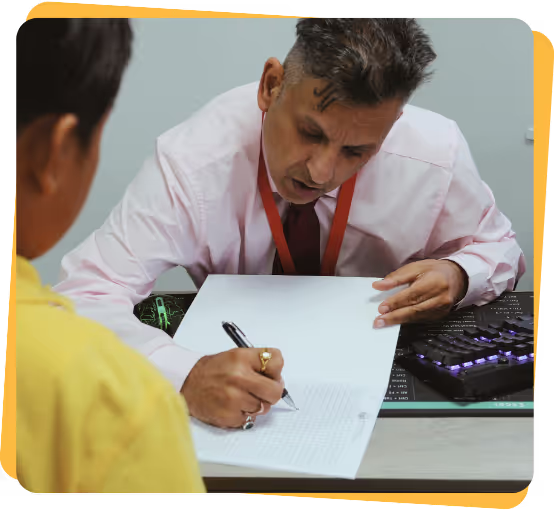
Mr Singh
Founder, Pass 11 Plus Grammar
Mr Singh is the founder of Pass 11 Plus Grammar, with over 30 years of teaching experience. Having overcome academic setbacks himself, he is passionate about ensuring no child struggles alone. His approach focuses on personalised support, strong foundations, and building confidence. He has helped students achieve outstanding results in 11+ and GCSE examinations
Loading related posts…