How to Prepare for SATs Year 6
Published on
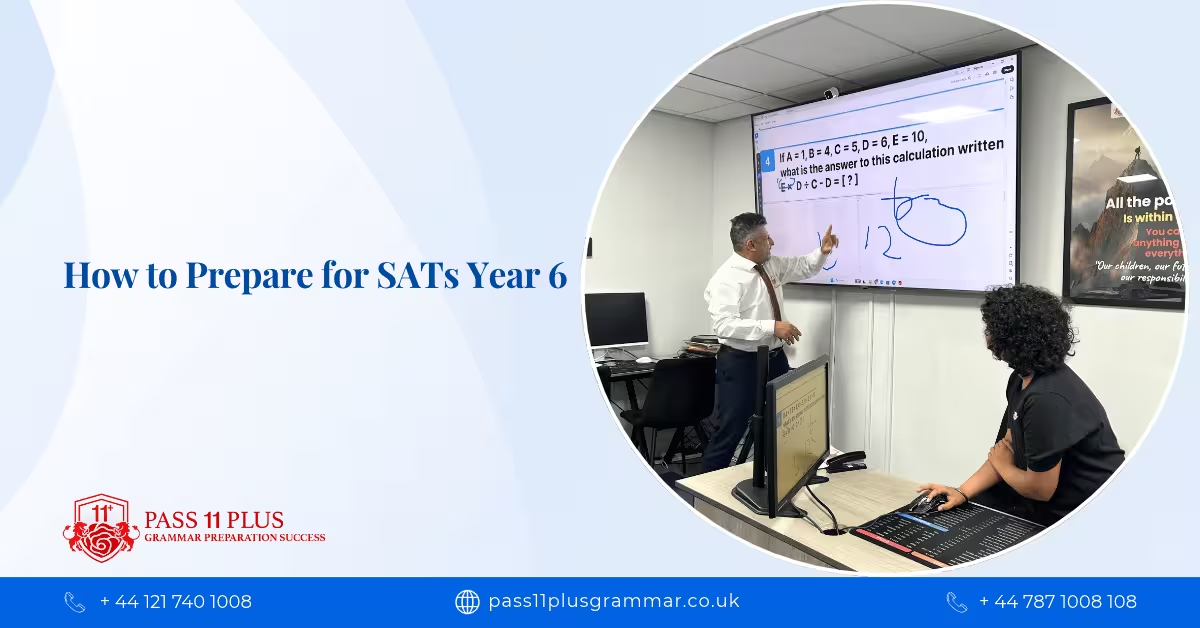
To prepare for Year 6 SATs, find your child's gaps, then practise a little and often, about 15 to 30 minutes on four or five days a week. Revise reading, arithmetic, maths reasoning, grammar and punctuation, and spelling. Read every day, use real past papers, add timed practice before May, and keep your child calm and rested.
Not sure how to prepare for SATs Year 6? You are not alone. The good news is that SATs do not need to be scary. With a calm plan, short daily practice and a little fun, your child can walk into the tests feeling ready. This guide explains the dates, what to revise and exactly how to revise for Year 6 SATs.
Everything here is checked against official government information, and we have added a month by month plan you can start today. If you would like expert help for your child, you can explore our Year 6 SATs tuition.
What are Year 6 SATs?
SATs is the name many people use for the national tests children take at the end of Key Stage 2. Key Stage 2 covers Years 3 to 6, so these tests are taken in Year 6, when children are 10 or 11. The official name is the Key Stage 2 National Curriculum tests.
The tests help show how well children are doing against the national curriculum, and they help teachers and parents see where extra support may be needed. They are not pass or fail, and they are separate from the 11+ that some grammar schools use.
Children take tests in three areas:
English grammar, punctuation and spelling
English reading
Maths
There are no SATs tests for English writing or science at the end of Key Stage 2. Teachers give a judgement for these subjects based on your child's work across the year.
What to revise for Year 6 SATs
The tests only cover what children should already have been taught by the end of Year 6. So revising is mostly about remembering, practising and getting faster. Here is what to revise in each subject.
Reading
Finding facts in a text.
Working out what the writer means, which is called inference.
Understanding word meanings from the context.
Thinking about why the author chose certain words.
Reading fiction, non-fiction and poems.
Grammar, punctuation and spelling
Grammar: Word types, tenses, clauses, relative clauses, modal verbs and fronted adverbials.
Punctuation: Full stops, commas, apostrophes, speech marks, brackets, dashes, colons and semicolons.
Spelling: The Year 5 and 6 word list and common spelling patterns. The spelling test has 20 words.
Maths
Arithmetic: Adding, taking away, multiplying and dividing, including long multiplication and division, plus fractions, decimals and percentages.
Reasoning: Word problems using fractions, decimals, percentages and ratio.
Shape and measures: Area, perimeter, volume, angles and units.
Data and position: Graphs, averages and coordinates.
Algebra basics: Simple missing number and formula questions.
Year 6 SATs tuition
Is your child ready for their Year 6 SATs?
Our Year 6 SATs tuition helps children revise key KS2 topics, improve exam techniques and approach their SATs with confidence.
How to prepare for SATs Year 6: 10 simple tips
If you are wondering how to prepare for SATs without stress, follow these steps.
1. Know what the papers look like
Children feel calmer when nothing is a surprise. Show your child the six papers and talk through what each one asks. The timetable and the table below will help.
2. Start with a quick check up
Use a past paper or a short mock to find the gaps. Then you can spend your time on what matters, not on what your child already knows.
3. Practise little and often
Fifteen to thirty minutes on four or five days a week beats a long session at the weekend. Short bursts keep your child fresh and happy.
4. Read every day
Reading helps with the reading paper, spelling and grammar. Ten to twenty minutes a day is enough. Let your child choose books they enjoy.
5. Build arithmetic speed
The arithmetic paper rewards quick, accurate calculation. Practise number facts, times tables, fractions, decimals, percentages and long multiplication and division in short, daily bursts.
6. Learn five spellings a day
The spelling paper has 20 words. Use the Year 5 and Year 6 word list from the National Curriculum, and practise a few words each day using look, say, cover, write and check.
7. Use real past papers
The Standards and Testing Agency publishes past KS2 papers. Start untimed, then move to timed practice as May gets closer.
8. Keep an error log
After each practice, write down mistakes in a small notebook, with the right answer and why. Review it every week. This turns mistakes into progress.
9. Teach exam habits
Read the question twice. Underline key words. Check the number of marks, because it hints at how much to write. Leave time to check answers.
10. Look after sleep, food and feelings
A rested, well-fed child thinks more clearly. Keep SATs week calm, with early nights, a good breakfast and plenty of praise for effort.
How to prepare for SATs Year 6 2026 to 2027: Month by month plan
Here is a simple plan from now until the tests. These are our suggestions, so please adjust them for your child.
1. November to December: Build the base
Read daily, practise times tables and number facts, and start the spelling list. Find out where your child feels least confident.
2. January to February: Fix the gaps
Work on one or two weak topics at a time, such as fractions or punctuation. Practise short bursts of arithmetic.
3. March to April: Practise real papers
Try past papers in short sections first, then whole papers with timing. Review the mistakes and revise the topics they show.
4. Early May: Stay calm and keep it light
Do a little practice, get plenty of sleep and eat a good breakfast. There is no need to cram in the last days.
5. Test week: Celebrate effort
Plan a treat after each day. Remind your child that they have worked hard.
Our SATs preparation Year 6 programme in Birmingham covers reading, arithmetic, reasoning and grammar, punctuation and spelling, and we teach online as well, so families across the UK can join.
How to revise for Year 6 SATs: Reading, grammar and maths
How to revise for Year 6 SATs reading
Read the text first, then the questions. Then go back to the text to find the answer.
Find the proof. Underline the words that back up each answer.
Practise inference. Ask "What makes you think that?" when you read together.
Watch the time. The reading paper is one hour for several texts, so practise reading at a steady pace.
How to revise for Year 6 SATs grammar, punctuation and spelling
Make a rules page. Write each rule with an example, such as where commas go.
Play short games. Spot the mistake in a sentence, or add the missing punctuation.
Learn spellings in small groups. Five words a week, using look, cover, write and check.
How to revise for Year 6 SATs maths
Practise arithmetic a little each day. Ten calculations in ten minutes builds speed.
Learn the methods. Make sure your child can use long multiplication and long division in a neat way.
Read word problems slowly. Underline the numbers and what the question asks for.
Show working. Writing steps down helps children keep track and spot slips.
How to prepare for KS1 SATs in Year 2
You may also be wondering how to prepare for KS1 SATs. Here is the important news: the Key Stage 1 tests in Year 2 are now optional, and schools decide whether to use them. Teacher assessment is also no longer required at the end of Key Stage 1.
So there is no need for formal revision at this age. The best preparation is simple and gentle:
Read together every day, and let your child read aloud to you.
Practise number bonds and counting in games and everyday life.
Talk about stories, and ask simple questions about them.
Keep everything fun, and avoid pressure.
These small habits also set your child up well for the Key Stage 2 tests later.
How to keep your child calm before SATs
1. Say it is just a check up
SATs are not pass or fail. They help show where children are doing well and where they might need more help.
2. Celebrate effort
Praise hard work and trying again, not only high scores.
3. Keep a normal routine
Good sleep, healthy meals and time to play help children feel steady.
4. Talk about worries
If your child feels nervous, listen kindly, and talk to the teacher if you need extra support.
5. Plan a treat
A fun activity after the tests gives your child something lovely to look forward to.
How Pass 11 Plus Grammar helps with Year 6 SATs
At Pass 11 Plus Grammar, we make learning feel friendly. We explain each topic in small steps, with lots of examples, so children understand why an answer works and feel proud when they get it right.
Our Year 6 SATs tutors help children build confidence in reading, grammar, punctuation, spelling and maths, and we work online so lessons fit around family life. Whatever stage your child is at, we will help them grow in confidence, one step at a time.
Final thoughts
Preparing for Year 6 SATs is about small, steady steps. Know the dates, revise reading, grammar and maths, use past papers in the spring and keep everything calm and kind. SATs are a check up, not a pass or fail test, and a happy, rested child will always do their best.
At Pass 11 Plus Grammar, we are here to help your child enjoy learning, one step at a time.
Frequently Asked Questions
How do I prepare my child for Year 6 SATs?
Start early and keep it calm. Read every day, practise maths facts and arithmetic in short bursts, learn the Year 5 and 6 spelling words, and go through grammar and punctuation rules. Use past papers in the spring to get used to the format, and look at which topics lose marks. Short, regular sessions work better than long ones.
What should my child revise for Year 6 SATs?
Children should revise reading skills, such as finding facts and working out what the writer means. In grammar, they should cover punctuation, word types, tenses and clauses, plus the Year 5 and 6 spelling words. In maths, they should practise arithmetic, fractions, decimals, percentages, ratio, shape, measures, statistics and word problems.
How do I prepare for KS1 SATs?
The Key Stage 1 tests in Year 2 are now optional, and schools decide whether to use them. The best preparation is simple: read together, practise number facts and keep things relaxed. There is no need for extra pressure at this age.

Mr Singh
Founder, Pass 11 Plus Grammar
Mr Singh is the founder of Pass 11 Plus Grammar, with over 30 years of teaching experience. Having overcome academic setbacks himself, he is passionate about ensuring no child struggles alone. His approach focuses on personalised support, strong foundations, and building confidence. He has helped students achieve outstanding results in 11+ and GCSE examinations
Loading related posts…