Loading page…
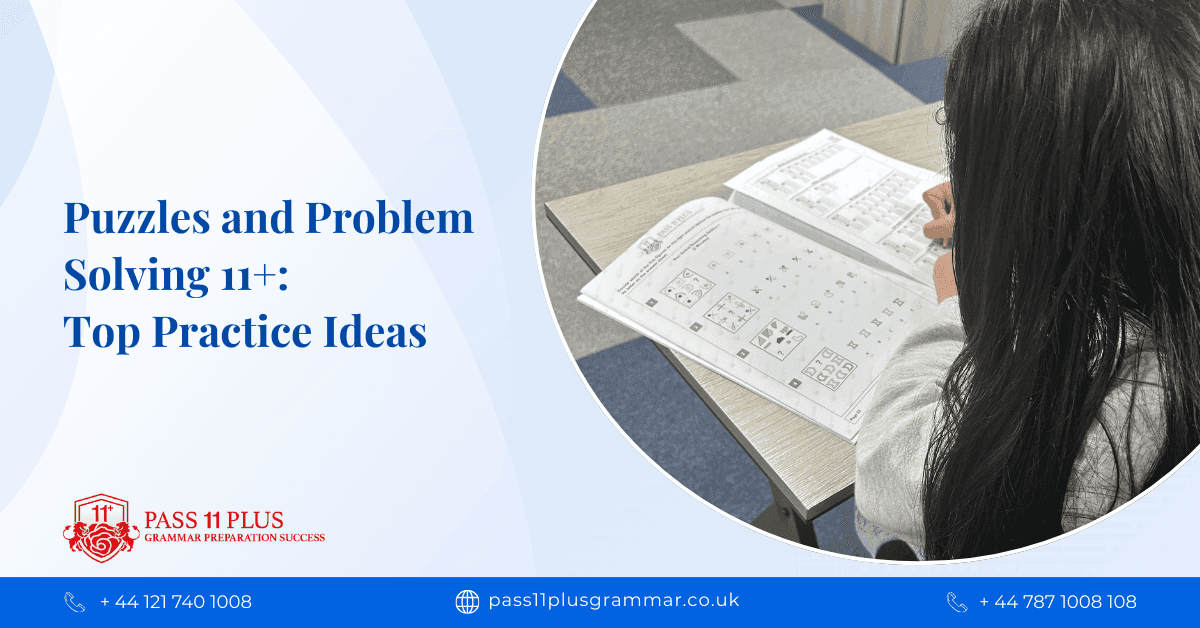
Puzzles and Problem Solving 11+: Top Practice Ideas
Published on
When parents think about the 11 Plus, they usually picture maths papers or comprehension passages. But 11+ puzzles and problem-solving sections are just as important. These questions are designed to test how a child thinks rather than what they memorise.
Logical thinking, pattern recognition, and structured reasoning are skills that develop over time. The good news is that with steady exposure and the right guidance, most children improve significantly in this area.
Let’s first look at the kinds of puzzles your child is likely to encounter.
Types of Puzzles and Problem Solving in 11+
Understanding the format is the first step in building confidence. Most 11+ puzzles and problem solving questions fall into the following categories.
1. Verbal Reasoning Puzzles
These focus on language-based logic. Children may be asked to:
Identify word patterns
Decode letter sequences
Solve analogies
Complete word codes
These questions test vocabulary, logic, and attention to detail.
2. Non-Verbal Reasoning Puzzles
These are visual pattern questions. They often involve:
Shape rotations
Mirror images
Pattern sequencesMissing shape identification
Many children find these tricky at first because they are unfamiliar. However, with practice, pattern recognition improves quickly.
3. Mathematical Logic Problems
These are not straightforward arithmetic questions. Instead, they involve:
Multi-step word problems
Number patterns
Logical deduction using numbers
Process of elimination
These questions test reasoning more than calculation.
4. Spatial and Sequence Challenges
Some 11 plus puzzles focus on spatial awareness or sequence logic, where children must:
Predict the next figure in a sequence
Rearrange shapes mentally
Identify symmetrical patterns
Exposure is key. The more children see these styles, the more comfortable they become.
8 Practical Ways to Build Puzzles and Problem Solving 11+ Skills
1. Play Logic-Based Board Games
Games naturally develop reasoning without feeling like study time.
Try:
Chess for forward thinking
Rush Hour for sequencing
Connect 4 for pattern recognition
Cluedo for deduction
These games build the same logical thinking used in many 11 plus puzzles.
Tip: Ask your child to explain why they made a certain move. Verbalising their reasoning strengthens structured thinking.
2. Introduce Word and Code Challenges
Many 11+ puzzles and problem solving sections include verbal reasoning.
Practise with:
Word ladders
Anagrams
Code-breaking puzzles
Synonym and analogy challenges
These strengthen vocabulary, pattern spotting, and quick mental shifts.
3. Use Real-Life Problem Solving
Everyday situations can become reasoning practice.
You might ask:
“If we leave in 15 minutes, what time will we arrive?”
“Which route is shortest on this map?”
“How can we divide this equally?”
These small exercises help children think logically without formal test pressure.
4. Build Spatial Awareness Through Hands-On Activities
Non-verbal reasoning often relies on visual thinking.
Helpful activities include:
Jigsaw puzzles
Tangram sets
LEGO building challenges
Copying and rotating patterns
Try setting mini challenges such as:
“Can you recreate this shape and then flip it?”
This builds flexibility in spatial reasoning.
5. Schedule Short, Focused Puzzle Sessions
Consistency matters more than intensity.
A simple weekly rhythm might include:
Two short reasoning sessions
One mixed 11 plus puzzles practice
One light review session
As confidence builds, introduce structured practice through our realistic 11 plus mock exams. Mock exposure helps children experience timed reasoning sections calmly and systematically.
6. Encourage Thinking Aloud
After solving a puzzle, ask:
“How did you work that out?”
“What made you choose that answer?”
This builds clarity in reasoning. When students work with our experienced 11 plus tutor, this reflective thinking becomes even stronger because our tutors guide them through structured solution methods.
7. Gradually Introduce Timed Practice
Timing should come later.
Start with untimed accuracy. Once your child understands question types, introduce gentle timing.
For example:
Week 1: Untimed reasoning
Week 2: Light timing
Week 3: Full timed sets
This gradual build prevents panic and builds stamina.
8. Mix Easy and Challenging Questions
If everything feels hard, confidence drops. If everything feels easy, growth slows.
A balanced practice set should include:
Familiar question types
One or two stretch questions
Review time
Structured support through our 11 plus summer intensive course helps sharpen weaker puzzle types closer to exam season without overwhelming students.
Wrapping Up
11+ Puzzles and problem solving questions are designed to stretch thinking, not to confuse children. At first, they may seem unfamiliar. Over time, with steady exposure and structured strategies, they become manageable and even enjoyable.
At Pass 11 Plus Grammar, we guide students through realistic reasoning practice, structured mock exams, and clear feedback so they develop calm, methodical thinking skills. With the right support, logical challenges stop feeling intimidating and start feeling achievable.
You may also like:
Frequently Asked Questions
Are puzzles and problem solving part of the 11 Plus exam?
Yes. Most 11 Plus exams include reasoning sections that test logical thinking, pattern recognition, and problem solving, either through verbal or non-verbal reasoning papers.
What type of puzzles come up in the 11 Plus?
Children are usually tested on number sequences, word codes, analogies, shape patterns, rotations, and logic-based deduction questions.
How can my child improve at 11 plus puzzles?
The biggest difference comes from practice and patience. The more your child sees different puzzle types, the less scary they feel. Let them try, make mistakes, and talk through how they solved each one. Over time, their thinking becomes quicker and more organised.
Mr Singh
Founder, Pass My GCSE
Mr Singh is the founder of Pass My GCSE, with over 30 years of teaching experience. Having overcome academic setbacks himself, he is passionate about ensuring no child struggles alone. His approach focuses on personalised support, strong foundations, and building confidence. He has helped students achieve outstanding results in 11+ and GCSE examinations
Loading related posts…