Loading page…
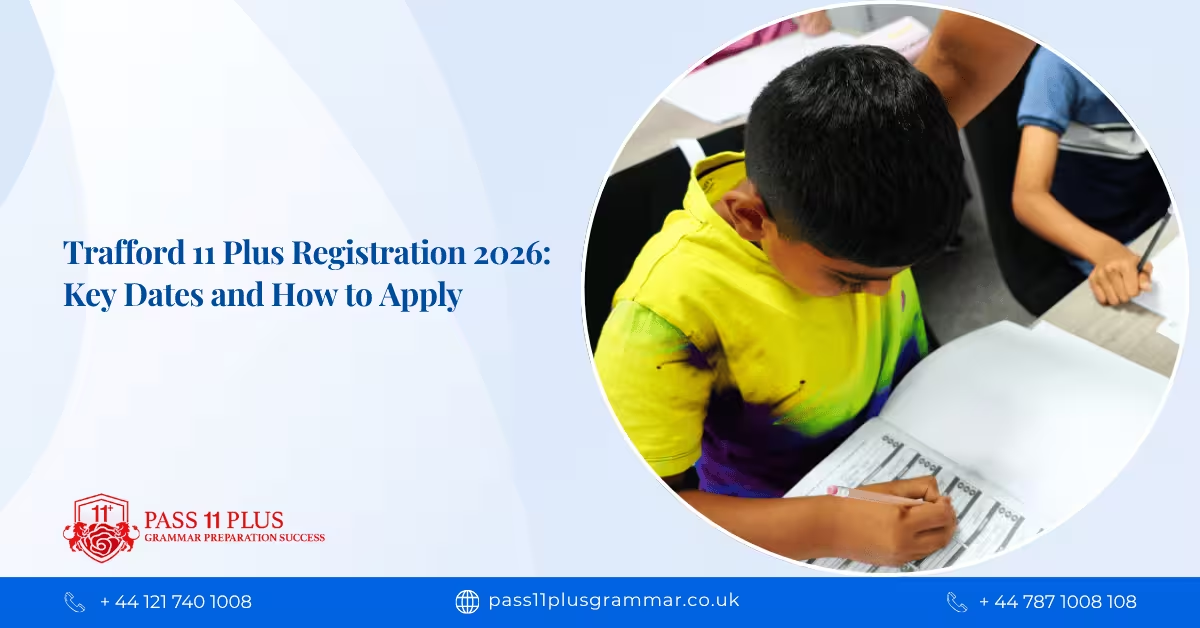
Trafford 11 Plus Registration 2026: Key Dates and How to Apply
Published on
The Trafford 11 plus is run by the Trafford Grammar Schools Consortium. Registration for 2026 opened on 23rd April 2026 and closes on 19th June 2026. The Trafford 11 plus exam takes place on 14 September 2026. Results are sent to parents in mid-October 2026. The test covers verbal reasoning, non-verbal reasoning and maths, produced by GL Assessment. One registration covers all five Trafford Consortium grammar schools, and the historical qualifying mark has been at least 324.
If you are thinking about a grammar school place in Trafford, this guide covers everything you need to know about the Trafford 11 plus registration dates, all five consortium schools, what the exam tests, how it is scored, what the pass mark looks like, and exactly how to prepare your child for September 2026.
Key facts
Consortium name: Trafford Grammar Schools Consortium
Grammar schools: 5 consortium schools, plus 2 separate non-consortium schools
Test provider: GL Assessment
Papers: Two multiple-choice papers, around 1 hour each
Subjects tested: Verbal reasoning, non-verbal reasoning and maths (KS2)
Scoring: Age-standardised, one combined total mark
Registration opens: 23rd April 2026
Registration closes: 19th June 2026
Trafford grammar schools
The Trafford Grammar Schools Consortium has five grammar schools, all using the same entrance exam. Your child only needs to sit the test once, even if you plan to apply to more than one of these schools.
Altrincham Grammar School for Boys
Altrincham Grammar School for Girls
Sale Grammar School
Stretford Grammar School
Urmston Grammar School
There are two further grammar schools in Greater Manchester that are not part of the Trafford Consortium and have their own separate admissions arrangements: Saint Ambrose College (boys) and Loreto Grammar School (girls). If you want your child to apply to either of these, you will need to register separately and follow their own exam process.
Trafford 11 plus 2026 dates
23rd April 2026: Trafford 11 plus registration opened
19th June 2026: Trafford 11 plus registration closes
14th September 2026: Trafford 11 plus exam day
Mid-October 2026: Results sent to parents
31st October 2026: Secondary school common application deadline
1st March 2027: National secondary school offers day
How to register for the Trafford 11 plus
Registration for the Trafford Grammar Schools Consortium 11 plus is free and completed online. You only need to register once to be considered for all five consortium schools. Here is how the process works.
1. Register during the window
Registration for 2026 opened on 23rd April and closes on 19th June. For 2027 entry, expect a similar window opening around April 2027. Register through the website of any of the five participating Trafford Consortium schools.
2. Provide your child's details
You will need your child's full name, date of birth, home address and current school. Children sitting the 2026 exam were born between 1st September 2015 and 31st August 2016.
3. Receive your exam centre details
After registering, you will be told where your child will sit the exam. The Trafford 11 plus exam takes place on Monday 14th September 2026.
4. Ask about access arrangements if needed
If your child has special educational needs that might affect how they sit the exam, contact the schools before registration closes to discuss access arrangements. Do not leave this until after the window has shut.
What does the Trafford 11 plus exam include?
The Trafford 11 plus exam consists of two multiple-choice papers, each lasting around one hour with a short break in between. Your child will have a question booklet and a separate answer sheet. Both papers start with an introduction and a few practice examples so your child knows exactly what to do before the real questions begin.
The papers assess a mix of verbal reasoning, non-verbal reasoning and maths. The test is produced by GL Assessment, which is also used across many other grammar school areas in England.
Verbal Reasoning
Extracting meaning from texts
Spotting word relationships
Logic with written information
Patterns and rules in language
Synonyms and antonyms
Spotting mistakes in sentences
Non-Verbal Reasoning
Recognising visual patterns
Relationships between shapes
Spotting common features in shapes
Using spatial awareness
Logic problems using images
Maths
Key Stage 2 curriculum
Number, the four operations
Place value and fractions
Measurement and geometry
Statistics
Multi-step problem-solving
What does the verbal reasoning section involve?
Verbal reasoning tests your child's ability to solve problems using written information. This is not usually taught directly in primary school, which is exactly why early practice matters so much. The test may also include a comprehension exercise that checks grammar, punctuation and vocabulary. Your child might need to choose the best word to complete a sentence, find synonyms and antonyms, or spot a mistake hidden in a sentence. Building this skill early with our free 11 plus practice papers gives your child a real head start.
What does the non-verbal reasoning section involve?
Non-verbal reasoning focuses on visual problem-solving using shapes, diagrams and patterns instead of words. Your child might need to complete a visual pattern, find the relationship between a sequence of shapes, spot a common feature across a set of shapes and apply it to a new one, or solve a logic problem using images. These question types feel completely unfamiliar to most children at first. Getting comfortable with them early, with guidance from our 11 plus tutors, makes a noticeable difference by September.
What level of maths is tested?
The maths questions are based on the Key Stage 2 curriculum, covering content taught in school up to the start of Year 6. This includes number work such as the four operations, place value and fractions, along with measurement, geometry and statistics. The questions tend to be a little more advanced than children are used to in regular lessons, and often involve multi-step problem-solving rather than single, simple calculations.
How is the Trafford 11 plus scored?
After the exam, answer sheets are marked using Optical Mark Recognition (OMR) technology, which is a scanning system that reads the marks your child has made on their answer sheet. Once raw scores are produced, each section goes through age standardisation.
What is age standardisation?
Children in Year 6 can have birthdays up to 12 months apart. A child born in September has had nearly a full extra year to develop compared to a child born the following August, even though they are in the same school year. Age standardisation adjusts each child's raw score based on how many completed months old they were on the day of the test. This makes the comparison fair, regardless of when a child's birthday falls.
Scores are standardised for each of the three sections in the exam: verbal reasoning, maths and non-verbal reasoning. Your child then receives one combined total standardised mark, which is the figure used when checking against each school's qualifying standard.
What is the Trafford 11 plus pass mark?
There is no single fixed pass mark that applies across every school every year. The qualifying mark for schools in the Trafford Consortium has historically been at least 324, and some schools allow automatic allocation for the top 20 scoring pupils under their own admissions criteria.
Because the figure can shift slightly between schools and between years, the safest goal is not to chase one specific number. Aim for the highest possible combined score your child can achieve, since a stronger result improves their position whichever school's criteria end up applying.
How to apply to Trafford grammar schools after results day
Meeting the qualifying mark is just one part of the process. After results are released, you apply through the normal secondary school admissions system. Here is how it works.
1. Receive your child's result (mid-October 2026)
You will see your child's combined standardised mark and whether they have met the qualifying standard for each school you are interested in.
2. Check each school's admissions policy
Read each school's admissions policy carefully before listing it. This tells you how that school prioritises applicants if it receives more qualifying applications than it has places, for example through catchment area or top-20 allocation.
3. Complete your common application form (CAF)
List your preferred schools in order of preference through your home local authority. The deadline is 31st October 2026. You can list up to six schools, so put your most preferred school first.
4. Wait for offers day (1st March 2027)
Secondary school offers are sent on 1st March 2027. You will receive one offer based on your preference list and the schools' admissions criteria. If your preferred school does not offer your child a place, you will receive information about how to appeal.
How to prepare your child for the Trafford 11 plus
The Trafford 11 plus is competitive, with five popular grammar schools drawing applications from across the borough and beyond. The good news is that focused, well-structured preparation genuinely improves outcomes. Here is how to approach it.
Start in Year 4 or Year 5
Aim to begin at least 12 months before the September exam. Short, regular sessions of 20 to 30 minutes work far better than long, rushed sessions closer to the date. Our 11 plus tuition is built around this steady, confidence-first approach from the very beginning.
Cover all three subjects evenly
The Trafford 11 plus tests verbal reasoning, non-verbal reasoning and maths. It is tempting to focus only on one area, but a strong combined score depends on solid performance across all three. Build a preparation plan that gives proper time to each subject rather than favouring the one your child finds easiest.
Get comfortable with non-verbal reasoning early
Non-verbal reasoning is rarely familiar to children before they start 11 plus preparation. Shapes, patterns and visual logic take real practice to master. The earlier your child starts working with these question types, the more natural they feel under exam pressure. Our free 11 plus practice papers are an easy way to begin.
Read widely every day
Strong reading underpins verbal reasoning performance. Encourage your child to read for 10 to 15 minutes a day, covering a mix of fiction, non-fiction, different genres and different authors. This builds vocabulary, comprehension and confidence with unfamiliar texts, all of which show up directly in the verbal reasoning paper.
Practise under timed conditions
Each paper lasts around one hour, and many children who know the material still lose marks simply because they are not used to working at pace. Our 11 plus mock exams replicate the real Trafford exam experience and come with a detailed performance breakdown, so you know exactly what to work on next.
Make the most of the summer
With the exam on 14th September 2026, the summer holidays are the single most valuable preparation window of the year. Our 11 plus intensive summer course gives your child focused, expert-led preparation across all three subjects before the new school year begins.
For one-to-one support tailored to the Trafford exam format and GL Assessment question style, our 11 plus tutors start with a full diagnostic assessment and build a programme around exactly where your child is right now. No generic plans. Just focused preparation across verbal reasoning, non-verbal reasoning and maths that actually moves the needle.
Final thoughts
The Trafford 11 plus gives families access to five strong grammar schools through a single registration and a single exam day. That makes the process easier to plan around than some other areas, but the exam itself remains genuinely competitive, with a historical qualifying mark of at least 324 across the consortium.
At Pass 11 Plus Grammar, we have been helping children earn grammar school places across the UK. Whether your child is just starting out in Year 4 or heading toward Year 6 and needs a focused final push, we have a programme built around exactly where they are right now.
Frequently Asked Questions
When does Trafford 11 plus registration open in 2026?
Trafford 11 plus registration for 2026 opened on 23rd April 2026 and closes on 19th June 2026. Registration is completed online through the website of any of the five Trafford Grammar Schools Consortium schools. For 2027 entry, registration is expected to open again around April 2027.
What is the pass mark for the Trafford 11 plus?
There is no single fixed pass mark. The qualifying mark for schools in the Trafford Consortium has historically been at least 324, and some schools allow automatic allocation for the top 20 scoring pupils.
When should my child start preparing for the Trafford 11 plus?
Start in Year 4 or early Year 5, at least 12 months before the September exam. The test covers verbal reasoning, non-verbal reasoning and maths. Verbal and non-verbal reasoning are not usually taught directly in primary school, so children need time to get comfortable with these question types before sitting them under timed exam conditions.

Mr Singh
Founder, Pass 11 Plus Grammar
Mr Singh is the founder of Pass 11 Plus Grammar, with over 30 years of teaching experience. Having overcome academic setbacks himself, he is passionate about ensuring no child struggles alone. His approach focuses on personalised support, strong foundations, and building confidence. He has helped students achieve outstanding results in 11+ and GCSE examinations
Loading related posts…