Loading page…
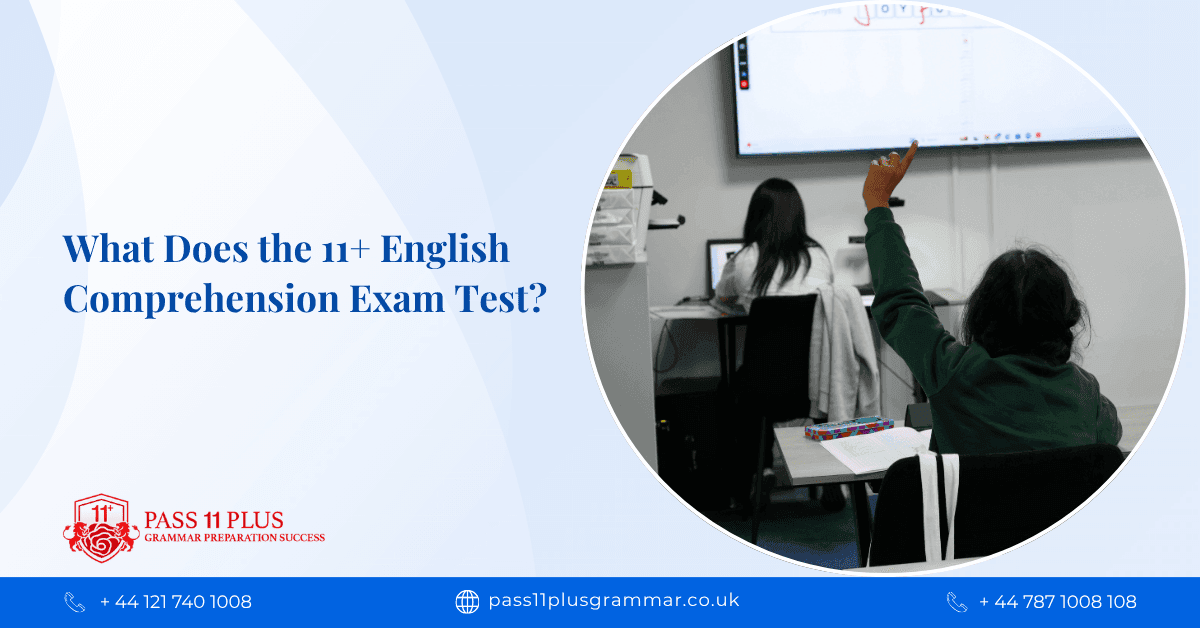
What Does the 11+ English Comprehension Exam Test?
Published on
Reading comprehension appears in almost every 11 plus and independent school entrance exam. But knowing it is on the paper is very different from knowing how to prepare for it. This guide breaks down exactly what the comprehension exam tests, question type by question type, and how to help your child approach each one with confidence.
The 11 plus English comprehension exam tests how well your child can read and understand an unseen passage of text. The five main question types are retrieval, inference, vocabulary, author's technique and summarising. The passage is always unseen; your child will not have read it before. It may be fiction, non-fiction or poetry. The exact format varies by exam board, but the skills being tested are the same across all of them.
What is 11 plus English comprehension?
Reading comprehension means being able to read a piece of text and really understand it. Not just the words on the page, but what they mean, why the writer chose them and what ideas are being communicated, both directly and between the lines.
In the 11 plus, your child is given a passage of text they have never seen before and asked a series of questions about it. The text could be a short story, an extract from a novel, a non-fiction article, a newspaper report or a poem. Whatever it is, your child has no time to prepare for it in advance.
This is what makes comprehension different from other parts of the 11 plus. There is no list of facts to memorise. The passage is always new. What your child needs is a set of reliable skills they can apply to any text, on any topic, on any day.
11+ English comprehension question types your child needs to know
While the exact questions change every year, they almost always fall into one of five categories. Understanding each type and having a clear strategy for each is the most efficient way to prepare.
1. Retrieval questions
Retrieval questions ask your child to find specific information that is clearly stated in the passage. The answer is there; your child just needs to locate it quickly and accurately. These questions often use phrases like "According to the text..." or "What does the writer say about..."
"According to the passage, how long did the expedition take?"
Retrieval sounds easy, but children often lose marks here by rushing or by misreading the question. Teach your child to read the question first, then scan the text for the relevant section before writing their answer. Copying exact words from the text is often the safest approach for retrieval questions.
Key skill: Reading carefully and scanning text efficiently.
2. Inference questions
Inference questions are where the most marks are won and lost in 11 plus English comprehension. They ask your child to work out something that is not directly stated in the text but can be figured out from the clues the writer has given. These questions often use phrases like "What does this suggest about..." or "How does the writer imply..."
"What does the passage suggest about how the character felt when she arrived?"
Inference is not guessing. It is reasoning from evidence. Teach your child to find the relevant part of the text, identify the clues the writer has used, and explain what those clues suggest. The answer should always be grounded in the text, not in what your child thinks is generally true.
Key skill: Making logical connections between evidence and meaning.
3. Vocabulary questions
Vocabulary questions ask your child to identify the meaning of a specific word or phrase as it is used in the passage. This is different from knowing the general dictionary definition; the answer must reflect how the word is used in this particular context. Common formats include choosing a synonym from multiple options or explaining what a word or phrase means.
"What does the word 'tentatively' tell us about how the character approached the door?"
Even if your child does not know the word, they should not panic. Teach them to read the whole sentence (and sometimes the sentences around it) carefully, to think about the tone and context, and to make their best reasoned judgement. A wide reading habit built over time is the most effective long-term preparation for vocabulary questions.
Key skill: Understanding words in context, not just in isolation.
4. Author's technique and intent
These questions ask your child to think about the choices the writer has made and why. This could be about the language used (metaphors, similes, repetition, alliteration), the structure of the text (why is this paragraph here? why does the story start in the middle of the action?), the tone (formal or informal, reassuring or alarming), or the overall purpose of the writing.
"Why does the writer use short sentences at this point in the passage? What effect does this create?"
Technique questions reward children who have been exposed to a wide range of texts and who have discussed how and why writers make certain choices. This cannot be drilled effectively from practice papers alone. It develops from a genuine engagement with reading over time.
Key skill: Identifying language and structural choices and explaining their effect.
5. Summary questions
Summary questions ask your child to identify the main ideas in a passage or section and express them clearly and concisely in their own words. These questions test whether your child can distinguish between the main point and supporting detail, and whether they can communicate that point clearly without simply copying large chunks of text.
"In your own words, summarise the main argument the writer is making in the second paragraph."
The phrase "in your own words" is a key instruction, copying directly from the text will not score full marks. Teach your child to read the relevant section, close the paper, say what the main point is out loud in a single sentence, and then write that down. This forces them to genuinely process what they have read rather than transcribing it.
Key skill: Identifying key ideas and expressing them precisely and concisely.
How do different exam boards test 11 plus English comprehension
The question types above appear across all major exam boards, but the format varies. Here is how comprehension is tested in each of the main 11 plus and independent school entrance exams.
GL Assessment
Used by most grammar schools across England. The English paper typically runs for 50 minutes and includes a reading comprehension passage followed by questions on vocabulary, grammar and punctuation.
The passage can be fiction, non-fiction or poetry
Questions are mostly multiple choice, though some papers include short written answers
Your child will be tested on retrieval, inference, vocabulary and the author's choices
The passage is original and unseen, not taken from a published book
ISEB Common Pre-Test
Used by many independent senior schools as a pre-test in Year 6. The ISEB English test is taken on a computer, and the questions adapt in difficulty based on how your child is performing.
Comprehension passages are around 300 to 500 words each
Maybe fiction, non-fiction or poetry from different time periods
All questions are multiple choice
Because the test is adaptive, questions get harder as your child answers correctly
Also includes a spelling, punctuation and grammar section
Cambridge Select Insight (CEM Select)
Used by a number of independent schools, including St Paul's Girls' School. Comprehension is included in the verbal reasoning section rather than as a standalone English paper.
Taken on a computer, text appears on the left, questions on the right
Your child can scroll through the passage as they answer
All questions are multiple choice
Passages can be fiction or non-fiction
School-set papers (own exams)
Many selective independent schools write their own entrance papers. These tend to be more demanding than standardised tests and typically require extended written responses.
Your child reads an unseen passage and writes full analytical answers
Questions may ask them to explain language choices in detail
Some papers also include a creative or extended writing task based on the passage
Marks are awarded for the quality, accuracy and depth of written responses
A step-by-step strategy for answering 11+ English comprehension questions
One of the most effective things you can do for your child is give them a reliable method they can follow in the exam room. Here is the approach we recommend.
1. Read the passage twice before answering anything
The first read is for the big picture: what is the text about, what is the tone, who are the characters, or what is the argument? The second read is slower and more careful. Encourage your child to read with a pencil in hand and underline anything that feels important or unusual.
2. Read every question before writing a single answer
Knowing what all the questions are asking before starting to answer them means your child can make connections while working through the paper. They may notice evidence for question 5 while answering question 2. Skimming ahead takes 30 seconds and can save several minutes of searching later.
3. Identify the question type before answering
Each question type needs a different approach. Is this asking for a specific fact (retrieval) or for what a word suggests (vocabulary) or for why the writer did something (technique)? Taking five seconds to identify the type before writing stops children from applying the wrong strategy and losing marks.
4. Go back to the relevant part of the text
Every comprehension question has a home in the passage. Teach your child to find the relevant lines or paragraph before writing their answer, rather than relying on memory. For questions that give a line reference, reread that section plus one or two lines above and below.
5. Use the mark allocation as a guide
A one-mark question needs one clear point. A three-mark question needs three distinct points or a more detailed explanation. If your child can see the marks available, teach them to match the depth of their answer to the marks on offer, no more, no less.
6. Never leave a question blank
Even if your child is not sure of the answer, they should always write something. A partial answer can still pick up marks. For multiple choice, they should eliminate the clearly wrong options first and then choose between the remaining ones. Leaving a question blank guarantees zero marks.
How to build 11+ English comprehension skills at home
1. Read widely and daily
Wide, varied reading is the single best preparation for any comprehension exam. Fiction builds empathy and inference skills. Non-fiction builds vocabulary and the ability to follow complex arguments. Poetry builds awareness of language and tone. Aim for at least 15 to 20 minutes every day across different genres. Download our free 11+ practice papers to supplement this with targeted comprehension exercises.
2. Ask questions while reading together
When you read with your child, ask open questions that encourage deeper thinking. "Why do you think the character made that choice?" "What does this line tell us about how she was feeling?" "What do you think will happen next and why?" These conversations build exactly the skills that inference and technique questions reward. They also make reading feel like a discussion rather than a chore.
3. Teach vocabulary actively
When your child comes across a word they do not know, look it up together and talk about how it is being used in that specific context. Keep a vocabulary notebook where new words are recorded with a short note about how they were used. Building a rich, precise vocabulary is the single biggest predictor of performance in comprehension exams over time.
4. Practise each question type separately first
Before your child does a full timed comprehension test, introduce each question type on its own with short practice passages. Teach them the specific approach for retrieval, then practise retrieval questions. Then inference, then vocabulary, and so on. Mixing all types together before your child understands each one individually makes it harder to identify and address specific weaknesses.
5. Build up to timed mock exams
Once your child is confident with all five question types, introduce timed full-length comprehension papers under realistic exam conditions. Our 11 plus mock exams mirror the real exam format closely and come with detailed marking so you can see exactly which question types your child is struggling with and target your preparation accordingly.
6. Get expert guidance
Comprehension is one of those subjects where an experienced eye makes a significant difference. A tutor who knows what the examiner is looking for can spot why your child is losing marks in a way that is genuinely hard to see from the outside. Our 11 plus tutors are experienced in developing comprehension skills specifically for the 11 plus and can give your child personalised feedback that general practice materials cannot. Our 11 plus intensive summer course also includes dedicated comprehension sessions in the run-up to the September exam.
Whatever your child's current level, our 11 plus tuition programmes are built around systematic, progressive improvement in every area of the English paper, including comprehension, vocabulary, grammar and creative writing.
Final thoughts
The 11 plus English comprehension exam rewards children who genuinely enjoy reading and who have learned to think carefully about what they read. But that does not mean preparation is out of reach for everyone else. The five question types are learnable. The strategies are teachable. And the habit of reading widely, which underpins everything, is one of the most enjoyable habits a child can build.
At Pass 11 Plus Grammar, we help children build exactly these skills, through expert tuition, well-designed practice materials and realistic mock exams that give you a clear picture of where your child stands at every stage of their preparation.
Frequently Asked Questions
What is tested in 11 plus English comprehension?
The 11 plus English comprehension exam tests how well your child can read and analyse an unseen passage of text. The five main question types are retrieval (finding information stated in the text), inference (reading between the lines), vocabulary (understanding words in context), author's technique (identifying and explaining language choices), and summarising (expressing the main ideas concisely in your own words).
How long is the 11 plus English comprehension paper?
This varies by exam board. GL Assessment English papers typically run for around 50 minutes, including both comprehension and grammar or vocabulary sections. The ISEB comprehension section is shorter, at around 25 minutes. School-set papers vary significantly and may give your child one hour or more, particularly if extended written responses are required. Always check your specific target school's format.
How can I help my child prepare for 11 plus English comprehension?
Start with daily reading across a wide range of genres, fiction, non-fiction and poetry. Discuss what your child reads using open questions that encourage deeper thinking. Introduce each of the five question types individually and teach a specific strategy for each. Then build to timed practice under exam conditions. Our mock exams give your child a detailed breakdown of results by question type, so you always know exactly where to focus next.

Mr Singh
Founder, Pass 11 Plus Grammar
Mr Singh is the founder of Pass 11 Plus Grammar, with over 30 years of teaching experience. Having overcome academic setbacks himself, he is passionate about ensuring no child struggles alone. His approach focuses on personalised support, strong foundations, and building confidence. He has helped students achieve outstanding results in 11+ and GCSE examinations
Loading related posts…