Loading page…
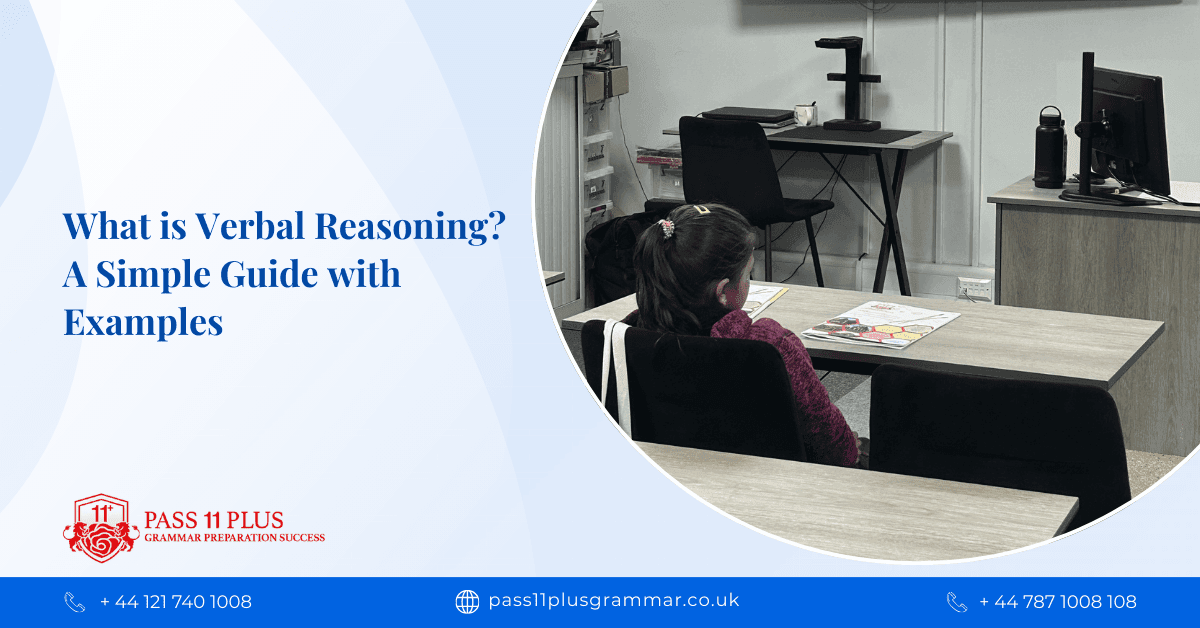
What is Verbal Reasoning? A Simple Guide with Examples
Published on
Verbal reasoning is the ability to think clearly and logically using words. It measures how well a child can understand written information, recognise relationships between ideas, and solve problems that rely on language rather than calculation.
Unlike traditional English exams, verbal reasoning does not focus on long essays or grammar rules. Instead, it looks at how a child processes information. Can they spot patterns in words? Can they identify connections between ideas? Can they decode a sequence under time pressure?
In many grammar school entrance exams, verbal reasoning plays a significant role because it reflects reasoning ability rather than memorised knowledge.
At its core, verbal reasoning tests thinking skills.
What is Verbal Reasoning Test?
A verbal reasoning test is usually made up of short, varied question types. Each one assesses a slightly different skill.
Children may be asked to:
Find two words that are most similar in meaning
Complete a word analogy
Decode a letter sequence
Identify the odd word out
Solve a short logical deduction
The challenge is not always vocabulary. Often, it is about recognising patterns and applying logic quickly.
Because these formats are rarely taught directly in schools, many children initially feel unsure. This is completely normal. Familiarity changes everything.
In our 11 plus year 3 programme, we introduce reasoning concepts gradually so children become comfortable with question styles before speed becomes important.
How to Explain Verbal Reasoning to a Child
If your child asks what verbal reasoning means, keep it simple.
You might say: “It is like solving word puzzles using logic.”
Children respond better when they see it as a challenge rather than a test. You can compare it to:
Solving riddles
Finding patterns in spelling
Working out secret codes
Spotting similarities between ideas
When framed this way, verbal reasoning becomes less intimidating.
In our 11 plus year 4 and 11 plus year 5 sessions, we focus on helping students build confidence in this thinking process before layering on timing pressure.
Verbal Reasoning Question Types
Once you understand what verbal reasoning is, the next step is recognising how it appears in an exam. The questions are usually short, varied, and designed to test thinking rather than memory.
Here are some common styles your child may encounter.
1. Word Relationships
Some questions explore how words connect to each other.
For example:
Bird is to nest as bee is to ___.
Your child must recognise that a bird lives in a nest, so a bee lives in a hive.
These questions test understanding of relationships rather than simple definitions. Children must think about how two ideas are linked.
2. Word Meaning in Context
A question might ask your child to select the closest meaning of a word based on how it is used.
For instance:
If someone is described as “reluctant”, are they:
a) eager
b) unsure
c) unwilling
d) angry
e) excited
The correct answer would be “unwilling”. These questions show whether your child truly understands vocabulary rather than just recognising words.
3. Alphabet Movement Patterns
Sometimes letters follow a logical movement pattern.
Example:
ACE becomes BDF. How does GHI change?
In this case, each letter has moved one step forward in the alphabet. So GHI becomes HIJ.
These questions reward children who notice patterns calmly instead of rushing.
4. Word Construction
Another type of question checks how well children understand word structure.
They may be asked to insert a letter that completes two words at once.
Example:
FLO(_)ATE
The missing letter is “T”, forming FLOAT and LATE.
This tests spelling awareness and flexibility in thinking.
5. Logical Statements
Some verbal reasoning papers include short sets of information.
For example:
Sofia reads every evening.
Liam reads on Saturdays.
Every Saturday is an evening.
Which statement must be true?
The correct answer is: Liam reads in the evening.
Why? Because:
Liam reads on Saturdays.
Every Saturday is an evening.
So logically, Liam must read in the evening.
These questions test careful reading and strict logic. Children must avoid guessing or adding extra assumptions. They can only use the exact information provided.
Wrapping Up
So what is verbal reasoning? It is a test of logical thinking through language. It measures clarity of thought, attention to detail, and the ability to see patterns quickly.
While it may feel unfamiliar at first, it becomes manageable with steady practice and structured preparation.
At Pass 11 Plus Grammar, we support students step by step, introducing reasoning formats early, strengthening vocabulary gradually, and preparing them through realistic 11 plus mock exams that reflect real test conditions. The goal is not just to improve scores, but to build confident thinkers who understand how verbal reasoning works.
You may also like:
Frequently Asked Questions
How to pass the verbal reasoning test?
Build vocabulary through regular reading, practise common question types consistently, and review mistakes carefully. Success comes from familiarity with patterns and improving speed under timed conditions.
Is verbal reasoning easy?
It depends on the child. Verbal reasoning can feel challenging at first because the formats are unfamiliar, but with regular practice most students improve steadily.
What are strong verbal reasoning skills?
Strong verbal reasoning skills include a wide vocabulary, the ability to spot word patterns, logical thinking, attention to detail, and reading instructions carefully.
What is a verbal reasoning example?
An example would be identifying a word that is closest in meaning to another word, or spotting the pattern in a letter sequence such as finding the next pair in a logical alphabet progression.

Mr Singh
Founder, Pass My GCSE
Mr Singh is the founder of Pass My GCSE, with over 30 years of teaching experience. Having overcome academic setbacks himself, he is passionate about ensuring no child struggles alone. His approach focuses on personalised support, strong foundations, and building confidence. He has helped students achieve outstanding results in 11+ and GCSE examinations
Loading related posts…