Loading page…
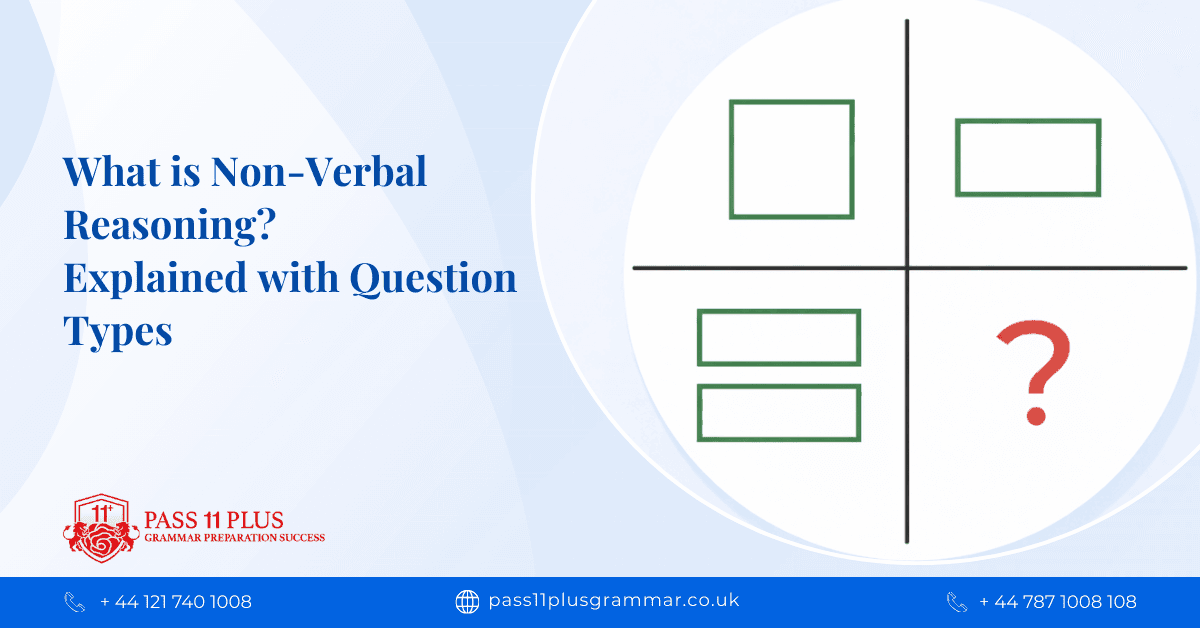
What is Non-Verbal Reasoning? Explained with Question Types
Published on
Non-verbal reasoning is the ability to solve problems using shapes, patterns, diagrams, and visual information rather than words. If verbal reasoning tests how a child thinks with language, non-verbal reasoning tests how they think with pictures.
In grammar school entrance exams, especially the 11 Plus, non-verbal reasoning plays an important role because it measures logical thinking that is not dependent on vocabulary. It looks at how well a child can identify patterns, understand spatial relationships, and apply logic to unfamiliar visual problems.
What is a Non-Verbal Reasoning Test?
A non-verbal reasoning test usually consists of multiple-choice questions based on visual patterns. Children are given a sequence of shapes, symbols, or diagrams and must work out what comes next or which option completes the pattern.
These tests are often timed, so speed and accuracy both matter.
Common formats include:
Identifying the next shape in a sequence
Spotting which shape is the odd one out
Completing a grid pattern
Rotating or reflecting shapes mentally
Identifying missing sections in a design
Unlike comprehension, there are no long passages to read. Instead, the challenge lies in analysing visual information quickly and methodically.
At Pass 11 Plus Grammar, we introduce these formats gradually through our 11 plus year 3 and 11 plus year 4 programmes, so children develop visual confidence long before the exam year.
Non-Verbal Reasoning Examples
Understanding non-verbal reasoning examples makes the concept clearer.
Imagine a row of shapes:
A black square, a white square, a black square, a white square.
The pattern alternates colours. The next shape would logically be a black square.
Now consider a sequence of shapes that rotate slightly each time. The child must notice the direction of rotation and apply it to find the next image.
Another example could involve a grid where shapes change position across rows and columns. The task is to identify the missing shape by understanding how the pattern moves.
These questions test observation skills and attention to detail. Often, the difference between two answer choices is very small.
How to Help a Child with Non-Verbal Reasoning
Parents often wonder how to help a child with non-verbal reasoning at home. The key is exposure and patience.
Here are practical ways to support development:
1. Use Hands-On Activities
Building with LEGO, completing jigsaw puzzles, or using tangram sets helps children visualise shapes and relationships. These activities strengthen spatial awareness naturally.
2. Practise Pattern Recognition
Encourage your child to spot patterns in everyday life. For example, look at tiled floors or decorative designs and ask what comes next.
3. Break Down Questions Slowly
When practising non-verbal reasoning examples, ask your child to explain what is changing from one image to the next. Is it rotation? Colour? Size? Position?
Encouraging this step-by-step observation builds disciplined thinking.
4. Introduce Timing Gradually
Start untimed so accuracy improves first. Once confidence grows, introduce light timing before moving to full timed sections.
In our 11 plus year 5 programme, we focus on refining both speed and accuracy so students feel prepared rather than rushed.
Non-Verbal Reasoning Question Types
Non-verbal reasoning questions are designed to test visual logic. Your child is not asked to explain answers in words. Instead, they must analyse shapes, patterns, and diagrams to find the correct option.
Below are some of the most common formats your child may see in a non-verbal reasoning test, along with simple examples to help you understand how they work.
1. Odd One Out
In this type of question, several shapes are shown together. Four follow a clear pattern, while one does not.
Example:
Imagine five shapes. Four of them have four sides, but one has five sides. The five-sided shape would be the odd one out.
Sometimes the difference is more subtle, such as rotation direction, shading, or line position.
These questions test attention to detail.
2. Shape Sequences
A row of shapes is shown in a pattern. The child must choose the next shape in the sequence.
Example:
A triangle rotates slightly to the right in each step. The task is to select the shape that continues the rotation correctly.
The key is identifying what changes between each step. It could be:
Position
Size
Colour
Direction
Number of shapes
3. Mirror Images and Reflections
Here, a shape is shown along with a line. The child must choose which option shows the correct mirror image.
Example:
If a shape faces left in the original image, its mirror reflection would face right. Small details such as dot placement often determine the correct answer.
These questions test spatial awareness.
4. Rotations
Rotation questions ask how a shape would look after being turned.
Example:
A square with a dot in the top-left corner is rotated 90 degrees clockwise. The dot would now appear in the top-right corner.
Children must mentally rotate the image without physically turning the page.
5. Identical Shapes
Several shapes are displayed, and the child must find two that are exactly the same.
The difficulty lies in small differences such as flipped orientation or slightly altered shading.
Careful comparison is essential.
6. Missing Shape in a Grid
A grid of shapes is shown with one square missing. The child must identify the pattern across rows and columns to select the correct missing piece.
Example:
In each row, the number of shaded areas increases by one. The missing square must follow the same rule.
These questions combine pattern recognition with logical deduction.
7. Nets and 3D Shapes
A flat 2D net is shown. The child must decide which 3D shape it would form when folded.
Example:
A net made of six connected squares may fold into a cube. The child must identify the correct arrangement that allows all faces to connect properly.
These questions test visualisation skills.
8. Code-Based Visual Questions
Instead of letters, shapes may represent coded information.
Example:
If a black circle followed by a triangle equals a specific pattern, what combination creates a different pattern?
These require spotting relationships between symbols and applying them consistently.
Final Thoughts
So what is non-verbal reasoning? It is the ability to think logically using shapes, patterns, and visual clues. It tests observation, spatial awareness, and analytical thinking rather than vocabulary.
Although it can seem challenging at first, familiarity and structured preparation make a significant difference.
At Pass 11 Plus Grammar, we introduce visual reasoning gradually, strengthen pattern recognition early, and prepare students through realistic 11 plus mock exams. We aim to help children approach non-verbal reasoning calmly and confidently, understanding the logic behind every question.
You may also like:
Frequently Asked Questions
What are examples of nonverbal reasoning?
Examples include identifying the next shape in a pattern, spotting the odd shape out, rotating shapes mentally, completing a grid pattern, or choosing the correct mirror image.
How do I prepare for a non-verbal reasoning test?
Practice common question types such as sequences, rotations, and symmetry regularly, start untimed to build accuracy, and gradually introduce timed practice to improve speed.
Is non-verbal reasoning an IQ test?
Not exactly. Non-verbal reasoning tests measure logical and spatial thinking skills, and while these are used in some IQ tests, 11 Plus non-verbal reasoning papers are designed for school selection, not full IQ assessment.

Mr Singh
Founder, Pass My GCSE
Mr Singh is the founder of Pass My GCSE, with over 30 years of teaching experience. Having overcome academic setbacks himself, he is passionate about ensuring no child struggles alone. His approach focuses on personalised support, strong foundations, and building confidence. He has helped students achieve outstanding results in 11+ and GCSE examinations
Loading related posts…