Loading page…
11 Plus English Topics: Full Topic List for GL, CEM, ISEB and CSSE
Published on
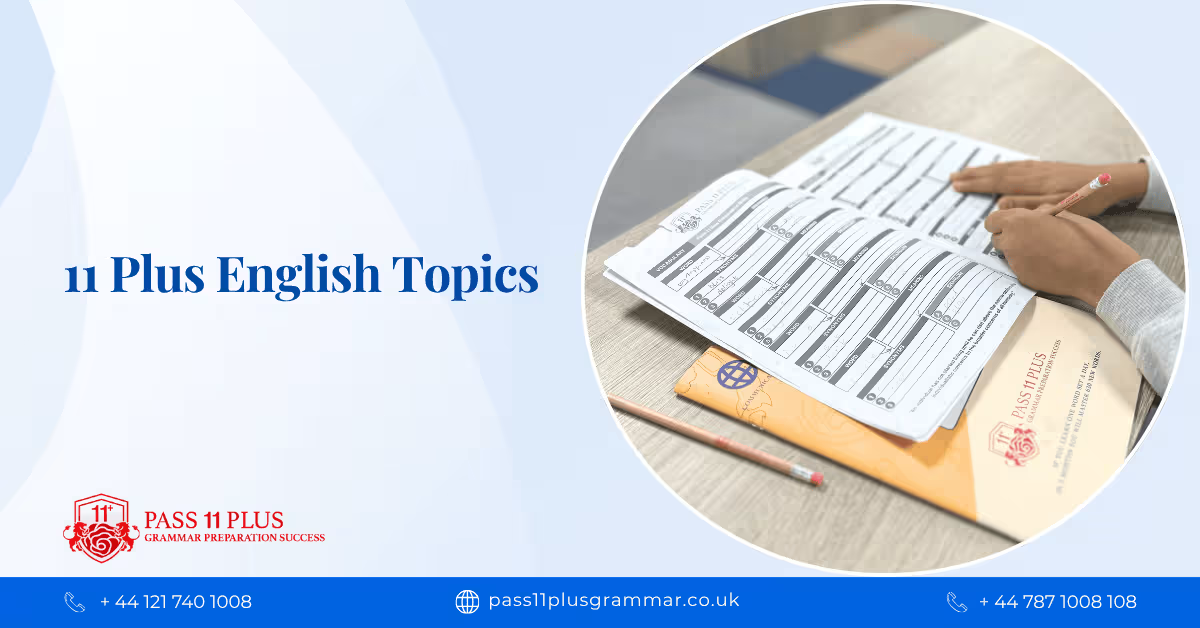
The 11 plus English topics fall into six areas: spelling, vocabulary, grammar, punctuation, comprehension and creative writing. They are based on the Key Stage 2 national curriculum taught in Year 5 and Year 6. GL and CEM exams cover both Year 5 and Year 6 content. ISEB focuses mainly on Year 5 content. The three topics children find hardest are prepositions, direct and reported speech, and inference. Comprehension carries the most marks in almost every paper, so reading every day is the single best thing you can do at home.
If you have ever wondered exactly what your child needs to know for the English paper, this guide is for you. Here is the complete 11 plus English topic list, broken into six clear areas, with the three hardest topics explained and a year by year plan for covering everything without the panic.
What is actually tested in 11 plus English?
Here is the good news. The 11 plus English exam does not test secret knowledge. It tests the same English your child is already learning at primary school, just at a higher level and at a faster pace.
The 11 plus English topics are mapped to the Key Stage 2 national curriculum, which is what schools teach in Year 5 and Year 6. GL Assessment and CEM style grammar school exams pull from both Year 5 and Year 6 content. The ISEB Pre-Test focuses mostly on Year 5 content, because children often sit it earlier in the year.
The tricky part is not the topics themselves. It is that your child sits the exam in the autumn of Year 6, before school has taught much of the Year 6 content. So a lot of what comes up in the paper is material your child has not met yet in class. That gap is exactly what good preparation fills.
Our 11 plus tuition is built around this exact topic list, so nothing gets missed and nothing gets left until the last minute. We work through each area in order, check understanding as we go, and revisit the weaker topics rather than racing ahead.
11 plus English topic list
Below are the six areas of 11 plus English. Think of them as six boxes that all need ticking. Comprehension usually carries the most marks, but the other five feed directly into it. A child with a weak vocabulary will struggle with comprehension. A child who cannot spot a tense change will lose marks in grammar questions and in their own writing.
Topic 1: Spelling
Spelling questions in the 11 plus are rarely about learning long word lists. They are about spotting patterns. Once your child understands how English words are built, they can spell words they have never seen before.
Subtopic | What your child needs to know |
Prefixes | Beginnings such as un, dis, mis, pre, re, sub, inter and how they change meaning. Understanding that unhappy is un plus happy stops the double letter guessing. |
Suffixes | Endings such as ful, ness, ment, tion, sion, able, ible, and the rules for dropping or keeping the letter e before them. |
Compound words | Two words joined into one, such as playground, notebook and everywhere. |
Plurals | Adding s, es, changing y to ies, changing f to ves, and the irregular ones such as children, mice, geese and sheep. |
Silent letters | The letters we write but do not say: knee, wrist, lamb, castle, gnome, doubt, island. |
Letter strings | Common groups of letters such as ough, augh, tion, cious and tious that behave in predictable ways. |
Double letters | When to double a consonant before adding an ending, as in running, hopped and beginning. |
Commonly confused words | Their and there, your and you are, its and it is, practice and practise, affect and effect. |
Topic 2: Vocabulary
Vocabulary is the quiet engine of the whole English paper. It affects comprehension, cloze questions, verbal reasoning and creative writing all at once. It is also the topic that rewards long-term reading more than any short-term revision.
Subtopic | What your child needs to know |
Definitions | Working out what a word means, both from a dictionary and from the words around it in a passage. |
Synonyms | Words with similar meanings, such as brave, courageous, fearless and bold, and understanding that they are not always interchangeable. |
Antonyms | Words with opposite meanings, such as generous and mean, or ancient and modern. |
Homophones | Words that sound the same but are spelled differently: hear and here, past and passed, allowed and aloud. |
Homographs | Words spelled the same but with different meanings or pronunciations: bow, lead, tear, minute, wind. |
Homonyms | Words that are both spelled and pronounced the same but mean different things, such as bank or bat. |
Words from abroad | Words English has borrowed, such as ballet, spaghetti, bungalow, safari and kindergarten. |
Figures of speech | Idioms, similes, metaphors and proverbs, including what they mean when the words are not literal. |
Diminutives and gendered words | Smaller or younger forms such as duckling, piglet and booklet, and pairs such as actor and actress. |
Abbreviations | Shortened forms such as Dr, etc, PM, and understanding what the full version is. |
Our 11 plus tutors build a vocabulary check into every English session. It takes five minutes, it is low pressure, and over a year it quietly adds hundreds of usable words to a child's writing.
Topic 3: Grammar
Grammar is the biggest topic area by number of subtopics. It sounds dry, but it is really just the set of rules that tells your child whether a sentence works. Children who know their grammar write better, spot errors faster, and understand comprehension passages more deeply.
Parts of speech
Subtopic | What your child needs to know |
Nouns | Common, proper, abstract and collective nouns, and noun phrases. |
Verbs | Action verbs, being verbs and the idea that every sentence needs one. |
Pronouns | Personal, possessive, relative and reflexive pronouns, and what each one replaces. |
Adjectives | Describing nouns, plus comparative and superlative forms such as big, bigger, biggest. |
Adverbs | Describing verbs, adjectives and other adverbs, including adverbs of time, place and manner. |
Prepositions | Words showing position or relationship, such as in, among, during, before and according to. |
Determiners | Words that go in front of nouns: a, an, the, this, those, some, many, my. |
Conjunctions | Joining words, both coordinating (and, but, so) and subordinating (because, although, while). |
Modal verbs | Verbs showing possibility or obligation: can, could, may, might, must, shall, should, will, would. |
Verb agreement and sentence structure
Subtopic | What your child needs to know |
Subjects and objects | Who is doing the action and who or what receives it. |
Subject and verb agreement | Singular subjects take singular verbs. The dog barks, not the dog bark. |
Simple tenses | Past, present and future, and keeping them consistent across a piece of writing. |
Progressive and perfect tenses | She was running, she has run, she had run, she will have run. |
Active and passive voice | The cat chased the mouse, compared with the mouse was chased by the cat. |
Subjunctive forms | Formal structures such as if I were you and I suggest that he go. |
Clauses and phrases | Main clauses, subordinate clauses and relative clauses, and how they build longer sentences. |
Sentence types | Statements, questions, commands and exclamations, and simple, compound and complex sentences. |
Topic 4: Punctuation
Punctuation marks are road signs for the reader. The 11 plus tests whether your child can read those signs and use them correctly. In papers with a writing task, punctuation is marked directly, so it is worth double the effort.
Subtopic | What your child needs to know |
Sentence enders | Full stops, question marks and exclamation marks, and not overusing the last one. |
Commas | In lists, after fronted adverbials, around extra information, and to separate clauses. |
Apostrophes | For contraction (do not becomes don't) and for possession (the dog's lead, the dogs' leads). |
Direct and reported speech | Inverted commas, the punctuation inside them, reporting clauses and starting a new line for a new speaker. |
Colons and semicolons | Colons to introduce a list or explanation. Semicolons to join two closely linked complete sentences. |
Hyphens and dashes | Joining words such as well-known, and using dashes to add an aside. |
Brackets | Adding extra information that could be removed without breaking the sentence. |
Capital letters | Sentence starts, names, places, days, months, titles and the pronoun I. |
Topic 5: Comprehension
If your child only had time to work on one area, this would be it. Comprehension carries the largest share of marks in almost every 11 plus English paper, and it is the area where preparation shows most clearly.
Comprehension questions come in three levels of difficulty, and it helps enormously if your child can tell which one they are looking at.
The full comprehension topic list
Subtopic | What your child needs to know |
Literal retrieval | Finding information stated directly in the passage, quickly and accurately. |
Deduction | Using clues in the text to reach a conclusion the writer has almost stated. |
Inference | Reading between the lines to work out what the writer suggests but never says. |
Vocabulary in context | Working out what an unfamiliar word means from the sentence around it. |
Summarising | Explaining the main idea of a paragraph or passage in a few words. |
Fiction | Character, setting, plot, narrative voice and dialogue. |
Non-fiction | Reports, articles, biographies, letters and instructions, and how they are organised. |
Poetry | Verse, rhyme, rhythm, imagery and mood, and why a poet chose a particular word. |
Drama | Play scripts, stage directions and how meaning is carried by dialogue alone. |
Persuasive writing | Spotting opinion presented as fact, rhetorical questions and emotive language. |
Literary devices | Simile, metaphor, personification, alliteration, onomatopoeia and repetition, plus their effect. |
Author's purpose | Whether the writer is aiming to inform, entertain, persuade or explain, and how you can tell. |
The fastest way to see where your child stands on comprehension is to sit a full paper under timed conditions. Our free 11+ practice papers include complete English papers with answer keys, so you can mark them at home and see exactly which question types are costing marks.
Topic 6: Creative writing
Not every 11 plus exam includes a writing task, but many do, and the ones that do treat it as a major component. CSSE in Essex sets a full extended writing task. Many independent schools set their own writing paper. Some GL regions add one too.
Creative writing is the topic that cannot be crammed. It is built slowly, one piece at a time, with feedback in between.
Subtopic | What your child needs to know |
Planning | Five minutes of planning before writing anything. Beginning, middle, end, plus three key images. |
Structure | Paragraphs that move the piece forward, an opening that hooks and an ending that lands. |
Vocabulary choice | Precise verbs beat weak verbs plus adverbs. He trudged is stronger than he walked slowly. |
Show do not tell | Writing that a character's hands were shaking rather than writing that he was scared. |
Sentence variety | Mixing short punchy sentences with longer flowing ones to control pace. |
Dialogue | Using speech to reveal character, punctuated correctly. |
Genre awareness | Story, description, letter, diary, persuasive piece and newspaper report, and how each one differs. |
Accuracy under time | Spelling, punctuation and grammar holding up when the clock is running. |
The 3 hardest 11 plus English topics
Across thousands of hours of teaching, the same three topics come up again and again as the ones children find hardest. If you are short on time, these are where extra effort pays back fastest.
1. Prepositions (grammar)
Prepositions are words that connect a noun or noun phrase to the rest of the sentence. They usually show time or place. Examples include in, among, during, before, and according to.
They are difficult because they look almost identical to adverbs and conjunctions. Children see the word before and cannot tell whether it is doing a preposition's job or a conjunction's job. There is one reliable test that solves it: a preposition is always followed by a noun, a pronoun, or a noun phrase. In before the storm, before is a preposition. In before he arrived, before is a conjunction, because a whole clause follows it.
2. Direct and reported speech (punctuation)
Direct speech is when the exact words someone says are written down. A reporting clause can be added to show who is speaking and how. For example: "Let's go!" he cried. Or: "But if we go now," Joy said, "we'll miss the fireworks!"
This topic is hard because several rules have to be applied at the same time, and getting one wrong loses the mark. It appears constantly in spot the mistake questions, and it is marked directly in any creative writing task.
The rules to lock in:
Everything spoken sits inside inverted commas.
Everything inside the inverted commas ends with a punctuation mark. Use a normal sentence ender such as a full stop, question mark or exclamation mark, or use a comma if a reporting clause follows.
Start a new line every time a new person speaks.
In reported speech, the inverted commas disappear, and the tense usually shifts back. "I am tired," she said becomes she said that she was tired.
3. Inference (comprehension)
Inference is the skill of forming an opinion based on evidence and wider knowledge. It is reading between the lines. This is completely different from retrieval questions, where the answer sits in the text waiting to be copied out. Inference is difficult right through to GCSE, so a ten year old finding it hard is entirely normal.
Examples of inference questions:
Why do you think the writer describes the cat as a vicious furball?
What does the phrase teeth gritted in determination suggest about Kwame's attitude to work?
What impression do you get of the village in the opening paragraph?
Notice that none of these can be answered by copying. Each one asks the child to think about why a writer chose those particular words.
The best home exercise for inference: Ask your child to write a short paragraph about a character who is angry, without ever using the word angry. Then furious, nervous, delighted, lonely. This forces them into the author's chair, and once they have built inference themselves, they start spotting it everywhere.
Top tips for comprehension and inference
Learn the command words. Compare, contrast, deduce, infer, suggest, imply, impression, atmosphere, purpose and effect all ask for slightly different things.
Practise skimming, scanning and summarising so evidence can be found fast under time pressure.
Read widely for pleasure, and do guided reading where you ask questions about what has just been read.
Always back an inference with a short quotation. Point, evidence, explain is a habit worth building early.
Which topics come up in which exam?
The topic list is broadly the same everywhere. What changes is the format, the emphasis and the timing. Knowing your child's exam board changes how you practise, not what you learn.
Exam | How the English topics are tested |
GL Assessment | Usually multiple choice with clearly separated sections for spelling, punctuation, grammar, comprehension and sometimes cloze. Draws on Year 5 and Year 6 content. The topic being tested is normally obvious from the question format. |
CEM style | Topics are mixed together rather than separated. Very heavy on vocabulary and cloze passages. Short, sharply timed sections, so pace matters as much as knowledge. Draws on Year 5 and Year 6 content. |
ISEB Pre-Test | Online and adaptive, so questions get harder as your child answers correctly. Focuses mainly on Year 5 content. Comprehension and vocabulary carry the most weight. No creative writing in the test itself. |
CSSE (Essex) | Written answers only, no multiple choice. One comprehension section plus a full extended creative writing task assessed on vocabulary, spelling, punctuation, grammar, originality and structure. |
Independent schools | Varies by school. Most set a comprehension paper plus their own creative writing task. Always check the individual school's admissions page. |
Check your target schools first. Before you plan any preparation, look up which exam each school on your list uses and whether it includes a writing task. Two families in the same street can need noticeably different preparation plans. If you are unsure, our team will happily talk it through with you.
11 plus English topics to cover, year by year
You do not need to cover everything at once. In fact, trying to is the single biggest cause of stress for families. Here is how we spread the 11 plus English topics to cover across the primary years.
Year 3: Build the foundations
Reading for pleasure every single day. Basic spelling patterns, prefixes and suffixes. Nouns, verbs, adjectives and adverbs. Full stops, capital letters and commas in lists. No exam pressure at all at this stage, just curiosity and confidence. Our Year 3 11 plus tuition introduces these gently, alongside early reasoning skills, so children arrive at Year 4 already enjoying English.
Year 4: Widen the vocabulary
Synonyms, antonyms, homophones and homographs. Sentence types and clauses. Apostrophes for contraction and possession. First proper comprehension work with short passages, focusing on retrieval before inference. Our Year 4 11 plus tuition starts introducing exam style question formats without any timing pressure, so the format becomes familiar long before it matters.
Year 5: Cover the full topic list
This is the big year. Every topic on this page should be taught and practised. Inference, literary devices, all punctuation including colons and semicolons, tenses and voice, and regular creative writing with feedback. Timed sections begin in the second half of the year. Our Year 5 11 plus tuition works through the complete topic list in a structured order with regular checks, so nothing is left to chance.
Year 6: Revise, refine and rehearse
Full timed papers, exam technique, and targeted work on whatever the mock exams reveal as weak. After the 11 plus is over, attention shifts to SATs in the summer term. Our Year 6 SATs tuition covers both stages, so there is no gap between the entrance exam and the end of primary school.
We prioritise comprehension and vocabulary first, because those carry the most marks, then fill the grammar and punctuation gaps around them. Our 11 plus intensive summer course is designed exactly for this, condensing the full topic list into focused days in the summer before the exam.
How to cover every 11 plus English topic without the stress
Knowing the topic list is one thing. Getting through it calmly is another. Here is what actually works, based on what we see with families every year.
1. Read every day, and talk about it
Ten to fifteen minutes of daily reading does more for 11 plus English than any workbook. It builds vocabulary, comprehension, inference, and grammar instinct all at the same time, and it does it without feeling like work.
Mix the diet. Fiction, non-fiction, newspapers, poetry, even comics and joke books. Then talk about it. Ask why the author chose that word. Ask what mood the page creates. Ask what a character will do next and why. Those conversations are inference practice in disguise.
2. Find the gaps before you fill them
There is no point drilling spelling patterns your child already knows while inference quietly goes untouched. Start with one full English paper, mark it honestly, and map the wrong answers against the topic list on this page.
You will usually find two or three specific topics causing most of the losses. Fix those first. Our free 11+ practice papers come with full answer keys so you can do this at home in an afternoon.
3. Short and often beats long and rare
Twenty focused minutes a day is worth more than a three hour session at the weekend. Children retain far more from regular short bursts, and the whole thing stays sustainable for the family.
4. Practise under the clock, but not too early
Timing pressure is a real part of the exam, especially in CEM-style papers where sections move quickly. But adding the clock before the knowledge is secure just creates anxiety and careless mistakes.
Learn the topic first. Practise it untimed. Then add timing. Then sit full papers. Our 11 plus mocks replicate real exam conditions and give you a breakdown by topic afterwards, so you always know precisely what to work on next rather than guessing.
5. Write something every week
Even if your child's exam has no writing task, writing is the fastest way to prove that grammar, punctuation and vocabulary have genuinely been learnt rather than just recognised on a worksheet.
One short piece a week with proper feedback is enough. Focus on one improvement at a time rather than covering the page in corrections, which only ever discourages.
6. Get expert eyes on the weak topics
Some topics are genuinely hard to teach at home. Inference, semicolons and passive voice all need someone who can explain them three different ways until one lands, and who can tell the difference between a careless slip and a real gap in understanding.
That is what our 11 plus tutors do every day. If you would rather have the whole journey mapped out, our 11 plus tuition programmes take your child through the complete English topic list step by step, with progress reports so you always know where things stand.
Final thoughts
The 11 plus English topic list looks long when you see it all in one place. Six areas and around forty subtopics is a lot to take in on a single page. But almost none of it is difficult in itself, and none of it is beyond a curious ten year old with time and support.
Start with reading. Add vocabulary. Build the grammar and punctuation rules one at a time. Save inference and creative writing for the long haul, because those are the ones that grow slowly. Then use timed papers and mocks in the final year to sharpen it all into exam performance.
If you would like a hand mapping it out for your child, we are here. We have been doing this for over 30 years, and we would love to help. Contact us today.
Frequently Asked Questions
What topics are in the 11 plus English exam?
The 11 plus English exam covers six topic areas: spelling, vocabulary, grammar, punctuation, comprehension and creative writing.
What is the hardest topic in 11 plus English?
Inference is widely regarded as the hardest 11 plus English topic. Inference means working out what a writer suggests without saying it directly, which is a very different skill from finding a fact in a passage. The other two topics children find hardest are prepositions, because they look so similar to adverbs and conjunctions, and the punctuation of direct and reported speech, because several rules have to be applied at once.
When should my child start covering 11 plus English topics?
The ideal time to start is Year 3 or early Year 4. This gives your child two to three years to build reading, vocabulary and writing skills gradually rather than cramming. Year 3 and Year 4 are best spent on reading habits, spelling patterns and basic grammar. Year 5 is when the full topic list should be covered properly and timed practice begins. Year 6 is for revision, exam technique and mock exams.
Do GL and CEM 11 plus English papers test the same topics?
They test the same underlying topic list but in different ways. GL Assessment papers are mostly multiple choice and test spelling, punctuation, grammar, vocabulary and comprehension as clearly separated sections, so the topic being tested is usually obvious. CEM style papers mix topics together, lean heavily on vocabulary and cloze passages, and run to tighter time limits. A child who knows the full English topic list well can handle both, but the exam technique needed for each is different.

Mr Singh
Founder, Pass 11 Plus Grammar
Mr Singh is the founder of Pass 11 Plus Grammar, with over 30 years of teaching experience. Having overcome academic setbacks himself, he is passionate about ensuring no child struggles alone. His approach focuses on personalised support, strong foundations, and building confidence. He has helped students achieve outstanding results in 11+ and GCSE examinations
Loading related posts…