11 Plus Non-Verbal Reasoning Games
Published on
11 plus non-verbal reasoning games are fun, short games that practise patterns, sequences, odd one out, rotation, reflection, nets and 3D shapes. Good ones use paper, shapes, blocks and puzzles. Play for 10 to 15 minutes, a few times a week, and add timed practice papers as the test gets closer.
11 plus non-verbal reasoning games turn tricky shape puzzles into play. With paper, a few counters and some building blocks, your child can build the pattern and spatial skills that help in the 11+. In this guide, you will find 12 easy games with simple rules, the skills each one practises and tips for making them work.
Why play 11 plus non-verbal reasoning games?
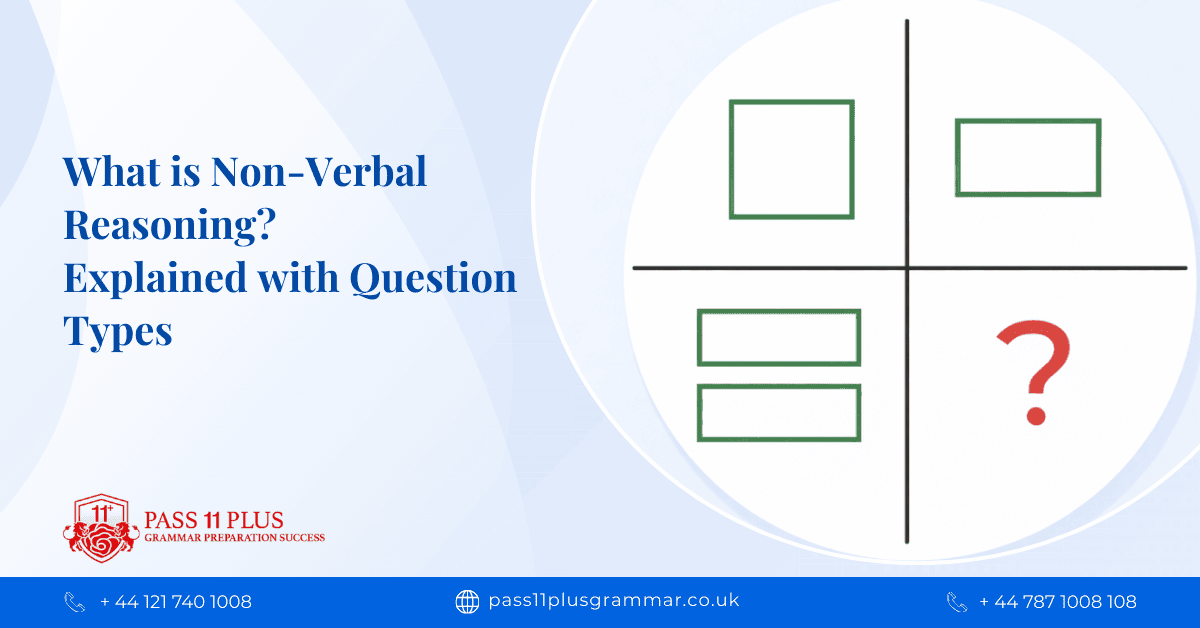
Non-verbal reasoning can feel strange at first. There are no words, only shapes and patterns, and it is usually not taught as a separate subject in school. That is why games are so helpful. They let children get used to the ideas in a safe and friendly way.
Here is why they work so well:
They build pattern spotting: The more patterns children see, the faster they notice rules.
They build spatial thinking: Turning, flipping and folding shapes in the head gets easier with practice.
They build confidence: Solving a puzzle feels great, and that feeling helps on test day.
They show where help is needed: If one game is always tricky, that skill needs more love.
11 plus tuition
Want to make 11+ non-verbal reasoning practice fun for your child?
Our 11+ tutors help children recognise patterns, understand shapes and tackle visual puzzles with greater confidence.
Best 11 plus non-verbal reasoning pattern games
Patterns are at the heart of NVR. These four games train children to spot rules quickly.
1. Pattern Chain
You need: Coloured counters, buttons, Lego bricks or drawn shapes.
How to play: Make a pattern in a row, such as a big red circle, a small blue square, a big red circle, a small blue square. Leave the last spot empty. Your child works out what comes next and says the rule out loud. Then swap, and let your child make a pattern for you.
NVR skills: Sequences, spotting rules and predicting the next step.
Make it easier: Change only one thing, such as colour.
Make it harder: Change size, colour and shape together, or make a pattern that grows.
2. Odd One Out Cards
You need: Five small cards or paper squares for each round, and coloured pens.
How to play: Draw five shapes on five cards. Make four of them follow one rule, such as "three sides" or "two shaded parts". Make the fifth break the rule. Shuffle the cards, and let your child find the odd one out and explain why. Tip: many odd one out puzzles are solved by a simple count of sides, lines or shaded parts.
NVR skills: Odd one out, careful looking and counting details.
Make it easier: Use big differences, such as shape or colour.
Make it harder: Make the difference tiny, such as the direction of a line or the position of a dot.
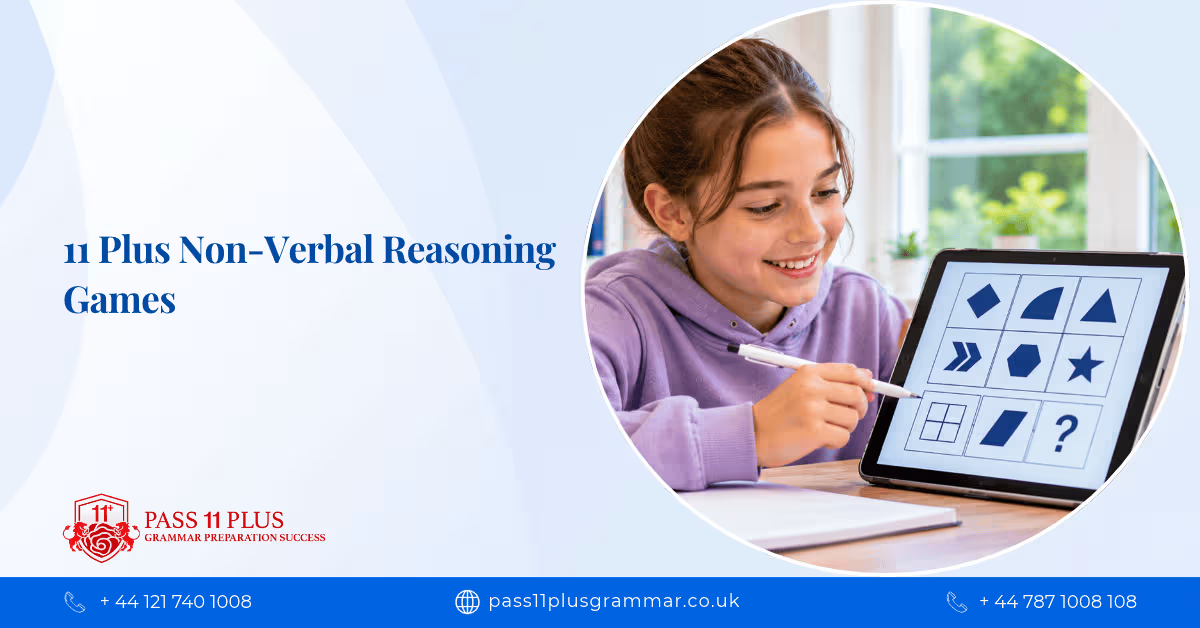
3. Missing Square Grid
You need: Paper, a ruler and coloured pens.
How to play: Draw a grid of three rows and three columns. Fill eight squares with shapes that follow a rule, for example each row adds one more line. Hide the ninth square, and let your child work out and draw what belongs there.
NVR skills: Matrices, rules across rows and columns, and logic.
Make it easier: Use a rule that only changes colour.
Make it harder: Use two rules at the same time, one across the rows and one down the columns.
4. What's The Rule?
You need: Paper and a pen.
How to play: Draw a shape, then draw how it changes, such as turned a quarter turn, shaded in or with an extra dot. Draw a new shape and ask, "A goes to B, so what does C go to?" Your child draws the answer and explains the rule.
NVR skills: Analogies, transformations and applying a rule to a new shape.
Make it easier: Use one simple change, such as shading.
Make it harder: Use two changes at once, such as turn and shade.
Fun 11+ non-verbal reasoning games for shapes
Turning, flipping and building shapes in the head is a big part of NVR. These four games make it hands on.
5. Tangram Challenge
You need: A paper square, scissors and a ruler. A tangram set has seven pieces cut from one square.
How to play: Cut a square into seven pieces to make your own tangram, or use a ready made set. Pick a simple picture, such as a house or a cat, and try to make it using all seven pieces. Time yourselves and try to beat your best.
NVR skills: Spatial thinking, matching shapes and turning shapes in your head.
Make it easier: Use pictures that show the pieces inside the outline.
Make it harder: Use outline pictures only, with no pieces shown.
6. Mirror Magic
You need: Squared paper, a pencil, a ruler and a small mirror.
How to play: Draw a straight line down the middle of the page. This is the mirror line. On one side, colour in a simple pattern using squares that touch the line. Your child draws the mirror image on the other side. Then check by holding a small mirror on the line.
NVR skills: Reflection, symmetry and noticing details.
Make it easier: Use only a few squares.
Make it harder: Use a diagonal mirror line, or a pattern that does not touch the line.
7. Turn Or Flip?
You need: Paper, scissors and a pen.
How to play: Draw a letter F or another shape that does not look the same when it is flipped. Cut it out. Draw four versions on a page: one turned, one turned again and one flipped like a mirror image. Ask your child to find the one that is a flip, and not just a turn. Check by moving the paper shape.
NVR skills: Telling rotation from reflection, which is a common NVR challenge.
Make it easier: Use only quarter turns.
Make it harder: Add more options, and turn the shapes by different amounts.
8. Cube Tower Views
You need: Six to eight small cubes or Lego bricks, paper and a pencil.
How to play: Build a small tower or shape. Draw what it looks like from the front and from above. Then take a photo or look again and check. Swap, and let your child build a shape from your drawings.
NVR skills: Understanding 3D shapes and how they look in 2D.
Make it easier: Use four cubes.
Make it harder: Draw the view from the side as well, or hide one cube behind another.
11 Plus non-verbal reasoning games for nets, folding and focus
These four games cover folding, nets and careful looking.
9. Net Detective
You need: Squared paper, scissors and sticky tape.
How to play: Draw several flat shapes made of six squares joined together. Ask your child to guess which ones will fold into a cube. Then cut them out and fold them to check. There are 11 different flat shapes, called nets, that fold into a cube.
NVR skills: Cube nets, folding in your head and 3D thinking.
Make it easier: Start with the classic cross shape.
Make it harder: Draw dots or patterns on the faces and predict where they end up.
10. Fold, Snip, Guess
You need: A square piece of paper and scissors.
How to play: Fold the paper in half, then in half again. Snip a small corner or edge. Before you unfold, ask your child to predict how many holes there will be and where they will be. Then unfold and see.
NVR skills: Folding paper questions, symmetry and predicting results.
Make it easier: Use one fold only.
Make it harder: Use more folds, or snip more than one place.
11. Spot The Change
You need: A tray, eight small objects or shape cards and a cloth.
How to play: Show your child the tray for twenty seconds. Cover it, and quietly change one thing: remove a shape, swap two or turn one around. Take off the cloth, and let your child spot what changed.
NVR skills: Attention to detail, memory and noticing small differences.
Make it easier: Use five objects.
Make it harder: Use shapes that look nearly the same, and change only a tiny detail.
12. Puzzle Night
You need: Jigsaw puzzles, a Sudoku book or other puzzle games.
How to play: Make a regular puzzle night. Work on a jigsaw together, try a Sudoku, or play a block puzzle game. Let your child lead and explain their thinking.
NVR skills: Spatial thinking, logic and patience.
Make it easier: Use a smaller jigsaw or a simple 4 by 4 Sudoku.
Make it harder: Use a bigger jigsaw, or race to finish a puzzle.
Building and online 11 plus non-verbal reasoning games
Building toys, such as Lego, and building games, such as Minecraft, can help children think about shapes and how things fit together. Free online NVR quizzes can also be a handy extra for quick practice of odd one out and pattern questions.
Keep screen time sensible: Mix online games with paper, blocks and puzzles.
Choose games that make children think: Look for puzzles with rules, patterns and shapes.
Talk about it: Ask your child to explain how they found each answer.
11+ Non-verbal reasoning games by skill
Use this quick guide to match a game to the skill your child wants to improve.
Sequences: Pattern Chain
Odd one out: Odd One Out Cards
Matrices: Missing Square Grid
Analogies and rules: What's The Rule?
Spatial thinking: Tangram Challenge, Puzzle Night
Reflection: Mirror Magic
Rotation: Turn Or Flip?
3D shapes: Cube Tower Views, Net Detective
Folding paper: Fold, Snip, Guess
Attention to detail: Spot The Change
Simple tips for solving non-verbal reasoning questions
Once your child enjoys the games, share these easy tips for real questions.
1. Look at one thing at a time
Check shape, then size, then shading, then position. Do not try to see everything at once.
2. Count
Count sides, lines, dots and shaded parts. Many odd one out puzzles come down to a simple count.
3. Say the rule out loud
If you can say the rule in one short sentence, you have probably found it.
4. Cross out wrong answers
Remove the options that clearly break the rule, then look closely at what is left.
5. Check the answer against the rule
Before you move on, make sure your answer fits every part of the rule.
How to make 11 plus non-verbal reasoning games work
1. Keep it short and happy
Ten to fifteen minutes is plenty. Stop while your child is still having fun.
2. Play along
Children love beating a grown up. Make a few mistakes on purpose, and let your child spot them.
3. Level up slowly
Start with the easier version of each game. When your child wins easily, move to the harder version.
4. Ask "How did you work that out?"
Explaining an answer out loud shows what a child really understands.
5. Celebrate effort
Praise trying hard, not only winning. A confident child keeps going when a puzzle feels tricky.
From 11 plus non-verbal reasoning games to real exam practice
Games are wonderful for building skills, but the real 11+ is a timed paper with its own style of questions. So the best plan mixes games with exam practice.
When your child feels happy with a skill, try some real questions. Our 11+ past papers help children get used to the way questions are set and how much time they have for each one.
Later, a mock exam shows what test day will feel like. If you are in Birmingham or the West Midlands, our 11 plus mocks in Birmingham let your child practise under test conditions, so the real day feels familiar and calm. We also provide online mock exams.
The holidays are a great time for a big boost. Our 11 plus intensive summer course brings the key topics together in a friendly, focused block, so children return to school ready for Year 6.
How Pass 11 Plus Grammar helps with 11 plus non-verbal reasoning
At Pass 11 Plus Grammar, we make reasoning feel friendly. We explain each question type in small steps, with lots of examples, so children understand why an answer works and enjoy getting it right. Our 11 plus tuition helps children build strong English, maths and reasoning skills, and it is available online across the UK.
We are a Birmingham based team, so if you would like local, friendly support, you can reach out to our 11 plus tutors in Birmingham. Whatever stage your child is at, we will help them grow in confidence, one step at a time.
Final thoughts
11 plus non-verbal reasoning games make practice fun, build pattern and spatial skills and help your child feel more confident with puzzles. Pick a game, play for ten minutes and see the smiles. Then add timed papers and mock exams as the test gets closer, so your child has both the skills and the exam habits they need.
At Pass 11 Plus Grammar, we are here to help your child enjoy learning, one friendly step at a time.
Frequently Asked Questions
What are 11 plus non-verbal reasoning games?
11 plus non-verbal reasoning games are fun games that practise the skills in non-verbal reasoning, such as spotting patterns, finding the odd one out, and understanding rotation, reflection and 3D shapes. They use paper, shapes, blocks and puzzles, so practice feels like play.
Do games really help with non-verbal reasoning?
Yes. Games help children get used to patterns and shapes in a relaxed way, and they build the spatial thinking that NVR needs. Games work best alongside real exam style questions, because NVR papers are timed and have their own formats.
What are the best games for 11+ non-verbal reasoning?
Good choices include Odd One Out Cards, Missing Square Grid, Tangram Challenge, Turn Or Flip, Net Detective and Fold, Snip, Guess. They practise odd one out, matrices, spatial thinking, rotation, reflection and folding.
Mr Singh
Founder, Pass 11 Plus Grammar
Mr Singh is the founder of Pass 11 Plus Grammar, with over 30 years of teaching experience. Having overcome academic setbacks himself, he is passionate about ensuring no child struggles alone. His approach focuses on personalised support, strong foundations, and building confidence. He has helped students achieve outstanding results in 11+ and GCSE examinations
Loading related posts…