Loading page…
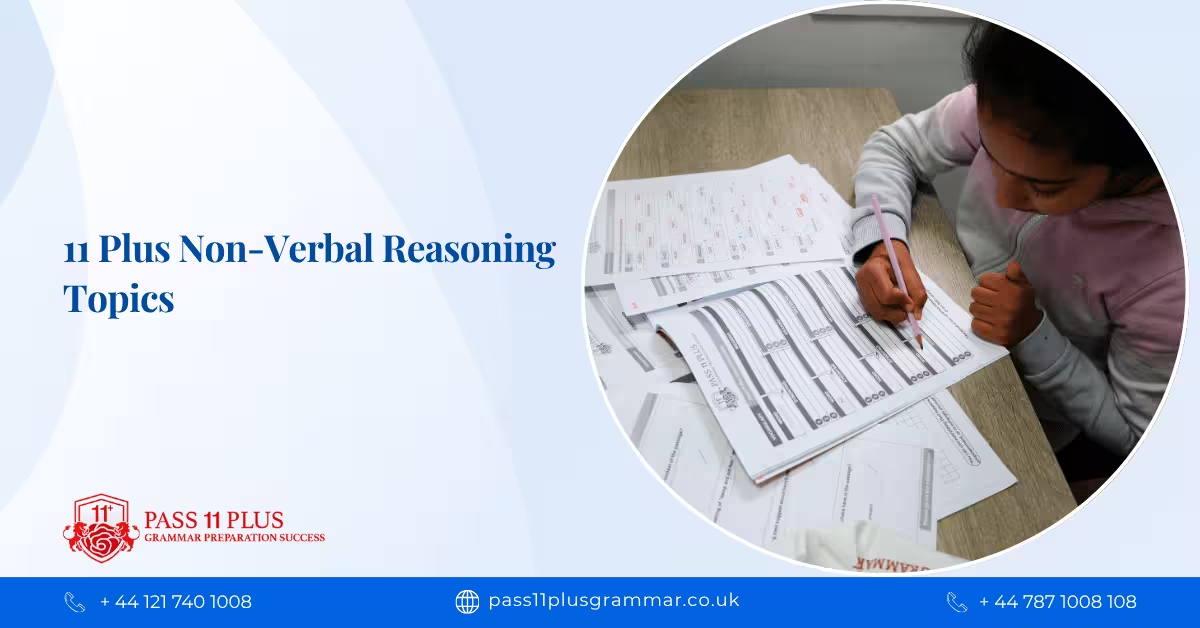
11 Plus Non-Verbal Reasoning Topics
Published on
The 11 plus NVR topics are split into three families. Interpreting shapes covers analogies and pairs, sequences, matrices, codes, odd one out, and match to a group. Moving 2D shapes covers hidden shapes, shape logic, rotation, reflection, and paper folding. Moving 3D shapes covers nets and cubes, rotating 3D shapes, building with blocks, and plan views from above. That is around 14 main topics. None of them are taught in school, which is why familiarity matters more in this paper than in any other.
Non-verbal reasoning is the paper that worries parents most, mainly because nobody is ever taught it at school. Here is the complete list of 11 plus non-verbal reasoning topics, all 14 question types explained, the three hardest ones, and a simple year-by-year plan so your child meets every topic in good time.
What is non-verbal reasoning?
Non-verbal reasoning means solving problems using pictures instead of words. Your child is shown shapes, patterns, grids and diagrams, and has to work out the rule that links them. There is no reading to do and no general knowledge to remember. Everything needed to answer the question is sitting right there on the page.
That sounds simple, and in a way it is. The tricky part is that non-verbal reasoning is not taught in school. It is not in the national curriculum, so unless a primary school runs an 11 plus club, most children reach Year 5 having never seen a single NVR question. Then they open a practice paper, see a page full of odd shapes and half-shaded circles, and freeze.
This is the most important thing to understand about the whole subject. When a child does badly in non-verbal reasoning at the start, it is rarely because they lack the ability. It is because the questions are unfamiliar. Take a bright child, show them each question type once, explain the rule behind it, and their score usually jumps within weeks.
Non-verbal reasoning tests four things at once: spotting patterns, finding rules, picturing shapes moving in your head, and doing all of it quickly. Those skills matter well beyond the exam. They feed straight into maths, science, design and computing later on. Our 11 plus tuition teaches NVR as a set of learnable skills rather than a mystery test of natural talent, because in thirty years of preparing children for grammar school entry we have watched far too many capable children written off based on one unfamiliar paper.
Which exams test non-verbal reasoning?
Not every school tests non-verbal reasoning, and the ones that do use different exam boards. This matters, because the topic list shifts slightly depending on which paper your child is sitting.
GL Assessment
Sat on paper, multiple choice
May be a whole NVR paper or NVR mixed into another paper
Draws from a known bank of question types
Timing is tight, so speed matters
ISEB Common Pre-Test
Taken on a computer
A non-verbal reasoning section of about 25 minutes
Adaptive, so questions get harder as your child gets them right
Mostly Year 5 level content
CAT4
Usually online, sometimes on paper
Not adaptive
Figure classification, analogies, matrices and figure analysis
Also includes a separate spatial section
Cambridge Select Insight
Taken on a computer, not adaptive
Non-verbal reasoning appears in the final section
Matrix style questions with a missing picture
Four answer options per question
Some grammar schools and independent schools also write their own papers. Those tend to borrow heavily from the GL style, so a child who knows the full topic list below is prepared for almost anything. If you are unsure which board your target schools use, one of our 11 plus tutors can talk you through it and map your child's preparation to the right papers.
The 11 plus non-verbal reasoning topics list
Here is the complete list of 11+ non-verbal reasoning topics. Different publishers count them differently, which is why you will see figures anywhere from 10 to 21 online. We group them into three families because that is how children actually learn them. Everything in family one is about looking. Everything in families two and three is about moving shapes in your head.
Interpreting shapes
These six topics are all about looking carefully. Nothing has to be turned or folded in your child's head. They simply have to notice what changes and what stays the same.
There are only ever a handful of things a picture can change: shape, size, number, shading, colour, position, direction and line style. Teach your child that short list, and they have a checklist to run through on every single question in this family. Most children who struggle are not short of ability; they are just looking randomly instead of systematically.
Topic 1: Analogies and pairs
Your child sees two pairs of pictures. The first pair is complete and shows a rule in action. The second pair has a gap. The job is to find the rule from the first pair and use it on the second.
The rule is usually something like "the shape gets one extra side", "the shading swaps from black to white", or "the small circle moves from the top to the bottom". Sometimes two rules run at once, which is where marks go missing. Teach your child to say the rule out loud in words before looking at the answers.
Topic 2: Sequences
A row of pictures is shown with one missing, usually at the end but sometimes in the middle. Your child works out what is happening step by step and picks the picture that fits.
The classic trap here is that two or three things are changing at once. A shape might be rotating a quarter turn each step while also gaining one extra dot. The fix is simple: follow one feature all the way along the row, then go back to the start and follow the next one. Trying to track everything at once is what causes mistakes.
Topic 3: Matrices
A matrix is a grid, usually two by two or three by three, with one square left empty. Your child picks the picture that completes it.
The trick with matrices is direction. Patterns can run across the rows, down the columns, diagonally, or in more than one direction at the same time. Teach your child to check rows first, then columns. If neither works on its own, the rule is probably a combination, such as picture one plus picture two making picture three with any repeated lines removed.
Topic 4: Codes
A set of pictures is shown, and each one has a two or three letter code underneath. Each letter stands for one feature of the picture. Your child works out what the letters mean and then chooses the correct code for a new picture.
Codes look frightening, but they follow a neat rule. The first letter of every code always describes the same feature, the second letter always describes another. So the method is to line up all the first letters, see what those pictures have in common, then repeat for the second letters. Written out like a little table, codes become one of the most reliable topics on the paper.
Topic 5: Odd one out
Five pictures are shown, and four of them follow a rule. Your child finds the one that does not belong.
The best approach is the opposite of what most children do. Instead of hunting for the odd picture, find what the majority have in common. Once you can say "four of these have an even number of sides", the odd one out identifies itself. Common rules include number of sides, number of shapes inside, shading, symmetry and whether lines cross.
Topic 6: Match to a group or pair
This is odd one out in reverse. Your child is shown a group of pictures that share a rule, and has to pick the answer option that belongs with them.
Some papers show two groups instead of one, and your child must decide which group the new picture joins. The method is the same: work out the rule of the group first, in words, then test each answer option against it and cross off the ones that fail.
Moving 2D shapes
Now the shapes start moving. These four topics ask your child to picture a flat shape being turned, flipped, folded or buried inside something else. This is spatial awareness, and it is the part of non-verbal reasoning that improves most dramatically with practice.
Topic 7: Hidden shapes
Your child is given a simple shape and has to find it hidden inside a more complicated one. There are three common versions: which picture contains the hidden shape, which picture does not contain it, and which group of shapes contains it.
The important rule is that the hidden shape must be the same size and shape as the original, although it can be turned round. Children lose marks by accepting a nearly right shape. Tracing the outline with a fingertip on the page is a genuinely useful habit here.
Topic 8: Shape logic
Shape logic questions ask your child to put shapes together or take them apart. There are three versions to know:
Combining shapes. Two or more pieces are laid on top of each other and your child works out the picture that results.
Forming a shape. Several pieces are shown, and your child chooses which ones fit together like a jigsaw to make the target shape.
Forming a silhouette. The shapes are joined and then filled in solid black, so only the outline matters.
Silhouette questions are much easier once your child knows to ignore everything inside the shape and look only at the edge.
Topic 9: Rotation
A shape is turned round a quarter, a half or three quarters of a full turn, and your child picks the option that shows it correctly. The shape itself never changes, only its direction.
Two habits help enormously. First, find one distinctive feature, such as an arrow, a shaded corner or a small dot, and track only that feature through the turn. Second, physically turn the page. It feels like cheating, but it is completely allowed, and it builds the mental picture your child will later be able to make without the page.
Topic 10: Reflection
A mirror line is shown, and your child picks the shape as it would appear in the mirror. Reflection is not the same as rotation, and confusing the two is the single most common error in the whole NVR paper.
Here is the difference in one sentence. In a rotation, the shape spins round, so the same side keeps facing the same way as the shape turns. In a reflection, the shape flips over, so left becomes right. If the mirror line is vertical, whatever was closest to the line stays closest to the line on the other side.
Topic 11: Paper folding
Also called hole punch questions. A square of paper is folded along a dashed line, shapes are cut out, and your child chooses what the paper looks like when it is opened out again.
This topic trips up more children than any other in family two, because the natural instinct is to slide the holes across to the other side. That is wrong. The holes are reflected, not moved. A hole close to the fold stays close to the fold. A hole near the outside edge appears near the opposite outside edge. If the paper is folded twice, the holes appear four times.
Fold a real sheet of paper with your child, punch it with a hole punch, and open it up. Do that three or four times and the rule sticks for good. Our 11+ free practice papers include NVR sections so you can test the rule straight away on real exam-style questions.
Moving 3D shapes
The last four topics move into three dimensions. These appear in GL papers, in CAT4 spatial sections and in many independent school tests. They are the topics most worth starting early, because the skills grow slowly.
Topic 12: Nets and cubes
Your child sees a flat net, which is a cube opened out and laid flat, with a different pattern on each face. They then choose which cube could be made by folding it up.
The way to answer these is by elimination rather than by imagination. Look at the cube options and ask two questions. Does this cube show a pattern that is not on the net at all? If so, cross it out immediately. Do two faces that are opposite each other on the net appear next to each other on the cube? If so, cross that out too, because faces that sit opposite one another can never be seen together. That usually leaves one answer standing without any folding needed in your head.
Topic 13: Rotating 3D shapes
A 3D shape is shown, and your child picks the option that is the same shape simply turned round. The tempting wrong answers are usually mirror images rather than rotations, or shapes with one small block moved.
Counting is the safest method. Count the blocks in the original, then count the blocks in each option. Any option with a different number is gone straight away. Then look for one unusual feature, such as a block sticking out on its own, and check whether it sits in the same place relative to everything else.
Topic 14: Building with blocks
Your child is shown a finished 3D shape and several groups of blocks, and has to choose the group that would build it. The difficulty is that some blocks in the finished shape are partly hidden or completely out of sight behind others.
Teach your child to count the hidden blocks. If a block is holding another one up in the air, there must be something underneath even if you cannot see it. Children who only count what is visible always undercount, and the answer they choose is always one or two blocks short.
Topic 15: Plan view from above
A 3D shape is shown, and your child picks the flat drawing of what it looks like from directly above, as if a bird were looking down at it.
The rule here is that height does not matter at all from above. A tower of five blocks and a single block look identical from the top. What matters is only the footprint, in other words, which squares of the floor are covered. Building the shape with real bricks and looking down at it is the fastest way to teach this.
The 3 hardest 11 plus NVR topics
After three decades of teaching this paper, the same three topics come up again and again as the ones children find hardest. None of them are impossible. They just need more time than the others.
1. Nets and cubes
This is the hardest 11 plus non verbal reasoning topic for most children, because it asks them to do something genuinely difficult: fold a flat shape into a solid one inside their head. Ten year olds vary enormously in how easily they can do this.
The good news is that the elimination method works without any mental folding at all. Rule out cubes showing patterns that are not on the net, then rule out cubes showing two opposite faces at once. Teach the method first and let the mental picture develop slowly in the background.
2. Paper folding and hole punch
Children lose marks here for one reason: they slide the holes across instead of reflecting them. It looks right, the wrong answer is always offered, and they walk into it every time until somebody explains the difference.
Once your child understands that the fold line works exactly like a mirror, and that distance from the fold is preserved, this topic becomes one of the more predictable ones on the paper.
3. Codes
Codes ask children to hold several rules in mind at once, which is a real memory load under exam pressure. They also punish guessing more than any other topic, because a code that is half right scores nothing.
The fix is to make it visual. Write the codes in a column, group them by first letter, and the pattern usually jumps out. Children who work codes on paper rather than in their heads get them right far more often.
If your child is losing marks in these three areas, that is normal, and it is fixable. Small group teaching works particularly well here because children learn a lot from hearing how another child explains the rule. Our 11 plus summer courses spend dedicated sessions on nets, folds and codes, which is often the fastest way to clear a stubborn weak spot before the autumn exams.
The 5 step method that works on every question
Every non-verbal reasoning question, whatever the topic, can be attacked with the same five steps. Teach your child this once, and they always have somewhere to start, even on a question type they have never seen.
1. Name it
What type of question is this? Sequence, matrix, code, net, fold? Naming the type tells your child what to look for and stops the panic.
2. Look
Run through the checklist: shape, size, number, shading, colour, position, direction, line style. Say what you notice out loud in practice sessions.
3. Compare
What stays the same and what changes? The features that stay the same are just decoration. The features that change carry the rule.
4. Say the rule
Put the rule into a short sentence before looking at the options. If your child cannot say it in words, they have not found it yet.
5. Eliminate
Cross out every option that breaks the rule. Most questions are won by ruling out four wrong answers rather than by spotting the right one.
Step five is the one that raises scores fastest. Non-verbal reasoning is multiple choice, so a child who can confidently cross out three options has turned a hard question into a coin flip at worst. Never leave a blank. There are no penalty marks in the 11 plus, so an educated guess is always better than an empty box.
11 plus NVR topics to cover, year by year
Non-verbal reasoning rewards early starters more than any other 11 plus subject. Not because the topics take years to learn, but because the spatial skills underneath them grow slowly and quietly with exposure.
Year 3: No formal NVR needed. Build the underlying skills through play: jigsaws, Lego, tangrams, spot the difference, mirror games and shape sorting. Introduce simple odd one out and sequence puzzles for fun only.
Year 4: Start proper familiarisation. Meet the interpreting shapes family first, then rotation and reflection. Untimed, one topic at a time, ten minutes a few times a week.
Year 5: Cover every topic on the list, including nets, folds and 3D. Begin gentle timing in the second half of the year. This is the year the topic list should be finished.
Year 6 (autumn): Revision, speed and exam technique. Full timed papers, mock exams and targeted work on the weakest two or three topics. Exams usually fall in September.
Here is how that maps onto our year groups. Year 3 11 plus tuition lays the foundations in maths and English while building spatial confidence through puzzle work rather than exam papers. Year 4 11 plus tuition is where we introduce non verbal reasoning properly, one question type at a time, with no clock running.
Year 5 11 plus tuition is the year that matters most. We work through the full topic list, check understanding as we go, and start bringing in timing once accuracy is secure. And in Year 6 SATs tuition, we sharpen everything into exam performance, with timed papers, technique work and preparation for the Key Stage 2 SATs that follow in May.
How to cover every 11+ non-verbal reasoning topic without the stress
The families who find non-verbal reasoning easiest are rarely the ones doing the most work. They are the ones doing the right work, regularly, over a long enough stretch of time.
1. One topic at a time
Do not hand your child a mixed practice paper as their first taste of NVR. Take one question type, explain the rule, work through five or six examples together, then let them do ten alone. Move on only when that type feels easy.
2. Accuracy first, speed second
Never start timing until your child is getting a topic right most of the time. Timing an unfamiliar question type teaches panic, not skill. Speed comes on its own once the method is automatic.
3. Little and often beats long sessions
Ten minutes on four days beats forty minutes on a Sunday. NVR is about recognition, and recognition builds through repeated short exposures. Short sessions also keep the subject feeling like puzzles rather than homework.
4. Always mark and always talk
A practice paper that is marked but not discussed teaches almost nothing. Go back over the wrong answers and ask your child to explain their thinking. Nine times out of ten you will find one small misunderstanding that was quietly costing marks across a whole topic.
5. Use real objects
Fold real paper. Build real cubes. Look down at real block towers. Hold up a real mirror. Children who have physically done the thing answer these questions far more confidently than children who have only seen them drawn.
6. Sit mock exams
The real paper is sat in a hall, under a clock, with a separate answer sheet to fill in. That is a very different experience from the kitchen table. Children who have done it before are calmer, and calm children score higher.
We build all of this into our teaching. Our 11 plus mocks replicate real exam conditions, including the separate answer sheet that catches so many children out, and every child gets a breakdown showing which NVR topics cost them marks. You can then take that breakdown and work on exactly the right things, rather than practising everything equally.
Final thoughts
The 11 plus non verbal reasoning topics list looks intimidating written out in one place. Fourteen question types, three families, shapes turning and folding and hiding inside each other. But this is the friendliest paper in the whole 11 plus once you understand how it works.
So start early, go one topic at a time, use real paper and real bricks, keep the sessions short, and leave the timing until accuracy is solid. Then use mock exams in the final year to turn that knowledge into a calm performance under a clock.
If you would like a hand mapping it out for your child, we are here. Contact us today.
Frequently Asked Questions
What is the hardest 11 plus non verbal reasoning topic?
Nets and cubes are the topics children find hardest, because they ask children to fold a flat shape into a cube in their heads. Paper folding comes a close second, because the cut shapes are reflected across the fold rather than slid across, and almost every child gets that wrong until it is explained. Codes are third because each letter stands for one feature, and several rules have to be kept in mind at once.
When should my child start non verbal reasoning?
Year 4 is the ideal time to start, with light familiarisation through puzzles and building toys possible in Year 3. Starting early matters more in NVR than in any other subject, because the skills build through exposure rather than through learning facts.
Do all grammar schools test non-verbal reasoning?
No. Schools choose which subjects to include, and some test only English and maths. Others include non-verbal reasoning as a full paper, and some mix NVR questions into a combined reasoning paper. Always check the admissions page for each school on your list, and check it again each year because arrangements change. If your child is applying to a mix of grammar and independent schools, covering the full topic list is the safest approach.

Mr Singh
Founder, Pass 11 Plus Grammar
Mr Singh is the founder of Pass 11 Plus Grammar, with over 30 years of teaching experience. Having overcome academic setbacks himself, he is passionate about ensuring no child struggles alone. His approach focuses on personalised support, strong foundations, and building confidence. He has helped students achieve outstanding results in 11+ and GCSE examinations
Loading related posts…