Loading page…
11 Plus Verbal Reasoning Topics: Complete Guide with Examples
Published on
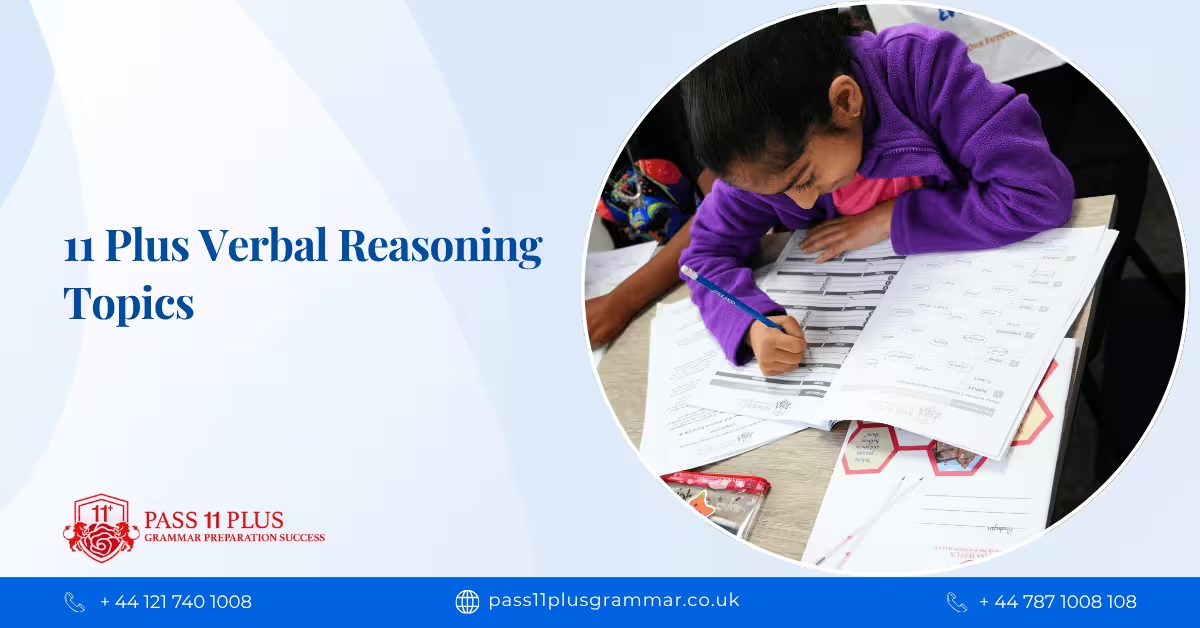
The 11 plus verbal reasoning topics fall into four main categories: Words and Wordplay (synonyms, antonyms, anagrams, hidden words, morph the word, stolen words), Logic (statement logic, deductions, letter and number logic), Patterns and Functions (letter codes, number codes, letter sequences, number sequences, reordering) and Numbers (find the calculation, balance the equation, substitutions). GL Assessment uses 21 standard VR question types. The three hardest are morph the word, stolen words, and find the calculation.
Verbal reasoning is one of the most important and most misunderstood subjects in the 11 plus. Children who have never seen it before often feel lost on their first attempt. Children who have practised it systematically almost always improve fast. This guide covers every verbal reasoning topic your child needs to know, with worked examples and preparation tips for each one.
The four categories of 11+ verbal reasoning topics
All 11 plus verbal reasoning topics sit within one of four main categories. Understanding how the topics are organised helps you and your child approach preparation in a structured, logical order.
Category 1: Words and Wordplay
Words and wordplay is the largest category of verbal reasoning topics and the one most closely connected to English skills. A strong vocabulary is an enormous advantage in this category, which is why daily reading from an early age matters so much for VR performance as well as English.
Synonyms and Antonyms
Synonym questions ask your child to find the word closest in meaning to a given word. Antonym questions ask them to find the word most opposite in meaning. These appear in almost every VR paper and account for a significant proportion of marks.
Example: Synonym question
Which word is most similar in meaning to COURAGEOUS?
A) Timid B) Bold C) Careful D) Quiet E) Angry
Answer: B) Bold
Courageous means brave or bold. Timid is the antonym (opposite). The other options are unrelated to courage.
Prep tip: Build vocabulary through daily reading rather than word lists. When your child reads, encourage them to notice interesting words and look up any they do not know. A word encountered in context is remembered far better than one on a flashcard.
Odd One Out
Odd one out questions test your child's ability to identify what the words in a group have in common and which word does not share that quality. The connection can be meaning, category, spelling pattern, or function.
Example: Odd one out
Find the odd one out: Robin Sparrow Eagle Salmon Pigeon
Answer: Salmon
All other words are birds. Salmon is a fish. The category connection is the key to solving this type of question.
Prep tip: Encourage your child to ask "what do these words have in common?" before looking for the odd one out. Sometimes there are two plausible answers, and your child needs to find the most specific connection to identify the one that does not fit.
Anagrams and Jumbled Words
Anagram questions give your child a jumbled set of letters and ask them to rearrange them to form a word. Often a clue or category is given to help narrow down the options. Speed is important here because children who struggle with anagrams tend to spend too long on individual questions.
Example: Anagram with category clue
Find the animal hidden in these letters: IRTLE
Answer: LITER rearranged = TIGER... or: TIGER (no, same letters). TIRLE = LITER, LITRE, RELIT... The animal is: TIGER
Using the clue (animal) narrows down the options significantly. Your child should always use the clue to guide their thinking before attempting to rearrange the letters.
Prep tip: Practise anagrams against the clock. The key skill is working quickly through letter combinations. Children who freeze on hard anagrams should move on and return at the end of the paper.
Hidden Words
Hidden word questions ask your child to find a word hidden at the boundary of two words within a sentence. The hidden word always spans exactly two consecutive words and is a specific number of letters long (usually three or four letters).
Example: Hidden word (find the 3-letter word)
The cat sat on the mat.
Answer: "sat on" contains the hidden word: "ATON"? No. "cat sat" = CAT + SAT. Hidden: ATS, TSA... Try each boundary: "the cat" = HEC, ECA, CAT. "cat sat" = ATS, TSA, SAT. Found: SAT is already a word and found within "cat sat".
Slide a window of the required letter count across every word boundary and check whether each combination is a real word. Practise this systematically rather than scanning randomly.
Prep tip: Teach your child to move through the sentence systematically, checking each word boundary in order. Rushing and scanning randomly leads to missed answers in this question type.
Cloze: Complete the Sentence
Cloze questions ask your child to choose the word that best fits a gap in a sentence. These appear in two forms: single-gap sentences (choose one word from five options) and double-gap sentences (choose two words from two separate sets of options).
Example: Cloze (single gap)
The explorer was ______ by the breathtaking view from the summit.
A) bored B) terrified C) captivated D) distracted E) confused
Answer: C) Captivated
The context (breathtaking view) tells us the explorer was positively affected. Captivated (held by fascination) fits perfectly. Bored and distracted are negative. Terrified and confused do not match the positive tone.
Prep tip: Teach your child to read the full sentence first, predict what kind of word should go in the gap, then look for that type among the options. This is faster and more accurate than trying each option in turn.
Category 2: Logic
Logic questions test your child's ability to reason from given information to a correct conclusion. They require careful, methodical thinking rather than language knowledge, and children who rush them tend to make avoidable errors.
Statement Logic and Deductions
Statement logic questions give your child a set of statements and ask them to identify which conclusion must be true. The key word here is "must." A conclusion that might be true but is not guaranteed by the statements is not a correct answer.
Example: Statement logic
All dogs are mammals. All mammals are warm-blooded. Bella is a dog. Which must be true?
A) Bella is cold-blooded B) Bella is a mammal C) All warm-blooded animals are dogs
Answer: B) Bella is a mammal
If all dogs are mammals and Bella is a dog, Bella must be a mammal. Option C makes an invalid reversal of the original statement. Option A contradicts it.
Prep tip: Teach your child to only accept conclusions that follow with 100% certainty from the given statements. If a conclusion is only "possible" or "likely," it is not a valid logical deduction in this context.
Category 3: Patterns and Functions
Patterns and functions questions test your child's ability to identify rules and apply them to new examples. This is where logical thinking and language knowledge combine most directly.
Letter Codes
Letter code questions give your child a word and its coded form, and ask them to decode another word using the same rule. The rule is usually a consistent shift of letters forward or backward through the alphabet.
Example: Letter codes
If CAT is coded as ECV, what is the code for DOG?
Answer: FQI
C shifts forward 2 to E. A shifts forward 2 to C. T shifts forward 2 to V. Apply the same rule: D shifts to F, O shifts to Q, G shifts to I. Answer: FQI.
Prep tip: Make sure your child knows the alphabet position of every letter by heart (A=1, B=2, C=3... Z=26). Being able to count forward and backward from any letter quickly is the core skill for all code question types.
Letter Sequences
Letter sequence questions give your child a series of letters that follow a pattern and ask them to identify the next letter or the missing letter in the series. The pattern is usually based on regular jumps forward or backward through the alphabet, often with two or more interleaved sequences.
Example: Letter sequence
What is the next letter in this sequence? B D F H __
Answer: J
Each letter jumps forward 2 places in the alphabet: B(+2)D(+2)F(+2)H(+2)J. The rule is a constant skip of 2.
Prep tip: When faced with a sequence that does not immediately make sense, check whether there are two interleaved sequences (looking at every other letter separately). Many harder letter sequence questions use this structure.
Number Sequences
Number sequence questions test the same logical thinking as letter sequences but use numbers. The rule connecting consecutive numbers might involve addition, subtraction, multiplication, division, or a combination. Some harder sequences involve alternating rules.
Example: Number sequence
What is the missing number? 3 6 12 24 __
Answer: 48
Each number is doubled (multiplied by 2). 3x2=6, 6x2=12, 12x2=24, 24x2=48. A multiplication rule rather than addition.
Category 4: Numbers
Number-based verbal reasoning questions sit at the crossover between Maths and verbal reasoning. They do not test advanced Maths content but they do require clear logical thinking about numerical relationships.
Balance the Equation and Substitutions
These questions give your child an equation or a set of rules and ask them to find the missing value. They may involve letters standing in for numbers, which children often find strange at first but quickly get used to with practice.
Example: Balance the equation
If a = 3 and b = 5, what is the value of 2a + b?
Answer: 11
2a = 2 x 3 = 6. 6 + b = 6 + 5 = 11. Substitute the given values and calculate step by step.
Prep tip: Encourage your child to always write out the substitution step by step rather than trying to calculate in their head. This reduces errors and is faster overall because it avoids having to restart after a mistake.
The 3 hardest verbal reasoning topics (with worked examples)
1. Morph the Word
In morph the word questions, your child is given two words and needs to get from the first word to the last word by changing one letter at a time. Each step must create a real, correctly spelled word. The challenge is holding multiple word options in mind simultaneously while checking each one is valid.
Worked example: Morph the word
Get from MOUSE to WORSE in three steps, changing one letter at a time.
Answer: MOUSE → HOUSE → HORSE → WORSE
Step 1: Change M to H: MOUSE → HOUSE (change first letter)
Step 2: Change U to R: HOUSE → HORSE (change fourth letter)
Step 3: Change H to W: HORSE → WORSE (change first letter)
Each intermediate word must be a real word spelled correctly.
How to approach morph the word
1. Look at the first and last word. Identify which letters are different and which are the same.
2. Try changing the most distinctive letters first (not the vowels, which often lead to dead ends).
3. After each step, check that the new word is correctly spelled and is a real English word.
4. If a path leads to a dead end, backtrack one step and try a different letter change from that point.
5. Double-check every word in your chain is spelled correctly before selecting your answer.
2. Stolen Words
In stolen words questions, your child is given an incomplete word with a gap inside it. Their job is to find the three or four letters that were "stolen" from inside the word. The stolen letters must: create a real word when inserted, complete the longer word correctly, and form a real English word on their own.
Worked example: Stolen words
Find the word that can be placed in the middle: DESCE __ BE
Clue: Something found in the body
Answer: RIB
RIB is a word on its own (a bone in the body, which fits the clue).
DESCE + RIB + BE = DESCRIBE (a real word spelled correctly).
Both conditions are met.
1. Read the clue first (if given) to get a sense of what the stolen word might be.
2. Look at the incomplete word and think about what letters could complete it as a real word.
3. Check that your candidate letters form a real word on their own.
4. Check that the completed long word is spelled correctly.
5. Reread the clue to confirm the stolen word matches it.
3. Find the Calculation
In find the calculation questions, your child is given sets of numbers connected by a hidden rule. They must identify the rule and use it to find a missing number. There are three types: find the missing number, find the odd pair out, and find the rule.
Worked example: Find the missing number
(12 [60] 5) (8 [40] 5) (48 [__] 12)
Answer: 20
Step 1: Find the rule linking 12, 60 and 5. Is it 12 x 5 = 60? Yes.
Step 2: Check with the second triplet: 8 x 5 = 40. Yes, the rule holds.
Step 3: Apply to the third triplet: 48 ÷ 12 = 4. 4 x 5 = 20.
Wait: the rule in triplet 3 has different numbers. Recheck. The rule must be: left ÷ right x 5 = middle.
12 ÷ 1 x 5 = 60? No. Try: left x right = middle: 12 x 5 = 60. 8 x 5 = 40. 48 x 12 = 576. No.
Try: (left / right) x 10 = middle: 12/5 = 2.4. No.
Simplest rule: middle = left x 5 in triplets 1 and 2. For triplet 3: 48 x ? = middle, where right = 12. Try middle = (left / right) x 5: 48/12 = 4. 4 x 5 = 20. Answer: 20.
1. Look at the first triplet. Try simple operations first: addition, subtraction, multiplication, division.
2. Test the rule you found on the second triplet to verify it is consistent.
3. If it does not work, try combining two operations (e.g. divide then multiply).
4. Once you have verified the rule on two triplets, apply it to the third to find the missing number.
5. Double-check your arithmetic before confirming the answer.
Verbal reasoning topics by exam board
The verbal reasoning topics your child encounters depend partly on which exam board is used by their target grammar schools. Here is a clear summary of the main differences.
GL Assessment verbal reasoning
GL Assessment uses 21 standard verbal reasoning question types, covering all four categories above. Papers are typically in multiple-choice format with a separate answer sheet. Each paper runs for around 50 minutes. The question types are consistent and predictable from year to year, which means systematic preparation by question type is very effective.
CEM verbal reasoning
CEM exams blend verbal reasoning with comprehension and vocabulary in a combined paper. The format is less structured than GL Assessment and the question types tend to be less predictable. The blending of verbal reasoning with English skills means that strong vocabulary and reading comprehension ability is particularly important for CEM preparation.
How to prepare for verbal reasoning topics
1. Learn each question type individually before doing full papers
The most common preparation mistake is starting with full practice papers before your child understands each question type. This produces slow improvement because your child is simultaneously learning the format and trying to answer correctly under pressure. Work through each category systematically, one question type at a time, until your child can answer that type reliably before moving on. Our free 11+ practice papers are a great resource once the foundational question types have been covered.
2. Build vocabulary through daily reading from Year 3
A large vocabulary is the foundation of strong performance across the entire words and wordplay category, and it helps with logic and codes too. Twenty to thirty minutes of reading every day, across different genres and text types, is the single best long-term investment in verbal reasoning preparation. Start this habit in Year 3 and make it non-negotiable throughout primary school.
3. Learn the alphabet positions by heart
Many verbal reasoning topics, including letter codes, letter sequences and some logic questions, require your child to count forward and backward through the alphabet quickly. A child who knows that M is the 13th letter and N is the 14th will solve code questions in seconds. A child who has to count from A every time will lose significant time across a full paper. Learning alphabet positions to instant recall should be an early preparation goal, starting in Year 4 at the latest.
4. Get targeted support from a specialist tutor
A specialist tutor who knows verbal reasoning question types in depth can identify exactly which categories and question types your child finds hardest and build a targeted plan to address them. Our 11 plus tutors at Pass 11 Plus Grammar have over 30 years of experience teaching every verbal reasoning topic to children preparing for grammar school entry. We cover every question type, including the three hardest, with worked examples and technique development for each one.
5. Build to timed paper practice and then sit a mock exam
Once your child is familiar with individual question types, move to timed full papers that mix all categories together. This builds the speed and exam stamina needed to perform well across a complete VR paper. Our 11 plus intensive summer course includes structured VR preparation alongside all other subjects. And our 11 plus mocks replicate the real exam conditions with full feedback by question type so you know exactly which VR topics still need work before September.
What to focus on by year group
Year 3: Daily reading, vocabulary building, introduction to word categories. Our Year 3 11+ tuition gently introduces verbal reasoning concepts.
Year 4: Learn alphabet positions, introduce synonyms, antonyms, odd one out and letter codes. Our Year 4 11+ tuition builds core VR skills.
Year 5: All 21 GL question types, timed practice begins, morph the word, stolen words and find the calculation. Our Year 5 11+ tuition covers every topic.
Year 6: Full timed papers. Mock exams. Targeted revision of weak question types. Our Year 6 SATs tuition brings everything together before September.
Final thoughts
Verbal reasoning is not a talent your child either has or does not have. It is a set of learnable question types, each with its own structure, its own strategy and its own common pitfalls. The children who perform best in 11 plus verbal reasoning are those who have been introduced to each question type systematically, practised it until it feels familiar, and then built up to timed paper practice under realistic conditions.
At Pass 11 Plus Grammar, our expert tutors cover every verbal reasoning topic from Year 3 to Year 6. Get in touch today and let us help your child master every topic on the 11 plus verbal reasoning list.
Frequently Asked Questions
How do I help my child with verbal reasoning?
The most effective approach is to work through each verbal reasoning question type individually, one at a time, before moving on to timed paper practice. Build vocabulary through daily reading. Learn alphabet positions by heart for code and sequence questions. Practise under timed conditions once all question types are familiar. Use free practice papers for regular home reinforcement. And sit at least one full mock exam before the real test to build confidence and reduce exam anxiety.
When should my child start practising verbal reasoning?
Vocabulary building and reading habits should start in Year 3. Formal verbal reasoning practice, working through individual question types, should begin in Year 4 or early Year 5.
How many verbal reasoning question types are there?
GL Assessment uses 21 standard verbal reasoning question types. These cover word-based questions, logic questions, code and sequence questions and number-based questions. CEM exams blend verbal reasoning with English in a less structured format. The exact number of question types your child encounters depends on the exam board used by their target grammar schools.

Mr Singh
Founder, Pass 11 Plus Grammar
Mr Singh is the founder of Pass 11 Plus Grammar, with over 30 years of teaching experience. Having overcome academic setbacks himself, he is passionate about ensuring no child struggles alone. His approach focuses on personalised support, strong foundations, and building confidence. He has helped students achieve outstanding results in 11+ and GCSE examinations
Loading related posts…