Loading page…
11 Plus (11+) Reading List
Published on
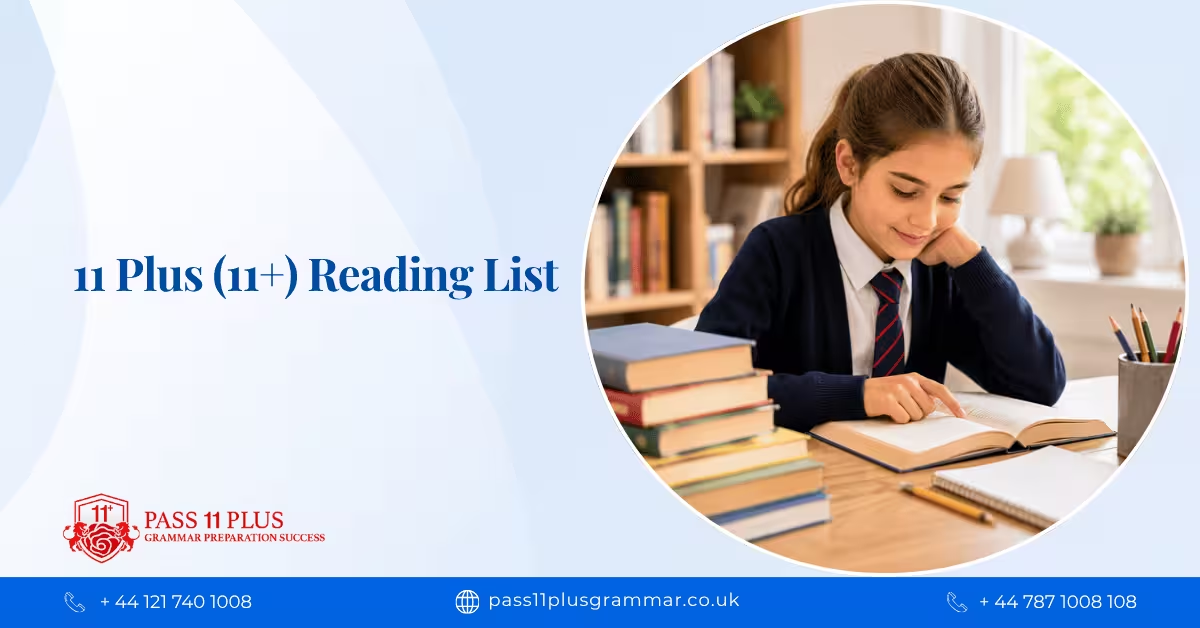
A strong 11 plus reading list is not one book; it is a wide mix of genres read regularly over two to three years. It should include classic fiction, adventure, mystery, fantasy, non-fiction and poetry, because comprehension papers can pull a passage from any of these. Fifteen to twenty minutes of daily reading from Year 3 or Year 4 builds the vocabulary and inference skills that comprehension, verbal reasoning and creative writing all depend on. Below you will find over 60 recommended books, organised so you can pick the right ones for your child's age and interests.
Reading is the single biggest thing that separates a confident 11 plus candidate from a nervous one. Here is our full 11 plus reading book list, sorted by genre and by year group, with real tips on how to turn story time into exam marks.
Why reading matters so much for the 11 plus
Every part of the 11 plus leans on reading, even the parts that do not look like it. Comprehension is the obvious one, but vocabulary questions, cloze passages, verbal reasoning word problems and creative writing all get easier when a child has simply read a lot.
Here is the thing most parents do not realise. You cannot cram vocabulary the way you can cram times tables. A word only really sticks once a child has met it in a sentence, worked out roughly what it means from the context, and then seen it again somewhere else a few weeks later. That only happens through reading. It is a slow build, not a quick fix, which is exactly why starting early matters so much.
We see this pattern every year in our 11 plus tuition sessions. Children who read widely from Year 3 or Year 4 arrive at comprehension papers already comfortable with tricky sentence structures and unfamiliar words. Children who start reading seriously in Year 6 are still decoding the words while their classmates are already thinking about the answer.
Complete 11+ reading list
Classic stories
Classics earn their place on every 11 plus reading list because comprehension papers love them. The sentence structures are a little more formal, the vocabulary is richer, and the stories have stood the test of time for good reason.
The Secret Garden - Frances Hodgson Burnett
Alice's Adventures in Wonderland - Lewis Carroll
The Jungle Book - Rudyard Kipling
Peter Pan - J. M. Barrie
Treasure Island - Robert Louis Stevenson
The Hobbit - J. R. R. Tolkien
The Chronicles of Narnia - C. S. Lewis
A Christmas Carol - Charles Dickens
Gulliver's Travels - Jonathan Swift
The Complete Fairy Tales - Hans Christian Andersen
Adventure stories
Adventure stories are usually the easiest sell to a reluctant reader, because the plot moves fast and there is always something happening. They are brilliant for building reading stamina, which matters just as much as vocabulary once your child hits timed papers.
Holes - Louis Sachar
Millions - Frank Cottrell Boyce
George's Marvellous Medicine - Roald Dahl
The Railway Children - E. Nesbit
Five Children and It - E. Nesbit
A Series of Unfortunate Events - Lemony Snicket
Diary of a Wimpy Kid - Jeff Kinney
The Curious Incident of the Dog in the Night-Time - Mark Haddon
If your child races through these and asks for more, it is a good sign they are ready for the slightly longer, more demanding titles further down this list, particularly in the fantasy and historical sections.
Mystery and detective stories
Mysteries are quietly one of the best genres for 11 plus preparation, because solving a mystery and answering an inference question use the exact same skill. Both ask a child to work out something the writer never says outright.
The Sherlock Holmes stories - Arthur Conan Doyle
The London Eye Mystery - Siobhan Dowd
Emil and the Detectives - Erich Kästner
The Thief Lord - Cornelia Funke
The Diamond Brothers series - Anthony Horowitz
And Then There Were None - Agatha Christie
The Highland Falcon Thief - M. G. Leonard
Nancy Drew series - Carolyn Keene
Fantasy stories
Fantasy books tend to be longer and more demanding than adventure stories, which makes them excellent once a child is a fairly confident reader. They also tend to introduce the richest, most unusual vocabulary of any genre on this list.
Harry Potter and the Philosopher's Stone - J. K. Rowling
Skellig - David Almond
The Spiderwick Chronicles - Holly Black and Tony DiTerlizzi
Percy Jackson and the Lightning Thief - Rick Riordan
Northern Lights - Philip Pullman
Tom's Midnight Garden - Philippa Pearce
Stormbreaker - Anthony Horowitz
The Neverending Story - Michael Ende
The Secret of Platform 13 - Eva Ibbotson
Fantasy is a genre where our 11 plus tutors often see the biggest jump in a child's vocabulary, simply because these authors invent so many new words and describe so many unusual settings that a young reader has to work them out from context constantly.
Animal and nature stories
These are a gentle, calming genre that works especially well for younger readers or for children who find fast-paced plots a little overwhelming. They also introduce a surprising amount of descriptive, sensory vocabulary.
Charlotte's Web - E. B. White
The Wind in the Willows - Kenneth Grahame
Fantastic Mr Fox - Roald Dahl
Black Beauty - Anna Sewell
Watership Down - Richard Adams
Dr Dolittle - Hugh Lofting
The Hundred and One Dalmatians - Dodie Smith
Animal Farm - George Orwell
Animal Farm is worth a special mention. It is short, simply written, and gentle for younger readers to start on, but it also works on two levels, which makes it a lovely book to talk about together once your child reaches Year 5 or Year 6 and is ready to think a little more deeply about what a story is really saying.
Historical stories
Historical fiction is one of the best genres for building the kind of descriptive, formal vocabulary that shows up in comprehension papers, because these authors are often recreating the way people spoke and wrote decades or centuries ago.
Goodnight Mister Tom - Michelle Magorian
War Horse - Michael Morpurgo
Carrie's War - Nina Bawden
The Silver Sword - Ian Serraillier
I Am David - Anne Holm
The Roman Mysteries series - Caroline Lawrence
Street Child - Berlie Doherty
Non-fiction books
Non-fiction is the genre parents forget most often, yet plenty of comprehension passages are taken from articles, biographies and factual writing rather than stories. A child who only ever reads fiction can be caught out by the different structure of a non-fiction passage.
Ten minutes of non-fiction reading once or twice a week is plenty. The goal is familiarity with the format, not turning your child into an encyclopedia. Alongside our own 11+ free practice papers, working through a genuine non-fiction article every week or two is one of the simplest ways to prepare for this style of comprehension passage.
Poetry worth reading aloud
Poetry is the most overlooked part of most reading lists, but it comes up in comprehension papers more often than parents expect. It also happens to be a brilliant, fun read aloud, which makes it an easy five-minute addition to bedtime.
The Owl and the Pussycat - Edward Lear
Jabberwocky - Lewis Carroll
The Highwayman - Alfred Noyes
The Charge of the Light Brigade - Alfred, Lord Tennyson
If - Rudyard Kipling
The Road Not Taken - Robert Frost
The Spider and the Fly - Mary Howitt
The Pied Piper of Hamelin - Robert Browning
How to use this reading list
This is a long list, and that is on purpose. Do not treat it as homework. Treat it as a menu. The goal is variety across genres, not working through every title in order.
Start with what your child already likes
If they love animals, start in the nature section. If they love puzzles, start with mysteries. A book that matches an existing interest gets finished. A book that does not usually gets abandoned by chapter three.
Rotate through genres over the year
Try to move between at least three or four different genres across a school year rather than staying in one comfort zone. Comprehension papers do not care what your child's favourite genre is.
Aim slightly above their comfort level
A book that is a little bit of a stretch, one where they meet a handful of new words per chapter, builds vocabulary far faster than an easy read. A book that is too far above them just causes frustration, so aim for a stretch, not a struggle.
Swap out anything that is not working
If a title on this list falls flat after a fair try, drop it and pick another from the same genre. There is no prize for finishing a book your child hates.
Reading list by year group
Different year groups need slightly different things from their reading. Younger children are building the habit and the basic vocabulary. Older children are refining comprehension skills and getting used to denser, more demanding text.
Year group | Reading focus |
Year 3 | Build the daily habit. Focus on enjoyment first, with a light mix of classics, adventure and animal stories read aloud or independently. |
Year 4 | Widen the genres. Introduce mystery and fantasy alongside classics, and start a simple new word notebook. |
Year 5 | Push reading level up a notch. Add historical fiction and regular non-fiction, and start talking through what was implied, not just what happened. |
Year 6 | Sharpen exam skills. Mix in poetry and non-fiction extracts, practise timed comprehension passages, and keep fiction reading going for stamina and enjoyment. |
If your child is working through structured preparation at home, our Year 3 11 plus tuition and Year 4 11 plus tuition programmes are built around exactly this kind of gentle, habit-forming reading and vocabulary work, long before the pressure of timed papers begins.
How to turn reading into exam marks
Reading alone gets a child most of the way there, but a little bit of gentle conversation around the reading turns it into an exam-ready skill. Here is how we approach it.
Ask why questions, not what questions
Instead of asking what happened, ask why a character made a particular choice, or why the writer chose that word. Why questions build inference. What questions only build memory.
Keep a simple new word notebook
Every time your child meets a word they do not know, write it down with a guessed meaning, then check it later. This turns passive reading into active vocabulary building without feeling like extra work.
Move from stories to timed passages in Year 5 and 6
Free reading builds the underlying skill, but your child also needs practice reading under time pressure and answering structured questions. This is exactly what our 11 plus mocks are designed to test.
Do not skip creative writing
A child who reads widely almost always writes better, since they have absorbed sentence structures and vocabulary without realising it. Encourage a short piece of creative writing once a week, inspired by whatever they have just read.
Reading also feeds directly into the wider English curriculum your child meets in Year 6, which is why the habits built here support their Year 6 SATs tuition just as much as their 11 plus preparation. The two are far more connected than most parents realise.
Final thoughts
This 11 plus reading list is long on purpose, because variety matters more than any single title. What your child reads for fun this year is quietly building the exact vocabulary, comprehension and inference skills that will show up in their exam a year or two from now.
If you would like help turning all of this reading into real exam confidence, we are here. We have been guiding families through the 11 plus for over thirty years, and we would love to help yours too. Contact us today.
Frequently Asked Questions
What is a good 11 plus reading list?
A good 11 plus reading list mixes genres rather than sticking to one type of book. It should include classic fiction, adventure, mystery, fantasy, non-fiction and some poetry, because the comprehension paper can pull a passage from any of these.
Should my child read fiction or non-fiction for the 11 plus?
Both. Fiction builds vocabulary, inference skills and an understanding of character and narrative, which appear constantly in comprehension papers. Non-fiction builds the skills needed for factual and report-style passages, including skimming for information and following an argument.
When should my child start the 11 plus reading list?
The earlier the better, ideally from Year 3. Reading habits built early give your child two to three years to work through a wide range of genres before the exam, rather than trying to catch up on vocabulary and comprehension skills in the final few months of Year 6.

Mr Singh
Founder, Pass 11 Plus Grammar
Mr Singh is the founder of Pass 11 Plus Grammar, with over 30 years of teaching experience. Having overcome academic setbacks himself, he is passionate about ensuring no child struggles alone. His approach focuses on personalised support, strong foundations, and building confidence. He has helped students achieve outstanding results in 11+ and GCSE examinations
Loading related posts…