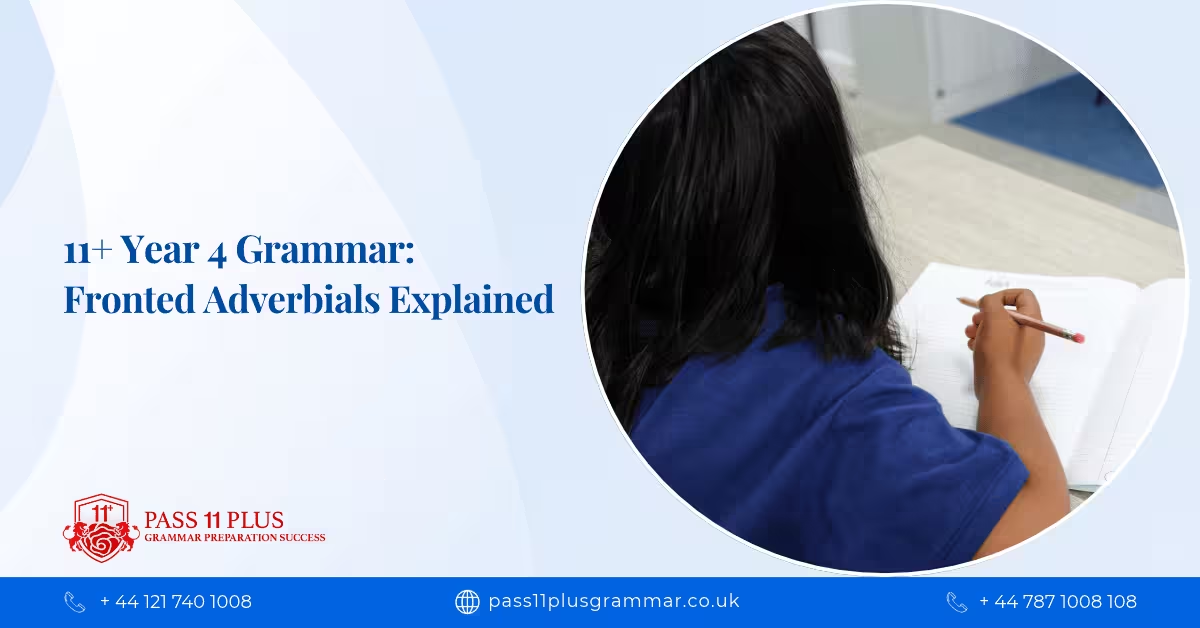
11+ Year 4 Grammar: Fronted Adverbials Explained
Published on
A fronted adverbial is a word or group of words at the start of a sentence that tells us when, where or how something happens. For example: Later that day, I heard the bad news. We put a comma after it. The national curriculum for England teaches fronted adverbials in Years 3 and 4, and many schools teach them in Year 4.
Fronted adverbials sound tricky, but they are really just a simple trick for starting a sentence more interestingly. In this guide, you will learn what they are, how to spot them and where the comma goes, with easy examples and practice questions your child can try today. If your child is in Year 4 and you would like expert help, you can explore our Year 4 11 plus tuition.
What is a fronted adverbial?
Let us take the name apart, one piece at a time.
An adverbial means a word or group of words that tells us more about the action in a sentence. It can tell us when, where or how something happens.
Fronted means moved to the front. Usually, an adverbial comes after the verb, which is the action word. When it is moved before the verb, we say it has been fronted.
So a fronted adverbial is an adverbial that has been moved to the start of a sentence. The government's national curriculum glossary describes it in the same way. It also says that we often follow a fronted adverbial with a comma.
Here is the same idea in two sentences:
We played football after school.
After school, we played football.
Both sentences mean the same thing. In the second one, "After school" has jumped to the front, and a comma has been added. That is all a fronted adverbial is.
Fronted adverbial examples for Year 4
Look at how each sentence changes when we move the adverbial to the front. The fronted adverbials are in bold.
Telling us when
Normal order: I heard the bad news later that day.
Fronted: Later that day, I heard the bad news.
Normal order: We check our spellings every Friday.
Fronted: Every Friday, we check our spellings.
Telling us where
Normal order: The children whispered in the library.
Fronted: In the library, the children whispered.
Telling us how
Normal order: The owl hooted loudly.
Fronted: Loudly, the owl hooted.
Using a longer group of words
Normal order: We will go to the park when the rain stops.
Fronted: When the rain stops, we will go to the park.
As you can see, a fronted adverbial can be one word, a short phrase or even a longer group of words with its own verb.
11 plus tuition
Master fronted adverbials for the 11+ exam
Our 11+ tutors help Year 4 pupils understand fronted adverbials and build confidence in English grammar.
Types of fronted adverbials
Most fronted adverbials you meet in Year 4 tell us one of four things. A good way to remember them is to ask a question.
1. Type: Time
Question it answers: When?
Examples: Yesterday, / After lunch, / Before bedtime, / Later that day
2. Type: Place
Question it answers: Where?
Examples: In the garden, / Behind the shed, / Under the old bridge, / Far away
3. Type: Manner
Question it answers: How?
Examples: Quietly, / With a big smile, / Slowly and carefully, / Without a sound
4. Type: Frequency
Question it answers: How often?
Examples: Every morning, / Once a week, / Sometimes, / Again and again
Every example above is followed by a comma, because that is the rule your child learns in Year 4.
How to use a comma after a fronted adverbial
The comma is the most important part. It works like a tiny pause. It tells the reader, "The first part is finished, and the main part of the sentence is coming next."
The rule is simple: put the comma straight after the fronted adverbial.
1. Find the fronted adverbial
It is the part at the start that tells us when, where or how. Example: Early in the morning
2. Put the comma straight after it
Do not leave a gap before the comma. Example: Early in the morning,
3. Finish the sentence
Add the main part and a full stop. Example: Early in the morning, the birds began to sing.
Without the comma, "After school we played football" can feel rushed to read. With the comma, "After school, we played football" is clear and neat.
A small note for grown ups: the national curriculum glossary says a fronted adverbial is often followed by a comma, and Year 4 children are taught to use one. For school work and tests, children should always follow the rule they have been taught and add the comma.
How to spot a fronted adverbial
Not every sentence starter is a fronted adverbial. Use this quick test.
Does it tell us when, where or how? If it does, it could be an adverbial.
Is it at the start of the sentence? If it is, it has been fronted.
Can we move it to the end? If the sentence still makes sense, it is probably a fronted adverbial.
Does a comma fit after it? If so, you have found one.
Watch out for sentence starters that are not fronted adverbials
Tomorrow, we are going to the zoo. Here, "Tomorrow" tells us when. It is a fronted adverbial, so it has a comma.
Tomorrow is my birthday. Here, "Tomorrow" is the subject of the sentence. It is not a fronted adverbial, so there is no comma.
The same word can do different jobs, so always look at what it is doing in the sentence.
Are fronted adverbials on the 11+?
This is a question many parents ask, so here is an honest answer. Fronted adverbials are not usually named as a topic in 11+ papers. However, they still matter for three reasons:
They are part of punctuation and grammar: 11+ English papers, such as GL Assessment's, test comprehension, spelling, punctuation and grammar. Knowing where commas go is part of that.
They improve writing: Some school-set papers include writing tasks, and fronted adverbials help children write clear and interesting sentences.
They build strong foundations: Good grammar in Year 4 makes harder skills in Years 5 and 6 much easier.
The 11+ is usually taken in the autumn of Year 6, so Year 4 is a gentle building year. There is no need to rush. Focus on reading, vocabulary and clear sentences. If you would like a simple plan, you can get in touch with our 11 plus preparation Year 4 tutors.
Please remember that tests differ by school and area, so check which test your child's chosen school uses.
Fronted adverbials practice questions with answers
Ask your child to try these on their own first. The answers are underneath.
1. Add the missing comma
Early in the morning the birds began to sing.
2. Move the adverbial to the front
The dog barked loudly at the gate.
3. Add a fronted adverbial that tells us when
_____ , we ate our lunch.
4. Which sentence has a fronted adverbial?
A) Gently, she closed the door. B) Summer is my favourite season.
5. Fix the punctuation
Every Friday we go swimming.
6. Finish the sentence
Behind the old shed, ...
Answers
1. Early in the morning, the birds began to sing.
2. Loudly, the dog barked at the gate. (Or: At the gate, the dog barked loudly.)
3. Many answers work, such as "At noon," or "After the lesson," or "Later that day,".
4. A is correct. "Gently" tells us how she closed the door. In B, "Summer" is the subject.
5. Every Friday, we go swimming.
6. Any sensible ending works, such as "Behind the old shed, we found a tiny hedgehog."
Fun ways to practise fronted adverbials at home
1. Play sentence swap
Say a simple sentence, such as "The cat slept on the sofa." Ask your child to move or add something at the front: "On the sofa, the cat slept."
2. Go on a book hunt
Look for fronted adverbials in a favourite storybook. Let your child point them out and check for the comma.
3. Write story starters
Challenge your child to start three sentences with three different fronted adverbials, one for time, one for place and one for manner.
4. Make word cards
Write time, place and manner phrases on cards. Mix them up, pick one and build a sentence around it.
5. Keep it short and happy
Five or ten minutes is plenty. Stop while your child is still enjoying it.
How Pass 11 Plus Grammar helps with 11+ Year 4 grammar
Grammar should never feel scary. At Pass 11 Plus Grammar, we explain topics like fronted adverbials in small, friendly steps, with lots of examples, so children understand the idea and enjoy using it.
We are a Birmingham based team, and we help families across the UK online. If you would like expert support for English and the 11+, you can get in touch with our 11 plus tutors in Birmingham. Whatever stage your child is at, we will help them grow in confidence, one step at a time.
Final thoughts
A fronted adverbial is an adverbial moved to the front of a sentence to tell us when, where or how something happens. Always add a comma after it, and ask yourself the question it answers. With a little regular practice, Year 4 children can use fronted adverbials with confidence, and the skill will help with punctuation, grammar and writing for years to come.
At Pass 11 Plus Grammar, we are here to help your child enjoy learning, one friendly step at a time.
Frequently Asked Questions
What is a fronted adverbial?
A fronted adverbial is a word or group of words at the start of a sentence that tells us when, where or how something happens. For example, in 'Later that day, I heard the bad news', the words 'Later that day' are the fronted adverbial. It has been moved to the front of the sentence, and it is followed by a comma.
Are fronted adverbials on the 11+?
Fronted adverbials are not usually named as a topic in 11+ papers. However, 11+ English papers can test punctuation and grammar, and the comma rule is part of good punctuation. Some school-set papers also include writing tasks, where fronted adverbials can make sentences stronger. Please check which test your child's chosen school uses.

Mr Singh
Founder, Pass 11 Plus Grammar
Mr Singh is the founder of Pass 11 Plus Grammar, with over 30 years of teaching experience. Having overcome academic setbacks himself, he is passionate about ensuring no child struggles alone. His approach focuses on personalised support, strong foundations, and building confidence. He has helped students achieve outstanding results in 11+ and GCSE examinations
Loading related posts…