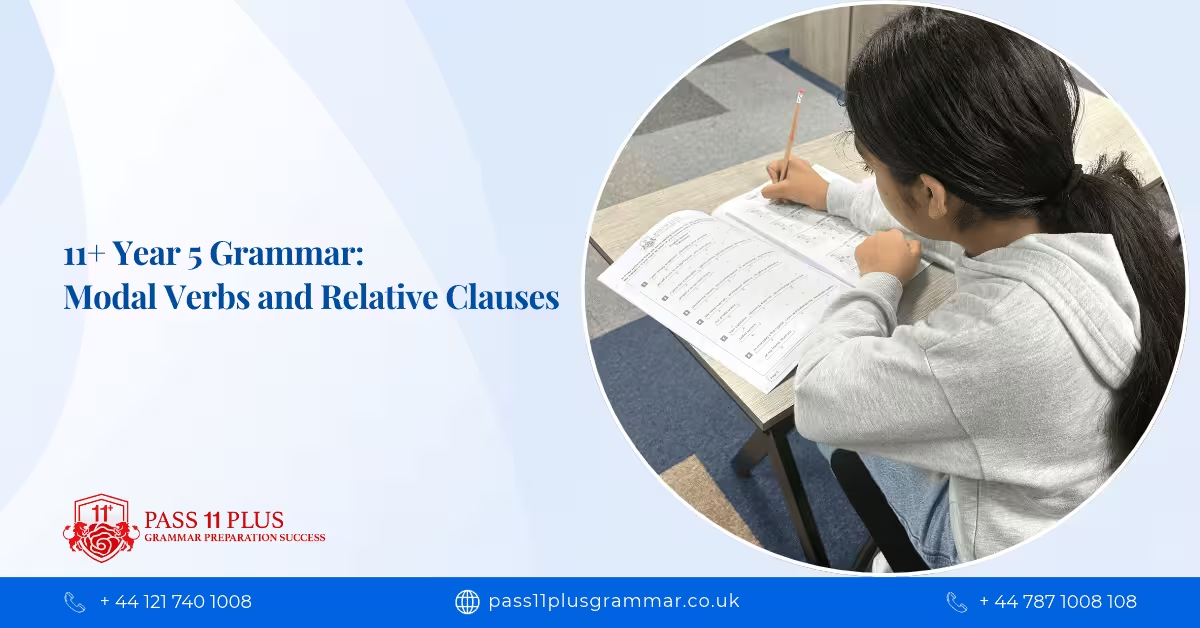
11+ Year 5 Grammar: Modal Verbs and Relative Clauses
Published on
Modal verbs are helping verbs, such as will, might, could, should and must, that show how sure something is, or what we can or must do. A relative clause gives extra information about a noun and often starts with who, which, whose, where, when or that. The National Curriculum for England lists both in Years 5 and 6, and its Appendix 2 lists them as Year 5 content.
Modal verbs and relative clauses sound like big, scary words, but they are simple ideas that make writing clearer and more interesting. In this guide, we explain both, with easy examples, handy rules and practice questions your child can try today. If your child is in Year 5 and you would like expert help, you can explore our Year 5 11 plus tuition.
What are modal verbs?
A modal verb is a helping verb. It sits in front of another verb and changes its meaning. The National Curriculum glossary says modal verbs can show things like certainty, ability or obligation.
Here are the main modal verbs:
will and would
can and could
may and might
shall and should
must and ought
See how one small word changes the whole meaning:
I can do this maths work by myself. (I am able to.)
You must wear a helmet. (You have to.)
It might rain later. (It is possible, but I am not sure.)
We should say thank you. (It is a good thing to do.)
Modal verbs and degrees of possibility
In Year 5, children learn that modal verbs and some adverbs show how likely something is. Think of a ladder. At the top, you are very sure. At the bottom, you are not sure at all.
Very sure
The sun will rise tomorrow.
Dinner must be ready by now.
Quite sure
The bus should arrive soon.
Not sure
It might snow tonight.
We could go to the park.
She may come to the party.
Modal adverbs also show possibility
The curriculum says children can use adverbs as well as modal verbs. Its examples are perhaps and surely. Other words that work in the same way are probably, possibly and definitely.
Perhaps we will see a rainbow.
It will probably be a sunny day.
I will definitely finish my homework.
Using these words well makes writing sound clear and careful, because it shows exactly how sure the writer is.
11 plus tuition
Is your Year 5 child ready for 11+ grammar?
Strengthen your child's English skills with our expert 11+ tuition covering modal verbs, relative clauses and essential grammar concepts.
Modal verb rules and common mistakes
Modal verbs follow a few simple rules. Learn these, and most mistakes disappear.
1. The next verb stays plain
After a modal verb, use the basic form of the verb. Write "She can swim", not "She can swims" or "She can swimming".
2. No extra -s for he, she or it
Modal verbs do not change. Write "He should go", not "He shoulds go".
3. Write "have", not "of"
Say it as "could've" if you like, but write "could have", "should have" and "would have".
4. Use "not" for the opposite
"Cannot", "must not" and "should not" show the opposite. In short form, they are "can't", "mustn't" and "shouldn't".
What is a relative clause?
A clause is a group of words with a verb in it. A relative clause is a special clause that gives extra information about a noun. According to the National Curriculum glossary, it often starts with a relative pronoun, such as who or that.
Look at this sentence:
That is the boy who lives near our school.
The words "who lives near our school" are the relative clause. They tell us more about the noun "boy". The word "who" is the relative pronoun, because it joins the extra information to the noun.
Relative clauses are great for joining two short sentences into one smooth sentence. Compare these:
I have a dog. The dog loves swimming.
I have a dog that loves swimming.
Relative pronouns: Who, which, whose, where, when and that
Each relative word has its own job. This table shows how to choose the right one.
1. Word: Who
Use it for: People
Example: The girl who sang won a prize.
2. Word: Which
Use it for: Things and animals
Example: The book which I read was funny.
3. Word: Whose
Use it for: Belonging to someone
Example: The boy whose bike was stolen was upset.
4. Word: Where
Use it for: Places
Example: This is the park where we play football.
5. Word: When
Use it for: Time
Example: I remember the day when we got our puppy.
6. Word: That
Use it for: People or things
Example: The film that we watched was exciting.
Leaving out the relative pronoun
The curriculum also mentions relative clauses where the relative pronoun is left out. Sometimes the word can be dropped and the sentence still makes sense.
With the pronoun: The cake that Mum baked was delicious.
Without it: The cake Mum baked was delicious.
This only works in some sentences, so read it aloud to check that it still sounds right.
Relative clauses and commas
Some relative clauses add extra information that is nice to know, but the sentence still makes sense without it. We often put commas around this extra information.
My uncle, who lives in Leeds, is visiting us.
Our school, which was built in 1950, has a big field.
If you take out the part between the commas, the sentence still works: "My uncle is visiting us." Extra information inside commas is called parenthesis, and the National Curriculum teaches children to use commas, brackets or dashes for it in Years 5 and 6.
Other relative clauses are needed to tell us which person or thing we mean. These usually have no commas.
The girl who sang won a prize. (This tells us which girl.)
How to build a relative clause in three steps
1. Start with two short sentences about the same thing
I met a girl. She plays the violin.
2. Swap the second noun or pronoun for the right relative word
"She" is a person, so we use "who". I met a girl. Who plays the violin.
3. Join them into one sentence
I met a girl who plays the violin.
Using modal verbs and relative clauses together
Great writers mix both ideas. This makes sentences rich, clear and interesting.
The boy who lives next door might join us.
The book that I borrowed should be on the shelf.
Perhaps the lady whose dog barked will call the police.
Try asking your child to build a sentence like this each day. It is a fun way to practise both skills at once.
Are modal verbs and relative clauses on the 11+?
Here is an honest answer. Modal verbs and relative clauses are not usually named as separate topics in 11+ papers. However, they are still worth learning for three reasons:
They are part of KS2 grammar: 11+ English papers, such as GL Assessment's, test comprehension, spelling, punctuation and grammar, and these ideas sit within that grammar.
They help with reading: Longer sentences with relative clauses and careful words like "might" and "must" often appear in reading passages. Understanding them helps children follow the meaning of harder texts.
They improve writing: Some school-set papers include writing tasks, where clear and varied sentences really help.
Year 5 is an ideal year for building skills steadily, because the 11+ is usually taken in the autumn of Year 6 in most parts of England. Dates differ by area, so please check yours. For a simple plan, you can reach out to our 11 plus preparation Year 5 tutors.
Year 5 grammar practice questions with answers
Ask your child to try these without looking at the answers first.
1. Choose the best modal verb
I am not sure, but it _____ rain later. (will / might)
2. Complete the sentence
You _____ wear a seatbelt in the car. It is the law. (could / must)
3. Fix the mistake
We should of left earlier.
4. Which is correct?
A) She can swims. B) She can swim.
5. Join with who, which or that
I have a hamster. The hamster loves its wheel.
6. Join with where
This is the park. We play football there.
7. Choose the relative pronoun
The boy _____ bike was stolen was upset. (who / whose)
8. Find the relative clause
The book that I borrowed was funny.
Answers
1. might. (We are not sure, so "might" fits better than "will".)
2. must. (It is the law, so it is something we have to do.)
3. We should have left earlier.
4. B is correct. After a modal verb, the next verb stays plain.
5. I have a hamster that loves its wheel. (Or: I have a hamster which loves its wheel.)
6. This is the park where we play football.
7. whose. (The bike belongs to the boy.)
8. "that I borrowed" is the relative clause. It tells us more about the book.
Fun Ways To Practise Year 5 Grammar At Home
1. Play the possibility ladder
Say "It will rain", "It should rain" and "It might rain". Ask your child to place them on a ladder from very sure to not sure.
2. Join two sentences
Give your child two short sentences and ask them to join them with who, which, whose, where or that.
3. Hunt in books
Look for modal verbs and relative clauses in a favourite book. Let your child underline them with different colours.
4. Describe a mystery person
Ask your child to describe a family member using relative clauses, such as "the person who always makes us laugh". Others guess who it is.
5. Keep it short and happy
Five or ten minutes is plenty. Stop while your child is still enjoying it.
How Pass 11 Plus Grammar helps with 11+ Year 5 grammar
Grammar should never feel scary. At Pass 11 Plus Grammar, we explain topics like modal verbs and relative clauses in small, friendly steps, with lots of examples, so children understand the idea and enjoy using it.
We are a Birmingham based team, and we help families across the UK online. If you would like expert support for English and the 11+, you can reach out to us at our 11 plus tuition in Birmingham. Whatever stage your child is at, we will help them grow in confidence, one step at a time.
Final thoughts
Modal verbs show how sure we are, or what we can and must do. Relative clauses add extra information about a noun and often start with who, which, whose, where, when or that. Learn the simple rules, practise a little each day, and your child will use both with confidence, in school work, in reading and in 11+ English.
At Pass 11 Plus Grammar, we are here to help your child enjoy learning, one friendly step at a time.
Frequently Asked Questions
What are modal verbs?
Modal verbs are special helping verbs that change the meaning of another verb. They can show how sure we are, what we are able to do, or what we must do. The main modal verbs are will, would, can, could, may, might, shall, should, must and ought.
What is a relative clause?
A relative clause is a part of a sentence that gives more information about a noun. It often starts with a word such as who, which, whose, where, when or that. For example, in 'The boy who lives next door is kind', the words 'who lives next door' are the relative clause.
What year do children learn modal verbs and relative clauses?
The National Curriculum for England lists using modal verbs or adverbs to show degrees of possibility, and using relative clauses, in the Years 5 and 6 writing programme. Its Appendix 2 lists both as Year 5 content.
Are modal verbs and relative clauses on the 11+?
They are not usually named as separate topics in 11+ papers. However, 11+ English papers test comprehension, spelling, punctuation and grammar, and these two ideas are part of the Key Stage 2 grammar your child learns. They also help children understand harder passages and write stronger sentences. Please check which test your child's chosen school uses.

Mr Singh
Founder, Pass 11 Plus Grammar
Mr Singh is the founder of Pass 11 Plus Grammar, with over 30 years of teaching experience. Having overcome academic setbacks himself, he is passionate about ensuring no child struggles alone. His approach focuses on personalised support, strong foundations, and building confidence. He has helped students achieve outstanding results in 11+ and GCSE examinations
Loading related posts…