Year 5 11+ Comprehension: Tips and Techniques
Published on
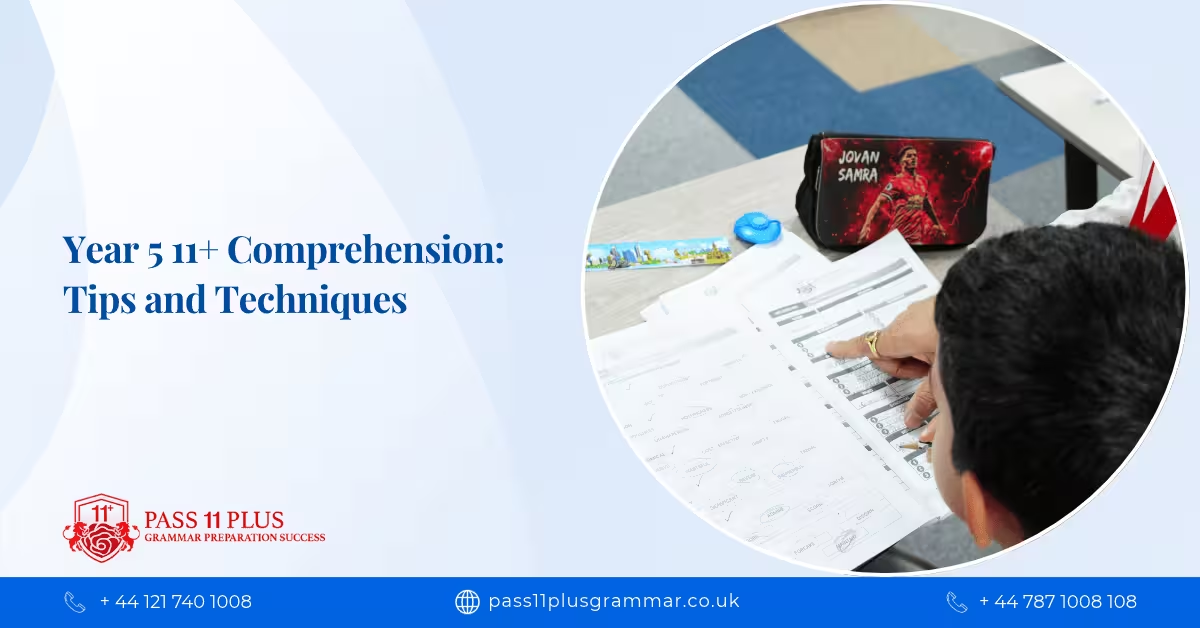
The best 11+ comprehension technique is to identify the question type, find the evidence in the text, and prove your answer. The official ISEB framework lists six skills: retrieval, inference, word meaning in context, effect of word choices, summarising and comparing. Year 5 children should read every day, build vocabulary, practise one question type at a time, and add timing slowly. Start untimed, then add short timed passages, and save full mocks for later in the year.
Comprehension is one of the biggest parts of 11+ English, and Year 5 is the perfect year to get good at it. This guide shows the Year 5 11+ comprehension tips and techniques that really work. You will learn what the questions test, how to answer each type, and how to practise with a worked example.
What is 11+ comprehension in Year 5?
Comprehension means understanding what you read. In the 11+, children read a passage and answer questions about it. The passage can be a story, a factual article or a poem.
Comprehension matters because it shows up in almost every 11+ test. It is also linked to vocabulary and reasoning, so strong readers often do well across the whole English paper. The National Curriculum for Years 5 and 6 also puts comprehension at the centre, asking children to make inferences, predict, summarise, tell fact from opinion and explain how authors use language.
Year 5 is the main 11+ preparation year, so it is the perfect time to build these skills. Our approach to 11 plus preparation Year 5 teaches each comprehension skill step by step, so children feel calm and confident when they meet a new passage.
What do 11+ comprehension questions test?
The official ISEB Common Pre-Tests Framework for 2026 to 2027 lists the exact skills tested in the reading comprehension part of its English test. Other 11+ tests test very similar skills, so these are the ones to practise.
1. Skill: Retrieval
What it means: Finding facts that are written in the text
A question might start with: "What did the character take from..."
2. Skill: Inference
What it means: Working out what is not said directly, using clues
A question might start with: “How do you think she felt? How do you know”
3. Skill: Word meaning in context
What it means: Explaining what a word means in this sentence
A question might start with: "In line 5, the word 'faint' means..."
4. Skill: Effect of word choices
What it means: Explaining how words and devices such as similes, metaphors, personification and alliteration add to the meaning
A question might start with: "Why did the author use the word..."
5. Skill: Summarising
What it means: Picking out the main ideas
A question might start with: "What is the main idea of the passage?"
6. Skill: Comparing
What it means: Spotting similarities and differences across the text, between characters, or between how formal the writing is
A question might start with: "How is the first character different from..."
The National Curriculum for Years 5 and 6 lines up with these skills. It asks children to make inferences with evidence, predict, summarise main ideas from more than one paragraph, explain how language and structure add to meaning, and tell fact from opinion.
11 Plus Tuition
Master 11+ comprehension in Year 5
Our 11 plus tutors help Year 5 pupils improve comprehension, understand complex texts and answer exam questions with confidence.
10 Year 5 11+ comprehension tips
These ten tips fit into daily life. You do not need long lessons. Small habits make a big difference.
1. Read every single day
Reading is the number one comprehension skill. Aim for 20 to 30 minutes a day, and mix stories, poems and non-fiction articles.
2. Read a little harder than usual
Pick books and articles that stretch your child a bit. New words and longer sentences train the brain for 11+ passages.
3. Talk about what you read
Ask: What happened? How do you know? Why did the author use that word? Chatting is comprehension practice without a worksheet.
4. Use a word jar
Add one new word a day with its meaning. Use it in a sentence at dinner. Vocabulary is the biggest help with 'word in context' questions.
5. Underline key words in questions
The question tells you exactly what to look for. Circle words like why, how, who and best, and note any line numbers.
6. Prove every answer
Teach your child to point to the exact words that back up their answer. If they cannot find evidence, they should think again.
7. Practise one question type at a time
Spend a week on inference, then a week on vocabulary in context. Focused practice beats random practice.
8. Learn the language tricks
Simile, metaphor, personification and alliteration appear in many questions. Learn what each one is and what effect it has.
9. Practise summarising
After reading, ask your child to sum up a passage in one sentence, then in three. This trains summary questions.
10. Add timing slowly
Begin untimed, then use a gentle timer. Speed grows after skills are secure, not before.
A step-by-step 11+ comprehension technique
A clear routine helps children stay calm. Here is a simple six step method that works for most passages.
1. Skim the passage
Read quickly to find the main idea, the characters or topic, and the mood. Do not worry about every detail yet.
2. Read the question slowly
Underline the key words. Decide what type of question it is: find, infer, word meaning, language effect, summary or compare.
3. Find the evidence
Go back to the right lines. For whole text questions, read from the beginning with the question in mind.
4. Think before choosing
Say the answer in your own words first. Then look at the options and pick the one that matches best.
5. Remove wrong answers
Cross out options that are not in the text, are too extreme or only partly true.
6. Check and move on
Check your answer against the text. If you are stuck, make your best choice and keep going so you do not run out of time.
How to answer each 11+ comprehension question type
Each question type needs a slightly different technique. Here is a quick guide.
1. Question type: Retrieval
Best technique: Find the exact words in the text. Use line numbers and key words from the question
Common trap: Picking an answer from memory instead of checking the text
2. Question type: Inference
Best technique: Find a clue, then say what it suggests. Use the pattern "The text says... so..."
Common trap: Choosing an answer that sounds sensible but has no evidence
3. Question type: Word meaning in context
Best technique: Read the whole sentence, then try each option in place of the word. Pick the one that fits
Common trap: Choosing the most common meaning of the word instead of the meaning in this sentence
4. Question type: Effect of word choices
Best technique: Name the device, then explain what it makes the reader see, hear or feel
Common trap: Naming the device but not explaining the effect
5. Question type: Summarising
Best technique: Find the main idea. Ask: what is this mostly about? Leave out small details
Common trap: Picking an option that is only true for one small part
6. Question type: Comparing
Best technique: Find two pieces of evidence, one for each thing, and look for how they are alike or different
Common trap: Describing only one side of the comparison
Worked example: Year 5 11+ comprehension practice
Let us try a short practice passage together. We wrote this passage ourselves, so you can use it freely at home. Read it first, then try the questions before you look at the answers.
The Night The Lights Went Out
When the lights went out, the whole house fell silent. Maya froze at the top of the stairs. Her heart thumped like a drum, and her hands gripped the banister. Outside, the wind whispered at the window, and the old oak tree scratched its long fingers against the glass.
"Dad?" she called. There was no reply.
Then she remembered the torch in the kitchen drawer. Slowly, she crept down the stairs, one careful step at a time. Halfway down, she spotted a faint glow beneath the kitchen door. She pushed it open. There was Dad, smiling in the light of a single candle, with a plate of warm toast in each hand.
"Power cut," he said. "I thought we could have a midnight feast."
Maya let out a long breath and laughed. The darkness did not seem so scary anymore.
Question 1: Retrieval. Where did Maya remember the torch was?
A) the cupboard B) the kitchen drawer C) the stairs D) her bedroom
Answer: B. The text says she remembered "the torch in the kitchen drawer". This is written directly, so go back and find the words.
Question 2: Inference. How did Maya feel when the lights went out?
A) bored B) nervous C) angry D) sleepy
Answer: B. The text never says "nervous", but her heart "thumped like a drum" and she "froze" and gripped the banister. Those clues show she felt nervous.
Question 3: Word meaning in context. In "a faint glow", the word faint means:
A) very bright B) weak and hard to see C) loud D) warm and golden
Answer: B. A candle seen under a door is a small, weak light. Put "weak and hard to see" in place of "faint" and the sentence still makes sense.
Question 4: Effect of word choices. "The old oak tree scratched its long fingers against the glass." What does this make the reader imagine?
A) the tree is alive and creepy B) the tree is very old C) the tree is falling D) the tree is friendly
Answer: A. This is personification, because the tree is given human fingers. It makes the tree seem alive and creepy, which builds the scary mood.
Question 5: Summarising. Which sentence sums up the passage best?
A) A girl finds a torch B) A girl is scared in the dark, then finds her dad has made a surprise feast C) A tree is outside a window D) A father makes toast
Answer: B. It covers the beginning (scared), the middle (searching) and the ending (feast). The other options are only small details.
For more practice, try our 11+ free practice papers, and for exam style questions use our 11+ past papers.
Multiple choice 11+ comprehension tips
Many 11+ tests use multiple choice questions. For example, the ISEB pre-tests are online and multiple choice, and GL style tests are mostly multiple choice too. Here are some tips for choosing the right answer.
Say the answer first. Think of the answer in your own words, then look for the closest option.
Remove wrong answers. Cross out options that are not in the text, are too extreme or are only partly true.
Watch for words like "always" and "never". They often make an answer wrong.
Check every option. Two answers can look right. Choose the one that is best supported by the text.
Do not change answers without a reason. Your first answer, based on evidence, is often right.
Keep moving. Do not spend too long on one question. In the ISEB pre-tests, children cannot go back and change earlier answers, so make your best choice and move on.
Fiction, non-fiction and poetry comprehension tips
Passages can be stories, factual texts or poems. Each type has its own tricks.
1. Fiction: Characters, feelings, setting, mood and how events change the story
Practice idea: After each chapter, ask "How did the character change?"
2. Non-fiction: The main topic of each paragraph, facts versus opinions, and key words in headings
Practice idea: Read a child friendly news article and underline three facts and one opinion
3. Poetry: Imagery, rhythm, sound patterns, similes and metaphors, and what the poem is really about
Practice idea: Read a short poem aloud, then explain the picture it paints
The National Curriculum for Years 5 and 6 asks children to read a wide range of fiction, poetry, plays and non-fiction, so mixing text types is good practice for both school and the 11+.
How to build vocabulary for 11+ comprehension
A big vocabulary makes every passage easier. Here are five simple ways to build it.
Keep a word jar: Add one new word each day with its meaning and a sentence.
Guess from context: When your child meets a new word, ask them to guess the meaning from the sentence, then check in a dictionary.
Learn word parts: Prefixes, suffixes and word roots unlock many new words. For example, "un" means not and "ful" means full of.
Use a thesaurus: Find three other words for "said" or "big", and talk about how the meaning changes.
Play word games: Crosswords, word searches and charades make learning fun.
How Pass 11 Plus Grammar helps with Year 5 11+ comprehension
Comprehension is one of the skills where expert help makes a real difference. Our Year 5 11 plus tuition teaches each question type step by step, builds vocabulary and uses practice that matches your child's target test.
We start with a gentle check to see which question types are easy and which need work.
We teach one skill at a time, with clear steps and lots of praise.
We build vocabulary in a fun, memorable way.
We add timing slowly. Our 11+ mocks give calm, timed practice with feedback.
We use the holidays well. Our 11+ intensive summer course gives focused, friendly practice before the big test.
If you live in Birmingham or the West Midlands, our 11+ tuition in Birmingham knows the local test and builds practice around it.
Final thoughts
Year 5 11+ comprehension is a skill that grows with practice. Read every day, learn new words, practise one question type at a time, and always prove your answer with evidence from the text. Add timing slowly, and your child will feel calm and confident on test day.
There is no need to panic, and no need to go it alone. At Pass 11 Plus Grammar, we are always here to help when you are ready.
Frequently Asked Questions
How can my Year 5 child get better at 11+ comprehension?
Read every day, talk about what you read, learn new words, and practise one question type at a time. Start with untimed passages, then add short timed ones. Always ask your child to prove their answer with evidence from the text, because this builds the habit of checking.

Mr Singh
Founder, Pass 11 Plus Grammar
Mr Singh is the founder of Pass 11 Plus Grammar, with over 30 years of teaching experience. Having overcome academic setbacks himself, he is passionate about ensuring no child struggles alone. His approach focuses on personalised support, strong foundations, and building confidence. He has helped students achieve outstanding results in 11+ and GCSE examinations
Loading related posts…