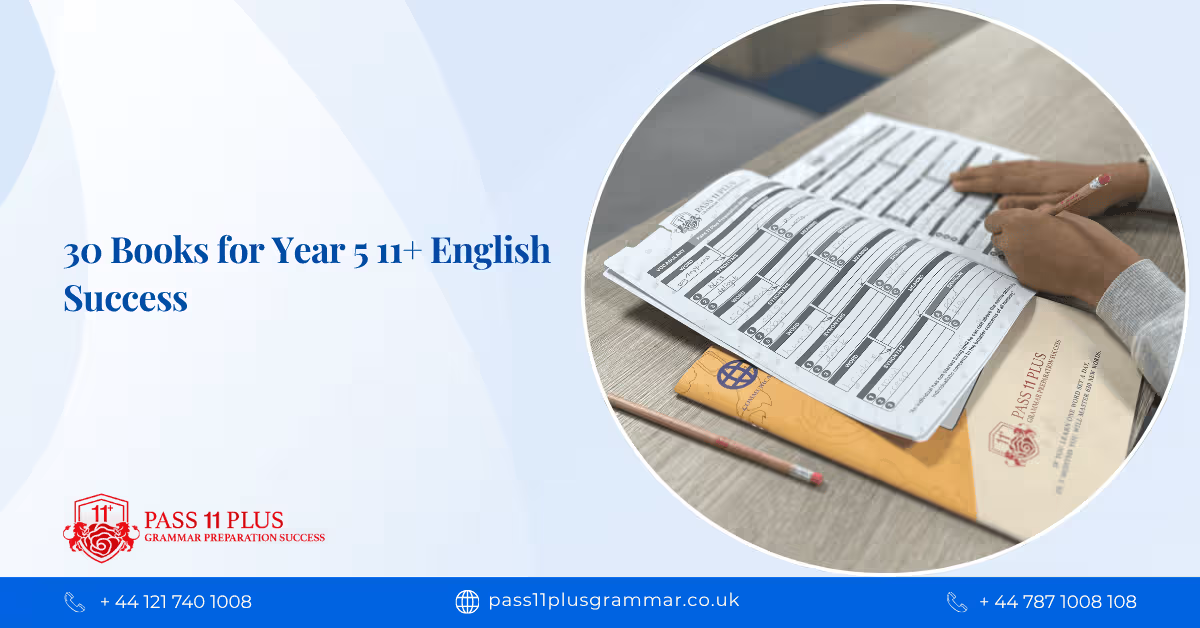
30 Books for Year 5 11+ English Success
Published on
The best books for Year 5 11+ English success mix classics (such as The Secret Garden, Treasure Island and Anne of Green Gables) with modern favourites (such as Holes, Wonder and The Phantom Tollbooth). Aim for about 20 to 30 minutes of reading a day, plus some reading aloud together. Talk about new words and ask, "How do you know?" Let your child choose, and save any book that is too hard or too upsetting for later. No official 11+ reading list exists, so use this as a menu, not a must-do list.
Reading is the secret ingredient of 11+ English. This list shares 30 books for Year 5 11+ English success, from classic tales to modern favourites, with simple tips on how to use them. It is full of stories your child will love, and every one grows vocabulary and understanding.
Why reading helps Year 5 11+ English success
Children who read a lot meet thousands of new words. They also learn how sentences, stories and ideas fit together, without even noticing. That is why reading is the base of 11+ English. It cannot be crammed in a few weeks, but it grows a little every day.
Many 11+ comprehension passages lean on classic fiction, so children who have read widely have often met the style before, even if they have not seen that exact passage. Reading also feeds verbal reasoning, because it builds vocabulary.
Year 5 is a great time to focus on it. Your child can read longer, richer books, and most grammar school tests are still around a year away. Our approach to 11 plus preparation Year 5 starts with reading for exactly this reason. Happy readers build strong English with far less stress.
What does an 11+ English test in Year 5?
Many 11+ English tests look at comprehension, vocabulary, spelling, punctuation and grammar. Some also include a short writing task. Each area is different, so check the schools you like. Here is how reading helps with each skill.
Skill | How reading helps |
Comprehension | Children get used to following a story, spotting clues and understanding characters |
Vocabulary | Every new book brings new words in context, so they stick |
Spelling | Seeing words again and again helps children remember how they look |
Punctuation and grammar | Children see how commas, speech marks and sentences work in real writing |
Writing | Good readers pick up ideas, sentence shapes and descriptive words for their own stories |
How to use this Year 5 11+ reading list
There is no official 11+ reading list, and different tutors and schools suggest different books. Many of these 30 books appear on school and 11+ reading lists, and together they cover a wide range of styles. Here is how to get the most from them.
1. Let your child choose
Offer two or three books from the list and let your child pick. Children read more when they choose.
2. Mix easy and stretching books
Most books should feel comfortable. Add one stretching book at a time, ideally one you read aloud together.
3. Read aloud together
Even confident readers enjoy a shared chapter. It lets you enjoy richer books and talk about tricky words.
4. Use the library
Borrowing is free, and librarians love suggesting books. Reading levels vary, so it helps to flick through a book first.
Classic books for Year 5 11+ English
Classics use richer words and longer sentences, which is the style your child may meet in 11+ comprehension passages. Read them together if they feel tricky at first.
Book | Author | Why it helps |
The Secret Garden | Frances Hodgson Burnett | Rich descriptions and older style vocabulary, in a story about friendship and growing |
The Wind in the Willows | Kenneth Grahame | Beautiful nature writing and gentle adventures, great for reading aloud |
Black Beauty | Anna Sewell | A story told by a horse, with clear emotions and period language |
The Railway Children | E. Nesbit | A warm family adventure with older style sentences |
Alice's Adventures in Wonderland | Lewis Carroll | Wordplay, riddles and silly logic that make children think |
Peter Pan | J.M. Barrie | Imaginative language and a classic story to discuss |
Treasure Island | Robert Louis Stevenson | A fast pirate adventure with period vocabulary a step up from most books for this age |
Anne of Green Gables | L.M. Montgomery | A funny, warm story with lots of descriptive words and lively dialogue |
Fantasy books for Year 5 11+ English
Fantasy stories are full of big ideas and rich words, and many children can read them for hours. They are a wonderful way to build stamina.
Book | Author | Why it helps |
The Lion, the Witch and the Wardrobe | C.S. Lewis | A classic fantasy with clear writing, good for inference and discussion |
Harry Potter and the Philosopher's Stone | J.K. Rowling | Lively language and a gripping plot that makes children want to keep reading |
The Hobbit | J.R.R. Tolkien | A longer stretch read with rich vocabulary. Lovely to share together |
Percy Jackson and the Lightning Thief | Rick Riordan | Fast, funny and packed with Greek myths |
Nevermoor: The Trials of Morrigan Crow | Jessica Townsend | Inventive world building and playful language |
The Phantom Tollbooth | Norton Juster | Clever wordplay and puns that make children love language |
Coraline | Neil Gaiman | A short, spooky story with careful, atmospheric writing. Check it suits your child first |
The Tale of Despereaux | Kate DiCamillo | A storyteller voice that speaks to the reader, with plenty of rich words |
Adventure books for Year 5 11+ Readers
Adventure books are exciting and fast paced. They are great for children who need a story that hooks them quickly.
Book | Author | Why it helps |
Kensuke's Kingdom | Michael Morpurgo | A survival story with clear, thoughtful writing and strong feelings |
Holes | Louis Sachar | Two timelines that join up, which builds a skill comprehension questions often test |
Journey to the River Sea | Eva Ibbotson | A rich, descriptive adventure that builds vocabulary |
The Wolf Wilder | Katherine Rundell | Beautiful, vivid writing and a brave heroine |
Cosmic | Frank Cottrell-Boyce | A funny, clever adventure that makes children think about big ideas |
Real life and historical books for 11+ Year 5
Books about real life and history help children understand different times, places and feelings. They are great for talking about "why" and "how do you know?"
Book | Author | Why it helps |
Wonder | R.J. Palacio | Told through different voices, which helps children see events from many points of view |
Goodnight Mister Tom | Michelle Magorian | A moving wartime story. Lovely as a joint read, talking as you go |
War Horse | Michael Morpurgo | A powerful historical story told from a horse's view, with strong feelings to discuss |
The Boy at the Back of the Class | Onjali Q. Raúf | A modern story about kindness and friendship |
Skellig | David Almond | Short, poetic and mysterious, with lots of hidden meanings to think about |
Street Child | Berlie Doherty | A story set in Victorian London that brings history to life |
Funny and clever books for vocabulary
Humour is a secret weapon. Children who laugh at a book will keep reading it, and that is exactly how vocabulary grows.
Book | Author | Why it helps |
Matilda | Roald Dahl | Inventive language and playful made-up words |
The BFG | Roald Dahl | Silly word play that makes children enjoy language |
A Series of Unfortunate Events: The Bad Beginning | Lemony Snicket | The author explains tricky words as he goes, which builds vocabulary in a funny way |
Check the themes before you start
Every child is different, and reading levels are not the same as emotional readiness. A few books on this list deal with serious ideas, such as war, loss, unkindness or frightening moments.
Book | What to be ready for |
Goodnight Mister Tom | Wartime, loss and a child who has been treated badly |
War Horse | The First World War, with sad and difficult scenes |
Street Child | Poverty and hard times in Victorian London |
Wonder | Unkindness and bullying, with a hopeful message |
Coraline | Spooky and a little scary in places |
Skellig | Illness and worry, in a gentle and poetic way |
11 Plus Tuition
Help your Year 5 child excel in 11+ English
Our 11 plus tutors support children with reading comprehension, vocabulary, and exam techniques to prepare for the 11+ with confidence.
A simple 6-week Year 5 reading plan
Here is an easy plan you can copy. Each week has a main book, a read-aloud and something extra. Change it to suit your child.
Main book (20 to 30 minutes a day) | Read together | Extra |
Weeks 1 and 2 - Holes | A chapter of The Secret Garden | Word jar: five new words a week |
Weeks 3 and 4 - The Phantom Tollbooth | A chapter of The Wind in the Willows | One short poem and a children's news story |
Weeks 5 and 6 - Anne of Green Gables | A chapter of Treasure Island | Retell your favourite chapter out loud |
How to turn reading into 11+ English skills
Reading builds skills best when you talk about it. These small habits turn a good book into 11+ practice, without feeling like homework.
1. Spot a new word
Pick one interesting word, like "enormous", "gloomy" or "reluctant".
2. Guess the meaning
Read the sentence around it and guess what it means. Using clues is a skill that helps in tests too.
3. Check and collect
Look it up together, write it in a word jar and find a word that means the same and one that means the opposite.
4. Ask "How do you know?"
After reading, ask a question like "How do you think she felt?" Then ask, "What clue tells you that?" This trains children to find evidence in the text.
5. Retell it
Ask your child to tell you what happened in their own words. It builds memory and understanding.
Beyond novels: Poems, fact books and news
Stories are only one kind of reading. Mix in other types to meet different kinds of words.
Poems: Short, rhythmic poems build a love of language. Read one aloud every few days.
Fact books: Books about animals, space and history teach topic words. Try National Geographic Kids or the Horrible Histories series.
Children's news: A children's newspaper such as First News, or the BBC Newsround website, gives short, real world articles to read and talk about.
What to do next for Year 5 11+ English preparation
Reading is the base, and Year 5 is when you can add a little more. Start to practise comprehension, vocabulary, spelling and grammar in short sessions, and try timed sections as topics become familiar. Keep everything kind, steady and short.
Many families like the reassurance of expert help in Year 5. Our Year 5 11 plus tuition covers English, maths and reasoning, and it starts with a clear picture of where your child is today, so we can build a calm plan from there.
Our experienced Year 5 11+ tutors help children get more from their reading. They talk about new words, practise comprehension questions and make English feel fun, not scary.
If you would like friendly advice, you can meet our 11 plus tutors in Birmingham, and we will happily talk through your options.
Final thoughts
These 30 books for Year 5 11+ English success are a menu of stories to enjoy. Choose books your child loves, add a few classics to share, talk about new words and big ideas, and read a little every day. Check the themes first, and put aside anything that feels too hard or too upsetting.
There is no need to rush, and no need to worry. Happy readers become confident writers and thinkers, and that is the best gift for the 11 plus and beyond. At Pass 11 Plus Grammar, we are always here to help when you are ready.
Frequently Asked Questions
Which books help with 11+ English in Year 5?
A mix of classics and modern stories works best. Good choices include The Secret Garden, The Wind in the Willows, Treasure Island, Anne of Green Gables, Holes, The Phantom Tollbooth, Goodnight Mister Tom and Wonder. Choose books your child enjoys, with a few that stretch their vocabulary, and talk about new words as you read.
Do classic books help with 11+ English?
Yes, they can help. 11+ comprehension passages often use older, more literary language, so children who have met classic stories before are more used to the vocabulary and sentence styles. Mix classics with modern books so reading stays fun.

Mr Singh
Founder, Pass 11 Plus Grammar
Mr Singh is the founder of Pass 11 Plus Grammar, with over 30 years of teaching experience. Having overcome academic setbacks himself, he is passionate about ensuring no child struggles alone. His approach focuses on personalised support, strong foundations, and building confidence. He has helped students achieve outstanding results in 11+ and GCSE examinations
Loading related posts…