How to Prepare for ISEB Pre-Test
Published on
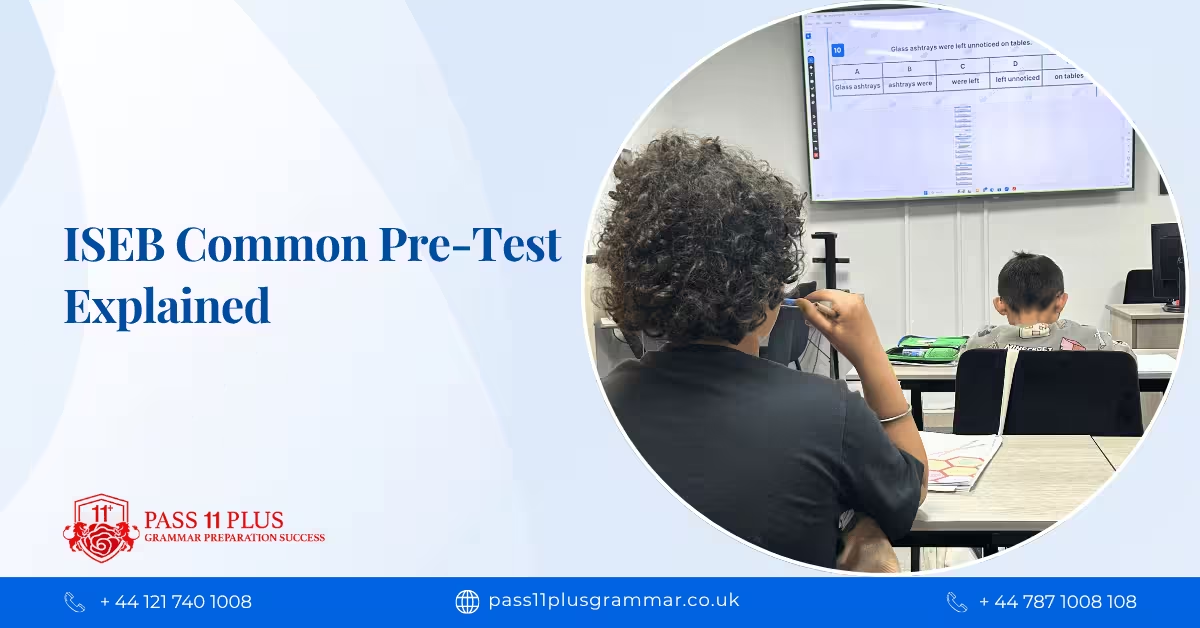
To prepare for the ISEB Pre-Test, start with ISEB's free Test Walkthrough, so your child knows the online platform. Then build skills in English, maths, verbal reasoning and non-verbal reasoning through reading, number games and puzzles, and add short timed practice. Keep sessions short, avoid last-minute cramming and stay positive. ISEB says extra practice is not a requirement because the tests are based on the national curriculum and aim to show your child's potential.
Is your child about to sit the ISEB Pre-Test, and you are not sure where to start? Do not worry. This guide explains how to prepare for ISEB, so your child feels calm, confident and ready.
How to prepare for ISEB Pre-Test
ISEB, the Independent Schools Examinations Board, says the Pre-Tests are based on the national curriculum, so your child learns most of what they need at school. The aim is to show your child's potential, not just what they already know.
Here is the short version:
Get familiar: Use the free ISEB Test Walkthrough.
Build skills: Read, play number games and try puzzles.
Practise gently: Short sessions, then short timed sections.
Stay calm: A relaxed child thinks more clearly.
What is the ISEB Common Pre-Test?
The ISEB Common Pre-Tests are online tests used by many independent senior schools as part of their admissions process. ISEB says they are also known as "the 11+". They are taken in Year 6 or Year 7. Here are the key facts from ISEB.
Test | Time | What it covers |
Mathematics | 40 minutes | National Curriculum maths up to the end of Year 5 |
English | 40 minutes | Reading comprehension and grammar |
Non-verbal reasoning | 30 minutes | Patterns and shapes, including 2D and 3D puzzles |
Verbal reasoning | 25 minutes | Letter, word and language based questions |
They are multiple choice and adaptive. This means the questions change to match your child's answers, and children cannot go back to change an earlier answer. ISEB publishes a full test framework on its website if you would like even more detail.
How to prepare your child for the ISEB Common Pre-Test: Step-by-step
Here is a calm, simple plan you can follow at home.
1. Find out your school's plan
Check which senior schools use the ISEB Pre-Tests and what dates they ask for. Parents register their child through ISEB's Guardian Portal.
2. Try the free Test Walkthrough
Let your child explore the online platform and the question styles, so nothing feels strange on test day.
3. Build skills in all four areas
Use reading, number games and puzzles every week, in short sessions.
5. Add short timed practice
When topics feel familiar, practise short timed sections, then longer sets closer to the test.
6. Rest before the test
Keep the final days light, sleep well and let your child feel positive.
11 Plus Tuition
Is your child preparing for the ISEB Common Pre-Test?
Our 11 plus tutors help children strengthen key academic skills, improve problem-solving abilities, and become familiar with ISEB Pre-Test question styles.
Start with the free ISEB Test Walkthrough
ISEB recommends that children familiarise themselves with the test platform, the format and the adjustable features as a core part of preparation. The ISEB Test Walkthrough is free, and it lets your child:
Explore the online test player,
Try the accessibility features, and
See the types and formats of questions that may be asked.
Because the test is online, it may feel very different from school papers. A little time on the walkthrough helps your child feel at home with the screen, the buttons and the layout. Please use it first, and then add other practice.
How to prepare for ISEB English
The English test looks at reading comprehension and grammar. The best preparation is a good reading habit.
1. Read every day
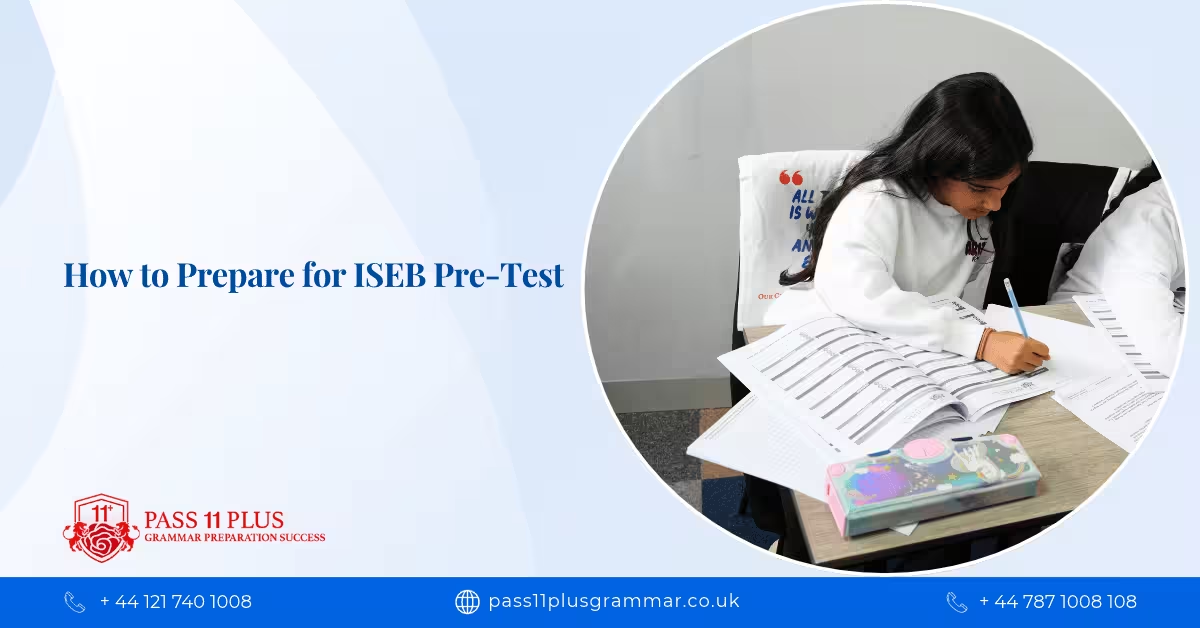
Aim for 20 to 30 minutes of reading a day. Mix stories, poems, fact books and children's news.
2. Practise on a screen
Read a short passage on a tablet or computer, then answer questions. It builds stamina for reading on screen.
3. Talk about words and clues
Ask, "How do you know?" It trains your child to find evidence in the text.
4. Brush up on grammar
Practise punctuation, word types, tenses and sentence structure in short bursts.
How to prepare for ISEB maths
ISEB maths questions are based on the National Curriculum up to the end of Year 5. That means your child does not need to learn Year 6 topics first. Strong basics matter most.
Times tables up to 12 x 12: Quick recall saves time on every question.
Number skills: Practise adding, subtracting, multiplying and dividing larger numbers.
Fractions, decimals and percentages: Show how they link, using real life examples such as prices and recipes.
Shape, measures and data: Practise area, perimeter, units and simple charts.
Word problems: Read slowly, find the key facts and explain each step out loud.
How to prepare for ISEB verbal reasoning
Verbal reasoning uses letters, words and language. It feels new to many children, but it improves quickly with simple practice.
Skill | Easy way to practise |
Word meanings | Play "same or opposite?" with words from a word jar |
Odd one out | Show four words and ask which does not fit, and why |
Letter patterns and codes | Make secret codes and swap messages |
Reading aloud | Read together and talk about new words |
How to prepare for ISEB non-verbal reasoning
Non-verbal reasoning uses shapes and patterns. ISEB's framework says the test includes both flat 2D questions and 3D spatial questions, so it helps to play with both.
Build and construct: LEGO, blocks and building games help children picture shapes in their heads.
Play visual games: ISEB suggests games like Spot the Difference and Q-Bitz, and visual memory games.
Spot patterns: Ask, "What comes next?" using shapes, colours and sizes.
Try rotations and reflections: Use paper shapes and a small mirror.
Explain the rule: Say it out loud, like "The shape turns a quarter turn each time."
Practice tools for the ISEB Pre-Test
1. Start with a free check
Try our 11+ free practice papers to see which topics feel easy and which need more time. It is a friendly way to find your starting point.
2. Practise the question styles
Because the ISEB test is adaptive, no fixed ISEB past papers exist. ISEB does say that Common Entrance 11+ past papers can be useful revision for the English and maths sections. Our 11+ past papers help build the same skills and get children used to multiple-choice English, maths and reasoning questions.
3. Get used to sitting a test
Our 11 plus mocks let children practise working calmly with a timer in a quiet room, so a real test feels familiar.
How to practise for an adaptive test
An adaptive test works differently from a normal paper, so a few special habits help.
What ISEB says | What it means for practice |
Questions change to match your child's answers | A hard question can mean the test has found the right level. Do not panic |
Children cannot go back to change earlier answers | Practise choosing an answer and moving on, without going back |
The test is on a screen | Practise reading and answering on a tablet or computer |
There is a timer | Children can hide the countdown timer if it worries them, so try this in the walkthrough |
A simple 8 week ISEB Pre-Test preparation plan
Here is an easy plan. Each week needs only a few short sessions, plus daily reading. Change it to fit your child.
Week | Focus | Ideas |
Week 1 | Get familiar | ISEB Test Walkthrough and a first look at all four areas |
Week 2 | English | Comprehension passages on screen, plus a word bank |
Week 3 | Maths | Times tables, fractions and word problems |
Week 4 | Verbal reasoning | Word games, codes and odd one out |
Week 5 | Non-verbal reasoning | Shape patterns, rotations and 3D building games |
Week 6 | Short timed sections | 10 to 15 minute sets in each area |
Week 7 | Longer practice | Mixed sets, one mock test and a review of mistakes |
Week 8 | Light review and rest | Favourite games, plenty of sleep and calm routines |
If you have more time, such as the summer before Year 6, our 11 plus intensive summer course brings the key topics together in a focused, friendly way, so your child starts the school year feeling ready.
ISEB Pre-Test day tips
ISEB gives simple advice for the big day, and we agree with it.
Eat a good breakfast. It helps your child focus.
Skip last-minute practice. ISEB says it can cause panic if your child cannot remember something.
Be positive. Say the test is a chance to show what they have learned.
Know the plan. Parents choose a test centre when they register, and the centre tells you the exact date and time.
Pack what the centre asks for. Textbooks, calculators and mobile devices are not allowed during the tests.
Arrive in good time. A calm start helps your child settle.
How Pass 11 Plus Grammar helps children with ISEB Pre-Test
At Pass 11 Plus Grammar, our 11 plus tuition builds the English, maths and reasoning skills that tests like the ISEB look for. We help children understand each topic, practise at a gentle pace and feel relaxed about assessments. Our tuition is available online across the UK.
If you would like friendly advice, you can meet our 11 plus tutors in Birmingham, and we will happily talk through your options with no pressure.
Final thoughts
Knowing how to prepare for the ISEB pretest can turn worry into a calm plan. Start with ISEB's free walkthrough, build English, maths and reasoning skills through everyday reading and play, add short timed practice, and keep the final days light. ISEB says extra practice is not a requirement, so keep it friendly and never stressful.
You do not have to do it alone. At Pass 11 Plus Grammar, we are always here to help you and your child feel ready, from the first practice paper to test day.
Frequently Asked Questions
How to prepare for the ISEB Pre-Test?
To prepare for the ISEB Pre-Test, start with ISEB's free Test Walkthrough so your child knows the online platform and question styles. Then build English, maths, verbal reasoning and non-verbal reasoning skills through reading, number games and puzzles, and practise short timed sections.
How early should we start preparing for the ISEB Pre-Test?
Gentle preparation, such as daily reading, number games and puzzles, can start in Year 4 or Year 5. In the months before the test, add familiarisation with the online platform and short timed practice. ISEB says live testing for 2026 to 2027 runs from 1 September 2026 to late May 2027, and each senior school sets its own dates.
What if my child finds some ISEB questions hard?
That is normal. The test is adaptive, so it chooses questions to match your child's level, and tricky questions can simply mean it has found the right level. Children should do their best, choose an answer and move on, because they cannot go back to change earlier answers.

Mr Singh
Founder, Pass 11 Plus Grammar
Mr Singh is the founder of Pass 11 Plus Grammar, with over 30 years of teaching experience. Having overcome academic setbacks himself, he is passionate about ensuring no child struggles alone. His approach focuses on personalised support, strong foundations, and building confidence. He has helped students achieve outstanding results in 11+ and GCSE examinations
Loading related posts…