Loading page…
Is ISEB Harder Than The 11+?
Published on
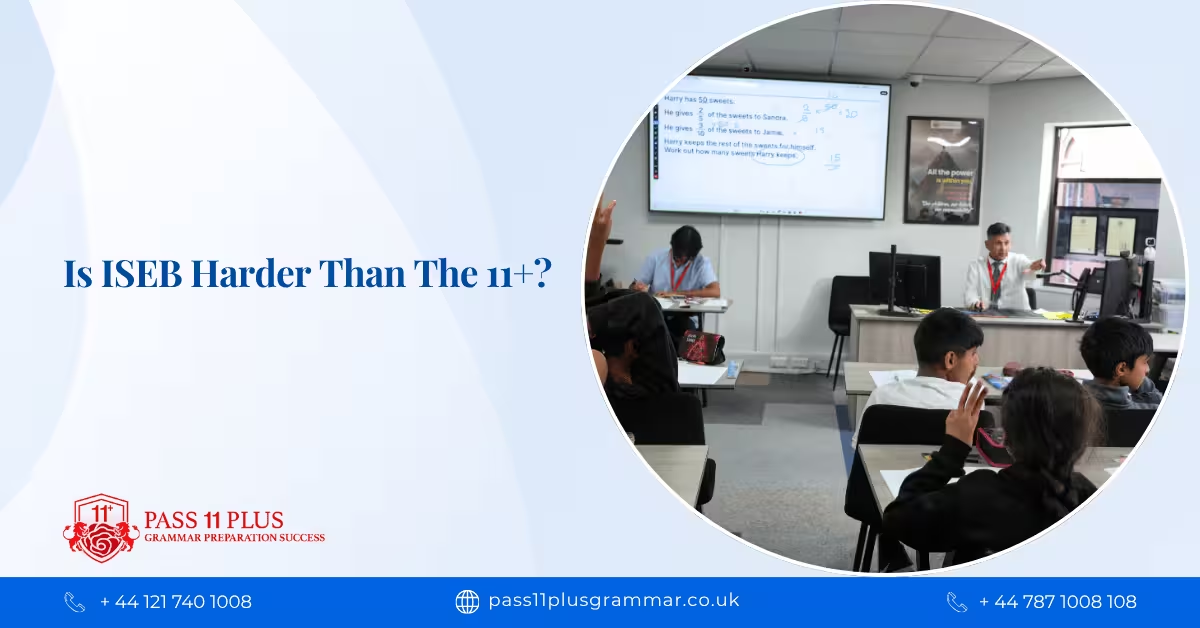
The ISEB Common Pre-Test and a grammar school 11+ are different tests, so one is not always harder than the other. The ISEB is an online, adaptive test. This means the questions change to suit your child, which can make it feel harder. A grammar school 11+ is usually a fixed multiple-choice paper, and the challenge comes from time pressure and from the number of children applying. How hard each one is depends on the school, the competition and your child's own strengths.
Lots of parents ask this question, and it is a good one. The ISEB test and the 11+ sound alike, but they work in very different ways. This guide explains both, so you know what each test is like and how to help your child get ready.
Is ISEB harder than the 11 plus? The short answer
Many parents want a simple yes or no. But the truth is that these two tests are like a football match and a swimming race. Both are tough, and both need practice. But they are not played in the same way, so it is hard to say that one is "harder".
Here is a simple way to think about it:
The ISEB is like a video game that moves you up a level every time you do well. Strong children meet tough questions quickly, so it often feels hard.
A grammar school 11+ is like a school test where everyone gets the same questions. It can be hard because of the timing and because lots of children want the same places.
So the real question is not "which is harder?" It is "which test will my child sit, and how can I help them get ready for it?" The rest of this guide helps you answer that.
What is the ISEB Common Pre-Test?
The ISEB Common Pre-Tests are a set of four online tests that many independent senior schools use as part of their admissions process. ISEB is the Independent Schools Examinations Board. We have collected the key facts below from ISEB's own information for families.
Feature | What ISEB says |
Number of tests | Four: English, mathematics, verbal reasoning and non-verbal reasoning |
Question style | Multiple choice, on a screen |
Adaptive? | Yes. Each question depends on the answers before it |
Time | About 2 hours 15 minutes in total, on one day or split over several days |
Who sits it | Usually children in Year 6 for Year 7 entry. Some schools use it for Year 9 entry |
How often | Once in an academic year. Results are shared with all schools your child applies to |
Testing window 2026-27 | From 1 September 2026 to late May 2027 |
Each senior school sets its own test deadline, so always check with the schools you like.
The tests are "adaptive". This means the computer looks at each answer and then picks the next question to match your child's level. Children do not waste time on questions that are far too easy or far too hard. The system also does not let children go back and change an earlier answer.
Want to know even more? Read our full guide to the ISEB Common Pre-Test, where we explain every part of it step by step.
What is the 11 plus?
The 11 plus is not one single national exam. Different grammar schools and areas use their own tests. Some areas share one test across many schools, and some schools write their own.
Here are two real examples from the groups that run the tests:
The Kent Test: The papers are multiple choice, and children write their answers on a separate answer sheet.
The King Edward VI Foundation grammar schools: Their test is provided by GL Assessment. It has two papers, each about 60 minutes long, and every question is multiple choice. It covers English, verbal reasoning, maths and non-verbal reasoning.
Many grammar school tests are taken in September of Year 6, and results arrive in October. That gives families time to choose schools before the national application deadline of 31 October.
The 11 plus is mainly used by grammar schools, and some independent schools use it too. Each area sets its own rules and its own qualifying score, so always read your local school information.
ISEB vs 11 Plus: Key differences at a glance
This table puts the two types of test side by side. The grammar school column describes what is typical. Your area may be a little different.
Feature | ISEB Common Pre-Test | Grammar school 11+ (typical) |
Who uses it | Many independent senior schools | Grammar schools, and some independent schools |
One national test? | Yes, a shared set of tests | No, it changes by area or school |
How the questions work | Adaptive, so they change with each answer | Fixed papers, so everyone gets the same questions |
Going back | Not allowed at all | Depends on the test. In the King Edward VI Foundation test, children cannot return to an earlier section |
On screen or paper | On a screen | Usually paper with a separate answer sheet |
Subjects | English, maths, verbal and non-verbal reasoning | Often similar, but the area decides what is included |
Maths level | Up to the end of Year 5 of the National Curriculum | Based on Key Stage 2, and it varies by area |
Scoring | Age-standardised scores, where the average is 100 | Age-standardised scores, with a qualifying score set by the area or school |
Time | About 2 hours 15 minutes | Often two papers of around an hour each |
For the ISEB, the facts come from ISEB's own Pre-Tests framework for 2026-27. For grammar tests, we used examples from Kent and the King Edward VI Foundation.
Notice that both tests look at similar skills. The biggest difference is the way the questions are delivered.
Why does the ISEB Pre-Test feel harder?
Some children come out of the ISEB feeling unsure. That is understandable, and there are good reasons for it.
1. The questions match your child's level
ISEB says the system picks questions that suit each pupil after every answer. A child who does well meets harder questions sooner. So most children reach questions they find tricky, and that does not mean they are doing badly.
2. There is no going back
Children cannot change an earlier answer. They must make a choice and move forward. That is a new skill for children who are used to checking their paper at the end.
3. It is all on a screen
Reading longer passages on a screen takes stamina. In the English test, children read short passages of 300 to 500 words and answer questions about them.
4. The reasoning questions can be new
Verbal reasoning uses letter, word and language-based questions. Non-verbal reasoning includes both flat 2D patterns and 3D spatial puzzles. Many children have not seen these before.
What makes a grammar school 11 plus hard?
The grammar school 11 plus has its own kind of challenge. It is not harder or easier. It is just different.
Competition: Grammar school places are in high demand. A child may need a high score compared with other children, not just a good score.
Time pressure: Papers are split into short, timed sections. In the King Edward VI Foundation test, for example, children cannot return to an earlier section once it is over, and the instructions and timings are played on an audio recording.
A fixed paper: Every child gets the same questions. Each question counts towards the score, so careless mistakes can cost marks.
A qualifying score: Each area or school sets a score a child must reach. This score changes by area and by year.
Several skills at once: Children need strong English, maths and reasoning, often all in one sitting.
Reading the school's own information is the best way to know how its test works. Each school or area explains its format, timing and scoring on its website.
Is the ISEB harder than GL?
Parents often hear the name GL and wonder how it fits in. GL Assessment is a company that makes tests, and many grammar school areas use GL papers. The King Edward VI Foundation, for example, says its entrance test is provided by GL Assessment.
So when people ask "Is ISEB harder than GL?", they are really comparing:
a fixed paper test that gives every child the same questions, with
an adaptive online test that changes questions as the child goes.
Neither is harder in every case. GL style papers reward speed, accuracy and knowing the question types. The ISEB rewards steady reasoning, strong reading and staying calm when the questions get tougher. Both reward children who have good foundations and plenty of practice.
11 Plus Tuition
Is your child preparing for the ISEB or the 11 Plus?
Our tutors know both the ISEB and the 11 plus, and help your child feel ready for whichever exam comes next.
Which test suits which child?
Every child is different. These are not rules, but they may help you think about your child.
Your child | May find this easier | May need extra practice with |
A keen reader who loves new words | The ISEB English test and the 11+ comprehension | Speed under time pressure |
Quick at spotting patterns | Reasoning sections in both tests | 3D spatial puzzles, which are part of the ISEB |
Happy to work fast with a pencil and paper | A fixed 11+ paper | Answering on a screen without going back |
Confident with computers and games | The ISEB screen format | Checking answers carefully on a paper test |
Gets nervous when questions are hard | Neither, without practice | Staying calm when a question feels tough |
How to prepare for the ISEB and the 11 Plus
Here is the good news. Both tests look at the same big skills: reading, English, maths and reasoning. So a strong start helps your child for either test. Here are five simple ways we help families get ready.
1. Learn how test questions are worded
Our 11+ past papers help children get used to the style and wording of grammar school questions, so a fixed paper feels familiar.
2. Begin with something free
Not sure where your child stands? Try our free 11+ practice papers and see which topics are strong and which need a little more love.
3. Practise under test conditions
Our 11 plus mocks let children practise being timed, staying focused and moving on from tricky questions, which helps in any type of test.
4. Use the summer to build skills
The long break before Year 6 is a good time to grow confidence. Our 11 plus intensive summer course brings the key topics together in a clear, friendly way.
5. Get steady, expert guidance
Our 11 plus tuition builds the English, maths and reasoning skills that both types of test look for, and it focuses on understanding, not just tricks.
Extra tips if your child is sitting the ISEB
Practise on a screen: Get your child used to reading and answering without scrolling back.
Practise moving on: Teach your child to choose their best answer, then let it go.
Read widely: Short stories, non-fiction and poems all help with the English passages.
Try spatial puzzles: Building blocks and 3D puzzles help children picture shapes in their head.
Use official help: ISEB publishes its own preparation guidance for families, including a test walkthrough and an official prep pack.
Which test should your child sit?
This is not usually a choice that parents make on their own. The schools you apply to decide which test they use. So the best first step is to make a list of the schools you like and read each one's admissions page.
1. List the schools you like
Include grammar schools and independent schools, if you are thinking about both.
2. Check each school's test
Does the school use the ISEB Common Pre-Test, a grammar school 11+, or its own exam?
3. Write down the dates and deadlines
ISEB registration is done through its Guardian Portal, and each school sets its own deadline. Grammar tests have their own registration windows, often in the summer before the test.
4. Plan practice that fits both
If your child will sit more than one type of test, focus on the shared skills first, then add test-specific practice.
Families often come to us unsure about which route to take. If you would like friendly advice, you can meet our 11 plus tutors in Birmingham that families trust, and we will help you make a clear plan.
Common myths about ISEB and 11 plus difficulty
Myth | The truth |
"ISEB is always harder than the 11+." | It often feels harder because it adapts, but a grammar school 11+ can be very tough too, because of time pressure and competition. |
"There is one pass mark." | No. ISEB gives schools age-standardised scores, and each school decides how to use them. Grammar areas set their own qualifying scores. |
"If the questions are hard, my child is doing badly." | Not necessarily. In an adaptive test, the system keeps choosing questions that suit your child's level. |
"The 11+ is one national exam." | No. Different areas and schools use different tests. |
"My child must have a tutor." | No. Many children prepare well at home. A tutor can help when a child is stuck or needs more confidence. |
Final thoughts
So, is ISEB harder than 11+? The honest answer is that they are different. The ISEB often feels harder because it is adaptive and online. A grammar school 11+ can feel just as hard because of the timing and the number of children applying. What matters most is the test your child will actually sit, and how well they are prepared for it.
Start by finding out which test your chosen schools use. Then build strong reading, English, maths and reasoning skills, and keep practice calm and regular. At Pass 11 Plus Grammar, we are here to guide you and your child at every step.
Frequently Asked Questions
Is the ISEB the same as the 11+?
No, but they are related. The ISEB Common Pre-Tests are a shared set of four online adaptive tests used by many independent senior schools, and ISEB says they are sometimes called the 11+. The 11+ in general is not one national exam. Grammar schools and local areas use their own tests, which are often paper-based and multiple choice.
Is the ISEB harder than GL?
Neither is harder in every case. GL Assessment makes tests used by many grammar school areas, and these are often fixed paper tests. The ISEB is adaptive and online. The ISEB can feel tougher because the questions rise in difficulty as a child answers well, but a grammar school test can be just as tough because of time pressure and high demand for places.
Can the same child prepare for both the ISEB and the 11+?
Yes. Both test English, maths, and reasoning skills, so strong reading, good Key Stage 2 maths and regular reasoning practice help with both. A child who plans to sit the ISEB should also practise answering questions on a screen without going back.

Mr Singh
Founder, Pass 11 Plus Grammar
Mr Singh is the founder of Pass 11 Plus Grammar, with over 30 years of teaching experience. Having overcome academic setbacks himself, he is passionate about ensuring no child struggles alone. His approach focuses on personalised support, strong foundations, and building confidence. He has helped students achieve outstanding results in 11+ and GCSE examinations
Loading related posts…