Loading page…
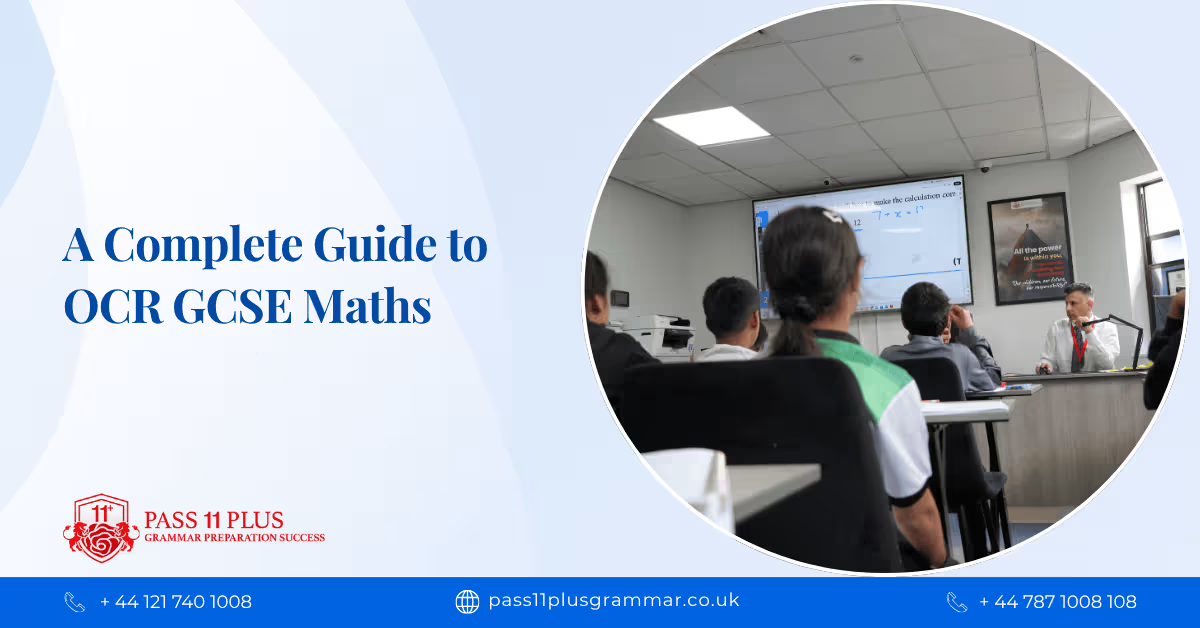
A Complete Guide to OCR GCSE Maths
Published on
OCR GCSE Maths is one of three major exam boards offering GCSE Maths in England, alongside AQA and Edexcel. It covers the same national curriculum content, but is structured slightly differently, with three papers per tier, each worth 100 marks over 90 minutes, for a total of 300 marks rather than the 240 used by AQA and Edexcel. Students sit either the Foundation tier, covering grades 1 to 5, or the Higher tier, covering grades 4 to 9, with a formula sheet provided on every paper for the 2025 to 2027 exam series.
If your child's school teaches OCR GCSE Maths, or you are simply trying to understand the OCR GCSE Maths specification properly, this guide covers everything in one place. From the syllabus and paper structure to the formula sheet, grade boundaries, and mark schemes, here's everything you need to know.
What is the OCR GCSE Maths specification?
The OCR GCSE Maths specification, officially coded J560, is the document published by OCR that sets out exactly what students studying OCR maths GCSE are taught and tested on. OCR is part of Cambridge University Press and Assessment, and this particular specification was first taught in September 2015, with the first certifications awarded in June 2017.
It genuinely helps to know that the underlying content is identical across every exam board. The Department for Education mandates the same GCSE maths curriculum nationwide, so whether a school teaches AQA, Edexcel or the OCR maths syllabus GCSE students follow, the topics covered are ultimately the same. What differs is how each board structures its exams and presents its questions, with OCR often leaning noticeably towards problem solving contexts rather than more straightforward, direct wording.
OCR Maths GCSE exam format
Your child sits three papers at one tier. Foundation and Higher use different paper numbers, which confuses a lot of families.
Tier | Paper |
Foundation | Paper 1 (J560/01), Calculator, 1 hr 30 mins, 100 marks |
Foundation | Paper 2 (J560/02), Non-calculator, 1 hr 30 mins, 100 marks |
Foundation | Paper 3 (J560/03), Calculator, 1 hr 30 mins, 100 marks |
Higher | Paper 4 (J560/04), Calculator, 1 hr 30 mins, 100 marks |
Higher | Paper 5 (J560/05), Non-calculator, 1 hr 30 mins, 100 marks |
Higher | Paper 6 (J560/06), Calculator, 1 hr 30 mins, 100 marks |
Each paper has 100 marks in 90 minutes, which is more marks per minute than AQA or Edexcel. OCR questions tend to be shorter and less wordy, with more method marks available across each question. The practical result is that pace matters a great deal, and students who leave long gaps unfilled lose more than they expect.
Any topic can come up on any paper, and later questions often mix topics together.
Foundation or Higher tier in OCR GCSE Maths
Foundation tier
Papers 1, 2 and 3 · grades 1 to 5
Core content only
More accessible questions throughout
Grade 5 is the highest available
Grade 4 needed about 44% in 2026
A good route to a secure pass
Higher tier
Papers 4, 5 and 6 · grades 4 to 9
Includes surds, algebraic proof and trigonometric graphs
Covers the sine rule, cosine rule and vectors
More demanding, multi-step problem solving throughout
Schools usually decide the tier using Year 9 results, and students can move during Year 10 or 11. All three papers must be sat at the same tier.
Choosing the tier well is one of the most important decisions in GCSE Maths. It is one of the first things we look at in our GCSE Maths tuition, ideally in Year 10 rather than weeks before the exams.
The OCR GCSE Maths syllabus
Section | What it covers |
1. Number operations and integers | Calculations, place value, factors, multiples, primes, HCF and LCM |
2. Fractions, decimals and percentages | Converting, ordering, calculating and percentage change |
3. Indices and surds | Powers, roots, standard form, and surds on Higher |
4. Approximation and estimation | Rounding, estimating and error intervals |
5. Ratio, proportion and rates of change | Ratio, direct and inverse proportion, growth and decay, compound measures |
6. Algebra | Expressions, equations, inequalities, sequences and functions |
7. Graphs of equations and functions | Straight lines, quadratics, other graphs and transformations |
8. Basic geometry | Angles, polygons, circles, constructions and loci |
9. Congruence and similarity | Congruent shapes, similar shapes and transformations |
10. Mensuration | Perimeter, area, volume, Pythagoras, trigonometry and vectors |
11. Probability | Probability scales, experiments, tree and Venn diagrams |
12. Statistics | Sampling, averages, charts, correlation and comparing data |
OCR GCSE Maths Higher topics
Higher students are tested on everything Foundation students are, plus extra, harder content. These OCR GCSE Maths Higher topics are where the grade 6 to 9 marks sit.
Surds and indices: Simplifying surds, rationalising, fractional and negative powers, recurring decimals
Advanced algebra: Algebraic fractions, completing the square, quadratic inequalities, algebraic proof
Functions and iteration: Composite and inverse functions, iterative methods to solve equations
Graphs and transformations: Equation of a circle, tangents, transforming graphs, area under a curve
Trigonometry and circles: Sine and cosine rules, area using sine, 3D trigonometry, circle theorems
Vectors and similarity: Vector proof, similar areas and volumes
Conditional probability: Harder tree and Venn diagram problems, set notation
Advanced statistics: Cumulative frequency, box plots, histograms with unequal widths
What is on the OCR GCSE Maths formula sheet?
Following an arrangement first introduced during the pandemic, the Department for Education and Ofqual confirmed that the OCR GCSE maths formula sheet would continue to be provided on every J560 paper for the 2025, 2026 and 2027 exam series, with Ofqual consulting on whether this continues beyond that point.
The formula sheet includes a genuinely useful range of formulae that no longer need to be memorised, including:
The area and circumference of a circle
Pythagoras' theorem
The basic trigonometric ratios, commonly remembered as SOH CAH TOA
The compound interest formula
The area of a trapezium and the volume of standard 3D shapes
On the Higher tier sheet specifically, the quadratic formula, the sine rule, the cosine rule, and the area of a triangle using sine
How do OCR GCSE Maths grade boundaries work?
One detail that catches a lot of families off guard is that OCR GCSE maths grade boundaries look quite different, in raw numbers, from AQA or Edexcel. This is because OCR's three papers total 300 marks, compared to the 240 marks used across AQA and Edexcel's three 80 mark papers.
This means an OCR grade boundary will naturally sit at a higher raw mark than the equivalent AQA or Edexcel boundary, even though the actual grade standard being represented is identical. A grade 7 on OCR simply reflects a different point out of 300, rather than a genuinely harder or easier target compared to another board.
How to read the OCR GCSE Maths mark scheme
The OCR GCSE Maths mark scheme uses short codes that confuse most students the first time. Once your child understands them, marking a past paper becomes a lesson in itself.
Code | What it means |
M1 | Method mark. Given for a correct method, even if the answer is wrong. |
A1 | Accuracy mark. Given for a correct answer, usually only if the method mark was earned. |
B1 | Independent mark. Given for a correct answer or step on its own. |
oe | Or equivalent. Another correct form of the answer also scores. |
ft | Follow through. Marks can still be earned using a wrong earlier answer correctly. |
isw | Ignore subsequent working. Once the right answer appears, later slips are ignored. |
soi | Seen or implied. The step does not need to be written if the next step shows it was done. |
OCR GCSE Maths past papers
Past papers are the best way to revise GCSE OCR Maths.
1. Sit the paper for real
90 minutes, no notes, no phone, calculator only if that paper allows it.
2. Mark it with the mark scheme
Use the M, A and B codes to see exactly where each mark came from.
3. Sort the lost marks
Did not know it, knew it but wrote it badly, or ran out of time. Each needs a different fix.
4. Read the examiner report
It shows where students nationally lost marks, which is a free list of traps.
5. Redo wrong questions two weeks later
That is the real test of whether the learning stuck.
Our GCSE Maths past papers page gathers papers and mark schemes by board and tier, so students can start straight away. For the weeks between full papers, our Pass GCSE platform adds structured topic practice.
GCSE Maths tuition
Give your child the confidence to pass OCR GCSE Maths
From core topics to exam technique, our specialist tutors cover exactly what the OCR specification demands.
How to revise for OCR GCSE Maths
1. Fix the foundations first
Fractions, negatives, percentages and rearranging formulae appear everywhere. When a student says they are bad at maths, the cause is usually one of these from Year 8 or 9.
2. Get the non-calculator paper right
Remember it is Paper 2 or Paper 5. Ten minutes of written arithmetic a few times a week protects a third of the grade.
3. Practise at OCR's pace
100 marks in 90 minutes is roughly a mark every 54 seconds. Timed practice with OCR papers builds the rhythm students need.
4. Revise by weighting
On Higher, algebra deserves the most time. On Foundation, number and ratio deserve half of it.
5. Keep a mistakes book
Every wrong question goes in one notebook with the correct method. Go back to it every couple of weeks.
6. Always show working
With so many M and B marks on OCR papers, writing each step down is the easiest way to protect marks on questions your child cannot finish.
Is the OCR GCSE Maths specification changing?
Not for students on the course now. After the Curriculum and Assessment Review, new curriculum content is expected from September 2028, with updated GCSEs from around 2029. Students sitting OCR GCSE Maths in 2027 and 2028 will use the current J560 specification, so every recent past paper is fully relevant.
How Pass 11 Plus Grammar supports OCR GCSE Maths students
We have been preparing students for exams for over thirty years, from our centre in Edgbaston and online across the UK.
1. A diagnostic before any teaching
We find the real gaps first, which usually sit further back than anyone expects.
2. Taught to J560, not a generic course
OCR's paper structure, pace and mark scheme style, practised with OCR papers.
3. Mark scheme technique
Students learn how M, A and B marks work, so they stop giving marks away.
4. Honest advice on tier
If a secure grade 5 on Foundation beats a fragile 4 on Higher, we will say so, early.
5. Clear progress reports
You hear how things are going from us long before a mock result tells you.
Our GCSE Maths tutors are specialists who know OCR papers inside out. Families join through our wider tuition programmes, and if you are local, our GCSE tuition in Birmingham runs from our Edgbaston centre, with online lessons available anywhere in the UK.
Final thoughts
OCR GCSE Maths covers exactly the same national curriculum content as AQA and Edexcel, presented through a slightly different paper structure, topic breakdown and question style. Understanding the specification, knowing what genuinely sits on the formula sheet, and revising with real past papers and mark schemes gives students a clear, practical route towards their target grade, whichever tier they are sitting.
Whatever stage your child is at with OCR Maths, we would love to help them build genuine confidence, one topic at a time. Get in touch with us today.
Frequently Asked Questions
How many papers are there in OCR GCSE Maths?
There are three papers per tier. Foundation students sit Papers 1, 2 and 3, and Higher students sit Papers 4, 5 and 6. Each paper lasts 1 hour 30 minutes and is worth 100 marks, giving 300 marks in total. Paper 2 on Foundation and Paper 5 on Higher are the non-calculator papers. The other papers allow a calculator.
Is there an OCR GCSE Maths formula sheet?
Yes. OCR provides a formula sheet for each tier in every paper, and the Department for Education confirmed that formula sheets would continue for GCSE Maths in 2025, 2026 and 2027.
What is on the OCR GCSE Maths formula sheet?
OCR GCSE Maths formula sheet covers key formulae such as areas and volumes, circles, Pythagoras' theorem, and trigonometry.

Mr Singh
Founder, Pass 11 Plus Grammar
Mr Singh is the founder of Pass 11 Plus Grammar, with over 30 years of teaching experience. Having overcome academic setbacks himself, he is passionate about ensuring no child struggles alone. His approach focuses on personalised support, strong foundations, and building confidence. He has helped students achieve outstanding results in 11+ and GCSE examinations
Loading related posts…